
EBDP Exam Guide: Enterprise Big Data Framework Syllabus and Study Plan
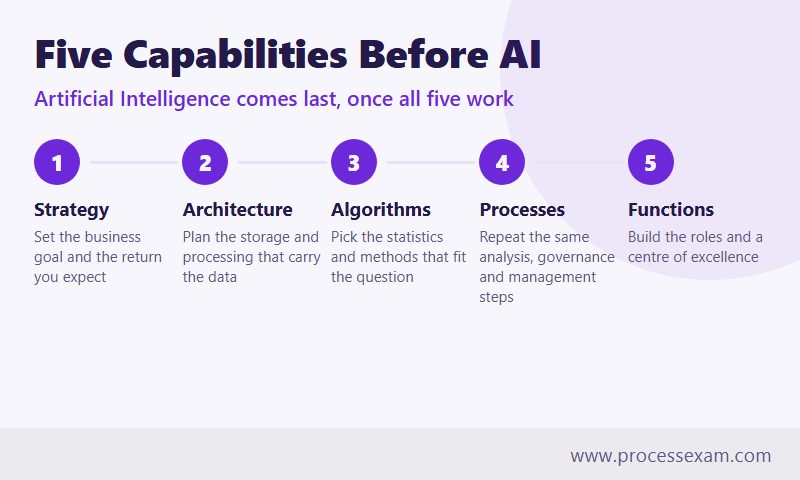
The Enterprise Big Data Framework treats big data as an organisational capability, not a piece of software: lasting value comes only when strategy, architecture, algorithms, processes, people and artificial intelligence are built up together, in that order. The APMG International EBDP exam checks that you can explain each of those six parts and how they connect. It has 60 multiple-choice questions, 90 minutes and a 65% pass mark.
That single idea shapes how to prepare. A candidate who memorises the Hadoop vocabulary but cannot say why a company should write a strategy before it buys storage is studying the wrong way round. This guide walks through the framework in the order the framework itself recommends, shows what each part asks of you, and ends with a four-week plan and a short note on what the certificate does and does not prove. It was checked against APMG's product page and the free EBDP handbook in October 2026.
What does the EBDP paper look like, and who awards the certificate?
Yes. APMG International's Enterprise Big Data certification page is live, carries no retirement notice and links to a booking route for the exam. The qualification was developed jointly with the Enterprise Big Data Framework Alliance, an independent body of knowledge, and APMG administers the examination. The full title is the APMG International DASCIN Certified Enterprise Big Data Professional, because the framework now sits under DASCIN.
| Exam detail | EBDP |
|---|---|
| Full name | APMG International DASCIN Certified Enterprise Big Data Professional (EBDP) |
| Exam code | EBDP |
| Vendor | APMG International |
| Number of questions | 60 multiple-choice |
| Duration | 90 minutes |
| Passing score | 65% |
| Exam fee | USD $320 |
| Prerequisites | None required |
Some points the table cannot carry. APMG says that fees depend on where the exam is administered, and that candidates who go through an accredited training organisation get their price from that provider, so treat USD $320 as the listed figure and confirm what you will actually pay when you book. Candidates who book the exam directly and self-study sit it online with a proctor watching through webcam, microphone and desktop, and APMG states that a directly booked exam must be taken within 12 months of purchase with no extension. You can see the options on APMG's public exam booking portal. The page does not say whether the paper is open or closed book, so check that with your training provider before you rely on notes.
The Alliance describes EBDP as an entry-level qualification for data analysts, project managers, business analysts, digital marketers, IT professionals and anyone who wants to understand how big data is used in an enterprise. Nothing in the entry requirements asks for coding or a statistics degree, which is useful to know, because the algorithms chapter will still ask you to read and explain basic statistics.
How do the six capabilities fit together, and why does the order matter?
The framework lists six capabilities: Big Data Strategy, Big Data Architecture, Big Data Algorithms, Big Data Processes, Big Data Functions and Artificial Intelligence. The handbook draws them as a ring and says there is a logical sequence for an organisation that wants to put the framework to work. The sequence starts at the middle of the diagram and follows the six elements clockwise, so strategy comes first and artificial intelligence last.
The reasoning behind that order is the most quotable part of the framework. The handbook argues that artificial intelligence can only be reached when the other elements are working properly, because AI needs a sufficiently developed big data organisation in order to learn how to decide things and to deliver value that lasts. It compares this to children needing a basic education before they can reason well. It also shows the AI element as a lifecycle rather than a box in a line, because an AI system can keep learning from the organisation's data.
Exam questions lean on this logic. A scenario might describe a company that wants to launch a machine learning project but has no agreed owner for its data, no repeatable analysis procedure and no clear business goal. The better answer points back to the earlier capabilities, not forward to a clever algorithm. When two options both sound sensible, ask which capability the organisation is actually missing.
The maturity assessment ties the six together
The handbook also covers big data maturity assessments, which organisations typically run once a year. A maturity model gives structure to an organisation's big data capabilities, shows where to start, and measures how far there is to go before the next stage. The Alliance's own assessment is built on the same six dimensions as the framework, so it is a useful way to remember them: a weak score in one dimension tells you which capability to work on next.
| Capability | Handbook chapter | The question it answers |
|---|---|---|
| Big Data Strategy | 3 | Why do it, and for what return? |
| Big Data Architecture | 4 | What technology stores and processes the data? |
| Big Data Algorithms | 5 | Which statistics and methods fit the problem? |
| Big Data Processes | 6 | Which repeatable steps keep results consistent? |
| Big Data Functions | 7 | Who does the work, and how are they organised? |
| Artificial Intelligence | 8 | How does the organisation let systems learn from its data? |
Chapters 1 and 2 sit in front of these six. Chapter 1 introduces big data, its history, its characteristics, data structures, artificial intelligence and machine learning, and chapter 2 explains the framework itself. That makes eight chapters in all, which is where the old advice about "eight core topics" came from: the exam draws on all of them, not only the six capabilities.
What do the Strategy and Architecture chapters expect you to know?
Strategy: from business driver to a written plan
Chapter 3 treats data as a strategic asset. It looks at big data as a competitive strategy, the business drivers that push organisations towards it, how to formulate a strategy, and a checklist for a big data strategy document. The handbook's own examples are Netflix, which looks at viewer behaviour when it decides what to produce, and Alibaba, which used data to decide which suppliers to lend to and recommend on its platform. You do not need those two stories word for word, but you should be able to give an example of your own that shows a data initiative tied to a business goal.
The wording that matters is about return on investment. The handbook warns that the possibilities for analysis are close to endless and that organisations can get lost in the volume, so a sound and structured strategy is the first step. Typical question stems ask you to choose the activity that belongs in a strategy (setting goals, weighing cost against benefit, meeting governance and compliance expectations) as opposed to one that belongs in a later stage such as tool selection.
Architecture: the technical backbone, taught vendor-neutrally
Chapter 4 is deliberately vendor-independent. It uses the NIST Big Data Reference Architecture as its common structure, and it explains why a reference architecture exists: a document that records good practice so that a project team has something to refer to. From there it covers distributed data storage and processing, big data storage, big data analysis architecture, and the Hadoop open source framework.
- Reference architecture. Be able to say what one is for and name NIST as the source of the one the handbook uses.
- Distributed storage and processing. Understand why data sets that are too large for one ordinary machine are spread across many, and what that gains in processing time.
- Structured and unstructured data. Chapter 1 covers data structures, and architecture questions often depend on whether the data is neatly tabulated or not.
- Hadoop. Know its role as the most common distributed processing framework, rather than its commands.
The handbook says plainly that it covers only the fundamentals that apply to every enterprise and points deeper material to a separate Engineer guide. That is a hint about depth: expect "what is it for" and "how do the parts relate" questions, not configuration detail.
How much statistics does the Algorithms chapter ask for?
More than many candidates expect, but at an introductory level. Chapter 5 begins by defining an algorithm as an unambiguous specification of how to solve a class of problems, then runs through descriptive statistics, statistical inference, correlation, regression, classification, clustering, outlier detection and data visualisation. The handbook calls the chapter an elementary introduction and says that advanced statistical and machine learning methods belong to the Analyst and Scientist guides.
A workable way to hold the chapter in your head is to pair each technique with the sort of question it answers:
- Descriptive statistics summarise a data set: averages, spread and shape.
- Statistical inference uses a sample to draw conclusions about a larger population.
- Correlation measures whether two variables move together, and reminds you that moving together is not the same as one causing the other.
- Regression estimates how one variable depends on others.
- Classification places items into known categories; clustering finds groups nobody named in advance.
- Outlier detection flags values that do not fit the pattern, which may be errors or may be the interesting cases.
- Data visualisation turns results into something decision makers can read.
The classification versus clustering pair is a common trap, so settle it early: classification needs labelled examples to learn from, clustering does not. If you have not met these terms before, the overview of big data on Wikipedia is a gentle place to see them in context before you tackle the handbook chapter. Work through the chapter with a calculator and a small invented data set; computing a mean, a median and a spread by hand does more for recall than rereading definitions.
What do the Processes and Functions chapters cover beyond the technology?
These two chapters are where the framework earns its "enterprise" label. Processes and people are what make an analysis repeatable and independent of one clever individual, and the exam treats that as core content.
Processes: three procedures, and the eight-step analysis
Chapter 6 describes three fundamental big data processes: the data analysis process, the data governance process and the data management process. The handbook says each has its own focus on control, compliance or quality. Governance sets policies and responsibilities at the strategic level, including accountability for data quality problems and compliance with local data laws, while management carries those policies out and monitors them at the operational level. If a question asks who decides and who executes, that is the split.
The data analysis process has eight sequential steps, and it is worth learning them in order because questions often ask what comes before or after a given step:
- Determine the business objective.
- Data identification.
- Data collection and sourcing.
- Data review.
- Data cleansing.
- Model building.
- Data processing.
- Communicating the results.
The handbook stresses that step one happens before there is any data: the objective sets the scope and, later, the choice of algorithm. It splits business objectives into six types, shown below, and each type implies a different way of reading the result. Step six builds a model on the principle that data equals model plus error, and step seven may be repeated, especially when the analysis is exploratory. Step eight is easy to underrate: the handbook argues that regular, structured communication, including visualisations, is what earns trust from business leaders.
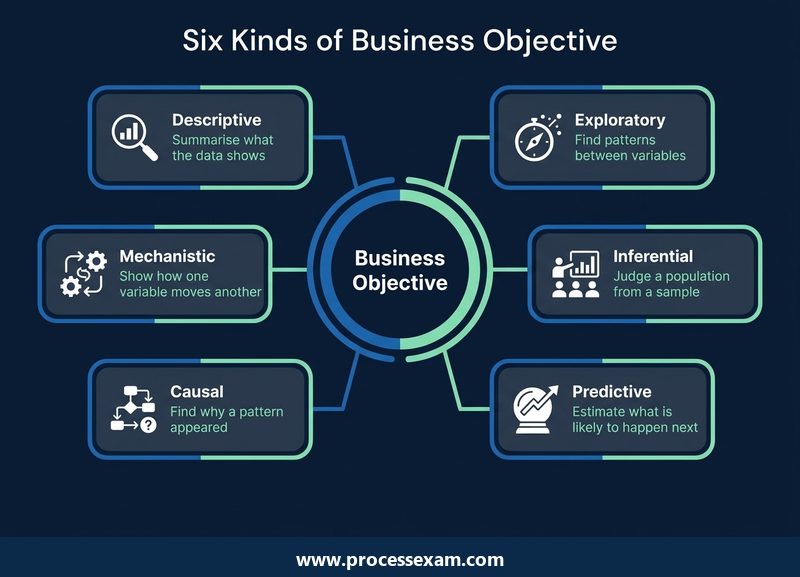
The six objective types are descriptive, exploratory, inferential, predictive, causal and mechanistic. A quick way to separate them is by the verb. Summarising a gas station chain's sales figures is descriptive. Finding which products are bought together is exploratory. Using a sample to judge which regions to advertise in is inferential. Estimating which products a customer will buy is predictive. Asking why sales were higher in one month is causal. Asking how weather conditions influence sales is mechanistic.
Functions: the human side of big data
Chapter 7 covers the non-technical half. It begins with the point that embedding big data is as much about change management as about data: people buy in when they understand a change and feel part of it. The chapter then moves through designing a big data organisation, roles and responsibilities in big data teams, big data skills and the organisational success factors. Its central structure is the Big Data Centre of Excellence, which the handbook presents as the way to get from one enthusiastic sponsor's pilot project to benefit across the whole enterprise. Expect questions about why pilots stall and what a centre of excellence changes.
Where does artificial intelligence fit in an exam about big data?
Chapter 8 is the shortest of the six capability chapters, and it is introductory: what artificial intelligence is, how it is used in the enterprise, cognitive analytics, the capabilities of AI and deep learning. Chapter 1 adds a short treatment of machine learning. The framework's position, stated in the earlier section, is that AI follows from the other five capabilities, so the exam is more likely to ask what an organisation needs before an AI project than to ask how a neural network is trained.
Study this chapter by linking it back. For each AI capability the handbook mentions, ask which earlier capability it depends on: data quality sits with processes, skills and roles with functions, the platform with architecture. That habit also covers the chapter 1 content on the four characteristics usually used to describe big data, namely volume, velocity, variety and veracity. Those four terms appear early in the handbook and are the likeliest vocabulary to be asked as a straight definition.
How do you turn the handbook into a four-week plan?
The free EBDP handbook by Jan-Willem Middelburg is the core text. APMG's page lists it as a free ebook, and the handbook describes itself as the reference guide for the APMG EBDP examination. It runs to roughly 120 pages, which suits a plan of four weeks at an hour or so a day. This is a suggested pattern, not an APMG requirement, and the pages checked published no per-chapter mark split, so give no chapter a free pass.
- Week 1: the frame. Read chapters 1 and 2 and draw the six-capability ring from memory, with the order and one sentence per capability. Learn the four Vs and the difference between structured and unstructured data. Finish by taking a short untimed set of questions to see how the exam words things.
- Week 2: strategy, architecture and algorithms. Chapters 3 to 5. Spend the most time on chapter 5 if statistics is new to you. Do the technique-and-question pairing above on a single sheet of paper.
- Week 3: processes, functions and AI. Chapters 6 to 8. Learn the eight analysis steps in order, the six objective types, governance versus management, and the centre of excellence. Finish the week with a full read of the glossary.
- Week 4: timed practice and gaps. Sit full 60-question papers against the clock and spend more time reviewing than answering.
Timing is simple arithmetic: 60 questions in 90 minutes is 1.5 minutes per question, which is generous for definition questions and tight for a scenario that you have to read twice. Practise in 90-minute blocks in a quiet room so that the pace is familiar. A good first-pass routine is to answer the quick ones, flag anything you would need a third read for, and coming back with the time you saved.
Make every wrong answer teach you something
Keep a mistake journal with three columns: the question topic, what you chose and why it was tempting, and the rule that decides it. After two or three papers, patterns appear. Many wrong answers in this exam come from picking a technically impressive option when the question was about an earlier capability, or from mixing up governance and management. Group your errors by capability and give the weakest one an extra session. When a paper includes a topic the handbook did not seem to cover, go back to the syllabus, which is laid out at the EBDP syllabus page by topic area, and re-read that section.
For timed papers that follow the six-capability structure, a full-length EBDP practice exam gives you the 60-question, 90-minute rehearsal and a score to compare week by week. Online communities can add something too: LinkedIn groups and big data subreddits are useful for asking narrow questions, such as how the NIST reference architecture differs from a company's own design, but check any advice against APMG's own pages, because forum answers age quickly.
What should the last week and exam day look like, and what does the certificate prove?
In the final week stop adding new material. Re-read your sheet of the six capabilities, the eight analysis steps and the six objective types, redo the questions you originally got wrong, and take one last full paper two or three days before the exam so that you still have time to fix what it shows. Sleep matters more than a late-night extra chapter. If you are sitting online, test your webcam, microphone and connection beforehand and clear the desk and room before the session starts.
On the day, answer the questions you know first, flag the slow ones and check the clock at the 45-minute mark, when you should be about halfway through the paper. A pass needs 65%, so a handful of slow questions will not sink you, but a stalled section can. Read scenario questions for the capability being tested before looking at the options.
What the credential is worth
EBDP is an entry-level qualification. It shows that you understand the terminology, the six-part framework and the logic of building a data capability in the right order, which is useful if you work with data teams, commission analysis, manage data projects or want a vendor-neutral foundation before specialising. APMG's page says certificates in this scheme do not expire. The Alliance's scheme also has role-based qualifications above this one, and the handbook points to separate Analyst, Scientist and Engineer guides for deeper statistics, machine learning and architecture, so EBDP can serve as a first step rather than an end point.
It does not show that you have built a data platform or run an analysis. Employers who hire for hands-on roles look for evidence of that as well, so pair the certificate with a short description of a real data task you contributed to: the objective, the data, the method and how you reported it. No salary figure is quoted here, because neither APMG nor the Alliance publishes one for this credential.
Frequently Asked Questions
What is the EBDP certification?
EBDP is the APMG International DASCIN Certified Enterprise Big Data Professional qualification. It is an entry-level, vendor-neutral certificate built on the Enterprise Big Data Framework, which covers strategy, architecture, algorithms, processes, functions and artificial intelligence, and it suits analysts, project managers and IT staff.
How many questions are on the EBDP exam and what is the pass mark?
The EBDP exam has 60 multiple-choice questions to answer in 90 minutes, and the pass mark is 65%. The time works out at 1.5 minutes per question, so scenario questions need more care than definitions.
How much does the EBDP exam cost?
The listed EBDP exam fee is USD $320. APMG says the price depends on where the exam is administered and that candidates who book through an accredited training organisation receive their price from that provider, so check the fee you will actually pay when you book.
Are there prerequisites for the EBDP exam?
No. The Enterprise Big Data Framework Alliance states that EBDP has no required prerequisite. It is designed as an entry-level qualification, so you do not need prior certification, coding skills or a statistics degree, although you will meet introductory statistics in the algorithms chapter.
How long does it take to prepare for EBDP?
A four-week plan of about an hour a day works for most candidates with some data exposure: two weeks on the handbook chapters, one on processes, functions and AI, and one on timed papers. Allow longer if statistics or architecture terms are new to you.
- APMG International Enterprise Big Data Professional Test Questions |
- EBDP Question Bank |
- Enterprise Big Data Professional Simulator |
- Enterprise Big Data Professional Mock Exam |
- APMG International Enterprise Big Data Professional Book |
- Enterprise Big Data Professional Certification Cost |
- Enterprise Big Data Professional Certification Requirements |
- APMG International Enterprise Big Data Professional Sample Questions |
- EBDP Exam Questions Download |
- EBDP Test Questions |
- Enterprise Big Data Professional PDF |
- Enterprise Big Data Framework


