
Difference Between Lean and Six Sigma, and Which Belt Fits You
On one packaging line, a quality team cut the defect rate sharply, yet orders now wait longer to ship than they did before the project began. Six Sigma saw the defects and fixed them; nobody was looking at the queue. That gap is the difference: Lean removes waste so work flows faster, while Six Sigma reduces variation so output is right. Lean Six Sigma runs both lenses at once.

People search for the difference between Lean and Six Sigma as if one must be the winner. In practice they answer two different questions about the same process. Lean asks where the time goes. Six Sigma asks why the result changes from one unit to the next. This article explains what each method contributes on its own, what changes when you combine them, how to tell which lens a problem needs, and which belt credential matches the work you actually do.
Why can the defect rate fall while the queue gets longer?
Go back to the packaging line. The improvement team ran a textbook project: they measured seal failures, found that heater temperature drifted during long runs, added a control chart and a tighter setting, and the rework rate collapsed. By every quality measure the project worked.
What the project did not touch was how work moved. To protect the new seal quality, the team added an inspection step after sealing, and inspection became a place where cartons waited. Batches were still large, so a whole pallet sat idle while the first carton was checked. Changeovers between carton sizes still took most of a shift, so the planners ran long batches to avoid them, which built stock in front of every station. The customer received cartons that were almost always right, and received them later.
Now imagine the opposite team. A Lean group walks the same line, maps the value stream, sees the piles of work in progress, shrinks batch sizes, cuts changeover time and pulls work through with kanban signals. Lead time drops. But the heater still drifts, so a faster line now produces bad seals faster, and the defects reach the customer sooner.
Neither team did anything wrong. Each used a method that is excellent at seeing one kind of problem and largely blind to the other. That is the whole reason the two methods were eventually joined, and it is a better starting point than any definition.
What does Lean contribute: waste, flow and the customer's clock?
Lean grew out of the Toyota Production System and was popularised in the West through studies of Japanese car making. Its central idea is simple: look at a process from the customer's point of view and treat every step, delay or item the customer would not willingly pay for as waste.
The waste Lean hunts
Lean practitioners classify waste so that it can be seen. The classic list names seven wastes: overproduction, inventory, defects, over-processing, waiting, motion and transportation. Many organisations add an eighth, unused talent or resource under-utilisation. Notice that defects appear in the list. Lean does care about quality, but it treats a defect mainly as rework that consumes time, not as a statistical signal to be explained.
How Lean measures a process
Lean measures time and quantity in motion. The key numbers are lead time (how long one unit takes from request to delivery), cycle time at each step, work in progress, and takt time, the pace at which the customer needs output. The relationship between them is often summarised by Little's Law: average lead time equals work in progress divided by throughput. Put plainly, if you want work to move faster without adding capacity, hold less of it in the system. That single idea explains why Lean teams obsess over batch size and queues.
The tools that come with it
- Value stream mapping draws every step, wait and hand-off from request to delivery, so waiting time becomes visible next to working time.
- 5S (sort, set in order, shine, standardise, sustain) organises a workplace so that problems and missing items are obvious.
- Kanban and pull systems release work only when the next step has room, which caps work in progress.
- Setup reduction and SMED shorten changeovers so that small batches become affordable.
- Standard work and poka-yoke fix the best-known method in place and make the wrong action difficult to perform.
- Kaizen events bring a small team together for a few days to redesign one area and implement changes on the spot.
Where Lean runs out
Lean is quick and visual, and it engages the people who do the work. Its limit shows up when a problem is caused by several interacting variables that nobody can see by walking the floor. A seal that fails one time in fifty because of an interaction between film thickness, dwell time and ambient humidity will not reveal itself on a value stream map. For that you need data, and a disciplined way of reading it.
What does Six Sigma contribute: variation, data and DMAIC?
Six Sigma was developed at Motorola in the 1980s and made famous when large industrial companies adopted it as a company-wide programme. Its central idea is that customers feel variation, not averages. A delivery that is on time on average but swings by days is a bad delivery service; a part whose mean dimension is perfect but whose spread is wide will still fail inspection.
What the name means
The name comes from statistics. Sigma is the symbol for standard deviation, and a process running at six sigma quality, by the method's convention, produces no more than 3.4 defects per million opportunities. Few processes need that level, and most projects never reach it. The figure is a direction of travel: reduce spread until the customer's limits sit far outside normal variation.
The DMAIC road map
Six Sigma improves existing processes through five phases, known as DMAIC:
- Define the problem, the customer and the measurable goal, usually in a project charter.
- Measure the current performance, after first checking that the measurement system itself can be trusted.
- Analyze the data to find and prove the root causes of variation, rather than the causes people assume.
- Improve the process by changing the causes that were proved, often after testing them with designed experiments.
- Control the gain with control charts, a control plan and a clean hand-over to the process owner.
The phases are gated. A project does not move to Improve until Analyze has evidence, which is what makes Six Sigma slower than a kaizen event and also why its results tend to last.
The tools that come with it
Six Sigma brings the statistical toolkit Lean lacks: measurement system analysis, process capability indices such as Cp and Cpk, hypothesis testing, regression, design of experiments and statistical process control. It also brings a project structure, with roles such as champion, process owner, Black Belt and Green Belt, and a habit of tying every project to a financial or customer result.
Where Six Sigma runs out
Six Sigma looks closely at the output of each step and can miss what happens between steps. A process can be statistically capable at every station and still spend most of its lead time waiting in queues. Six Sigma projects can also be heavy for simple problems: if the cause is obvious once someone walks the process, a five-phase project with a statistical analysis is slower than just fixing it.
How do Lean and Six Sigma differ, point by point?
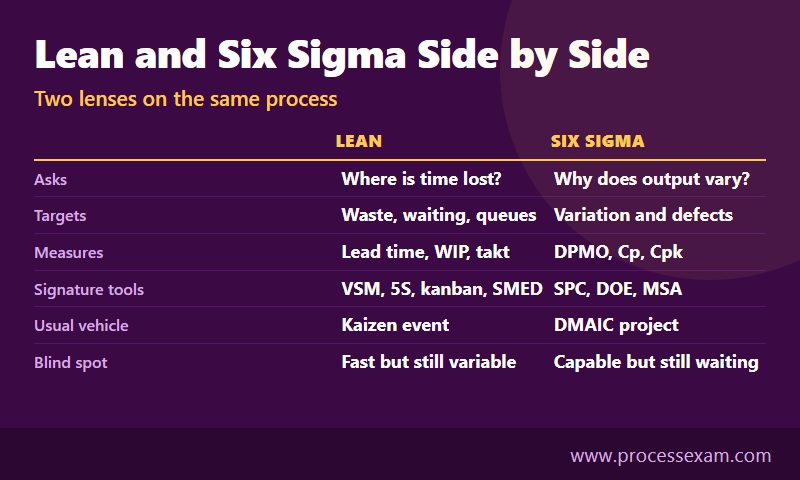
With both methods laid out, the difference between Lean and Six Sigma can be stated precisely rather than as slogans. The chart below sets them side by side, and the notes after it explain the rows that cause the most confusion.
The question each one asks
Lean asks where time and effort are lost. Six Sigma asks why the output varies. Everything else follows from that: the measures, the tools and the pace of the work.
Speed versus proof
A Lean improvement is often made within days, because the waste is visible and the fix can be tried on the spot. A Six Sigma improvement usually takes weeks or months, because the cause has to be proved with data before it is changed. Both are rational. When the cause is visible, proof is a waste of time; when it is hidden, a quick fix is a guess.
Is Lean a philosophy and Six Sigma a program?
You will often read that Lean is a culture and Six Sigma is merely a project method. That contrast is too tidy. Lean certainly aims to change daily habits, through standard work, visual management and continuous small improvements. But Six Sigma deployments also change culture: they change how managers ask for evidence, how projects are chosen and how results are reported. The more useful distinction is scale. Lean spreads through many small improvements made by the people who do the work; Six Sigma concentrates effort in fewer, larger projects led by trained specialists.
Which one saves more money?
There is no general answer, and any article that gives one is guessing. Lean savings usually come from freed capacity, lower inventory and shorter lead times. Six Sigma savings usually come from less scrap, rework, warranty cost and customer complaints. Which pool is larger depends on the process in front of you, which is exactly why the two are combined.
What changes when you combine them into Lean Six Sigma?
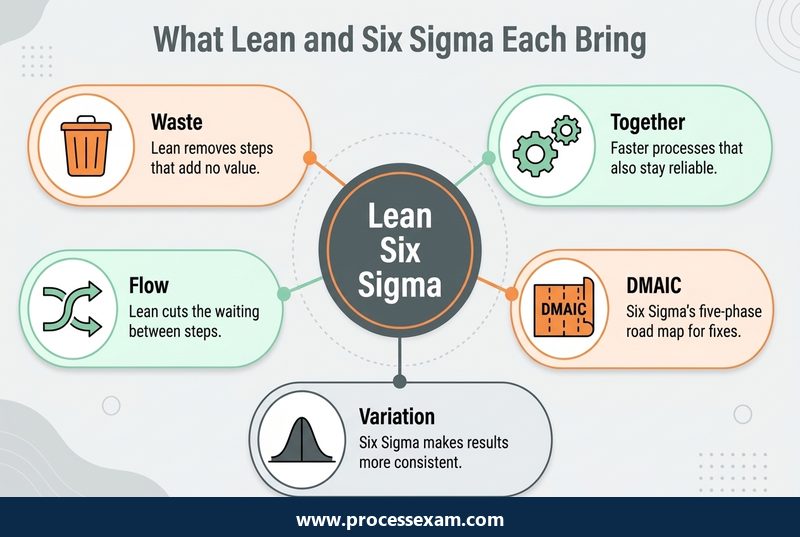
Lean Six Sigma is not a third method with its own theory. It is a working arrangement that uses DMAIC as the spine and brings Lean tools into the phases where they fit. The combination changes four things about how improvement is done.
Projects are chosen by both lenses
In a combined programme, the first look at a process asks two questions at once: where does work wait, and where does output vary? A value stream map often answers the first and points to the step where the second matters most. The packaging line from the opening would have been caught here, because the map would have shown the new inspection queue next to the improved seal yield.
Lean tools sit inside DMAIC
Value stream maps and flow metrics join the Measure phase. Waste analysis joins Analyze, next to the statistical search for root causes. Kaizen events, pull systems, 5S and setup reduction become options in Improve. Visual controls and total productive maintenance join control charts in Control. The result is a road map that can deliver a quick flow fix and a proved variation fix in the same project.
Sequencing becomes a deliberate choice
A common rule of thumb is to remove obvious waste first and then attack variation in what remains. Stabilising a messy process with Lean tools makes the data cleaner and the statistical work smaller. The reverse also happens: when a process is unstable, the variation itself causes waiting and rework, and a Six Sigma fix is what makes flow possible. The point of the combination is that the team chooses the order on purpose.
The credential names catch up
Certification bodies reflect this merger. IASSC calls every belt it certifies Lean Six Sigma, and its Green Belt Body of Knowledge places a section called The Lean Enterprise inside Define, a value stream map inside Measure, and Lean controls (5S, kanban and poka-yoke) inside Control. ASQ keeps the plain Six Sigma name, yet its 2022 Green Belt body of knowledge has a whole topic on Lean principles in the organisation and a Lean tools topic in the Improve phase. So is Lean Six Sigma different from Six Sigma today? In the classroom, much less than the names suggest.
How do you tell which lens a problem needs?
Before choosing a method, look at the symptoms. A few questions sort most problems quickly.
Signs that Lean should lead
- Customers complain about how long things take, not about what they receive.
- Work sits in piles, inboxes or queues between steps.
- People spend visible time searching, walking, waiting for approvals or re-entering data.
- Changeovers are so painful that the plan is built around avoiding them.
Signs that Six Sigma should lead
- Customers complain that results are inconsistent, even when they arrive on time.
- The same defect keeps returning after several obvious fixes.
- People disagree about the cause and each has a plausible story.
- Several variables may interact, and the data exists or can be collected.
Three examples outside the factory
A hospital discharge process. Patients wait hours for discharge after the decision is made. The steps are all done correctly; the time is lost between them, in waiting for a signature, a pharmacy order or transport. That is a Lean problem first.
An invoice matching team. Most invoices clear quickly, but a stubborn minority fail matching, and nobody can say why. Here the data is plentiful and the cause is hidden among supplier, format and entry variables. Six Sigma leads.
A software release pipeline. Releases are slow because changes queue for manual testing, and a share of releases fail in production. The queue is a flow problem, the failures are a variation problem. Both lenses are needed, which is the classic case for Lean Six Sigma.
Which belt credential fits the way you work?
Once you know which lens your work relies on, the belt choice becomes a question of depth and of how much the certificate needs to say about Lean. The credentials we cover map onto the two methods like this.
| Credential | Where Lean sits in its body of knowledge | Exam questions | Time allowed (minutes) | Fee (USD) | Pass mark |
|---|---|---|---|---|---|
| ASQ Certified Six Sigma Green Belt (CSSGB) | Lean principles in the organisation; Lean tools in Improve; Lean tools for process control | 110 | Total appointment time - 270 Exam time - 258 |
ASQ MEMBERS - $383 NON-MEMBERS - $483 RETAKES - $283 |
550/750 |
| ASQ Certified Six Sigma Black Belt (CSSBB) | Lean and Six Sigma integration in deployment; flow metrics; waste analysis; Lean methods in Improve | 165 | Total appointment time - 270 Exam time - 258 |
ASQ MEMBERS - $485 NON-MEMBERS - $585 RETAKES - $385 |
550/750 |
| IASSC Certified Lean Six Sigma Green Belt (ICGB) | The Lean Enterprise in Define; value stream map in Measure; Lean controls in Control | 100 | 180 | 350 | 70 |
| IASSC Certified Lean Six Sigma Black Belt (ICBB) | Lean and Six Sigma tools across DMAIC at Black Belt depth | 150 | 240 | 450 | 70 |
If your background is Lean and you need the statistics
Many people arrive from kaizen teams, operations or production supervision, already fluent in value streams and 5S. For them the gap is statistical: measurement systems, capability, hypothesis tests and control charts. A Green Belt is the natural step. The IASSC Green Belt keeps Lean in its title and syllabus, and its Green Belt syllabus outline shows how the Lean Enterprise topics sit beside the statistics. The ASQ Green Belt covers the same Lean ground under a Six Sigma name and asks for years of on-the-job experience, as ASQ sets out on its Six Sigma Green Belt page.
If your background is Six Sigma and flow is your blind spot
Analysts and quality engineers often know DMAIC and statistics well but have never run a kaizen event or cut a changeover. The ASQ Green Belt body of knowledge makes them learn Lean concepts such as takt time, flow, just-in-time and value stream mapping, plus Lean tools for control such as total productive maintenance and the visual factory. Studying for it is a structured way to close the flow gap described in this article.
Test the gap before you commit
If the Green Belt fits, find out where your gap really is before you spend on an application. Sit our CSSGB practice test under timed conditions and look at which questions you miss: misses clustered in the Lean tools mean the flow lens needs work, misses in Measure and Analyze mean the statistics do. That split is a more honest study plan than any reading list.
If you lead programmes, not only projects
The Black Belt is where the combination becomes a management responsibility. ASQ's 2022 Black Belt body of knowledge opens by asking candidates to describe the integration and complementary relationship between Six Sigma and Lean, and to understand an organisation's Lean Six Sigma maturity. It also tests process flow metrics such as work in queue, touch time and throughput, the effect of hidden factories, and Lean methods such as heijunka and theory of constraints. ASQ's Six Sigma Black Belt page describes the credential as aimed at professionals who lead improvement initiatives. The IASSC Black Belt is the alternative for those who need the Lean Six Sigma name at that depth.
Yellow Belt, and when to book
Team members who take part in projects rather than lead them are well served by a Yellow Belt from either body, the ASQ CSSYB or the IASSC ICYB. For the ASQ exams, note that ASQ delivers them by computer in testing windows rather than on any day; the current windows and deadlines are listed on ASQ's exam dates page, so check it before you plan your study timetable. If you are still deciding between the two certifying bodies themselves, we compare them on eligibility, format and renewal in our guide to how the two bodies differ in recognition.
What mistakes do people make when comparing Lean and Six Sigma?
Most confusion about Lean and Six Sigma comes from a handful of habits.
- Treating them as rival brands. They are lenses. Choosing one for life means choosing which half of your problems to ignore.
- Judging a project by one measure. The packaging line looked like a success on defects and a failure on lead time. Track at least one flow measure and one variation measure on every project.
- Using statistics where walking would do. If the waste is visible, fix it. Save DMAIC for causes that stay hidden.
- Using a kaizen event on a hidden cause. A few days of workshop changes can mask a variation problem for a month and then let it return.
- Reading the certificate name as the syllabus. An ASQ Six Sigma belt tests Lean; an IASSC Lean Six Sigma belt tests statistics. Read the body of knowledge, not the title.
- Forgetting the Control phase. Both methods lose their gains without standard work, visual controls and a process owner who keeps watching the numbers.
The short version is the one the packaging line teaches. Lean makes the process fast, Six Sigma makes it right, and a process the customer is happy with needs to be both. Learn to see with each lens, then choose the credential that proves you can use the one your work relies on most.
Frequently Asked Questions
What is the difference between Lean and Six Sigma?
Lean removes waste so work flows to the customer faster, using tools such as value stream maps, kanban and setup reduction. Six Sigma reduces variation so output is consistently right, using data, statistics and the DMAIC road map. Lean asks where time is lost; Six Sigma asks why results vary from unit to unit.
Is Lean Six Sigma different from Six Sigma?
Lean Six Sigma uses the DMAIC structure of Six Sigma and adds Lean tools for waste and flow inside its phases. In current certification syllabuses the gap is small: ASQ's Six Sigma belts include Lean topics, and IASSC's Lean Six Sigma belts include the statistical tools of Six Sigma.
Should Lean or Six Sigma come first?
A common rule is to remove obvious waste first, because a simpler and more stable process gives cleaner data for statistical work. When instability itself causes the waiting and rework, a Six Sigma fix has to come first. The combined approach asks the team to choose the order deliberately for each process.
Does the ASQ Six Sigma Green Belt exam cover Lean?
Yes. ASQ's 2022 Green Belt body of knowledge includes Lean principles in the organisation, such as takt time, flow and value stream mapping, Lean tools in the Improve phase such as kanban, 5S and poka-yoke, and Lean tools for process control such as total productive maintenance and the visual factory.
Which Lean Six Sigma belt should I start with?
Start with a Yellow Belt if you take part in improvement projects without leading them. Choose a Green Belt if you will run projects within your own area and need the statistical tools. A Black Belt suits people who lead larger projects or a programme and coach other belts through DMAIC.
- ASQ Six Sigma Green Belt Sample Questions |
- ASQ Six Sigma Green Belt Test Questions |
- CSSGB Question Bank |
- CSSGB Exam Questions Download |
- CSSGB Test Questions |
- Six Sigma Green Belt PDF |
- ASQ Six Sigma Green Belt Book |
- ASQ CSSGB BOK PDF |
- Six Sigma Green Belt Certification Cost |
- Six Sigma Green Belt Certification Requirements |
- CSSGB Body of Knowledge (BOK) |
- CSSGB Handbook


