
CTSC Certification: Separating Fact from Fiction on the ASCM Exam
Updated on 19 September 2026. What’s new: CTSC exam fee corrected to USD $2,275, with the current 150-question, 210-minute format and pass mark.
The CTSC certification is ASCM's credential for professionals who lead end-to-end supply chain transformation. Most of what you hear about it is half true. The facts are simple: one exam of 150 questions in 210 minutes, a fee of USD $2,275, and a passing score of 300 / 350. It tests strategy and change leadership, not coding.
The APICS Certified in Transformation for Supply Chain (CTSC) credential is one of the newer programmes from ASCM, the Association for Supply Chain Management (formerly APICS). Because it is newer than CPIM, CSCP or CLTD, candidates meet more guesswork about it: rumours about its cost, claims that it is only for technical specialists, doubts about how it is scored, and exaggerated promises about what it does for a career.
This guide separates fact from fiction. It sets out the exam facts, explains every area of the CTSC body of knowledge, shows how the exam is scored, gives a realistic study plan, and lists the myths that cost candidates a pass. It is written for supply chain managers, operations and planning leads, consultants and programme managers who are deciding whether CTSC is right for them, and for those who have already decided and want to pass on the first attempt.
What is the ASCM CTSC certification, and who is it for?
CTSC stands for Certified in Transformation for Supply Chain. It shows that you can diagnose where a supply chain falls short, design the future state, build the business case, run the change and then review whether the transformation delivered. ASCM describes the programme as the frameworks and strategies needed to diagnose, design and implement end-to-end supply chain transformations, bridging high-level strategy and technical execution.
The credential sits alongside ASCM's other certifications but answers a different question. CPIM is about planning and inventory. CSCP is about the end-to-end supply chain as it runs today. CLTD is about logistics, transportation and distribution. CTSC is about changing the supply chain: moving an organisation from where it is to where it needs to be, and keeping the improvement in place afterwards.
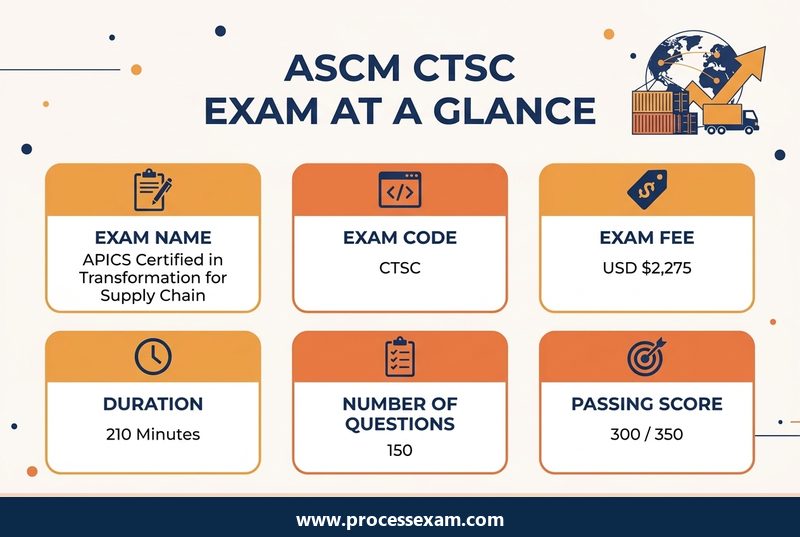
Here are the exam facts in one place:
| Exam detail | CTSC |
|---|---|
| Full name | ASCM APICS Certified in Transformation for Supply Chain |
| Exam code | CTSC |
| Vendor | ASCM |
| Number of questions | 150 |
| Duration | 210 minutes |
| Exam fee | USD $2,275 |
| Passing score | 300 / 350 |
| Question format | Multiple choice |
The people who gain most from CTSC tend to fall into four groups. Supply chain and operations managers who are asked to lead a transformation programme. Consultants who design and deliver supply chain improvement for clients. Programme and project managers who run digital or operating-model change in a supply chain setting. And experienced planners, buyers or logistics leads who want to move from running processes to redesigning them.
ASCM publishes the current exam details, what the bundle includes and how to book on its official CTSC certification page. Check it before you buy, because ASCM updates its programmes and purchase options from time to time.
Is the CTSC exam fee really as high as people say?
The first myth is about money. Older articles and forum posts quote a range of figures for CTSC, and many of them are out of date or mix up the exam with other programmes. The fee you should plan around is USD $2,275. Treat any other number you see as something to check on ASCM's page rather than as a fact.
What the fee buys
ASCM sells CTSC as a bundle rather than as a bare exam seat. According to ASCM's CTSC page, the bundle includes the CTSC Learning System and exam voucher, a second-chance exam (restrictions apply), digital and printed books for one year, online study tools with quizzes, a practice exam, learning activities and a resource centre, and the CTSC Exam Content Manual. ASCM also notes that a one-year membership is added if you are not already a member with a certification upgrade, so confirm exactly what your purchase includes before you pay.
How to judge the cost fairly
The fair comparison is not the fee against zero; it is the fee against what the credential does for you. Three questions help. Will your employer fund it? Many organisations pay for certifications linked to a transformation programme they are already running, so ask before you pay yourself. Will you use the knowledge soon? CTSC is most valuable when you can apply it to a real initiative within months, while the frameworks are fresh. And does it fill a gap? If your CV already shows planning and operations credentials, a transformation credential adds a new dimension; if you are early in your career, a foundation credential may come first.
What the myth gets wrong
The myth is not that CTSC costs money; it does. The myth is that the cost is hidden or unpredictable. The fee is published, the bundle contents are listed, and the retake option is part of the bundle. Plan the spend the way you would plan any project: know the price, know what is included, and decide whether the return justifies it.
Do you need deep technical skills to pass the CTSC exam?
The second myth is that CTSC is a technical exam for engineers or data scientists. It is not. The exam tests whether you can lead transformation: choosing frameworks, assessing the current state, building a business case, managing change and governance, and reviewing results. Digital technology appears throughout, but as something a leader must understand and select, not something you must code or configure.
ASCM's CTSC Exam Content Manual organises the body of knowledge into four content areas and gives the share of the exam for each. The table below uses those figures.
| Content area | Share of exam |
|---|---|
| I. Supply Chain Transformation Overview | 33% |
| II. Preparing for Supply Chain Transformation | 41% |
| III. Executing Supply Chain Transformation | 15% |
| IV. Review of Supply Chain Transformation | 11% |
Together, the first two areas make up almost three quarters of the exam. That tells you where most of your study time should go. The full topic list is set out on our CTSC syllabus page; the summary below explains what each area really asks of you.
Supply Chain Transformation Overview
This area sets the foundation. It covers the types of supply chains and how they are classified, supply chain maturity stages, and the business cases that justify transformation. It then moves into strategy: market and strategy types, the components of a supply chain strategy such as goals, KPIs, action plans and strategy maps, and the organisation's value proposition across suppliers, service providers, operations, intermediaries and customers.
You also need to know the models and frameworks a transformation leader draws on: the balanced scorecard, ASCM's SCOR Digital Standard and SCORmark, the Global Reporting Initiative, ASCM's Enterprise Standards for Sustainability, ISO standards, ASCM's Digital Capabilities Model for Supply Networks, CMMI and APQC benchmarks. Cost and service improvement roadmaps such as Lean, Six Sigma, theory of constraints, total quality management, agile operations and project management appear here too, along with organisational design, risk management methodology and the supply chain security landscape, including cybersecurity and counterfeits. The area closes with the drivers of transformation, including ESG and corporate social responsibility requirements, and with the leadership skills and culture that make transformation possible.
Preparing for Supply Chain Transformation
This is the largest area and the one that most separates candidates who pass from those who do not. It covers everything that must happen before implementation: selecting the drivers of transformation (macroeconomics, legal and regulatory landscape, geopolitics, industry and market characteristics, voice of the customer and voice of the process, strategic imperatives, sustainability, digitisation and performance benchmarks), then assessing the current state through gap and maturity assessments and spotting common misalignments.
From there you conceptualise the future-state operating model with process and geographic mapping, modelling and simulation and analysis of alternatives; identify, scope and prioritise initiatives; and initiate workstreams with project charters, kickoff milestones, resource plans, communication plans, change management plans and stakeholder management plans. The area also covers preliminary and detailed business cases (value drivers, financial value of improvements, resources, cost and schedule, KPIs, messaging), selecting a transformation framework, building the roadmap and portfolio, drafting execution plans, and establishing portfolio governance. Expect scenario questions that ask what should happen next, or what is missing, at a given point in this sequence.
Executing Supply Chain Transformation
Execution is about delivering the change without losing control of it. The first theme is change management: tailoring the change process, assigning roles such as the change control board, sponsor, agents and champions, setting internal and external communication channels, providing training based on a needs assessment, and using intrinsic and extrinsic incentives. The second theme is design and delivery: collaborating with stakeholders, designing and testing solutions through supply chain architecture, prototyping, network modelling and simulation, and pilot projects, then implementing project KPIs, delivering individual projects and scaling up to enterprise-wide solutions. The third theme is governance and risk: portfolio and project governance, risk management, information security, resilience benchmarks and ASCM enterprise certification for sustainability.
Review of Supply Chain Transformation
The smallest area, but not one to skip. It covers assessing the transformation through portfolio performance, critical success factors, KPIs and tracking mechanisms; rating transformation maturity using assessment and audit results; communicating results to internal and external stakeholders; and reflecting on the effort by gathering feedback, documenting lessons learned, implementing continual improvement and identifying the next initiatives. Questions here often test whether you can tell a completed project from a transformation that has actually delivered its intended value.
Business concepts you are expected to know
ASCM also expects a working understanding of strategic planning, leadership, project management, accounting and finance, modelling and simulation, change management, optimisation, continuous process improvement and digital transformation. The key terminology list includes project control ideas such as earned value, the cost performance index and the schedule performance index, analysis tools such as SWOT, PESTLE, SIPOC, FMEA, fault tree analysis and the five whys, and supply chain concepts such as circular and reverse supply chains, digital twins and control towers. None of this requires programming; all of it requires you to know when and why each tool is used.
How hard is the CTSC exam, and how is it scored?
CTSC is a demanding exam, but its difficulty is often misunderstood. It is not hard because of obscure facts. It is hard because most questions describe a situation and ask for the best action, and several options can sound reasonable. Candidates who know the sequence of a transformation, and the purpose of each tool within it, find the right answer far more often than those who memorised definitions.
How the exam is built
The exam has 150 multiple-choice questions and a time limit of 210 minutes. ASCM's Exam Content Manual explains that 20 of the 150 are pre-test questions: they look like the others and are spread randomly through the exam, but they do not count toward your score. Since you cannot tell which ones they are, answer every question as if it counts. ASCM's CTSC page states that the exam is delivered by computer at Pearson VUE test centres worldwide and online through the OnVUE system.
How the score works
The passing score is 300 / 350. ASCM reports CTSC results on a scaled score range of 200 to 350, and a score of 300 or above is a pass. Scaled scoring lets ASCM compare results fairly across different versions of the exam. Two further points matter for exam strategy. There is no penalty for a wrong answer, and an unanswered question counts the same as a wrong one, so never leave a question blank. And every question has exactly one correct answer, so if you can eliminate two options, your chance of a right answer on a guess doubles.
Why pacing matters
210 minutes for 150 questions gives you a little under a minute and a half per question. That is enough, but only if you do not stall. Long scenarios can tempt you to reread; read the final line first so you know what is being asked, then read the scenario for the facts that matter. Flag hard questions and return to them once you have answered the rest.
Can you pass CTSC by memorising, or do practice tests matter?
The fourth myth is that you can pass by reading the learning system once and memorising lists. ASCM's own guidance says otherwise. Its Exam Content Manual notes that questions more often ask you to apply the body of knowledge to a scenario than to recall it, and that the manual itself, not the learning system, defines what can be tested. It also says the learning system does not teach the test: some learning system content is not examined, and some exam content may not be covered by the learning system.
That is why a scenario-based CTSC practice exam is worth more than another read of your notes: it shows whether you can apply the framework under time pressure.
Use the Exam Content Manual as your map
Start with the manual. Print or save the content outline, and turn each numbered topic into a checklist item. As you study, tick off only the topics you could explain to a colleague, with an example. The manual also lists the references behind each area, including ASCM's SCOR Digital Standard, the Digital Capabilities Model for Supply Networks, the Enterprise Standards for Sustainability and the ASCM Supply Chain Dictionary, which the exam uses as its standard for terminology.
Practise with timed questions
Practice questions do three things reading cannot. They show you how ASCM phrases scenarios. They reveal which areas you only think you understand. And they build the pace you need for 150 questions in 210 minutes. ASCM offers a short five-question CTSC quiz that is a useful first taste of the question style. When you are ready for full-length timing, the CTSC practice exam on ProcessExam follows the same 150-question, 210-minute format, so you can measure readiness under realistic conditions.
Review every wrong answer
The value of a practice test is in the review, not the score. For each question you missed or guessed, write down the topic, why the right answer is right, and why the option you picked is wrong. After two or three tests, this error log shows a pattern: most candidates find that a handful of topics, usually in the preparation area, account for most of their mistakes.
What does a realistic CTSC study plan look like?
There is no single correct timeline, but an eight-week plan suits most working professionals who can study five to eight hours a week. It follows the exam weighting, spending the most time where the most marks are. If you already lead transformation work, you may compress it; if the frameworks are new to you, stretch it to ten or twelve weeks.
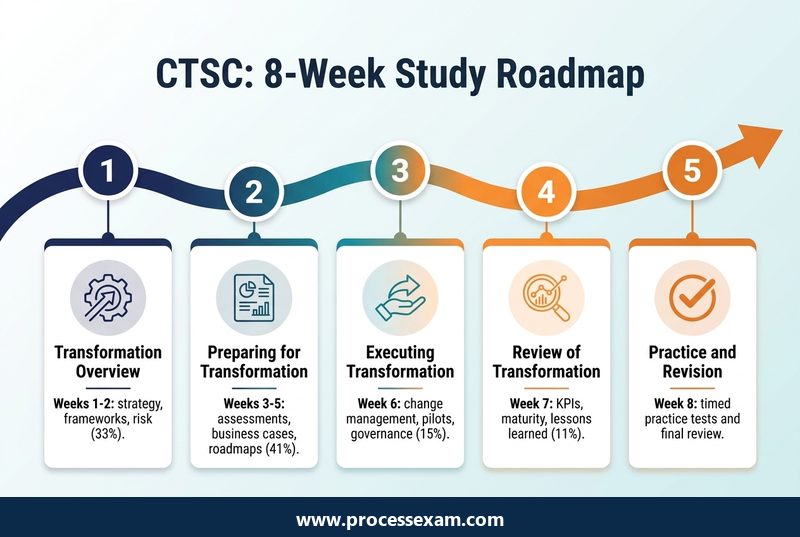
| Weeks | Focus | What to finish |
|---|---|---|
| 1-2 | Transformation Overview (33%) | Supply chain types and maturity, strategy components, SCOR DS, DCM, Lean, Six Sigma, risk and security basics |
| 3-5 | Preparing for Transformation (41%) | Drivers, gap and maturity assessments, future-state design, business cases, roadmaps, portfolio governance |
| 6 | Executing Transformation (15%) | Change management roles, training and incentives, pilots and scale-up, governance and risk |
| 7 | Review of Transformation (11%) | KPIs and tracking, maturity rating, communicating results, lessons learned |
| 8 | Practice and revision | Two timed full-length practice tests, error log review, final one-page notes |
Weeks one to five: build the foundation
Spend the first five weeks on the two largest areas. Read each topic in the learning system, check it against the content outline, and write a short example from your own work for each tool or framework. For the preparation area, draw the whole sequence on a single page: drivers, current-state assessment, future-state design, initiatives, workstreams, business case, framework selection, roadmap, execution plan and governance. Many scenario questions test whether you know which step comes next.
Weeks six and seven: finish the smaller areas
Execution and review carry fewer marks, but they are also easier to master quickly because they build on what you already studied. Focus on the roles in change management, the difference between piloting and scaling, and how maturity is assessed after the change. Take a short practice set at the end of each week to confirm the new material has stuck.
Week eight: practise and consolidate
Take one full-length timed practice test early in the week and another near the end. Between them, work only on the topics your error log flags. The evening before the exam, read your one-page notes and stop. Confirm your appointment details, and if you are testing online through OnVUE, check your room, webcam and connection in advance.
Which CTSC myths lead candidates to fail?
Most failed attempts trace back to a belief that sounded reasonable but was not true. These are the most common ones.
- "It is a technology exam." Candidates who spend their time on digital tools and skip business cases, governance and change management lose marks in the largest areas of the exam.
- "All four areas are equal." They are not. Preparing for Supply Chain Transformation alone is 41% of the exam; a plan that splits time evenly under-prepares for it.
- "The learning system is enough." ASCM itself says the Exam Content Manual defines what can be tested. Use both, and check every topic in the outline.
- "Experience will carry me." Real transformation experience helps, but the exam uses ASCM's terminology and frameworks. If your company calls something by another name, learn ASCM's term from the Supply Chain Dictionary.
- "Leave hard questions blank." There is no penalty for a wrong answer, and a blank counts as wrong. Always answer, then flag and return if time allows.
- "Practice tests are for the last week." Timed practice in the middle of your plan exposes weak areas while there is still time to fix them.
- "Once certified, always certified." The credential must be maintained, as explained below.
Is the CTSC certification worth it for your career?
The final myth is the one most often repeated in marketing: that a certification guarantees a promotion or a specific salary rise. No credential does that, and you should be sceptical of any article that quotes such figures without a named salary survey behind them. What CTSC does offer is more concrete.
What the credential proves
CTSC gives employers and clients independent evidence that you understand how a supply chain transformation is structured from start to finish: how to justify it, plan it, run it and prove it worked. That matters because transformation programmes are expensive and visible, and organisations want leaders who can speak the language of strategy, finance and operations at the same time.
Where it helps most
The credential is most useful in roles where you are expected to change how the supply chain works rather than only run it: supply chain transformation or excellence manager, operations or supply chain director, supply chain consultant, programme or portfolio manager for operations, and continuous improvement lead. It is also a strong complement to CPIM, CSCP or CLTD, because it adds the leadership and change dimension that those credentials cover more lightly.
Keeping the credential active
According to the Exam Content Manual, CTSC holders must maintain the certification every five years, starting from the date it is earned, by collecting 75 certification maintenance points in each five-year cycle. If the points are not submitted by the due date, the certification is suspended and the holder has 90 days to submit; after that it is lost and the exam must be passed again. Build maintenance into your plans from the start, since conferences, courses and other professional development all count.
If you are weighing the decision, start small: read ASCM's CTSC page, take ASCM's five-question quiz, and look through the content outline. If the topics describe work you are doing or want to do, CTSC is likely a good fit, and the facts in this guide give you everything you need to plan for it realistically.
Frequently Asked Questions
How many questions are on the CTSC exam?
The ASCM CTSC exam has 150 multiple-choice questions and a time limit of 210 minutes. According to ASCM, 20 of those questions are unscored pre-test items spread randomly through the exam, so answer every question carefully because you cannot tell which ones count toward your final score.
What is the passing score for the CTSC exam?
The passing score for CTSC is 300 / 350. ASCM reports results on a scaled range from 200 to 350, and any score of 300 or above is a pass. There is no penalty for wrong answers, and a blank answer counts as wrong, so always answer every question on the exam.
How much does the CTSC certification cost?
The CTSC exam fee is USD $2,275. ASCM sells CTSC as a bundle that includes the learning system and exam, and it may add a one-year membership for non-members. Check ASCM's CTSC page for exactly what your purchase includes before you pay for it.
What topics does the CTSC exam cover?
The exam covers four areas: Supply Chain Transformation Overview, Preparing for Supply Chain Transformation, Executing Supply Chain Transformation, and Review of Supply Chain Transformation. ASCM's Exam Content Manual weights them at 33%, 41%, 15% and 11% of the exam, so the first two areas deserve most of your study time.
How long should I study for the CTSC exam?
Most working professionals need around eight weeks at five to eight hours a week. Spend the first five weeks on the two largest content areas, two weeks on execution and review, and the final week on timed practice tests. Allow longer if the transformation frameworks are new to you.
How do I keep the CTSC certification active?
ASCM requires CTSC holders to maintain the certification every five years by collecting 75 certification maintenance points in each cycle. If points are not submitted by the due date the credential is suspended, with 90 days to submit, after which the exam must be passed again.
- Supply Chain Management |
- CTSC Question Bank |
- CTSC Body of Knowledge (BOK) |
- CTSC Exam Questions Download |
- CTSC Test Questions |
- APICS CTSC Simulator |
- APICS CTSC Mock Exam |
- APICS CTSC Certification |
- APICS CTSC Certification Cost |
- APICS CTSC Certification Requirements |
- APICS CTSC |
- APICS CTSC PDF |
- ASCM APICS Certified in Transformation for Supply Chain Test Questions |
- ASCM APICS Certified in Transformation for Supply Chain Book |
- ASCM CTSC BOK PDF |
- APICS Certified in Transformation for Supply Chain Certification Cost |
- APICS Certified in Transformation for Supply Chain Certification Requirements |
- ASCM APICS CTSC Question Bank |
- ASCM APICS CTSC Book |
- ASCM APICS CTSC Study Guide |
- ASCM APICS Certified in Transformation for Supply Chain Sample Questions |
- APICS Certified in Transformation for Supply Chain PDF |
- ASCM APICS CTSC Exam Questions |
- ASCM APICS CTSC Sample Questions


