
CPSSA Study Guide: Pega Senior System Architect Exam, Infinity '25
Updated on 3 October 2026. What’s new: now covers the Pega Infinity '25 exam (PEGACPSSA25V1): 60 questions, 90 minutes, 70% to pass, USD $190
Two claims handlers open the same case within seconds of each other, and both press Save. Whose edit survives? On Pega the answer depends on a locking choice somebody made, and that kind of judgement call is what the Certified Pega Senior System Architect (CPSSA) exam tests beyond the System Architect paper. The Infinity '25 exam has 60 questions in 90 minutes, costs USD $190 and needs 70% to pass.

This guide is for developers who already hold the System Architect credential and are deciding whether and how to sit the senior exam. It sets out what Pega's exam page lists today, how the six topics are weighted, what each topic really asks, a six-week plan around Pega Academy's mission, the retake rules, and what the badge changes at work. Everything about the exam itself was checked against Pega Academy in October 2026.
What does the CPSSA exam ask for today, and which Pega version does it follow?
Older write-ups of this credential, including an earlier version of this page, describe it as an exam on a much older Pega release. That is out of date. Pega Academy now shows the Certified Pega Senior System Architect exam for Pega Infinity '25, with the exam code PEGACPSSA25V1, as checked in October 2026. No newer '26 version of this senior exam was listed beside it at that time, although some other Pega certification paths already show one. Pega gives the exam in English and Japanese and does not list a retirement date.
The exam page also lists the Senior System Architect mission as the way to prepare, and Pega's certifications page states that you must be a Certified Pega System Architect before you can earn this credential. So the route is: System Architect, then the senior mission, then this exam. The figures below are the ones that matter when you book.
| Exam detail | CPSSA |
|---|---|
| Exam code | CPSSA (PEGACPSSA25V1) |
| Full name | Certified Pega Senior System Architect |
| Version | CPSSA Version 25 |
| Number of questions | 60 |
| Duration | 90 minutes |
| Passing score | 70% |
| Exam fee | USD $190 |
Pega describes the credential as proof that you can design and build for reusability across multiple lines of business. Its own list of validated skills covers best practices, debugging, performance tuning, maintenance and the security and access controls of an application. The format mixes single-answer and multiple-answer multiple choice, drag-and-drop matching and scenario questions built on a short reading passage. You can read the full details on the vendor's Certified Pega Senior System Architect exam page.
How do the 60 CPSSA questions divide across the six topics?
Pega publishes six topics with percentage weights. Applied to a 60-question paper, the weights give the approximate counts in the graphic and table below. Pega does not state exactly how many questions each topic receives, so treat the counts as a planning guide rather than a promise.
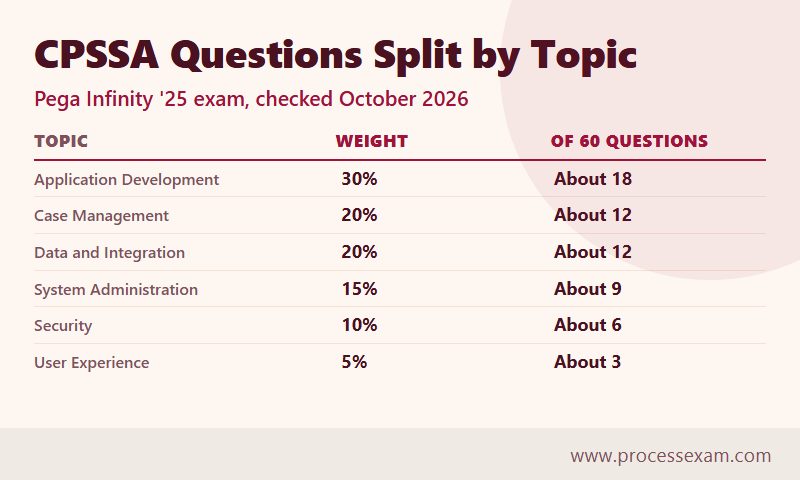
| Topic | Weight | Roughly how many of 60 |
|---|---|---|
| Application Development | 30% | 18 |
| Case Management | 20% | 12 |
| Data and Integration | 20% | 12 |
| System Administration | 15% | 9 |
| Security | 10% | 6 |
| User Experience | 5% | 3 |
Two facts follow from the numbers. First, 70% of 60 is 42, so up to 30% of the paper can be wrong and you still pass, provided every question counts equally, which Pega does not confirm. Second, application development, case management and data integration together make up 70% of the paper. A candidate who is strong there and weak on user experience can still pass comfortably; a candidate who treats application development as revision of the System Architect paper will find it has moved on.
One more rule shapes the way you should practise. Pega's exam policies state that it verifies only pass or fail results and that it does not provide scores or domain breakdowns. If you fail, you will not be told which topic let you down, so you must find your weak topics before the exam, with timed practice papers sorted by topic. The topic list is also on ProcessExam's CPSSA syllabus page, which matches the six weights above.
What does the 30% Application Development topic expect you to know?
This is the largest topic, and its twelve listed objectives are less about clicking through a wizard than about explaining how Pega decides which rule runs and how an application is organised so that it can be reused. Work through the objectives in the order below; each one builds on the one before.
Class structure, reuse and the New Application wizard
You should be able to describe how classes inherit from one another, through both the pattern of the class name and the declared parent class, and why a layered structure with an enterprise layer, a framework layer and an implementation layer lets several lines of business share the same rules. Pega names this idea modular architecture and enterprise reuse. Expect a scenario in which a rule needs to be available to two applications and you must pick the class or ruleset where it belongs. The New Application wizard appears as a way to create the layered application with sensible defaults, so know what it builds for you and what you must still decide.
Rule resolution and availability
Rule resolution is the process that selects one rule out of every candidate with the same name. The engine weighs availability, the ruleset list in the user's access group, the class hierarchy, circumstances and effective dates. The exam asks about the outcome rather than the algorithm: given a set of rules and an access group, which rule runs? It also asks how you change availability, for example how marking a rule as blocked or not available in one place changes what other applications can use.
Circumstancing on one variable or several
Circumstancing lets you keep one rule and vary it by a property value, a date or a combination. A rate that differs by region is the classic case. Learn the difference between a circumstance on a single property and one that tests several, and what happens when two circumstanced versions both qualify. Remember that a circumstanced rule adds complexity for the next maintainer, so questions often reward the answer that uses the simplest tool that works.
Queue processors and job schedulers
Both run work in the background and the exam wants you to separate them cleanly. A queue processor handles items that are put on a queue, so work happens because something asked for it, such as sending an email after a case reaches a stage. A job scheduler runs on a clock, such as a nightly clean-up, with nothing waiting in a queue. If a scenario says "every night at two" you are looking at a job scheduler; if it says "when the customer submits" you are looking at a queue processor.
Activities and automatic actions
Activities are procedural rules built from steps and methods. They still exist in case processing, so know their role and their elements, but also remember that modern Pega work prefers declarative and configured rules where one exists. Related to this is the objective on automating an action when a property changes. Declarative rules such as Declare OnChange exist for exactly that reason, so a question that describes "run this when the value changes" is usually pointing at a declarative rule rather than an activity called from several places.
Versioning, skimming and migration
Rulesets carry version numbers, and applications are versioned as they move through releases. Skimming collects the highest version of each rule into a new, higher ruleset version so that old versions fall out of the list. You should know why a team skims, which versions it touches and what it leaves alone. Finally, migrating an application means packaging it, typically through a product rule, and moving it between environments. The exam checks that you can say what goes into the package and why a validated set of rulesets is the starting point.
How do case management and data integration questions test senior judgement?
Together these two topics are 40% of the paper. They are where the senior exam stops asking what a feature is and starts asking which option fits a described business problem.
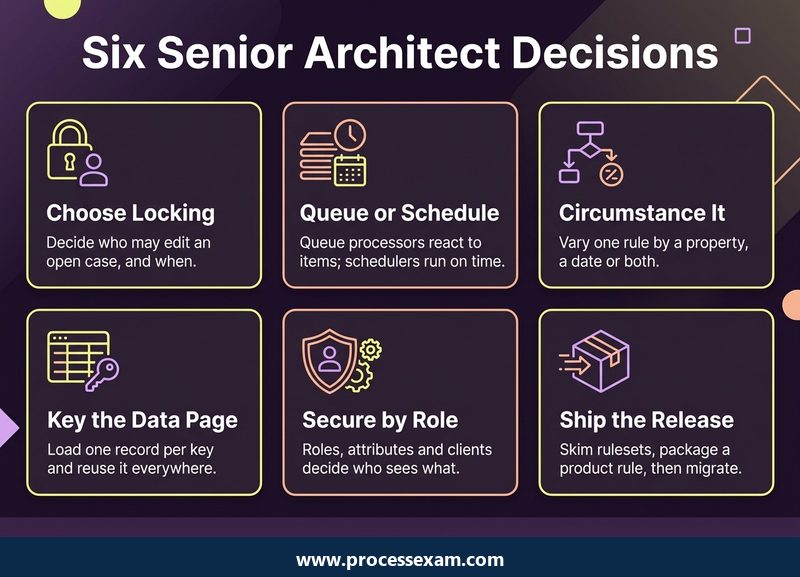
Case management at 20%
Start with who owns the work. A work group is a set of operators who share work and report to a manager, a work queue is a shared holding place for assignments that anyone with access may pick up, and the organisational structure of organisation, division and unit determines how the two relate to the people in the company. Questions describe a routing need and you pick the structure that meets it.
Parallel processing is next. You should know how a case can run several streams of work at once and what must finish before the case moves on, whether through split and join shapes in a flow or through child cases. Then comes the opening problem of this guide: concurrent access. Pessimistic locking lets the first user hold the case while others see it read-only; optimistic locking lets several people open it and rejects a save if somebody else changed the record in the meantime. Know the trade-off, the effect of a lock timeout, and which strategy a described business favours.
The remaining objectives deal with flow actions and service levels. Pre-processing and post-processing let you run a data transform or activity before a flow action is shown and after it is submitted. Extending a service-level agreement means going beyond a fixed goal and deadline, for instance by changing when the clock starts or what escalation fires, and the exam asks what you would configure to get a given behaviour.
Data and integration at 20%
Five objectives make up this topic, and the first is as practical as any. Validating data against a pattern means testing an entry against a regular expression, such as a postal code or an identifier, so you should be comfortable reading a simple pattern and choosing where the validation belongs. Next are keyed data pages. A data page that loads a record by key, and a list data page that offers keyed access to a single entry, avoid fetching the same customer ten times on the same screen. Know when keyed access fits, and when a plain parameterised data page is the better choice.
Exchanging data with other applications is the integration core. You need to know how a connector calls an external system, how a service lets an outside system call Pega, and how the mapping between the two works. Integration errors then test your judgement: a connector can fail on a timeout, a bad response or a rejected request, and the right design decides whether the case waits, retries, or routes to a person. The last objective, the field value rule, covers the labels and display values a property presents, which is also the unit that Pega localises.
Do administration, security and user experience deserve time at 30% together?
Yes, and especially because candidates tend to skip them. Fifteen, ten and five percent make 30% of the paper between them, and these are the topics where a few hours of reading earns marks that the other topics make you work for.
System administration at 15%
Measuring and debugging performance sits at the centre. Be able to name the kinds of tools Pega provides, such as the Tracer for stepping through rule execution and the Performance Analyzer for resource figures, and say what each one answers. Log reading is the second objective: you must tell system events from performance events and know why an alert about a slow interaction is a different signal from an error. The remaining objectives are application settings, which hold values that change between environments, such as the address of an external service, so that rules migrate without edits, and the resource settings that an integration needs.
Security at 10%
Three access models are compared. Role-based access control grants access through roles and privileges, attribute-based access control adds conditions on the data itself, such as the region of a record, and client-based access control restricts data by the client or customer it belongs to. Questions describe a need and ask which model, or which combination, answers it. The same topic covers organising and managing case attachments, including who may view, add or delete a category, protecting sensitive data with encryption, and tracking and auditing data changes so that you can show who changed what.
User experience at 5%
The smallest topic is still testable. Know how to configure portals for different audiences, how Pega Web Embed places a Pega application inside an existing website, how the Constellation SDKs use Constellation DX components to bring Constellation into another design system, how fields are grouped in views, and how a Constellation application makes request and response calls to the DX API's REST endpoints. Three questions are not a reason to ignore this, since they are the cheapest marks if you have read the Constellation material once.
Where does the Senior System Architect mission fit in a six-week plan?
Pega Academy's Senior System Architect mission is the preparation the exam page points to. When checked in October 2026, it showed a total of almost 45 hours and listed intermediate application development, intermediate data and integration, access control, background processing and the Constellation adoption mission among its required parts. The plan below spreads that study across six weeks of about eight hours each, and it keeps the last week free for timed papers.
| Week | Focus | What to finish |
|---|---|---|
| 1 | Application structure | Class hierarchy, layered applications, rule resolution, availability and circumstancing |
| 2 | Background work and release | Queue processors, job schedulers, activities, declarative rules, skimming and product rules |
| 3 | Case management | Work groups and queues, parallel processing, locking, flow action processing, service levels |
| 4 | Data and integration | Pattern validation, keyed data pages, connectors, integration errors, field values |
| 5 | Administration, security, experience | Performance tools, logs, application settings, access models, attachments, Constellation topics |
| 6 | Timed practice | Two full 90-minute papers, a topic-by-topic error list and a final pass over the weakest area |
Reading alone will not carry the exam, because the questions describe projects. Build a small application in a Pega sandbox as you go. Create the three-layer structure, circumstance one rule, add a queue processor and break a connector on purpose to see how the failure surfaces. Each small experiment gives you an answer to one scenario question before it appears.
When the six weeks are nearly done, a timed run on the CPSSA practice exam from ProcessExam will show which of the six topics still costs you marks, and that error list tells you how to spend the final days. Keep the evening before light: skim your list of objectives, confirm your booking time and identification, and stop studying early.
Using the 90 minutes
Sixty questions in 90 minutes allows an average of 90 seconds each, which is generous for definition questions and tight for the scenarios with a reading passage. Answer the quick ones first, flag long scenarios and return to them. Pega says non-native English speakers automatically receive an extra half hour when they take the exam in English, so if that applies to you, the pace is more relaxed. Read each multiple-response question for how many answers it wants; a candidate who finds three correct options when two are required loses the mark.
What are the CPSSA booking, retake and cancellation rules?
Pega delivers its exams through Pearson VUE, at a test centre or by online proctoring, and you register through your own account on the Pearson VUE page for Pega exams. Pega's own exam policies set out the retake and cancellation rules, which are worth reading before you pay.
- First failure: wait three calendar days before a second attempt.
- Second failure: wait fourteen calendar days before a third attempt.
- Attempt limit: an exam version may be taken three times in a 12-month period, and a fourth attempt can be scheduled one year after the first.
- Fees: the full exam fee is due each time, so every retake costs the same USD $190 again.
- Cancelling: a refund is granted when you cancel at least 24 hours ahead, and a later cancellation or reschedule is subject to a same-day forfeit of the fee.
- Online exams: extra time is the only accommodation available when you test remotely through Pearson VUE's OnVUE application.
- Results: Pega reports pass or fail only.
Read these rules together with the money. A candidate who books too early and fails twice has paid two full fees and used two of the three attempts in the year. Spending one more week on practice papers costs nothing. Pega's policies page also states that you accept a non-disclosure agreement at the exam, so do not plan to copy or share any question text. Pega's pages, as read for this guide, do not set an expiry date for the credential; if your employer needs recertification terms, confirm them on the Pega certification exam policies page.
Does the Senior badge change what you are trusted with on a project?
The credential does not hand you a new job title, but it answers the question a delivery lead asks before giving someone a harder task: will this person make a design choice that breaks later? A System Architect shows that you can build with Pega rules. A Certified Senior System Architect shows that you can pick between rules, decide where reuse belongs, plan how work is locked, queued and routed, and keep an application safe and measurable.
In practice that means three kinds of change. You are more likely to be asked to review other developers' rules and to set up the class and ruleset structure at the start of a project. You are the person to consult on a performance alert or a data integration that fails in production. And you are better placed to move toward a lead architect role, the next level on Pega's architect track, where the questions are about whole applications rather than single cases.
Ask a simple test when you decide whether the exam is ready for you. Can you explain, without notes, why a given requirement belongs in a queue processor and not a job scheduler, which locking strategy a described team needs and which access model protects a given record? If the answer to all three is yes, you are close. If it is no, the plan above shows where to spend the next fortnight, and no salary survey or job advert will give you a better reason to wait than that.
Keep one habit throughout: whenever you read an objective, say aloud what problem it solves. A rule that you can describe in terms of its problem is a rule you can choose in a scenario, and choosing is exactly what a senior exam measures.
Frequently Asked Questions
What does CPSSA stand for in Pega?
CPSSA stands for Certified Pega Senior System Architect. It is Pega's mid-level developer credential, taken after the System Architect exam. Pega describes it as proof that you can use the platform to design and build for reusability across multiple lines of business.
How many questions are on the CPSSA exam and what is the passing score?
The CPSSA exam has 60 questions to answer in 90 minutes, and the passing score is 70%. The questions include multiple choice, drag-and-drop matching and scenario items. Pega reports a pass or fail result only and gives no domain breakdown to candidates who fail.
How much does the CPSSA exam cost and where do you take it?
The CPSSA exam costs USD $190 per attempt, and the full fee is due again on every retake. You register through a Pearson VUE account and can sit the exam at a test centre or through online proctoring. Cancelling at least 24 hours ahead earns a refund.
Do you need the System Architect certification before CPSSA?
Yes. Pega Academy states that you must be a Certified Pega System Architect to earn the Senior System Architect certification. The exam page also lists the Senior System Architect mission as the preparation, so the usual route is the System Architect credential, then the mission, then the exam.
How long must you wait to retake the CPSSA exam after failing?
Pega requires three calendar days after a first failure and fourteen calendar days after a second. An exam version can be taken three times in a 12-month period, and a fourth attempt can be scheduled one year after the first. Every attempt carries the full fee.
- System Architect |
- Pega Senior System Architect Test Questions |
- Pega Senior System Architect Book |
- Senior System Architect Certification Cost |
- Senior System Architect Certification Requirements |
- Pega Senior System Architect Sample Questions |
- Senior System Architect PDF |
- CPSSA Question Bank |
- CPSSA Exam Questions Download |
- CPSSA Test Questions |
- PEGACPSSA25V1 Mock Exam |
- PEGACPSSA25V1 Simulator |
- PEGACPSSA25V1 Book |
- PEGACPSSA25V1 Certification |
- PEGACPSSA25V1 Certification Cost |
- PEGACPSSA25V1 Certification Requirements |
- PEGACPSSA25V1 Question Bank |
- PEGACPSSA25V1 Study Guide |
- PEGACPSSA25V1 |
- PEGACPSSA25V1 Exam Questions |
- PEGACPSSA25V1 PDF |
- PEGACPSSA25V1 Sample Questions


