
CPIM Part 1 Is Gone: Moving Your Study Plan to CPIM 9.0
Updated on 22 September 2026. What’s new: CPIM is now a single exam, so the old Part 1 and Part 2 split is replaced by the current version 9.0 exam.
You pull your CPIM Part 1 study guide off the shelf, open it at the inventory chapter you half finished, and go to book the exam. There is no Part 1 to book. ASCM, the association formerly called APICS, ran its last Part 1 and Part 2 sittings on 1 February 2024, and since 1 June 2026 the only exam is CPIM 9.0: one paper that covers the whole program. Much of what you learned still counts. The plan around it has to change.
This article is for candidates who studied, or started studying, under the old two-part model. It explains what happened to Part 1 and Part 2, whether a Part 1 pass still counts, which Part 1 topics carry straight into CPIM 9.0 and which areas are new, whether your old books are still safe to use, how to rebuild a study plan without starting from zero, and how to handle one long exam instead of two shorter ones. Everything here was checked against ASCM's own candidate documents in September 2026.
What happened to CPIM Part 1 and Part 2?
For several years the APICS CPIM credential was earned in two steps. Part 1 covered the foundations of supply chain planning, and Part 2 went deeper into the techniques a planner uses every day. Under version 7.0 you needed both passes to hold the certification. That model ended with version 8.0, and version 9.0 has now replaced 8.0 in turn.
The switch to one exam in 2023
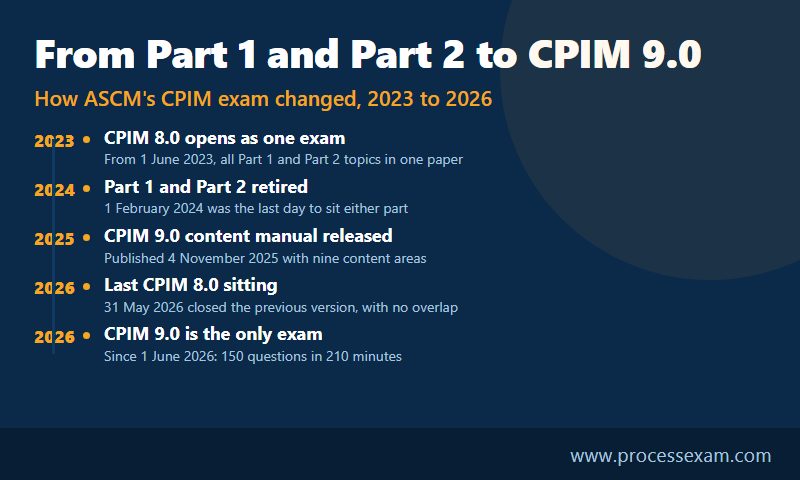
ASCM's CPIM 8.0 candidate FAQ set out the change in plain terms: the number of exams needed dropped from two to one, and the single exam would include all the topics and terms from both Part 1 and Part 2. The new exam opened on 1 June 2023. For about eight months the old and new routes ran side by side, and 1 February 2024 was the final day anyone could sit a 7.0 Part 1 or Part 2 exam. No exceptions were offered after that date.
One line in that FAQ matters more than any other to a former Part 1 student. ASCM said the scope stayed the same but the depth of knowledge was aligned more closely with the previous Part 2 content outline, and that the new content manual followed the Part 2 format. In other words, the merged exam did not average the two parts out. It kept the breadth of both and the depth of the harder one.
From version 8.0 to version 9.0 in 2026
The second change was a content refresh rather than a change of structure. ASCM updates each program roughly every five years, and its CPIM 9.0 candidate FAQ gives the dates: the new exam content manual appeared on 4 November 2025, new learning systems went on sale on 3 February 2026, the 8.0 exam closed on 31 May 2026 and version 9.0 opened on 1 June 2026. This time there was no overlap. Only one version is live on any given day, and the date of your appointment decides which one you sit.
So a candidate who bought a Part 1 guide a few years ago has lived through two changes, not one. The guide was written for an exam that no longer exists, and it predates both the merger and the 2024 job task analysis that shaped version 9.0.
Does a passed CPIM Part 1 exam still count toward certification?
No, and it is better to know this before you plan than after. ASCM answered the question directly when it announced the single exam: to earn CPIM, you pass both Part 1 and Part 2, or you pass the single exam. Passing only one of the two parts counts as neither partial nor full qualification for the new exam. With the two-part route closed since February 2024, a lone Part 1 pass is now a record of what you studied, not a step toward the credential.
If you passed both parts
You hold CPIM, as long as you keep it maintained. ASCM stated that holders of an active CPIM do not need to sit the newer exam, although they may choose to take it and claim maintenance points for doing so. Your certificate stays available in your ASCM account while it is active, so there is nothing to convert or reapply for.
If you passed Part 1 only, or started and stopped
Treat yourself as a candidate with a head start rather than a candidate with credit. The knowledge is real: forecasting basics, inventory policy and the logic of master scheduling and MRP are still at the centre of the exam. What you lack is Part 2 depth, the content added since, and practice at sitting one long paper. The rest of this article is built around closing those three gaps.
If you failed or missed a recent attempt
Money and dates are where transition candidates most often get caught out. ASCM's version 9.0 FAQ says anyone who failed the 8.0 exam qualifies for discounted retake pricing on the new exam. It also says an authorization to test cannot be extended once it expires and all fees are forfeited, so check the expiry date in your ASCM account before you set a study timetable. The mandatory 14-day wait between attempts still applies.
The exam you would book today
| Exam detail | ASCM CPIM |
|---|---|
| Credential | APICS Certified in Planning and Inventory Management (CPIM) |
| Exam code | CPIM |
| Vendor | ASCM |
| Current version | V 9.0 |
| Exams required | One (Part 1 and Part 2 retired) |
| Number of questions | 150 |
| Duration | 210 minutes |
| Exam fee | USD $1,265 |
| Passing score | 300 / 350 |
The fee shown is the figure in our records; ASCM charges a higher rate to nonmembers and to members without its certification upgrade, so confirm the price for your own membership status before you pay.
Which CPIM Part 1 topics still carry over into CPIM 9.0?
Almost all of them, just in new places and at greater depth. Part 1 grouped its content into six topics: a supply chain overview, the fundamentals of demand management, planning supply, executing the supply plan, inventory management, and continuous improvement, quality and technology. Version 9.0 organises the program into nine content areas. The table shows where each Part 1 topic now lives.
| Part 1 topic | Where it sits in CPIM 9.0 | What to add on top |
|---|---|---|
| Supply chain overview | Align the supply chain to support the business strategy | Strategy choices, KPIs, supply chain risk and sustainability goals |
| Fundamentals of demand management | Plan and manage demand; aggregate demand in S&OP | Forecast error measures, demand shaping, product life cycle effects |
| Plan supply | Plan and manage internal supply sources; aggregate supply in S&OP | Rough-cut capacity checks, MPS maintenance, product costing |
| Execute the supply plan | Plan, manage and execute detailed schedules; external supply | Loading, sequencing, supplier relationships and procurement methods |
| Inventory management | Plan and manage inventory | Costs and valuation, inventory control, returns and product disposition |
| Continuous improvement, quality and technology | Manage quality, continuous improvement and technology | Master data integrity, system requirements, emerging technologies |
The foundations you can trust
If your Part 1 notes explain the difference between independent and dependent demand, the purpose of a master production schedule, how an MRP record nets gross requirements against stock on hand and scheduled receipts, why safety stock exists and how ABC classification works, that material is still correct. Planning logic does not go out of date the way exam logistics do. These ideas sit underneath several of the nine areas at once, which is why candidates with solid Part 1 foundations usually find the calculation questions the least worrying part of the exam.
Where the same topic now goes further
The difference is the questions asked about those foundations. A Part 1 question might check that you know what a time fence is. A version 9.0 question is more likely to describe a customer order arriving inside the demand time fence, give you the master schedule and the available-to-promise figures, and ask what the planner should do. The concept is the same; the job is to apply it inside a scenario. When you revise a Part 1 topic, finish each session by working one realistic problem from end to end rather than rereading definitions.
Terminology that moved
Old guides sometimes use labels the current content manual has replaced or grouped differently. Version 9.0 splits supply into internal and external sources, for example, where older material treated supply as one block. The version 9.0 content manual also points candidates to the 19th edition of the ASCM Supply Chain Dictionary for definitions. If your guide was written against an earlier edition, check the key terms again, because the exam marks ASCM's current wording, not the wording you learned first.
What does CPIM 9.0 test that a Part 1 guide never prepared you for?
Four kinds of content will feel unfamiliar if Part 1 was your only preparation. Put them at the front of your new plan, because they are where marks leak for candidates who assume their old knowledge covers everything.
Part 2 depth across the board
Since the merger, the single exam has been written at the depth of the old Part 2. That affects every area, including the ones you recognise. Expect multi-step calculations, questions that give you a table or chart to interpret, and options where two answers look reasonable and only one follows ASCM's recommended practice. The version 9.0 content manual itself says candidates are assumed to arrive with experience or knowledge of basic planning methods, which is a polite way of saying that fundamentals alone will not carry you.
External supply as its own area
Version 9.0 gives external supply sources their own content area. It covers how suppliers are selected, how sole, single and multisource arrangements differ, supplier scorecards and relationship management, purchasing and procurement methods, and how to respond when a supplier changes terms or fails to deliver. A Part 1 guide touched purchasing in passing. The current exam expects you to weigh cost against availability and risk and to defend the choice.
Risk, sustainability and returns
The 2024 job task analysis widened the program's scope to take in more sustainability content, and it shows up in more than one place. The strategy area now asks about supply chain risk identification, business continuity planning, tools such as failure mode and effects analysis, and sustainability goals measured against the triple bottom line and published guidelines. The inventory area adds reverse logistics, the waste hierarchy and circular economy considerations for returned goods. None of this appeared in a Part 1 topic list, and much of it is vocabulary you need to recognise quickly.
Technology and master data
The quality and improvement area now includes managing technology: helping to define system requirements, keeping master data accurate, and knowing where emerging tools such as artificial intelligence, the internet of things, 3D printing and robotic process automation fit into planning. You will not be asked to configure software, but you will be asked what good data and good system choices do for a plan.
Distribution also deserves a mention. It was not one of Part 1's six topics, yet it is a full content area today, covering network design trade-offs, replenishment of distribution centres and the management of customer orders. Give it a proper block of study time rather than a skim.
Is your old CPIM Part 1 study material still safe to use?
Some of it is, and the trick is knowing which parts. ASCM's own guidance has shifted over time. When the exam first went to a single paper, its FAQ said candidates could use their existing materials but recommended the new learning system written for the new outline. For version 9.0 the advice is firmer: ASCM recommends the updated CPIM Learning System and published a change document in January 2026 describing the differences between the 8.0 and 9.0 content. Its FAQ also said that candidates who owned the previous learning system and had an exam booked after 1 June 2026 could request the new learning system in digital form at no charge by sending their Pearson VUE booking confirmation to ASCM support. If that applies to you, contact ASCM to confirm the offer is still open rather than assuming it is.
A Part 1 guide is two generations older than anything ASCM supports today. Sort it, do not bin it.
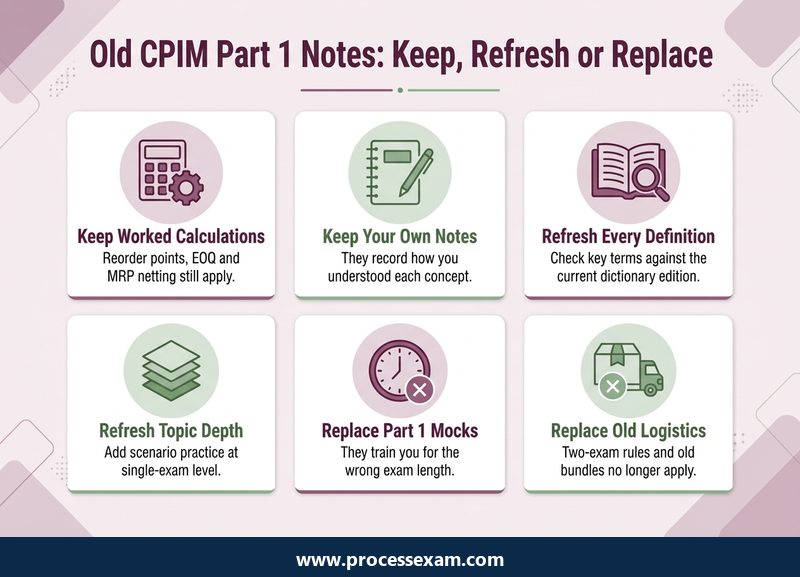
Keep
- Worked calculations. Reorder points, economic order quantity, MRP netting and simple forecasts are solved the same way today.
- Your own notes and flashcards. They record how you understood a concept, and that understanding is still valuable.
Refresh
- Definitions. Check every key term against the current dictionary edition and the version 9.0 content outline.
- Topic depth. For each Part 1 chapter, add scenario practice at the level the single exam expects.
Replace
- Practice tests built for Part 1. They cover a fraction of today's content and train you for the wrong length of exam.
- Exam logistics. Anything about two exams, old bundles, old second-chance rules or old scheduling windows is out of date.
- Anything missing external supply, sustainability or technology. Fill those gaps from current material only.
Be wary of free material online that still carries a Part 1 or Part 2 label. It was accurate for the exam it was written for, and nothing else. The simplest test for any resource is whether it names version 9.0 and all nine content areas.
How do you rebuild a CPIM study plan on top of Part 1 foundations?
Returning candidates tend to make one of two mistakes: they start again from page one and waste weeks on topics they already know, or they skip straight to practice tests and discover the new content only when they fail it. A better plan uses your Part 1 base as an asset and spends most of the time on the gaps.
- Audit against the current outline. Print ASCM's 2026 CPIM module content outline and mark every section green (confident), amber (familiar but rusty) or red (new to you). Former Part 1 students usually find their reds clustered in external supply, risk and sustainability, technology and distribution.
- Learn the reds first. New content takes the most effort, so do it while your energy is highest. Use current material only for these sections.
- Deepen the ambers. Revisit the Part 1 topics, but at Part 2 depth. For each one, work multi-step problems and scenario questions instead of rereading chapters.
- Connect the areas. Planning questions cross boundaries: a forecast error changes the S&OP plan, which changes the master schedule, which changes inventory and supplier orders. Practise tracing one change through the whole chain.
- Check yourself in short sets. Mixed question sets across all nine areas show whether your greens are really green. Working through free sample questions on CPIM topics is a quick way to see the current style before you commit to full papers.
- Rehearse the full length. Finish with at least two complete, timed sittings and an error log sorted by content area.
| Phase | Main goal | You are ready to move on when |
|---|---|---|
| Audit | Know exactly which sections are new, rusty or solid | Every outline section carries a colour |
| New ground | Learn the red sections from current material | You can explain each red section without notes |
| Depth | Lift Part 1 topics to single-exam level | Multi-step problems feel routine, not slow |
| Integration | Link demand, supply, inventory and schedules | You can follow one planning change end to end |
| Rehearsal | Build stamina and pace for one long paper | Two timed full sittings with a stable score |
How long this takes depends on how recently you studied and how much of the outline comes up red. Someone who passed Part 1 last year and plans every day at work will move faster than someone returning after a long break. Set the date only after the audit, when you can see the size of the job.
What exam-day tactics suit a single 210-minute CPIM paper?
Part 1 candidates prepared for a shorter sitting. The current exam asks for 150 questions in one session of three and a half hours, and concentration, not knowledge, is often what fails in the last hour. ASCM's content manual includes its own test-taking advice, and the tactics below build on it.
Pace with checkpoints, not a stopwatch per question
Spread evenly, 210 minutes across 150 questions leaves roughly 84 seconds for each one. Rather than timing each one, set two checkpoints: aim to be past question 50 at about the 70-minute mark and past question 100 at about the 140-minute mark. If you are behind at a checkpoint, speed up on the next few straightforward questions instead of rushing a difficult one.
Work in two passes
ASCM advises approaching the questions in order without dwelling on the unfamiliar ones, then returning to them later. On the first pass, answer everything you can and flag anything that needs a long calculation or a second read. On the second pass, go back to the flagged items with the time you saved. Because some questions are unscored pretest items that you cannot identify, give every question the same care.
Read the whole question and any table
The content manual warns against assuming information is missing or guessing what a question asks before reading it fully. When a question includes a table or chart, study it before looking at the options. Many wrong answers in planning questions come from using the wrong period, the wrong unit or the wrong row.
Take the options at face value
ASCM says it avoids trick questions and that exactly one option is correct. If you find yourself building an elaborate reason why an unlikely option might be right, stop. Eliminate what is clearly wrong, choose the answer that follows ASCM's recommended practice, and move on. Leave no question unanswered, since a guess can score and a blank cannot, and change an answer only if you are certain you misread the question.
Keep something back for the final hour
Plan how you will stay sharp: sleep well the night before, eat beforehand, and if you test online, set up the room and run the system check a day early so nothing drains your focus at the start. A full-length rehearsal matters most here. Sitting a timed CPIM practice exam at full length before the real one tells you when your attention starts to slip and which content areas are still costing you marks.
After the exam
Your score report includes diagnostic information by content area. If you pass, the credential is yours to use straight away. If you do not, that breakdown is the most useful study guide you will get: rebuild your plan around the weakest areas, allow for the 14-day wait, and book again once your practice scores are steady.
Your old Part 1 guide is not wasted. It taught you the language and logic of planning, and that is still the core of CPIM. Pair it with current material for everything that has changed, practise at the depth of the single exam, and the switch from two papers to one becomes a matter of planning rather than starting over.
Frequently Asked Questions
Can I still take the CPIM Part 1 exam?
No. ASCM retired the two-part CPIM when it moved to a single exam, and 1 February 2024 was the last day anyone could sit a Part 1 or Part 2 exam. Since 1 June 2026 the only exam on offer is CPIM 9.0, which covers the whole program in one sitting.
Does passing CPIM Part 1 count toward CPIM 9.0?
No. ASCM said that passing only Part 1 or only Part 2 gives neither partial nor full credit toward the single exam. Candidates earned CPIM by passing both parts before the old route closed, or they now pass the single exam. Your Part 1 knowledge still helps, but it carries no formal credit.
Can I use my old CPIM Part 1 study guide for CPIM 9.0?
Only as a supplement. Worked calculations and core planning concepts still hold, but a Part 1 guide misses Part 2 depth and the content added in version 9.0, such as external supply, sustainability and technology. ASCM recommends the updated CPIM Learning System, and its change document explains what moved between versions.
What is the difference between CPIM 8.0 and CPIM 9.0?
Both are single exams. Version 9.0 followed a 2024 job task analysis that widened the scope toward technology and sustainability and split supply into internal and external supply areas, giving nine content areas. CPIM 8.0 closed on 31 May 2026, and version 9.0 has been the only exam since 1 June 2026.
Is the APICS CPIM certification still worth it if I only passed Part 1?
Yes, if your work involves planning or inventory. The credential itself has not lost value; only the route to it changed. Former Part 1 candidates already know much of the core material, so the remaining effort goes into Part 2 depth, the new version 9.0 content and practising one long exam.
- Supply Chain Management |
- ASCM APICS Certified Planning and Inventory Management Test Questions |
- CPIM Question Bank |
- CPIM Body of Knowledge (BOK) |
- APICS CPIM Simulator |
- APICS CPIM Mock Exam |
- ASCM APICS Certified Planning and Inventory Management Book |
- ASCM CPIM BOK PDF |
- APICS Certified Planning and Inventory Management Certification Cost |
- APICS Certified Planning and Inventory Management Certification Requirements |
- ASCM APICS CPIM Question Bank |
- ASCM APICS CPIM Book |
- ASCM APICS CPIM Study Guide |
- APICS CPIM Certification |
- APICS CPIM Certification Cost |
- APICS CPIM Certification Requirements |
- ASCM APICS Certified Planning and Inventory Management Sample Questions |
- CPIM Exam Questions Download |
- CPIM Test Questions |
- APICS Certified Planning and Inventory Management PDF |
- ASCM APICS CPIM Exam Questions |
- ASCM APICS CPIM Sample Questions |
- APICS CPIM |
- APICS CPIM PDF


