
CPIM Exam Technique: Calculations, Scenarios and Pacing
Myth: the CPIM exam rewards whoever has memorised the most definitions. It does not. ASCM's exam content manual describes questions that usually want you to evaluate a scenario or finish a calculation, and then choose the best of four options. Version 9.0 gives you 150 of them in 210 minutes, so technique on stems, arithmetic and the clock decides the close results.

This guide is about technique rather than content. It shows how the questions are built, how to read a scenario so the answer shows itself, three calculation types worked from first principles, how to split the clock, and what the learning system's quizzes can and cannot tell you. Every number in the worked examples is our own illustration, not an ASCM question. The syllabus weightings, the Part 1 history, career paths and renewal are covered in our other CPIM guides, so they are left out here.
How are CPIM questions built in version 9.0, and what do they ask you to do?
Each question gives you four options, and exactly one is correct. The ASCM exam content manual (ECM) describes three jobs a question can set: select the best option, complete a calculation from the information given, or show that you understand a concept, process or procedure. It adds that questions may need finer distinctions than the exercises in a course, and that you will often have to evaluate or analyse a scenario and decide on the best solution.
| Fact | CPIM 9.0 |
|---|---|
| Exam code and vendor | CPIM, ASCM (version 9.0) |
| Questions | 150 questions, of which 20 are unscored pretest items |
| Time | 210 minutes (three and a half hours) |
| Passing score | 300 on a scaled range of 200 to 350 |
| Exam fee | USD 1,265 for members with the certification upgrade; USD 1,755 for nonmembers and members without it |
| Delivery | Pearson VUE test centres, or online through OnVUE |
Two details in the ECM change how you should work. First, the 20 pretest questions are mixed in and candidates are not told which they are, so every question deserves a real answer: you cannot safely write off a hard one as unscored. Second, the manual says plainly that no exam question is derived from the learning system, which means you cannot memorise your way to a pass from the course text alone. You have to practise the method on questions you have not seen.
Recall, application and calculation items
It helps to sort every practice question into one of three kinds before you answer it, because each kind has its own pace and its own typical error.
- Recall items check that you know a term, a rule or the purpose of a technique. They are quick when you know the topic and impossible to reason out when you do not, so they reward steady revision of the glossary and the content outline.
- Application items put a situation in front of you and ask which action, policy or conclusion fits best. The time goes into reading, not into remembering.
- Calculation items need a number from a formula or a record, with one or two unit conversions hidden inside. The time goes into arithmetic, and the typical error is a missed step rather than a missing concept.
The ECM sample questions show all three. One asks for the weighted average cost of inventory on a given date, another for the MRP and available-to-promise figures in a short table, and others for the effect of a bottleneck or the right planning horizon. You can compare your own work with a fuller set on the CPIM sample questions page.
How do you read a scenario stem so the right option shows itself?
A stem is the story and data before the options. The ECM tells candidates to read the question completely, study any table or graph, avoid assuming that information is missing, and not to look for hidden tricks, because every option has been written to avoid misleading wording. That last point matters: the wrong options are not traps set to catch you out; they are plausible answers to a different question. Your job is to find which question the stem actually asks.
A six-step routine for any stem
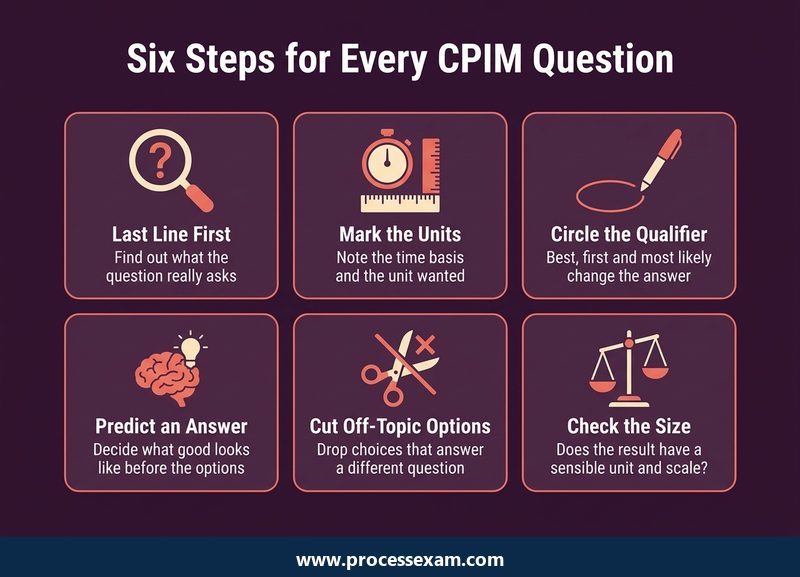
The routine is only useful when each step is quick, so practise it until it costs a few seconds.
- Read the last sentence first. It tells you whether you are looking for a number, a first action, a cause or a policy.
- Mark the unit and the time basis. Per month or per year, units or dollars, weeks or days. Most calculation errors begin here.
- Circle the qualifier. Words such as best, first, most likely and primary change which of two sensible answers wins.
- Predict before you read the options. Decide what a good answer would say, then look for it. Reading options first invites you to be persuaded by the best-written one.
- Remove options that answer another question. A correct statement about safety stock is still wrong if the stem asks about capacity.
- Check the arithmetic against the stem. Does the answer have the right unit and a sensible size?
Here is how it works on an illustration of the application type.
Rough-cut capacity planning shows the paint line loaded at 125 percent of available capacity in weeks 7 to 9, and at 70 percent in weeks 4 to 6. The customer orders in weeks 7 to 9 are firm. The products are not perishable and can be built ahead without any loss of quality. Which action is best first? (A) Reject the lowest-margin orders in weeks 7 to 9. (B) Build part of the week 7 to 9 load in weeks 4 to 6. (C) Approve overtime in weeks 7 to 9. (D) Raise the lot size on all paint line products.
The last sentence asks for the best first action, so you are choosing between responses, not computing. The stem hands you two facts that decide it: the orders are firm, and the product can be built ahead. Option A abandons demand that the stem calls firm. Option C solves the overload, but at a cost, while the line has free capacity three weeks earlier. Option D changes how much is made per run and does nothing about when the capacity is used. Option B moves load into the weeks where the line has room, so it is the best first action. Notice that the winning detail was a single clause about building ahead; skim past it and options B and C look equally good.
A good habit is to underline the clause that decided each practice question and keep a list of them. After a month you will see the same few clause types again and again: perishability, a firm commitment, a lead time, a constraint, a cost that is already sunk.
Which calculations come up, and where does the hidden step sit?
The ECM content outline names the techniques that turn into arithmetic: economic and period order quantities, days of supply, safety stock driven by inventory costs and service level, the MRP time-phased record, available-to-promise, and forecast error measures such as mean absolute deviation and tracking signals. You do not need exotic mathematics. You need the standard formulas, clean working and an eye for the step the stem has hidden. Both examples below use our own invented numbers.
Economic order quantity with a percentage carrying cost
Illustration: demand is 1,000 units a month, each order costs 50 dollars to place, the unit cost is 15 dollars, and the carrying cost is 20 percent of unit cost a year. What is the economic order quantity?
- Hidden step one: demand is monthly, but the carrying cost is annual. Convert demand to 12,000 units a year.
- Hidden step two: the carrying cost is given as a percentage, not as dollars. Holding one unit for a year costs 20 percent of 15 dollars, which is 3 dollars.
- Formula: EOQ = the square root of (2 × annual demand × order cost ÷ annual holding cost per unit) = the square root of (2 × 12,000 × 50 ÷ 3) = the square root of 400,000, which is about 632 units.
A sense check catches most slips. At the EOQ the yearly ordering cost and the yearly holding cost are equal, so you can test the answer: about 19 orders at 50 dollars is roughly 949 dollars, and an average stock of 316 units at 3 dollars is also roughly 949 dollars. If the two figures disagree, a step went wrong. Candidates who skip the monthly-to-annual conversion land near 183 units, which is exactly the kind of figure that appears among the options, and that is a good reason to do the conversion in writing.
Safety stock from forecast error and lead time
Illustration: weekly demand averages 400 units, the mean absolute deviation (MAD) of the weekly forecast error is 48 units, the replenishment lead time is four weeks, and the target service level corresponds to a z value of 1.65. What are the safety stock and the reorder point?
- Hidden step one: the stem gives MAD, but the formula needs the standard deviation. For normally distributed error, the standard deviation is about 1.25 times MAD, so 1.25 × 48 = 60 units a week.
- Hidden step two: the error is a weekly figure, but the exposure lasts the whole lead time. Weekly variation scales with the square root of the number of weeks: 60 × 2 = 120 units.
- Safety stock: z × 120 = 1.65 × 120 = 198 units.
- Reorder point: demand over the lead time plus safety stock = 4 × 400 + 198 = 1,798 units.
Three wrong answers are easy to predict: 99 units (lead time ignored), 396 units (lead time multiplied in rather than square-rooted) and about 158 units (MAD used as if it were the standard deviation). Whichever formula version your learning system uses, learn which inputs it expects, and read the stem for the form in which each input arrives.
How do you net an MRP record without losing the safety stock?
The ECM outline lists the MRP time-phased record as something candidates must be able to use: gross requirements, scheduled receipts, projected available balance, net requirements, planned order receipts and planned order releases. A record question gives you a short table and asks for one cell, so a single missed rule makes the whole column wrong. Here is an invented item with 40 units on hand, a safety stock of 20, a fixed lot size of 100 and a lead time of two weeks.
| Week | 1 | 2 | 3 | 4 | 5 | 6 |
|---|---|---|---|---|---|---|
| Gross requirements | 0 | 30 | 50 | 0 | 60 | 40 |
| Scheduled receipts | 0 | 100 | 0 | 0 | 0 | 0 |
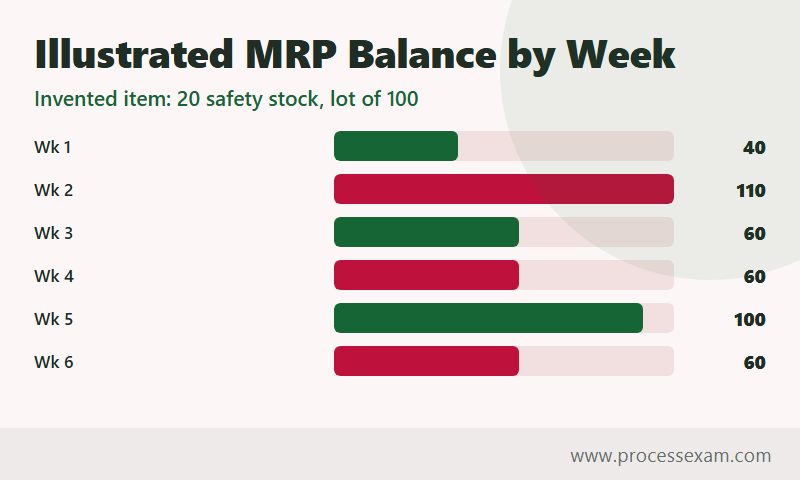
| Projected available balance | 40 | 110 | 60 | 60 | 100 | 60 |
| Planned order receipts | 0 | 0 | 0 | 0 | 100 | 0 |
| Planned order releases | 0 | 0 | 100 | 0 | 0 | 0 |
Work it one column at a time. Week 2 starts from 40 on hand, adds the 100 scheduled receipt and takes out 30, leaving 110. Week 3 uses 50 and leaves 60, and week 4 holds at 60. In week 5, requirements of 60 would take the balance to zero, which is below the safety stock of 20, so the record shows a net requirement of 20 and one lot of 100 is planned to arrive. The balance becomes 100, and week 6 closes at 60. With a two-week lead time, the matching order release belongs in week 3.
The test here is the safety stock. Treat a balance of zero as acceptable and no order is planned at all, a plausible but wrong reading. Other common slips are releasing the order in week 5 instead of offsetting it by the lead time, and planning 20 units instead of a full lot. Before you commit to a number, run three checks: is the balance never below safety stock, is the quantity a multiple of the lot size, and is the release one lead time earlier than the receipt?
The figures in this record also make a quick picture of how the balance moves through the six weeks.
How should you split the clock across 150 questions?
Dividing 210 minutes by 150 questions gives 84 seconds for each. That average hides a wide spread. A recall item you know takes well under half a minute; a record or reorder-point calculation can take two minutes or more. If you spend the average on everything, the hard items run you out of time while the easy ones leave time unused.
A pace plan you can rehearse
This plan is our suggestion, not an ASCM rule. Aim for about 70 seconds a question on a first pass through all 150, which takes just under three hours and leaves more than half an hour for the questions you flagged. Convert that into three landmarks and write them on your scratch material at the start:
- Around question 50 when the first hour ends.
- Around question 100 when the second hour ends.
- Question 150 reached with over half an hour left for the flagged ones.
The ECM itself advises approaching the questions in order, not spending too long on unfamiliar or difficult ones, and returning to them later. Check the exam tutorial at the start of the session to see how marking a question for review works in the interface, because you should not be discovering that with the clock running.
When to move on and when to guess
Set a ceiling for a single question, for example double the average, and move on when you reach it. Before you leave, eliminate any option you can, pick the likeliest of the rest and flag it. ASCM scores only correct answers, with no penalty for wrong ones, and counts a blank as wrong, so an answer for every question is better than any gap. The ECM also warns against changing an answer unless you are absolutely certain you marked the wrong one. A first pick made while the stem was fresh is usually better than a late doubt.
Protect your attention across the whole sitting
Three and a half hours of scenario reading is tiring, and units and qualifiers are the first things to slip when you are tired. Practise at least once at full length so you know when your attention fades, and decide beforehand what you will do about it: a few slow breaths between sections, a stretch of the shoulders, a deliberate re-read of the last sentence in every stem. Check the Pearson VUE rules on breaks for your delivery method when you book, rather than assuming.
What can the learning system's checks tell you about readiness?
ASCM's CPIM learning system includes quizzes with immediate feedback, practice questions, flashcards and a practice exam, plus an adaptive study path that adjusts to your exam date and knowledge gaps and a progress tracker. ASCM also runs a short five-question quiz, and its free trial opens the first module for 30 days. These are useful for two jobs: finding gaps in the content, and giving you repetitions of the method.
They are poor at one job. The ECM says the learning system does not teach the test and that no exam question comes from it, so a good score on its quizzes proves you know the course, not that you can handle unseen stems under time pressure. Treat the results as a diagnostic rather than a prediction.
Turn every miss into a cause
Keep a simple log with one line for each question you get wrong, in a spreadsheet or a notebook. Record the topic and then a cause code:
- Concept gap: you did not know the idea. Go back to the ECM content area and the learning system module.
- Calculation slip: you knew the formula but missed a unit or a conversion. Add that slip to your list of hidden steps.
- Misread stem: you answered a different question. Practise the last-sentence-first habit.
- Time: you knew it but ran out of clock. Work on the pace plan above.
After two weeks the log shows where the marks are going. If it shows mostly slips and misreads, that is good news, because slips respond to drills within days while a concept gap can take weeks.
What should your last week of practice look like?
By the final week, stop collecting new material. Everything that remains should either raise accuracy on what you already know or settle your pacing.
- Redo your error log, not the whole course. Rework every calculation you missed from a blank page, and write the hidden step beside each.
- Sit one paper at full length. Use 150 questions, the full clock, no pauses, and your landmarks written out. Afterwards, note where your attention dropped.
- Drill the formulas until they are automatic. EOQ, safety stock, reorder point, MRP netting, available-to-promise and a forecast error measure should each come out cleanly from a cold start.
- Keep the day before light. Read the ECM key terminology list once and stop. Rest is worth more than another session of cramming.
- Prepare logistics. Check your identification, your start time and, for an online sitting, your room and equipment, against the instructions in your ASCM confirmation.
Once the formulas feel automatic, the CPIM practice exam gives you fresh stems to run your six-step routine against, and every miss goes straight into the log. The aim is to arrive at the exam having already made your mistakes somewhere cheaper. You can read ASCM's own description of the exam, fees and learning options on the ASCM CPIM page, and download the CPIM exam content manual, which is the document that defines what can be asked.
Frequently Asked Questions
What is the CPIM passing score?
ASCM reports CPIM results on a scaled range of 200 to 350, and 300 is the minimum passing score. Scores from 200 to 299 fail. The result report also includes diagnostic information by content area, which shows where marks were lost if you need to retake the exam.
How many questions are on the CPIM exam, and how long do you get?
CPIM version 9.0 has 150 questions and a time limit of 210 minutes, which is three and a half hours. Twenty of the questions are unscored pretest items, and ASCM does not tell candidates which ones they are, so you should answer every question as if it counts.
Does the CPIM exam include calculations?
Yes. ASCM's exam content manual says questions either ask you to select the best of four options or to complete a calculation from the information given. Its content outline names economic order quantity, safety stock, the MRP time-phased record, available-to-promise and forecast error measures among the techniques you must be able to use.
Is there a penalty for wrong answers on the CPIM exam?
No. ASCM scores only the questions you answer correctly, and an unanswered question counts the same as a wrong one. That makes guessing better than leaving a blank. Eliminate the options you can, pick the likeliest remaining one and move on, since changing answers late rarely helps.
Do the learning system quizzes contain the real CPIM exam questions?
No. The exam content manual states that no CPIM exam question is derived from the learning system, and that the system does not teach the test. Use its quizzes and practice exam to find gaps and to practise your method, and rely on the content manual to define what can be asked.
- Supply Chain Management |
- ASCM APICS Certified Planning and Inventory Management Test Questions |
- CPIM Question Bank |
- CPIM Body of Knowledge (BOK) |
- APICS CPIM Simulator |
- APICS CPIM Mock Exam |
- ASCM APICS Certified Planning and Inventory Management Book |
- ASCM CPIM BOK PDF |
- APICS Certified Planning and Inventory Management Certification Cost |
- APICS Certified Planning and Inventory Management Certification Requirements |
- ASCM APICS CPIM Question Bank |
- ASCM APICS CPIM Book |
- ASCM APICS CPIM Study Guide |
- APICS CPIM Certification |
- APICS CPIM Certification Cost |
- APICS CPIM Certification Requirements |
- ASCM APICS Certified Planning and Inventory Management Sample Questions |
- CPIM Exam Questions Download |
- CPIM Test Questions |
- APICS Certified Planning and Inventory Management PDF |
- ASCM APICS CPIM Exam Questions |
- ASCM APICS CPIM Sample Questions |
- APICS CPIM |
- APICS CPIM PDF


