
ASCM CPIM Career Roadmap: Roles, CSCP, CLTD and Renewal
You have spent four years as a demand planner, and your manager has hinted at a supply chain manager opening next spring. Do you sit CPIM now, add CSCP first, or wait? For most planners the answer is CPIM first. It is one ASCM exam of 150 questions, version 9.0 since 1 June 2026, and it fits planning, scheduling and inventory work more closely than any other ASCM credential. CSCP and CLTD suit what comes after.

This roadmap is for people who already work in or near planning and want to know where CPIM leads, how it sits beside ASCM's other two big credentials, and what the year after passing should look like. It does not repeat the exam-day tactics, the content-area breakdown or the Part 1 to version 9.0 story covered in our other CPIM guides.
Which planning roles does CPIM serve, and where does it fit in a career?
CPIM is a planning credential, so it pays off where a person's decisions set quantities, dates and priorities: what to make, what to buy, when, and how much to hold. The stage of your career decides which of those decisions you currently own, and therefore what the certification adds. The list of content areas on the CPIM syllabus page maps neatly onto the stages below.
Early career: planner, scheduler, inventory analyst, buyer
At this stage you run the plan that somebody else designed. You release orders, chase shortages and clear exceptions from the ERP screen. CPIM gives you the reasons behind the parameters you have been working with: why a lot size is set where it is, how safety stock relates to lead time and demand variation, and what a planning time fence protects. Candidates in these roles often find that the exam turns familiar daily tasks into a coherent system, which is the point at which people start suggesting changes instead of only executing them.
Mid career: master scheduler, supply planner, materials manager
Here you own the plan itself. A master scheduler balances the sales forecast against capacity, a supply planner decides how to cover a net requirement, and a materials manager answers for inventory investment and service together. The CPIM areas on sales and operations planning, master scheduling, capacity and inventory carry the most weight for these jobs, and the credential gives hiring managers a shared vocabulary to test you against. Moving from one plant to another, or from one ERP to another, is easier when your reasoning rests on the method and not on one system's menus.
Senior roles: S&OP lead, planning manager, supply chain manager
Senior planners spend their time in cross-functional meetings, where finance, sales and operations each defend a different number. CPIM helps in these rooms because it teaches how the numbers connect: how a forecast change reaches capacity, purchasing and cash. For a supply chain manager the credential is usually a base layer, with a broader certification such as CSCP added once the job spans suppliers, logistics and customers.
Sideways moves: ERP, MRP and master data specialists
Not every CPIM holder is a planner by title. ASCM's own CPIM page carries testimonials from an ERP system administrator, a senior planning specialist, a director of materials and a vice president of supply chain, which shows how wide the range is. People who configure or support planning systems gain the most from understanding what the planning logic is supposed to do, because they can then tell a system fault from a planning policy.
What does ASCM say about pay?
The headline on ASCM's CPIM page reads "Earn 15% more with a CPIM certification". It is the vendor's own statement and the page gave no breakdown by country or role, so treat it as a marketing claim, not a forecast for your job. Ask recruiters in your own market what they pay for planners with and without the credential, and weigh the ASCM fee against that answer.
How do CPIM, CSCP and CLTD differ when you put them side by side?
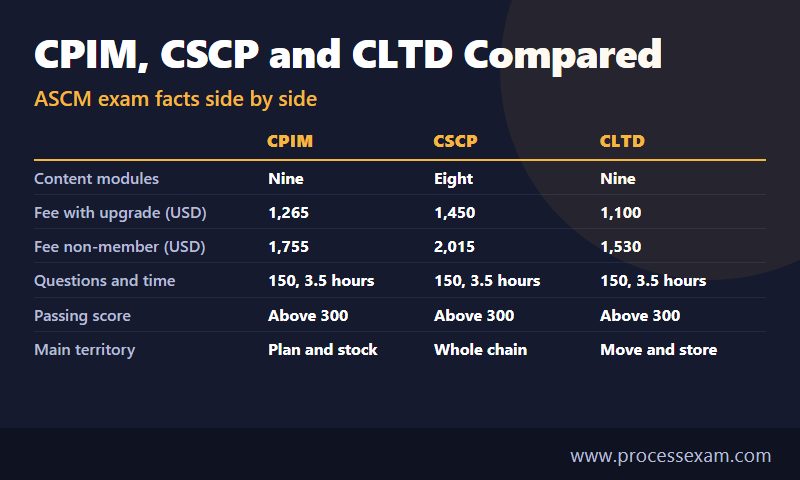
All three are ASCM exams with the same shape: 150 questions, three and a half hours, a score range of 200 to 350 and a pass above 300. The difference lies in the territory each one covers and in the fee. The figures below come from the three credential pages on ascm.org, read in October 2026.
| Item | CPIM | CSCP | CLTD |
|---|---|---|---|
| Full name | Certified in Planning and Inventory Management | Certified Supply Chain Professional | Certified in Logistics, Transportation and Distribution |
| Content modules | Nine | Eight | Nine |
| Exam fee with the membership and certification upgrade (USD) | 1,265 | 1,450 | 1,100 |
| Exam fee for non-members and members without the upgrade (USD) | 1,755 | 2,015 | 1,530 |
| Main territory | Demand, supply, inventory and scheduling inside the plan | The whole chain from suppliers to customers, including risk and sustainability | Warehousing, transportation, order management and reverse flows |
Read the territory row as a question about where your decisions land. If you set what is made and bought, CPIM is the closer fit. If you design or oversee the network of suppliers, plants and customers, CSCP is. If your daily work is moving and storing goods, CLTD is. The overlap is real, since inventory, demand and global flows appear in more than one syllabus, but the weighting differs. ASCM's pages for CSCP and CLTD list the topics each one covers.
Which one gets you further with a hiring manager?
That depends on the advertisement. Planner and scheduler openings tend to name CPIM, while network, sourcing and supply chain manager openings tend to name CSCP, and distribution or transport openings name CLTD. Before you choose, open five advertisements for the job you want in two years and count which credential each names. The count is better evidence than any general ranking.
In what order should you earn them, and when is CPIM enough?
There is no required sequence between ASCM credentials. Order is a matter of what your next job asks for and of how much study time a year can hold. Three common paths show the logic.
- Planner who stays in planning. CPIM alone can carry you from planner to master scheduler to planning manager. A second credential becomes useful only when your remit grows beyond the plan, so there is no hurry to add one.
- Planner heading for supply chain management. CPIM first, then CSCP. The planning depth from CPIM makes the CSCP material on demand, internal operations and inventory feel like revision, and you reach the new material on networks, risk and relationships with a firmer base.
- Planner moving toward distribution. CPIM first, then CLTD. Inventory and demand knowledge carries over to warehouse and transport planning, and CLTD adds the logistics detail that planning never covers.
A fourth path is to stop at CPIM and spend the next study hours on a skill the exam does not test, such as analytics, a planning software certificate or a finance course on working capital. For a planner whose employer asks for none of the other credentials, that is often the better use of a year.
What are the signs that a second credential is due?
- Your job description now names suppliers, carriers or customers you do not currently plan for.
- Interviewers for the next role keep asking about network design, risk or transport cost, and you answer from second-hand knowledge.
- Your planning work runs smoothly and you are bored by it, which usually means the next challenge lies outside the plan.
- Your employer offers to fund study, which removes the fee barrier that stops many candidates.
Two practical points apply to any sequence. First, each credential carries its own five-year maintenance cycle, so holding three means three sets of dates to track. Second, ASCM's maintenance handbook awards points for passing an additional ASCM certification exam, so a second credential also helps renew the first. The later section on maintenance points explains how.
What does a CPIM 9.0 booking involve today?
ASCM's CPIM 9.0 FAQ sets the changeover cleanly: the previous version could be sat until 31 May 2026, and from 1 June 2026 only the updated exam is offered, with no choice between versions. If a colleague passed years ago, their experience came from an older structure, so ask for the topics and not the study plan. ASCM publishes the details in its CPIM 2025/2026 FAQs.
| Exam detail | ASCM CPIM |
|---|---|
| Exam name | ASCM APICS Planning and Inventory Management |
| Exam code | CPIM |
| Version | 9.0 (single exam) |
| Exam price | USD 1,265 with the membership and certification upgrade; USD 1,755 for non-members, per ASCM |
| Duration | 210 minutes |
| Number of questions | 150 |
| Passing score | 300 / 350 |
| Delivery | Pearson VUE test centres or online with OnVUE |
The CPIM page lists a bundle of learning system, exam and a second-chance exam at USD 2,275 for members with the upgrade, and a failed attempt is followed by a 14-day wait before a retake, according to ASCM's FAQ. Those two facts shape a career plan: a fee this size is easier to justify when the attempt is expected to succeed, and a retake delay matters if a promotion decision sits on a date.
The ASCM page for CPIM does not state a degree or work-experience requirement. Check the current ASCM exam handbook before you pay, since policies change. Once you have decided that CPIM is your step, work through the CPIM practice exam and look at the score pattern before you pick an exam date, so the booking follows evidence of readiness and not a hopeful guess.
Which actions turn the CPIM result into career value in the first three months?
ASCM's own page says results are immediate and the certification can be used right away. The first quarter after the pass decides whether the credential does any work for you. Here is a sequence that fits the way the maintenance rules work.
- Note the exact date you were certified. The five-year maintenance cycle starts on that date and ends on the last day of the same month five years later. Certified on 14 November 2026, for example, your due date is 30 November 2031. Put it in your calendar now, and a reminder one year ahead.
- Check your credential on ASCM's verification page. ASCM runs a public credential verification search for employers. It shows a completed credential, while exam results and partial progress do not appear. Confirm that your name and designation display correctly before a recruiter looks.
- Update your CV and profiles with the designation. Add it after your name and in the certifications section, with the month and year, so a recruiter's keyword search finds it.
- Tell your manager what you can now take on. A credential on its own rarely changes a job. A specific proposal does: a review of safety stock settings for the top fifty items, a cleaner master schedule meeting, a forecast accuracy report. Offer one and agree a date for the result.
- Start your maintenance log in week one. Points can be earned from the day you are certified, and activities before certification do not count, including the exam you just passed. A simple sheet with date, activity, hours or points and a proof file saves a hard evening in year five.
- Decide on ASCM membership. Membership earns points every year and unlocks the Certification Maintenance Dashboard, a tracking tool for members. ASCM notes that it does not review what you type there, so keep your own documents for any audit.
How can you collect 75 maintenance points without it becoming a chore?
ASCM's certification maintenance handbook sets the rule for CPIM: 75 points in each five-year cycle, with 100 for the fellow-level designation, CPIM-F. Points come from two categories, education and service, and the handbook sets no maximum in either. The rubric below uses the handbook's own values. It is dated March 2024, so confirm the current figures on ASCM's maintenance page before you rely on them. The full text is in ASCM's certification maintenance handbook.
| Activity | Points under the handbook |
|---|---|
| ASCM membership | 6 per year |
| Membership of another relevant professional body | 2 per year |
| Another ASCM certification exam passed (not the one that earned the credential) | 20 per exam |
| Completing an ASCM learning system with 80 percent or more on the post assessment | 30 per learning system |
| ASCM conference attendance | 8 per day, up to 3 days |
| Relevant courses, webinars, workshops, either taken or taught | 1 per hour taken, 2 per hour taught |
| Reading a relevant book of at least 200 pages | 5 per book |
| ASCM formal mentorship | 2 per year per mentee |
| Writing a relevant book | 40 per book |
Because no category has a ceiling, you can reach 75 in several ways. The three routes below are illustrations built from that rubric, not ASCM recommendations, and each lands on exactly 75.
| Route | What goes in the log over five years | Points |
|---|---|---|
| Steady and inexpensive | ASCM membership for five years (30), two relevant books (10), 35 hours of webinars and workshops (35) | 75 |
| One large step | A second ASCM learning system finished at 80 percent or more (30), that credential's exam passed (20), 25 hours of training (25) | 75 |
| Conference-led | ASCM membership for five years (30), a three-day ASCM conference (24), 21 hours of webinars and workshops (21) | 75 |
Two details trip people up. Work you do as part of your full-time job is not automatically points, and the handbook has a list of eligible and ineligible topics, so the activity has to relate to operations management, supply chain or logistics. Also, retaking the exam you already hold does not renew the credential or move the due date, although the handbook notes it may earn points. Read the eligible-topics list before you buy a course just for points.
Which route suits which person?
The steady route suits someone whose employer pays for membership and runs regular training. The large-step route suits someone who already plans a second credential, because the study doubles as maintenance. The conference route suits someone in a role where networking is part of the job. Mixing them is allowed, and most people will.
What happens if the five years run out, and can renewal ever stop?
You can apply for maintenance at any point in the cycle, provided the points were earned inside it, but the application cannot be opened until 30 days after the cycle begins. When approved, the new due date moves to five years beyond the previous one, and the handbook says you can download an updated certificate. ASCM sends reminder emails one year, 90 days, 60 days and 30 days ahead, though the handbook adds that you remain responsible whether or not an email arrives. Keep your address current in your ASCM account.
If the date passes with no application, the certification goes into suspended status and you have 90 days to submit. After that the credential is lost and you must retake and pass the exam again. A fellow-level holder must also reapply for the designation. Rebuilding is far more expensive than 75 modest points, so a late log is a poor reason to lose the credential.
Points used in one cycle cannot be reused in another for the same certification, which is another reason to keep dated records per cycle. For senior professionals, the handbook describes a lifetime certification status that removes the five-year renewal. It is not automatic: you ask ASCM in writing and provide proof of age, and there is no fee for the change. Read the handbook's wording for the current conditions before you plan around it.
A year-one plan in one paragraph
Month one: record the date, the due date and the verification page check. Months two and three: pitch one planning improvement to your manager and log any training you attend. Months four to twelve: pick a maintenance route, join or renew membership if it suits you, and decide, with the evidence from job advertisements, whether CSCP or CLTD is the next step. By the first anniversary a planner who follows this has a credential in use, a log that is already ahead and a clear next decision.
Frequently Asked Questions
What does CPIM stand for, and who is it for?
CPIM stands for Certified in Planning and Inventory Management, an ASCM credential. It suits planners, schedulers, inventory and materials managers, buyers and ERP specialists who set or support decisions about demand, supply and stock. It is a single exam, version 9.0, with 150 questions in three and a half hours.
What are the requirements for the CPIM certification?
The ASCM CPIM page asks you to pass one exam: 150 questions in three and a half hours, with a score above 300 on a 200 to 350 scale. The page lists no degree or work-experience requirement. Check the current ASCM exam handbook before you book, because policies change.
What are the benefits of CPIM certification?
CPIM gives planners a shared method for demand, supply, inventory and scheduling, which supports moves from planner to master scheduler, planning manager or supply chain manager. ASCM states that CPIM holders earn 15 percent more, a vendor claim without a breakdown, so compare it with pay in your own market.
Should I take CPIM or CSCP first?
If your job sets what is made, bought and held, take CPIM first, since it matches planning work most closely. If you oversee suppliers, networks and customers as a whole, CSCP may come first. No ASCM rule fixes the order. Count which credential the roles you want advertise.
How do I keep my CPIM active after passing?
ASCM requires 75 maintenance points in each five-year cycle, or 100 for the CPIM-F fellow designation. Points come from activities such as membership, courses, conferences, books and further ASCM exams. A missed deadline brings a 90-day suspension, then loss of the credential and a retake.
- Supply Chain Management |
- ASCM APICS Certified Planning and Inventory Management Test Questions |
- CPIM Question Bank |
- CPIM Body of Knowledge (BOK) |
- APICS CPIM Simulator |
- APICS CPIM Mock Exam |
- ASCM APICS Certified Planning and Inventory Management Book |
- ASCM CPIM BOK PDF |
- APICS Certified Planning and Inventory Management Certification Cost |
- APICS Certified Planning and Inventory Management Certification Requirements |
- ASCM APICS CPIM Question Bank |
- ASCM APICS CPIM Book |
- ASCM APICS CPIM Study Guide |
- APICS CPIM Certification |
- APICS CPIM Certification Cost |
- APICS CPIM Certification Requirements |
- ASCM APICS Certified Planning and Inventory Management Sample Questions |
- CPIM Exam Questions Download |
- CPIM Test Questions |
- APICS Certified Planning and Inventory Management PDF |
- ASCM APICS CPIM Exam Questions |
- ASCM APICS CPIM Sample Questions |
- APICS CPIM |
- APICS CPIM PDF


