
Is the IAPM CJPM Certification Worth It? Fee, Exam and Value
Updated on 3 October 2026. What’s new: the CJPM fee is listed at USD 111; IAPM sets each candidate's price by citizenship, and its 20% student discount does not cover the CJPM
Yes, if you want proof of project management basics before anyone hands you a project, and you accept that the proof is modest. The IAPM Certified Junior Project Manager (CJPM) is listed at USD 111, though IAPM sets the real amount by your citizenship. It is a 40-question online test with a 35-minute limit and a 65% pass mark, and the certificate never expires.
That combination makes the CJPM an unusual credential. It asks for no project experience, no course and no application file, so the only things you invest are a few weeks of study and one exam fee. The sections below tell you what that buys, what it does not, and how to decide whether it belongs on your resume.
What does a junior project manager certificate actually prove?
It proves that you can name the building blocks of a project and say what each one is for. IAPM describes the CJPM as its entry-level certification for project management novices, students and people who are interested in a future career in the field. The exam covers eight subject areas, from the project file and the project environment to the work breakdown structure, and every one of them is a document or a step that a real project produces.
That is a different claim from "I have managed projects". A recruiter reading CJPM on a resume learns three things: you understand how a project is started and structured, you have sat a timed online test on it, and you chose to invest in the subject before a job demanded it. For someone with no project title yet, those three signals are worth something, because they separate a candidate who talks about project work from one who has studied how it is organised.
What it does not prove
It does not prove that you can lead people, handle a budget overrun or negotiate scope with a difficult sponsor. Nothing in a 35-minute multiple-choice paper can. Treat the CJPM as a statement of vocabulary and method, and back it with a real example from work, a volunteer role or a university group project. The pairing of the credential and one concrete story is what carries weight in an interview.
How hiring managers tend to read it
Employers screen entry-level project coordinator and assistant roles on potential, not on seniority. A short, inexpensive certificate that is easy to verify fits that screening. It will not beat a candidate who already holds a recognised senior credential, but it was never aimed at that contest. Its real competition is a resume with no project learning on it at all.
Is the CJPM meant for you, or a waste of a weekend?
IAPM states that the certificate has no project experience requirement, and its page names no formal education or age condition either. That openness shapes who gains the most from it.
Who gains the most
- Students and recent graduates who want something project-shaped beside a degree that never mentioned a work breakdown structure.
- Career changers moving from operations, sales, teaching or engineering into coordination work, who need to show the new direction on paper.
- Team members who keep getting pulled into projects without training, and who would like a common vocabulary with the project manager they report to.
- Future IAPM candidates. IAPM presents the CJPM as the first step of a ladder that continues with its Certified Project Manager and senior levels, so it is a low-risk way to try the style of the exams.
Who should look elsewhere
If you already run projects and need a credential that tenders, procurement teams or your employer's pay grades name explicitly, a junior-level certificate will not move that needle. Look at the exam body your sector asks for. PMI's CAPM, for example, has its own eligibility rules, so check PMI's current requirements before you compare the two. The CJPM answers "how do I show I have started?", not "how do I prove I am senior?".
How is the 35-minute CJPM paper laid out?
The exam is delivered online. IAPM says it runs through Classmarker, works on the major operating systems and on smart devices, and needs a stable internet connection. Questions are multiple choice with one or more correct answers, plus right-or-wrong statements. That mix matters: a question with several correct answers punishes a half-remembered rule, so partial recognition is not enough.
| Item | CJPM figure |
|---|---|
| Certification | IAPM Certified Junior Project Manager (CJPM) |
| Vendor | IAPM |
| Questions | 40 |
| Duration | 35 minutes |
| Passing score | 65% |
| Fee | USD 111 as listed; IAPM prices by citizenship |
| Delivery | Online, through Classmarker |
| Prerequisites | None stated by IAPM |
| Validity | Lifetime, no recertification |
Do the maths on the clock
Thirty-five minutes for forty questions leaves about 52 seconds per question. A 65% pass mark means 26 correct answers out of 40, so you can miss 14. Those two numbers shape your tactics: you do not need perfection, but you cannot afford to stall on one tricky multi-answer item for three minutes. The pacing plan below is one way to keep the clock honest.
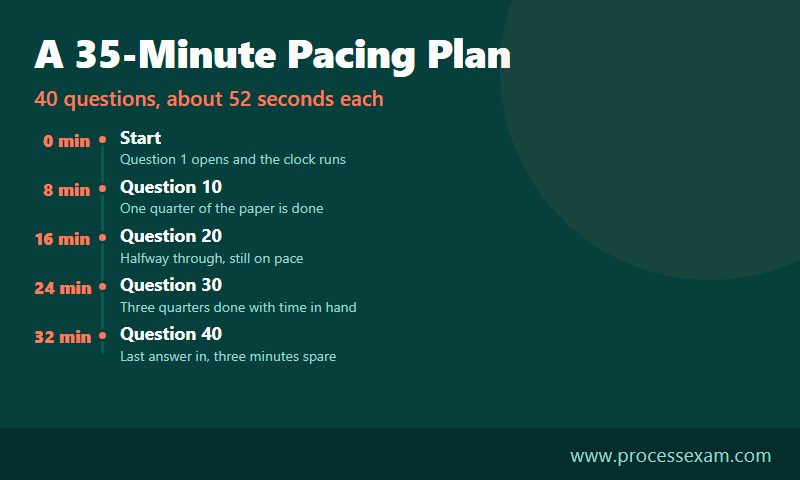
Aim to reach question 10 around minute 8, question 20 around minute 16 and question 30 around minute 24. That leaves the last three minutes spare for any item you want to re-read. Practise it on a timed run, not in your head, because the first time you feel 52 seconds should not be on exam day.
Reading a multi-answer question calmly
IAPM states that some questions have more than one correct answer. Read the stem twice, then judge each option on its own instead of hunting for the single best one. An option is either consistent with the project practice you studied or it is not. Candidates lose marks here by stopping after the first correct-looking option, so train the habit of finishing the list before you answer.
If you do not pass
IAPM allows a repeat with new questions. If the second attempt also fails, you wait 12 months before a third, and the fee applies again each time. That rule makes the first sitting the cheapest one, which is a good reason to take a timed trial run before booking. The registration step itself happens on IAPM's registration page.
Why does the CJPM fee depend on your country, and what will you pay?
The CJPM is listed at USD 111. IAPM's own page, however, says the fee depends on your citizenship, so that project managers of all nations can afford its certifications; the exact amount appears once you select your nationality on the IAPM site. Treat USD 111 as a planning figure and confirm your own price at checkout before you commit.
Do not count on a discount here. IAPM gives pupils, students and staff of aid organisations 20% off most of its certificates, but its fee page (checked October 2026) excludes the Certified Junior Project Manager from that offer. The price you see after choosing your nationality is the price you pay, once, for a credential that lasts for life.
What the cost is really compared with
The fair comparison is not the fee against zero. Put it beside the other things you could spend the same hours and money on:
- A larger credential with experience gates. Bigger project certifications usually cost more and ask for documented project hours, which a newcomer does not have yet.
- A paid course with no certificate. Attendance proves you showed up; a pass mark proves you answered correctly.
- Nothing at all. This is cheapest, but it leaves the learning unstructured and the resume unchanged.
Because the certificate is valid for life, you also never pay a renewal fee or collect continuing-education points. IAPM puts it plainly: once certified, always certified. For a junior credential, that removes the worry that the investment decays while you are still early in your career.
What do the eight CJPM topics ask you to produce?
IAPM lists eight topics, and a useful way to study them is to treat each as an artefact you could build for a small project. The names below follow IAPM's list; the explanations are our own study aids. The full outline of each area sits on our CJPM syllabus page.
1. Project Check
Before any work begins, a project is examined for whether it is worth starting. Expect questions about what a sensible first assessment looks like and which signals say "stop and rethink".
2. Project File
This is the documentation habit: where decisions, plans and changes are recorded so the project can be handed over or reviewed. The test usually rewards knowing why a record exists, not only what it is called.
3. Project Environment
Projects live inside organisations, markets and rules. Questions here ask you to separate what the team controls from what it only influences, and to spot the factors that can help or disrupt a plan.
4. Stakeholders
Identify who is affected, who can decide and who can block. Typical items ask which stakeholder needs what kind of communication, and what happens when one is overlooked.
5. Project Charter
The charter formally authorises a project. Learn what it contains, who signs it and how it differs from a detailed plan. A common trap is confusing the charter's purpose with that of a specification.
6. Creation of the Specification
Here the focus is turning needs into written requirements. Expect to recognise a clear, testable requirement against a vague wish, and to know who must agree before it is fixed.
7. Creation of the Phase Model
A phase model divides the project into stages with decision points between them. Revise the idea of a gate: a moment where the project is reviewed before more money and time are committed.
8. Creation of the Work Breakdown Structure
The work breakdown structure splits the total scope into smaller deliverables that can be estimated and assigned. If the idea is new to you, the general explanation of a work breakdown structure on Wikipedia is a gentle background read; then practise decomposing a familiar task, such as organising an event, into three levels.
One small project, all eight topics
Imagine a twelve-person department moving to a new floor. The project check asks whether the move is worth doing now or should wait for the lease decision. The environment covers the building rules, the removal firm's availability and the quarter-end rush. The stakeholders are the staff, facilities, IT and the finance director who pays. A one-page charter names the sponsor, the goal and the budget ceiling. The specification states that every desk needs power, network access and storage before Monday. The phase model splits the move into planning, preparation, the move weekend and a settling-in review. The work breakdown structure lists packing, cabling, furniture and labelling as deliverables with owners. The project file keeps the plans, approvals and change decisions together. Walking one familiar example through all eight topics is a fast way to see how each exam area fits into one story.
How the topics connect
The sequence is no accident. The check decides whether to start, the environment and stakeholders describe the context, the charter authorises the work, the specification says what must be delivered, the phase model sets the order and the breakdown structure divides the effort, while the project file records the whole chain. When one question seems hard, ask where it sits in that chain; the answer often points to the correct option.
Is three weeks enough to get ready for the CJPM?
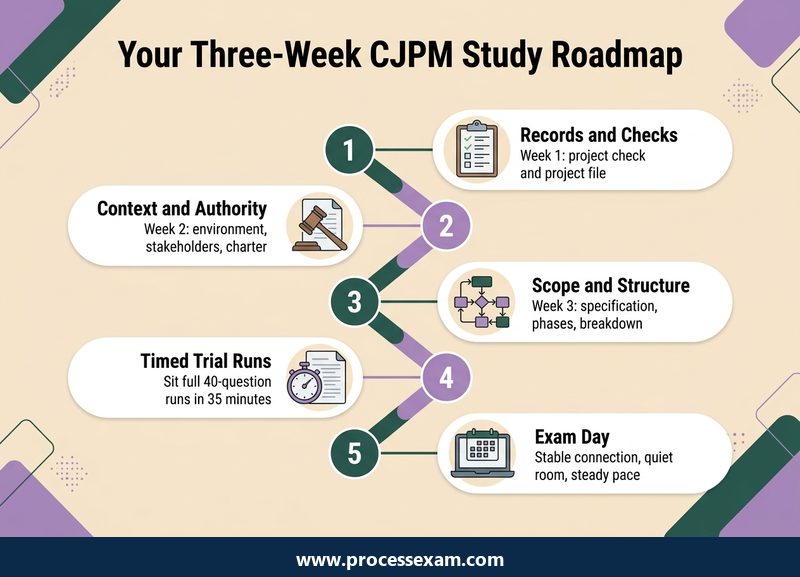
IAPM supports candidates with a free web-learning platform, its Project Managers Guide as the basis of the certification, and a pre-test with feedback from its support team. Its advice is to work through all the chapters, take notes and repeat what you have learned. The plan below turns that advice into a calendar. It is our suggestion, not an IAPM schedule, and it assumes about four to five hours a week.
Week 1: foundations and records
Read the material for the project check and the project file. Write a one-page summary in your own words. Close the book and list from memory what a project file should contain; check the gaps the next day.
Week 2: context and authority
Cover the environment, stakeholders and the charter. Pick a real or imagined project, such as moving a team to a new office, and draft a stakeholder list and a half-page charter. Writing forces you to decide, and the exam's multi-answer questions reward people who have decided before.
Week 3: structure, then the clock
Study the specification, phase model and breakdown structure, then spend the last two days on timed trials. Sit full 40-question runs at 35 minutes. Review every miss by asking which topic it belonged to and whether you misread the question or did not know the idea.
Where timed questions fit
Drilling timed questions in the final stretch is what turns knowledge into marks. For a full-length rehearsal with explanations, the CJPM practice exam on our site follows the 40-question, 35-minute shape, so the pace feels familiar before you pay IAPM's fee.
The week before the exam
Do one last timed run, then stop adding new material. Check your internet connection and device the day before, close other applications, and choose a time when you will not be interrupted. A stable connection is IAPM's own requirement, so treat it as part of the preparation.
Where does the CJPM lead once you hold it?
On IAPM's ladder, the CJPM sits at the bottom. The levels above it include the Certified Project Manager, the Certified Senior Project Manager, three agile variants, the Certified International Project Manager and the Certified Project Management Trainer. None of this obliges you to climb, but the structure shows that your first certificate belongs to a path.
Practical next moves
- Add it where it is read. Put the certificate in your resume's certifications block and, if you are job hunting, in your profile headline.
- Volunteer for a small project. A club event, a department migration or a charity fundraiser gives you the example that turns the credential into evidence.
- Decide on the next level after six months. If you now manage work for others, IAPM's Certified Project Manager is the natural comparison. If you prefer a different body's credential, compare its entry rules first.
Why the lifetime validity matters
Many credentials ask for renewal fees, points or retesting. IAPM says its certificates are valid for life and carry no recertification. For a junior certificate, the downside is that nobody refreshes the content for you; if you stay in project work for years, you will want to learn newer methods yourself. The upside is that a career gap or a move to another country never costs you the certificate.
What to say about it in an interview
Keep the answer short and specific. Name the certificate, say what you studied, then give one example where you applied it, such as the stakeholder list you drafted for a student society event. Interviewers remember a small, true story far longer than a list of exam topics, and the credential then reads as a starting point instead of a trophy.
So, is it worth it for you?
Use these four checks. If you answer yes to at least three, the CJPM is probably a sound, cheap step:
- You have little or no formal project management training today.
- You want a resume line that shows project learning without waiting for a project title.
- You can set aside roughly three weeks of evening study.
- You accept that this is a foundation credential and will add a real project example beside it.
If you answered no to most of them, a role-specific or senior credential may serve you better. Before you spend anything, read the current exam conditions on IAPM's CJPM page, because fees, discounts and retake rules are set by IAPM and can change.
Frequently Asked Questions
Is the CJPM certification worth it?
It is worth it as a low-cost first step if you are a student, career changer or team member new to projects. It shows you know project basics, needs no experience and never expires. It will not substitute for real project results or for senior credentials your employer may specifically require.
What does the CJPM exam consist of?
The online exam has 40 questions in 35 minutes, delivered through Classmarker. Items are multiple choice with one or more correct answers, plus right-or-wrong statements. They cover eight topics, from the project check and project file to the work breakdown structure. You need 65% to pass.
How much does the CJPM cost?
The CJPM is listed at USD 111. IAPM states that its fee depends on your citizenship, so the amount you see after choosing your nationality may differ. IAPM's 20% student discount does not apply to the CJPM. Confirm the price on IAPM's fee page.
Can you retake the CJPM if you fail?
Yes. IAPM lets you repeat the exam with new questions, and the fee applies again each time. If you fail the second attempt as well, you must wait 12 months before a third. Because retakes cost money, a timed practice run before the first booking is a sensible precaution.
Does the CJPM certificate expire?
No. IAPM says its certificates are valid for life, with no recertification, so once you are certified you stay certified. There are no renewal fees or continuing-education points to collect. The trade-off is that you must refresh your own knowledge of newer project methods as your career develops.
- IAPM Junior Project Manager Test Questions |
- CJPM Question Bank |
- CJPM Body of Knowledge (BOK) |
- Junior Project Manager Simulator |
- Junior Project Manager Mock Exam |
- IAPM Junior Project Manager Book |
- IAPM CJPM BOK PDF |
- Junior Project Manager Certification Cost |
- Junior Project Manager Certification Requirements |
- IAPM Junior Project Manager Sample Questions |
- CJPM Exam Questions Download |
- CJPM Test Questions |
- Junior Project Manager PDF


