
CIS-VR Exam Guide: Blueprint, Cost and How to Prepare
It is Monday morning. The vulnerable items queue has grown overnight, two scanners have reported the same server with different data, half the records carry no asset owner, and the change window closes on Thursday. Deciding what gets remediated first, and being able to defend that order to an auditor, is exactly the work ServiceNow Vulnerability Response automates. The CIS-VR exam asks whether you can configure that decision, not whether you can describe it.
That framing matters, because it explains why candidates who know the theory of vulnerability management still fail. The ServiceNow Certified Implementation Specialist - Vulnerability Response exam is built around configuration choices: which integration brings the data in, which calculator sets the risk, which rule groups the items, which rule creates the remediation task and which target date it inherits. Almost every question is a small version of the Monday-morning problem above.
This guide walks through the exam as an implementation job rather than a syllabus. It covers who the credential is for, the facts you need before booking, the five blueprint domains and their weights, how the data actually flows through the application, a study routine that fits around shift work, the places candidates lose marks, and what the last check before the exam should look like.
Which problems does a CIS-VR specialist solve day to day?
A vulnerability response implementation lives between two groups that rarely agree. Security owns the scanners and the risk appetite. IT operations owns the servers, the patch cycles and the change calendar. Vulnerability Response is the layer that translates one into the other, and the implementation specialist is the person who configures the translation.
In practice that means answering questions like these. Which scanner is authoritative when two of them disagree about the same host? How does a raw CVSS base score become a risk rating that reflects whether the asset is internet facing or holds regulated data? When thousands of vulnerable items share a single patch, how do they arrive at one remediation task instead of thousands of tickets? Who approves a deferral, when does that deferral expire, and what happens when the same finding reappears after it does?
The credential is aimed at the people who make those calls: ServiceNow implementation consultants rolling Vulnerability Response out for a customer, platform administrators who inherit the application after go-live, security operations engineers who own the queue, and SecOps architects who design the integration and assignment model before anyone writes a rule. ServiceNow also opens the exam to customers, partners and employees, so you do not need to work for a partner to sit it.
What the credential confirms is narrow and useful: that you can configure, implement and maintain a Vulnerability Response instance. It is not a vulnerability management theory exam, and it is not a penetration testing credential. If your job is to make the platform produce a defensible remediation queue, it is the certification that matches.
What are the CIS-VR exam facts, and what does booking involve?
The format is short and dense. Forty-five questions in ninety minutes sounds generous, until you meet the scenario items that describe an integration setup across six lines and ask which configuration produces the stated result. Budget your time for those and the rest looks after itself.
| Exam detail | CIS-VR |
|---|---|
| Full name | ServiceNow Certified Implementation Specialist - Vulnerability Response |
| Exam code | CIS-VR |
| Vendor | ServiceNow |
| Number of questions | 45 |
| Duration | 90 minutes |
| Exam fee | USD $450 |
| Passing score | Pass / Fail |
| Scheduling | Pearson VUE |
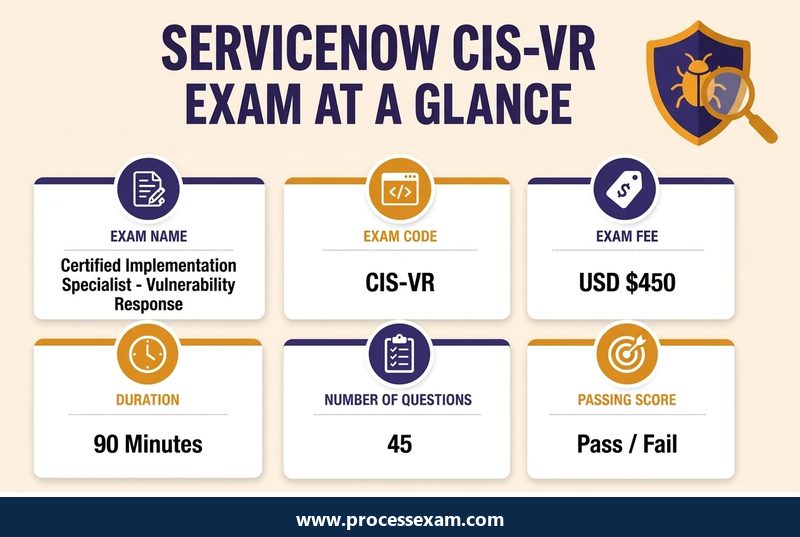
Two details catch people out at booking time. The first is prerequisites: ServiceNow positions the implementation specialist exams on top of its administrator credential, so check the current prerequisite wording on the official CIS-VR exam blueprint before you pay, rather than after. The second is maintenance. ServiceNow keeps mainline certifications current through delta exams tied to platform releases, so a CIS-VR pass is not a one-off event; your ServiceNow University profile is where the delta requirement for your credential appears.
The result itself is reported as Pass or Fail. ServiceNow does not publish a numeric passing score or a pass rate for CIS-VR, so any percentage you find quoted on a forum is somebody's estimate. The only pass rate that should influence your study plan is your own, measured on timed practice under the same forty-five question, ninety minute constraint.
How is the CIS-VR blueprint weighted across its five domains?
The exam is divided into five domains, and the weights are lopsided enough to shape a study plan on their own. Four fifths of the exam sits in the first four domains; reporting is a thin slice. You can see the full topic breakdown on our CIS-VR exam syllabus page, and the summary below explains what each domain actually tests.
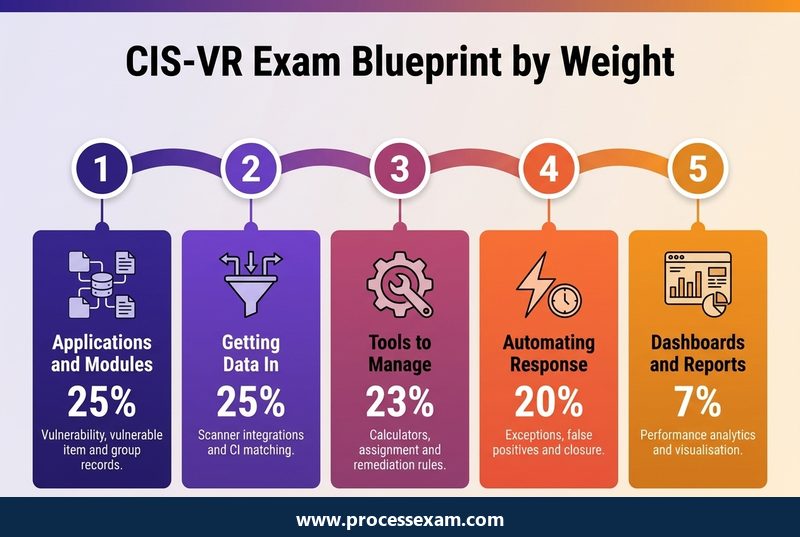
Vulnerability Response applications and modules - 25%
This domain establishes where Vulnerability Response sits inside Security Operations and what the application is made of. Expect to be asked about the record types and how they relate: vulnerability entries that arrive from the National Vulnerability Database and from third-party scanners, vulnerable items that pair a vulnerability entry with a configuration item, and vulnerability groups that collect items for a single piece of remediation work.
It also covers the wider footprint of the application. Application Vulnerability Response handles findings from code and application scanners, and Container Vulnerability Response handles image and container findings, each with its own record structure. Knowing which of the three families a described finding belongs to is often the first step in answering a longer scenario question correctly.
Getting data into Vulnerability Response - 25%
An equal quarter of the exam is about ingestion, which is fair, because a Vulnerability Response implementation succeeds or fails on its data. You need the vocabulary precisely: a vulnerability is the definition, a vulnerable item is the instance of that definition on a specific configuration item, and the two are created by different processes.
Integration questions cover the supported scanner connectors, how scheduled imports run, how discovered hosts are matched to configuration items in the CMDB, and what happens to a finding when no matching CI exists. Solution management and enrichment appear here too: how patch and solution data is attached to findings so that remediation work can be grouped by the fix rather than by the flaw. ServiceNow's product documentation is the reference to keep open while you work through this domain, because the field names in the exam are the field names in the docs.
Tools to manage Vulnerability Response - 23%
This is the configuration heart of the exam. Classification rules decide how incoming findings are categorised. Assignment rules route vulnerable items and groups to the right assignment group. Remediation task rules control when a task is created and what it contains. Remediation target rules set the due dates that service level commitments are measured against. Vulnerability calculators produce the risk score and risk rating that drive the queue order.
Vulnerability workspaces sit on top of all of it, giving analysts and managers a working view of the queue rather than a list view. Learn the order in which these rules evaluate and what happens when two rules match the same record. Scenario questions in this domain frequently hinge on precedence rather than on what an individual rule does.
Automating Vulnerability Response - 20%
Automation covers everything that happens to a finding other than patching it. Exception handling, with its request, approval and expiry cycle, is the largest part: know who can raise a deferral, what happens when it lapses, and how a reopened item behaves. False positive handling follows the same shape but for a different reason, and the exam expects you to distinguish the two.
Beyond exceptions, this domain covers the workflow and flow automation that moves items through their states, the conditions under which items and groups close automatically after a rescan confirms the fix, and the housekeeping rules that keep the queue from filling with stale records.
Dashboards and reports - 7%
The smallest domain, and the one candidates over-prepare. It asks what the shipped dashboards show, how Performance Analytics collects vulnerability data over time, and which visualisation answers a given management question. A single focused session covers it. Spend the time you save on the ingestion and tooling domains instead.
How does raw scanner data become a defensible remediation queue?
Most exam scenarios are a slice of one long pipeline, so it pays to be able to run that pipeline in your head from end to end. Follow one finding through it and the domains stop feeling like separate lists.
A scheduled integration pulls results from a third-party scanner. Each result is matched against a vulnerability entry, and the host it was found on is matched against a configuration item in the CMDB. That pairing creates a vulnerable item. If the CMDB match fails, the item still exists but nobody owns it, which is why CMDB quality shows up in a vulnerability exam at all.
The calculator then scores the item. A base severity from the scanner or the vulnerability entry is adjusted by conditions you configure, such as whether the asset is internet facing, which business service it supports, or how it is classified in the CMDB. The output is a risk score and a risk rating, and that rating is the number the business argues about, so understand precisely which inputs move it.
Grouping comes next. Items that share a solution, a vulnerability or a set of assets are collected into a vulnerability group so that one remediation task can cover them. Assignment rules send the group to an owner, remediation task rules create the work, and remediation target rules stamp the due date. From there the item is patched, deferred through an exception, or marked a false positive; a later scan confirms the outcome and the closure rules tidy up.
Every one of those steps is a configuration decision with a wrong answer available. That is the exam in one paragraph: given the outcome described, which configuration produced it, or which configuration would have prevented it.
What study routine fits someone already working in security operations?
Most CIS-VR candidates are not students. They have a queue to run, so the routine that works is short, repeated and built around the instance rather than around a textbook.
Start from the blueprint, not from a video course
Print the five domains with their weights and keep them beside you. Every study session should be traceable to one of them. Candidates who start with a course instead usually end up strong in whichever domain the course covered first and thin everywhere else.
Get instance time, and be realistic about how
Vulnerability Response is a licensed application, so it is not part of a standard personal developer instance the way core platform features are. If your employer runs it, ask for a sub-production instance and permission to configure in it. If not, lean on ServiceNow's own enablement: the ServiceNow University learning content for CIS-VR is where the vendor's guided material for this credential sits, and it uses the exact terminology the exam uses.
Configure something, then break it
Reading about a remediation target rule teaches you what it is. Creating one, watching a group inherit the wrong due date because a higher-precedence rule matched first, and then fixing it teaches you what the exam asks. Do this for calculators, assignment rules and exception approvals in particular.
Keep a one-page decision sheet
As you study, build a single page of decisions rather than definitions: when to use a group versus an individual item, when an exception is right and when a false positive is, which record a given field lives on, and which rule wins when two match. This page is what you revise in the last week; the notes underneath it are scaffolding you will not reread.
Test under the real constraint early
Forty-five questions in ninety minutes is a pace, and pace is a skill. Sit a full timed set early enough that a weak domain can still be fixed, then again a week later on fresh questions. A score that rises on questions you have never seen is the only reliable signal; a score that rises on questions you have already reviewed only measures your memory.
Where do CIS-VR candidates lose marks?
The failure patterns are consistent, and none of them are about intelligence.
- Treating the vocabulary loosely. Vulnerability, vulnerable item and vulnerability group are three different records with three different behaviours. Answer options are written to punish anyone who uses the words interchangeably.
- Learning rules individually. Knowing what an assignment rule does is not enough when the question turns on which of two matching rules applied first.
- Skipping the integration detail. A quarter of the exam is ingestion. Candidates who have only ever seen data already inside the instance guess their way through it.
- Confusing exceptions with false positives. Both remove an item from the active queue, for opposite reasons, with different approval and expiry behaviour.
- Ignoring the CMDB. Configuration item matching decides whether a finding has an owner. Scenario questions about unassigned items usually have a CMDB answer.
- Over-studying dashboards. Seven per cent of the exam does not deserve a third of the study time, however satisfying the charts are.
- Reading the scenario twice. With two minutes per question at most, read the final sentence first so you know what is being asked before you absorb the detail.
What does the final check before exam day look like?
The last stretch is about confirming readiness, not adding material. If a domain is still unfamiliar a week out, the honest move is to move the booking rather than to cram it.
One week out
Sit a full timed set and sort every wrong answer by domain, not by topic. If the errors cluster in one domain, go back to the instance for that domain rather than answering more questions about it; repeated questions on a misunderstanding just repeat the misunderstanding. If the errors are scattered evenly, the problem is usually pace, and more timed practice is the fix.
Two days out
Run one more timed set on questions you have not seen, then stop adding anything new. A good final rehearsal is a CIS-VR mock exam sat in one sitting with the clock running and no notes open, because it tells you two things at once: whether your coverage holds up across all five domains, and whether ninety minutes is comfortable or tight for you. Review it the same day while the reasoning is fresh.
The day before
Read your one-page decision sheet, confirm the appointment details with the test centre or the online proctoring requirements, and stop. If you are sitting remotely, check the room, the webcam and the connection in advance rather than twenty minutes before the slot; a technical scramble costs more concentration than any last revision gains.
During the exam
Work in two passes. On the first, answer everything you are sure of and flag anything that needs more than two minutes. On the second, return to the flagged items with the remaining time. When two options both look defensible, choose the one that follows the platform's intended design rather than the clever workaround: distractors in this exam are usually technically possible but poor practice, such as editing records directly instead of letting a rule drive the outcome.
After the result
Pass or fail arrives without a score breakdown, so write down what felt weak while you still remember it. If you passed, note the delta requirement that keeps the credential current. If you did not, your own notes plus a fresh timed set will usually show the gap within a week, and a retake from that position is a very different exercise from a first attempt.
What does CIS-VR change about a security-operations career?
Vulnerability Response is bought by organisations that already have a scanner and a backlog they cannot work through. What they lack is the process that turns findings into accountable work, which is why the implementation skill is valued separately from the security knowledge.
The credential helps in three concrete ways. It gives a customer or an employer independent evidence that you can configure the application rather than merely use it, which matters when partners staff delivery teams. It positions you for the SecOps side of the ServiceNow practice, where vulnerability, security incident and configuration work overlap. And it pairs naturally with the platform's data credentials, because a vulnerability queue is only as good as the CMDB underneath it, so specialists who understand both are unusually useful on a rollout.
Typical roles that benefit include ServiceNow SecOps consultant, security operations engineer, vulnerability management lead, platform administrator in a security-owned instance and SecOps solution architect. If your organisation is about to implement Vulnerability Response, or has implemented it and cannot get the queue under control, the knowledge behind this exam is precisely what that project is missing.
Frequently Asked Questions
How many questions does the CIS-VR exam have?
The ServiceNow CIS-VR exam has 45 questions with a 90 minute time limit. That is roughly two minutes per question, but scenario items take longer than recall items, so practise pacing yourself and flag anything that stalls you rather than working through it in order.
What is the passing score for CIS-VR?
ServiceNow reports the CIS-VR result as Pass or Fail and does not publish a numeric passing score or a pass rate. Use your own scores on timed practice sets as the readiness measure, and check you can explain why each incorrect option is wrong.
How much does the CIS-VR exam cost?
The CIS-VR exam fee is USD $450, and the exam is scheduled through Pearson VUE. ServiceNow sometimes issues vouchers through its partner and customer learning programmes, so confirm the current price and any voucher entitlement on ServiceNow's exam page before booking.
Which CIS-VR domain carries the most weight?
Two domains tie for the largest share at 25% each. They are Vulnerability Response applications and modules, and getting data into Vulnerability Response. Tools to manage Vulnerability Response follows at 23%, automating Vulnerability Response at 20%, and dashboards and reports takes the remaining 7% of the blueprint.
Do I need hands-on ServiceNow experience to pass CIS-VR?
Realistically, yes. The questions describe configuration situations and ask which setting produced the outcome, which is hard to answer from reading alone. Time in a sub-production instance configuring calculators, assignment rules and exception approvals is the most efficient preparation available.
What is the difference between a vulnerability and a vulnerable item?
A vulnerability is the definition of a flaw, sourced from the National Vulnerability Database or a third-party scanner. A vulnerable item is that flaw on one specific configuration item in your environment. Remediation work is tracked against vulnerable items and the groups they form.
How long should I study for the CIS-VR exam?
Candidates already working with ServiceNow Security Operations usually need three to five weeks of steady study. Allow longer if scanner integrations or the CMDB side are new to you, since those areas together account for half of the exam blueprint.
- ServiceNow Vulnerability Response Implementation Specialist Test Questions |
- CIS-VR Question Bank |
- ServiceNow Vulnerability Response Implementation Specialist Book |
- Vulnerability Response Implementation Specialist Certification Cost |
- Vulnerability Response Implementation Specialist Certification Requirements |
- ServiceNow Vulnerability Response Implementation Specialist Sample Questions |
- CIS-VR Exam Questions Download |
- CIS-VR Test Questions |
- Vulnerability Response Implementation Specialist PDF |
- Technology |
- CIS-Vulnerability Response Mock Exam |
- CIS-Vulnerability Response Simulator |
- CIS-Vulnerability Response Certification |
- CIS-Vulnerability Response Certification Cost |
- CIS-Vulnerability Response Certification Requirements |
- ServiceNow CIS-Vulnerability Response Question Bank |
- ServiceNow CIS-Vulnerability Response Study Guide |
- CIS-Vulnerability Response |
- CIS-Vulnerability Response PDF |
- ServiceNow CIS-Vulnerability Response Exam Questions |
- ServiceNow CIS-Vulnerability Response Sample Questions


