
ServiceNow HAM Certification: CIS-HAM Domains, Cost and Study Order
You cannot book the ServiceNow CIS-HAM exam until you hold CIS-DF, so the first question is not how to study but whether you are eligible. ServiceNow's blueprint, updated in January 2026, makes the Data Foundations credential a prerequisite. After that, CIS-HAM is 60 questions in 90 minutes for USD $450, reported as Pass or Fail, and it rewards people who can keep hardware records truthful.

The full title is ServiceNow Certified Implementation Specialist – Hardware Asset Management, and searchers shorten it to "ServiceNow HAM certification" or simply "CIS-HAM". It is aimed at the people who configure and run the Hardware Asset Management application: implementation consultants, platform administrators who inherited an asset module, and IT asset managers who want to prove they can do more than read a report. The guide below follows ServiceNow's own blueprint, because that document is the only reliable map of what the 60 questions draw on.
Every rule and domain detail below comes from ServiceNow's blueprint page for CIS-HAM, apart from the exam fee and the community post noted in the next section. Where a rule is the kind ServiceNow revises, such as fees or retake waiting periods, the advice is to read the current page before you pay.
Why can't you book CIS-HAM straight away?
The blueprint states the rule in one line: candidates must hold the Certified Implementation Specialist – Data Foundations (CMDB and CSDM) certification before registering for CIS-HAM. It is a registration gate, not advice. If you do not hold CIS-DF, the first exam to schedule is CIS-DF, and CIS-HAM follows once that result is on your record.
The reasoning is easy to see once you read the HAM domains. A hardware asset is only useful if its record agrees with the configuration item that Discovery found for the same device, and that agreement depends on the CMDB and the Common Service Data Model. A candidate who has never thought about identification, reconciliation and class hierarchies will struggle with the questions about assets versus configuration items, normalization and data certification, which together carry a large share of the paper.
A second source worth knowing about is a ServiceNow Community post, a member's compilation of the 2026 certification list dated March 2026. It is not a ServiceNow notice, but it lists CIS-HAM among the implementer certifications marked "to hold this cert, must pass the CIS-DF exam by December 31, 2026". Read that as a signal that existing holders also have a Data Foundations deadline, and confirm the current wording on ServiceNow University before you plan around it.
What experience does ServiceNow recommend?
Experience is recommended, not enforced. The blueprint suggests six months of field experience taking part in ServiceNow deployment projects or maintaining instances, and participation in at least two deployment projects, specifically ITSM Asset Management and Hardware Asset Management. If you have not worked on a live HAM implementation, the Hardware Asset Simulator that ServiceNow lists among its resources is the nearest substitute, and a personal developer instance is the next.
Does the exam test the training or the product?
Both, in effect. ServiceNow says exam questions are based on its official training materials, the product documentation site and the developer site, and that study materials posted elsewhere are not official. Treat any third-party practice material, ours included, as a way to rehearse recall and timing, never as the source of the answer. When a practice item and the documentation disagree, the documentation wins.
What do 60 questions, 90 minutes and USD $450 actually involve?
The figures are short, and the details around them are what catch people out. This table gathers the exam facts in one place.
| Item | CIS-HAM |
|---|---|
| Full name | ServiceNow Certified Implementation Specialist - Hardware Asset Management |
| Exam code | CIS-HAM |
| Questions | 60 |
| Duration | 90 minutes |
| Exam fee | USD $450 |
| Passing score | Pass / Fail |
| Prerequisite | CIS-DF held before registering |
| Delivery | Pearson test centre or online with a proctor |
| Vendor | ServiceNow |
Ninety minutes for sixty questions leaves a minute and a half for each. A definition question will not use that, while a scenario with a stockroom, a transfer order and a contract in it will, so bank time early and spend it later.
Which question formats appear?
Two. Single-answer multiple choice offers at least three possible responses. Multiple-select offers at least four, the question states how many to choose, and you must select all the correct ones because ServiceNow gives no partial credit. The practical consequence is that a multiple-select question you half understand is worth nothing, so those deserve a second pass if time allows.
How does registration work, and what does it cost to wait?
Registering is paying. ServiceNow accepts learning credits and credit cards, and its page says instructor-led training completion includes one free exam attempt. Once you have registered, you have 90 days to schedule and sit the exam; miss that window and the registration expires, which means paying the full fee again. The fee is not refundable, so register when you are ready to book a date, not as a motivational device.
On delivery, ServiceNow sends you from its My Exams page to Pearson VUE, where you choose between a test centre and online proctoring through a webcam. The vendor's ServiceNow page on Pearson VUE is where the booking itself happens.
What does the result tell you?
You see a conditional pass or fail the moment you submit. A report follows showing the percentage of items you answered correctly in each section. ServiceNow is explicit that those section percentages do not decide the outcome, should not be averaged, and do not measure expertise. The overall result compares your total, one point per question, with a cut score that is not published and is not always 70 percent. So "what percentage do I need?" has no answer, while "am I solid in every domain?" does.
"Conditional" matters too: ServiceNow can audit and review an exam at any time, and a certification can be revoked after investigation if its test security policies were broken. A failed attempt carries a waiting period before the next one, and the exam fee is payable again each time, so check the vendor's retake policy for mainline exams before you book.
Which of the five CIS-HAM domains deserves your first week?
The blueprint splits the exam into five domains with published weights, and the weights are the most useful numbers you can plan with. They sum to 100 percent.
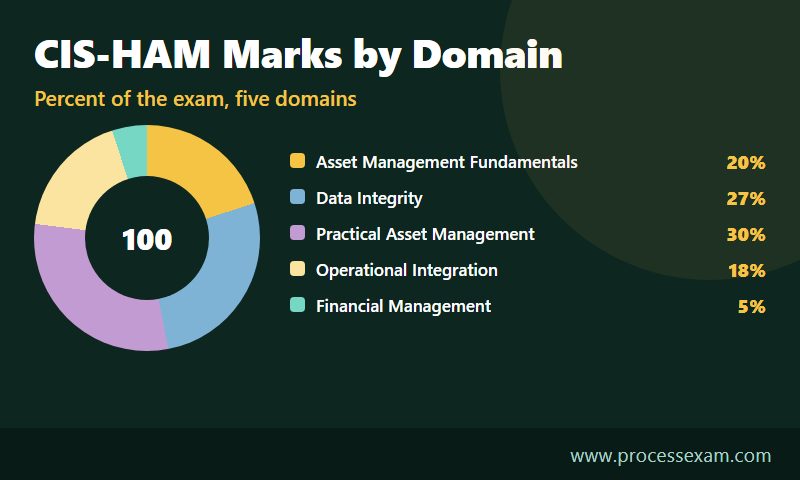
| Domain | Share of exam | Core ground |
|---|---|---|
| IT Asset Management Overview & Fundamentals | 20% | ITAM terms, the hardware lifecycle, recommended practices, personas and roles, plugins and navigation |
| Data Integrity – Attributes and Data Sources | 27% | Trustworthy data, assets versus CIs, Discovery and normalization, hardware model normalization |
| Practical Management of IT Assets | 30% | Consumables, inventory and stock, audits, automating the lifecycle, retirement, contracts |
| Operational Integration of IT Asset Management Processes | 18% | Reports and dashboards, requests and procurement, extending asset management, data accuracy |
| Financial Management of IT Assets | 5% | Contract financials, depreciation, fixed assets, total cost of ownership |
Two readings of that table are worth making explicit. First, the two data-and-operations domains, Data Integrity and Practical Management, together hold 57 percent of the marks, so they should hold more than half of your study time. Second, the Financial domain is only 5 percent, which is about three questions on a sixty-question paper. Skipping it entirely is a gamble you might win, but a short pass over depreciation and total cost of ownership is cheap insurance, and it also helps with the contract questions that sit in the Practical domain.
A sensible first week, then, is a read of the whole blueprint followed by honest self-scoring: for each sub-topic, can you explain it aloud and show it in an instance? Start the deep work where your gaps and the weights overlap. Someone coming from a service desk background will usually be weakest on normalization and stock management; someone from procurement will usually be weakest on the CMDB side. The domain layout is also set out on our CIS-HAM syllabus page, which is handy next to the blueprint when you are building a tick list.
How is an asset different from a configuration item, and why does it carry so many marks?
The Data Integrity domain, at 27 percent, starts from a distinction that sounds pedantic until a record goes wrong. An asset is a thing the business owns and pays for; it has a cost, an owner, a life and a financial trail. A configuration item is a thing the business runs and depends on; it has relationships, a class and a health. One physical laptop is both, and ServiceNow keeps two records that must stay in step. The blueprint asks you to know the characteristics of each, how they relate, and what keeps them in sync.
What counts as trustworthy data?
The blueprint opens the domain with trustworthy data fundamentals: what the term means and why it is critical for IT asset management. In practice it means a record is complete, current and consistent with the physical world. A lifecycle report built on records that disagree with reality is worse than no report, because people act on it. Expect scenario questions in which a symptom, such as a device counted twice or a model that cannot be matched, points back to a data creation or synchronization problem.
How are hardware assets and CIs created and managed?
The domain covers creating hardware assets and CIs: the processes, asset states, device details, hardware models, hardware model categories and CI classes. Then it moves to managing them: synchronizing asset and CI data, enforcing CI verification, asset tracking and tracking strategies. Learn why a hardware model belongs to a category, how a device inherits attributes from its model, and which changes on one record are expected to carry across to the other.
Where do Discovery and normalization fit?
Two sub-topics hold the technical weight. The first is hardware discovery and normalization: using Discovery, the CMDB and Normalization Data Services to deliver trustworthy data. The second is hardware model normalization, which the blueprint breaks into what it does and does not do, what data it provides (key fields and hardware model lifecycle data), how it works (the process, the normalization tables and statuses, manual normalization, resolving issues, and the Hardware Model Normalization Overview dashboard) and the ServiceNow hardware model Content Service that supports it.
The idea is easier than the vocabulary. Discovery finds a device and reports a model name as typed by a manufacturer; normalization maps messy names to one clean model record so that "the same laptop" is recognised across thousands of rows, and so that lifecycle dates attach to the right model. The exam likes the edges: what normalization will not fix, and what to do when a record fails to normalize automatically. Run it in a sandbox, watch a record fail, and resolve it by hand once; the lesson sticks.
How does a laptop travel from purchase order to retirement?
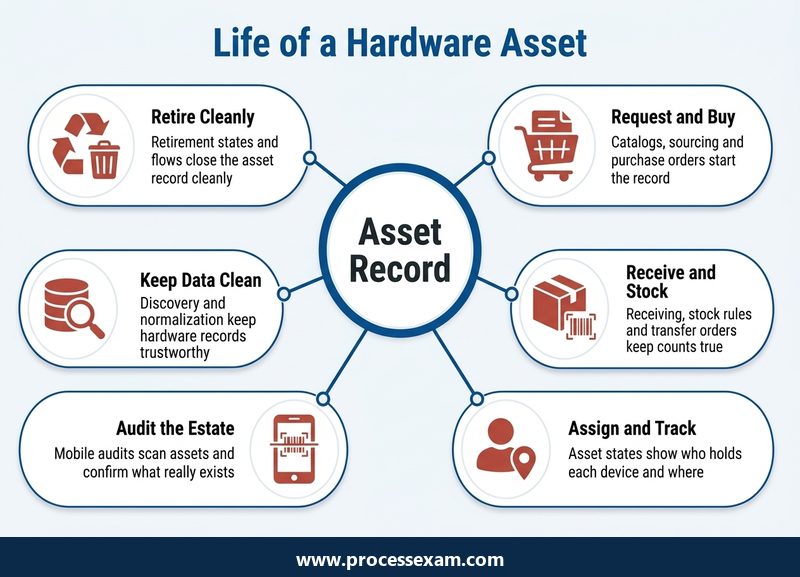
The Practical Management domain is the heaviest, at 30 percent, and the cleanest way to hold it in your head is to follow one device. The picture below puts the stages around the asset record, and the sections that follow take each stage in turn, adding the Operational Integration material (requests, procurement, reports) that sits alongside.
Where does the record begin?
It begins with a request. The Operational Integration domain covers managing requests and procurement in ITSM Asset Management: catalogs, publishing, ordering, sourcing, receiving, purchase orders and the mobile ITAM apps. The blueprint also asks about automating stock management in both ITSM Asset Management and HAM, from warehouses and from vendors, configuring stock rules and placing bulk stock orders. Know which step creates which record and what state the asset is in at each point.
What is the difference between an asset and a consumable?
The Practical domain opens with consumables, and the blueprint wants you to separate assets from consumables and to manage the latter: creating, tracking and consuming them. The test is whether the item deserves an individual record. A laptop does; a box of cables is counted as a quantity and drawn down. Questions of the form "which of these is normally a consumable?" are easy marks for anyone who has thought it through once, and unexpectedly expensive for anyone who has not.
How do stock, transfers and audits work?
Inventory and stock covers tracking, transfer orders, stock rules and asset audits. A stock rule keeps a stockroom topped up to a level you define; a transfer order moves quantity between stockrooms and leaves a trail. Asset audits are the process by which the records are compared with the physical estate. The blueprint's automation sub-topic points to the Mobile Asset Inventory Audit: creating audits, scanning assets, reviewing what was scanned and completing the audit. Remember the sequence, because scenario questions tend to ask which step comes next or which one was skipped.
What can be automated across the lifecycle?
The automation topic spans four things. Automating asset population means import and update sets, transform maps and complex imports, which is how data from a spreadsheet or a vendor feed becomes records. Automating inventory means the audit process above. Managing asset retirement covers asset states and the process, manual and automated, including the workflows behind it. And automating the hardware asset lifecycle with HAM covers its goals, asset flows and asset tasks, standard flows, customizing flows and asset actions. If you have only ever clicked through the lifecycle by hand, build a flow in a test instance; the questions assume you know what a flow can and cannot change.
How do contracts fit?
The last Practical sub-topic is contract and change management, specifically managing hardware contracts: creating, adjusting and understanding their lifecycle. A contract record links the thing you own to the terms you bought it on, which is why it reappears in the Financial domain when contract rate cards and expense lines are discussed.
What do the lighter domains still expect about dashboards, data hygiene and cost?
The Fundamentals domain (20 percent) sounds like warm-up material, and it is the safest place to collect marks if you cover it properly. It includes ITAM terminology, concepts and goals, the hardware asset lifecycle with its stages and components, recommended practices such as the capability blueprint and the Now Create implementation methodology, ITAM personas, roles and groups, and how HAM and ITSM Asset Management are implemented in the platform: plugins, processes, capabilities and navigation. Learn the personas and what each one does, because role-based questions are among the easiest to prepare for and among the easiest to lose by guessing.
Which reports and dashboards are in scope?
The Operational Integration domain asks about the available asset reports and how to customise them, the ITAM dashboards (Overview and My Assets, with their purpose, process and data), the HAM Hardware Asset Manager dashboard and the Hardware Asset Workspace. Spend an hour in each. You do not need to memorise every widget; you need to know which view a given role would open to answer a given question.
What does extending asset management mean?
The blueprint separates asset management from configuration management and then asks how to extend both: extending asset, CI and product model classes, following recommended practice. The caution to carry into the exam is that extension is a design decision with consequences for data quality, so the "right" answer is usually the conservative one that keeps records consistent.
How are data accuracy and hygiene handled?
The final Operational sub-topic defines data management and hygiene and covers data certification: its roles, process, filters and schedules. Certification is the recurring check where owners confirm that the records they are responsible for are right. Questions tend to ask who performs it, what it is filtered by and why it runs on a schedule.
How much finance does an implementer need?
Not much, but not none. Hardware contract financials covers contract rate cards, expense lines and processing costs. IT cost management covers depreciation, fixed assets and total cost of ownership. For a 5 percent domain, learn the vocabulary: what depreciation does to the book value of an asset over time, what makes a fixed asset different from an expense, and what a total cost of ownership view includes beyond the purchase price.
In what order should you work through the training, the sandbox and the practice?
ServiceNow lists the courses it recommends for CIS-HAM: Welcome to ServiceNow, ServiceNow Administration Fundamentals, Get Started with Now Create, ServiceNow Platform Implementation, and Hardware Asset Management (HAM) Fundamentals, in its instructor-led or on-demand form. You will already know much of the first four if you hold CIS-DF, which makes the HAM Fundamentals course the real centre of the plan. The page also points to the Hardware Asset Simulator and says practice exams from its partner MeasureUp are available, with access explained in a knowledge article.
Here is an order that suits a candidate who already holds CIS-DF. Give each block as many sessions as your own gaps require rather than forcing it into a calendar.
- Read the blueprint and score yourself. For each sub-topic, write "can explain", "can show" or "can neither". The last group is your study list.
- Take the HAM Fundamentals course end to end. It covers lifecycle, personas and the application's structure, which is the 20 percent domain and the scaffolding for the others.
- Work the data domain in a sandbox. Create a hardware model, create assets, link them to CIs, let a record fail normalization and resolve it, then read the normalization dashboard.
- Work the practical domain by following one device. Order it, receive it, stock it, transfer it, audit it, retire it. Build or customise one flow while you are there.
- Cover dashboards, certification and finance. These are the lighter domains, so a focused pass is enough, but do not skip the data certification process.
- Rehearse under timing. A full sixty-question run in ninety minutes shows whether you pace yourself and whether multiple-select items trip you. A CIS-HAM practice exam is one way to rehearse once the content feels familiar, and the review of each wrong answer is where it teaches.
- Do a final blueprint pass. Re-score yourself, re-read the sub-topics you marked "can neither" at the start, and stop adding new material in the last stretch.
How do you know you are ready?
Because the result is Pass or Fail with an unpublished cut score, readiness has to come from evidence you create. Can you walk a stranger through the life of a device from request to retirement without notes? Can you explain, in two sentences, why a record would fail to normalize? Can you name the roles involved in data certification? If the answers are yes and your timed practice runs show no domain where you are guessing, you are ready. If one domain is persistently weak, spend the extra days there rather than on a domain you already like.
What do you get after a pass, and what keeps it valid?
A pass earns the Certified Implementation Specialist – Hardware Asset Management certification and a Credly digital badge. The credential then needs upkeep: ServiceNow's page says to maintain it you complete annual maintenance exams, known as deltas, and pay the yearly Certification Maintenance Program fee. Plan for that recurring cost and effort when you decide whether the certification is right for you. The Data Foundations dependency mentioned earlier is part of the same picture, so check the current rules for both credentials together.
What the credential changes at work is mostly about trust. A HAM implementer who is certified can be put in front of a customer's asset data and be expected to understand why it is wrong, not merely that it is. Typical roles that benefit are ServiceNow implementation consultants, platform administrators responsible for asset and CMDB data, IT asset managers moving into a ServiceNow-based practice, and procurement or finance analysts who work alongside them. This guide gives no salary figure, because none can be sourced reliably for this particular credential; if pay is the deciding factor, use a current salary survey for your own region and role.
For background on the discipline itself, Wikipedia's article on IT asset management gives a neutral overview of lifecycle, inventory and cost control, and ServiceNow's own CIS-HAM blueprint remains the page to reread before you book, since fees, rules and domains are the vendor's to change.
Frequently Asked Questions
What is the ServiceNow CIS-HAM certification?
CIS-HAM is ServiceNow's Certified Implementation Specialist - Hardware Asset Management credential. It confirms you can configure, implement and maintain the Hardware Asset Management application, covering lifecycle, data integrity, stock, audits, contracts and cost. It sits in ServiceNow's mainline implementer family.
How many questions and how much time does the CIS-HAM exam give you?
The exam has 60 questions and lasts 90 minutes, which averages a minute and a half per question. Items are single-answer multiple choice or multiple-select, where all correct responses must be chosen because there is no partial credit, so pace yourself accordingly.
How much does the CIS-HAM exam cost?
The CIS-HAM exam fee is USD $450. Registration means payment, and ServiceNow's blueprint says the fee is non-refundable and that you then have 90 days to schedule and sit the exam, so register only when you are ready to book a date.
What is the passing score for CIS-HAM?
CIS-HAM is reported as Pass / Fail. ServiceNow compares your total with a cut score that is not published and is not always 70 percent. The per-section percentages on your result report show performance by domain but do not decide the outcome.
Do you need CIS-DF before taking CIS-HAM?
Yes. ServiceNow's CIS-HAM blueprint says candidates must hold the Certified Implementation Specialist - Data Foundations (CMDB and CSDM) certification before registering for the exam. Check the current prerequisite wording on ServiceNow University before booking, because the vendor can revise it.
- ServiceNow Hardware Asset Management Implementation Specialist Test Questions |
- CIS-HAM Question Bank |
- ServiceNow Hardware Asset Management Implementation Specialist Book |
- Hardware Asset Management Implementation Specialist Certification Cost |
- Hardware Asset Management Implementation Specialist Certification Requirements |
- ServiceNow Hardware Asset Management Implementation Specialist Sample Questions |
- CIS-HAM Exam Questions Download |
- CIS-HAM Test Questions |
- Hardware Asset Management Implementation Specialist PDF |
- Technology |
- CIS-Hardware Asset Management Mock Exam |
- CIS-Hardware Asset Management Simulator |
- CIS-Hardware Asset Management Certification |
- CIS-Hardware Asset Management Certification Cost |
- ServiceNow CIS-Hardware Asset Management Question Bank |
- ServiceNow CIS-Hardware Asset Management Study Guide |
- CIS-Hardware Asset Management |
- CIS-Hardware Asset Management PDF |
- ServiceNow CIS-Hardware Asset Management Exam Questions |
- ServiceNow CIS-Hardware Asset Management Sample Questions


