
CInP Exam: Cost, Syllabus and a Study Plan for Innovation Professionals
A mock exam is worth your time, and the useful detail is that GInI gives one away. Its own CInP mock is a 50-question PDF with an answer key, so the real question is how to use a mock, not whether to buy one. Used properly, it shows which part of a 90-question, 60%-pass exam is costing you marks before you pay USD 450 or 550 for the real attempt.
This guide is written for working professionals who run workshops, sprints and pilots and now want the credential that proves it. It covers the rules and fees as GInI states them, how the questions are spread across the study book, what the free mock reveals, a four-week plan, the score at which booking makes sense, and what keeps the certificate alive afterwards. Facts were checked against GInI's certification page and guidebook in October 2026.
Does a mock exam really change your CInP result?
It changes how you spend your study hours, which is where most people lose marks. Experienced innovators usually know the ideas. What they lack is the vendor's way of naming and ordering them: three scales of innovation, four general types, a front end, a mid zone and a back end, an innovation management system with its own stages. A question that sounds like common sense can have exactly one answer that uses GInI's wording, and three that a practising innovator would find perfectly reasonable.
A mock attempt exposes that gap in a single sitting. Reading the study book tells you what you believe you know; a timed paper tells you what you can actually retrieve. The gap between those two is the work to do.
What a mock cannot do
A mock does not replace the book. The exam is written from one body of knowledge, and the guidebook says the questions are derived from the chapters of GInI's Applied Innovation textbook, abbreviated AInMB. A practice paper only samples that material. If you treat it as the syllabus, you will memorise a few dozen answers and stall on the first unfamiliar scenario.
Nor does a high mock score guarantee a pass. It is evidence, and its strength depends on how the mock was taken: timed, closed-book, in one sitting, with every miss analysed afterwards. The sections below describe that discipline step by step.
Who gains most
Three kinds of candidate benefit most. People with a design or product background, who know the methods but not GInI's vocabulary. Project managers moving into innovation work, who know phase-gate reviews but not the front end of innovation. And people returning after years away from study, who need to rebuild the stamina for 90 minutes without a pause. The guidebook is open about the audience: the credential is meant for front-line professionals and mid-level managers, including those with limited or no innovation experience, so the exam rewards structured study more than seniority.
What do the CInP rules, fee and eligibility look like in October 2026?
GInI still lists the Certified Innovation Professional on its certification pages as a 90-minute exam of 90 multiple-choice questions with a 60% passing score. The figures below combine that page with the guidebook.
| Detail | CInP |
|---|---|
| Exam code | CInP |
| Full name | GInI Certified Innovation Professional (CInP) |
| Vendor | GInI (Global Innovation Institute) |
| Questions | 90 |
| Duration | 90 minutes |
| Passing score | 60% |
| Exam fee | GInI Member - USD $ 450; Non-Member - USD $ 550 |
| Retake fee | USD $ 275 |
Who can sit it
GInI asks you to meet one of three experience rules: one year of professional experience with a master's degree or higher, two years with a bachelor's degree, or four years with less than a bachelor's degree. On top of that, you must show proof that you own the AInMB textbook. That second condition surprises candidates who plan to study only from practice material, because the application cannot go ahead without the book.
What happens after you apply
The guidebook describes a short path. You pay the enrolment fee, GInI reviews the application for completeness (it says this can take up to 48 hours), and then it sends you the exam details. A share of applications is picked at random for an audit. If yours is chosen you receive an email after payment and have 90 days to send a copy of your diploma or its equivalent and a letter of experience on company letterhead, signed by a supervisor. GInI states that it does not accept faxed or emailed audit papers, only post. A failed audit refunds the fee minus a processing charge, so keep your paperwork tidy before you apply.
Which pieces of the cost are easy to miss
The exam fee is only part of the budget. You need the textbook, and if you choose instructor-led learning you pay an accredited provider separately. Keeping the credential later costs an IDU application fee of USD 75 for GInI members or USD 125 for non-members every three-year cycle, as the certification page lists. GInI does not refund a scheduled exam that you simply decide not to take. Read the full GInI CInP guidebook before paying, and use GInI's CInP certification page for the price you will actually be charged on the day.
How are the 90 questions spread across the study book?
GInI publishes an exam blueprint that gives the share of questions drawn from each part of the AInMB. Because each question counts the same, the blueprint is the best guide to where one hour of study returns the most marks.
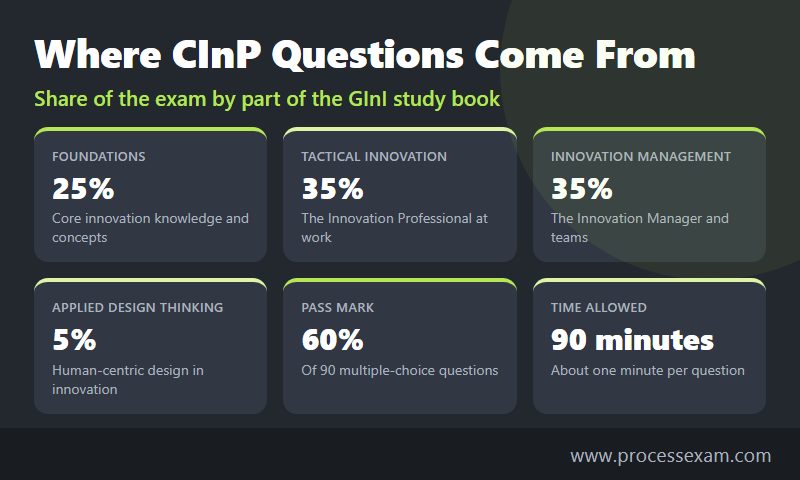
| Part of the study book | Share of exam | What to expect |
|---|---|---|
| Foundations: core innovation knowledge and concepts | 25% | Types and scales of innovation, innovator profiles, creativity and brainstorming, how projects run |
| Tactical innovation and the Innovation Professional | 35% | The breakthrough method, research and insights, futuring, design thinking in practice |
| Innovation management and the Innovation Manager | 35% | Teams, the management process, engagement, open innovation, storytelling, idea selection |
| Applied design thinking | 5% | The stages of design thinking and where prototyping fits |
The two big parts
Tactical innovation and innovation management together account for 70% of the paper. They are also the areas where a mock paper is most useful, because the questions describe situations: a team is moving a project out of the front end, a selection committee wants a pitch, an engagement programme is losing energy. You pick the best response, and the best response is the one that follows GInI's process.
The small part that still matters
Applied design thinking holds only 5% of the weight, so it should not take a quarter of your study time. Learn its stages and its purpose once, practise recognising them in scenarios, and move on. In a 90-question paper, 5% is only a handful of questions, while a weak 35% part can sink the entire result.
The chapters behind the percentages
GInI's content outline lists the topics by chapter. The first group covers what an Innovation Professional does, the fundamentals of business innovation, running innovation projects, the many forms that new outputs take, what makes an effective innovator, and creativity, ideation and brainstorming. It also includes the GInI breakthrough innovation method. Running projects is split into the front end, mid zone and back end of innovation. A research chapter follows, covering core concepts, problem and solution research, forward-looking methods, hard research and building an insights plan. Next comes design thinking and the role of design.
The management half begins with the Innovation Manager as project leader and as builder of a core team. It continues with the innovation management process, programme and project management tools, engagement, designing innovation spaces, open innovation, storytelling, selecting winning ideas and, finally, integration. Use that list as a checklist: for every line, you should be able to explain the idea in two sentences without opening the book. The overview of innovation management on Wikipedia is a neutral place to refresh the general vocabulary, though the exam itself follows GInI's own terms.
What does GInI's free 50-question mock show about the question style?
GInI publishes a mock exam in its resource centre. The version available in October 2026 is labelled V1.3 and holds 50 questions with four options each, followed by an answer key. It is about half the length of the real paper, so treat it as a sample of the style, not a full rehearsal. You can download it from the GInI CInP mock exam link.
The order follows the book
The questions run in the same order as the textbook. The opening group asks about the strategies an Innovation Professional develops for each concept, the four types of business innovation, the three scales of innovation, and the elements of brand innovation. The next group moves to personality and brain dominance, de Bono's six hats, and how big a brainstorming group should be. After that come the front end, mid zone and back end, research and futuring, design thinking, the Innovation Manager's roles, engagement, open innovation and crowdsourcing, and finally programme tools such as product roadmaps and phase-gate reviews.
That ordering is a gift for planning, because a miss in question 12 points straight to the creativity chapter and a miss in question 41 to the engagement chapter. On the real exam the guidebook says questions appear in random order, so do not expect the same neat sequence on the day.
What the wording tests
Most stems ask for a definition or a place in a framework: which phase of a project suits which thinking style, what a selection committee pitch relies on, what happens to a project that fails a gate review. The wrong options are usually plausible in everyday business, which is why familiarity with GInI's own terms decides the result. Several stems use fill-in-the-blank phrasing with four candidate phrases, so recognising exact vocabulary matters more than reasoning from first principles.
If you want more variety once the PDF is finished, the CInP sample questions on ProcessExam give you extra items to try before you commit to anything longer.
Treating the answer key with care
With a free mock, the answer key is the biggest trap. The temptation is to glance at it while working. Resist that: take the paper first, mark it afterwards, and only then read each explanation in the book. A paper whose answers you have already seen cannot measure anything, and fifty questions are too few to waste on a single attempt.
How do you turn one mock attempt into a study plan?
Think of a mock as a diagnostic, not a goal. The routine below works with GInI's free paper and with any longer set you use later.
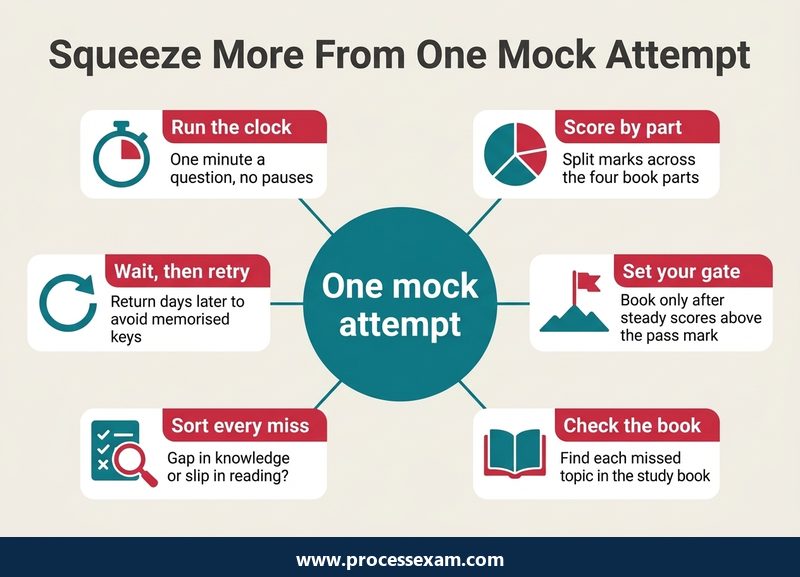
- Sit it under real conditions. Allow one minute per question, as the real exam does, close the book and silence your phone. The guidebook warns that the timer cannot be paused once the exam starts, so practise without stops.
- Score it by book part. Place each question under Foundations, Tactical, Management or Design Thinking. A total of 70% hides the fact that you might be at 90% in one part and 45% in another.
- Sort every miss. Ask whether it was a knowledge gap, a vocabulary gap or a reading slip. Each needs a different fix: study, flashcards, or slower reading.
- Return to the textbook, not the key. Find the exact page and write a two-line summary in your own words.
- Wait before you retry. A repeat after two or three days with the order shuffled tests memory of ideas, not memory of letters.
A four-week schedule
This plan assumes about six to eight hours a week, with the textbook already in hand.
| Week | Focus | Output |
|---|---|---|
| 1 | Foundations and creativity chapters | One-page summary of types, scales and innovator profiles; first half of the free mock |
| 2 | Tactical chapters: project phases and research | Diagram of front end, mid zone and back end with the research methods used in each |
| 3 | Management chapters | List of Innovation Manager roles, team mix, engagement mechanisms, open innovation and selection methods |
| 4 | Design thinking, integration and mocks | Two full timed attempts, error log by book part, final review |
Keep an error log with three columns: the question, why you missed it, and the page that fixes it. By week four, patterns in that log show you where the remaining marks are.
Once the free paper has nothing new to teach you, a larger bank of fresh items keeps the later attempts honest, and the CInP practice exam from ProcessExam can serve that purpose when you want extra timed sittings.
What score tells you it is time to book the exam date?
The pass mark is 60%, which on a 90-question paper means 54 correct answers. GInI does not publish a rule about what to score before applying, so any readiness threshold is a judgment call. A cautious rule of thumb is to wait until you score at least 75% on three separate timed attempts that used different questions, with no part of the book below 65%.
Why a buffer matters: a mock is taken in comfort, and the real paper arrives with nerves, a fixed clock and no chance to pause. Sitting just at 60% in practice leaves no margin for a bad hour. The extra distance also compensates for the fact that practice items are written by someone else and will not match GInI's real questions exactly.
Signs you are ready
- Your three most recent scores are within about five points of each other.
- You finish with ten minutes spare, rather than guessing the last dozen items.
- You can explain why each wrong option is wrong, not just why the right one is right.
- No part of the book is consistently below the others.
Signs you should wait
If your best score came on a paper you had already seen, if you cannot place misses in a book part, or if your marks swing by fifteen points between sittings, one more week of study costs far less than a retake. The retake itself is not free, and the guidebook allows only one half-price retake after a first failed attempt; later retakes are charged in full.
What happens on exam day, and what if you fail?
GInI's usual delivery is computer-based testing, with paper-based testing available only in limited circumstances on special request. The guidebook sets out the rules in plain language.
- The questions are multiple choice, and each has four options with one correct answer.
- The questions come in random order.
- There are no scheduled breaks, although you may take a break as needed; the timer keeps running.
- If your connection drops, you can resume where you left off, but the timer does not pause.
- You can move back to earlier questions to review your answers.
- The verdict, Pass or Fail, appears the moment you submit, and the digital certificate is expected within seven business days of passing.
Pacing the 90 minutes
Ninety questions in ninety minutes is one minute each. Use a simple rule: a first pass at about 55 seconds a question, flag anything that needs thought, and use the remaining time on the flagged items. Because you can navigate back, there is no reason to freeze on a single stem. Answer every question before you submit, because a blank can never score.
If the result is Fail
Use the diagnostic habits from the mock. Write down, while the memory is fresh, which areas felt weakest, then go back to those chapters. The guidebook says a first failed attempt can be retaken one time at half price, after which retakes cost the full fee. The retake price listed for this exam is USD 275, so confirm what GInI quotes your account before you re-enrol. Do not rebook straight away: a week or two of targeted study beats a quick second try.
Is the CInP worth keeping, and how do you renew it?
GInI positions the CInP as the entry point to its professional ladder. The certification page lists more advanced credentials beside it: Certified Design Thinking Professional, Certified Innovation Strategist, Certified Chief Innovation Officer and others. People who search for a certified innovation manager or officer will find those names there, and the CInP is the starting point for anyone with less than four years of total professional experience, according to the guidebook.
What the credential says to an employer
It shows that you have worked through a structured method for running innovation projects and programmes, rather than relying on instinct. It does not claim to certify creativity. The syllabus is about process: how an idea moves from research to pilot, how teams are formed, how engagement is sustained and how winning ideas are chosen. For a manager hiring an innovation lead, that shared vocabulary is the practical benefit.
Keeping the certificate current
The certificate is active for three years from the day you pass. To maintain it you need 45 Innovation Development Units (IDUs) in that period, or you can retake the exam before the cycle ends. Within six weeks of expiry you submit a continuation application, self-certify the units and pay the fee. GInI caps what each activity can contribute: up to 40 IDUs for continuing education, 30 for teaching or presenting, 30 for on-the-job projects and 20 for research and publishing. A lapsed certificate can be reinstated by retaking the exam, and re-examination requires waiting at least twelve months from your latest certification date.
Planning the units early
Because on-the-job projects count, an innovation strategy you draft or a lab you set up at work can earn credit. Log hours as they happen rather than reconstructing them in year three. Webinars and similar sessions are capped at 15 IDUs within the continuing education category, so mix courses, workshops and project work.
The decision to take the exam is personal. If your work involves innovation programmes, and your employer values a recognised framework, the fee and the textbook are a manageable investment. If you simply need creative techniques, a short course may serve you better. Whichever route you pick, begin with the free GInI mock, score it honestly and let the result set your plan.
Frequently Asked Questions
How many questions are on the CInP exam, and what is the passing score?
The CInP exam has 90 multiple-choice questions to finish in 90 minutes, and the passing score is 60%. Each question has four options with one correct answer, and GInI shows a Pass or Fail result as soon as you submit your answers.
Is the CInP exam easy?
It is a foundation-level professional exam, and the 60% pass mark is forgiving, but it is not a free pass. The questions follow GInI's own terms and process, so even experienced innovators miss marks on vocabulary. Candidates who study the textbook and sit timed mocks usually do well.
How much does the CInP exam cost?
The exam fee is USD 450 for GInI members and USD 550 for non-members. The retake price is listed at USD 275. Keeping the credential costs an IDU application fee of USD 75 for members or USD 125 for non-members each three-year cycle.
Who is eligible for the CInP exam?
You need one year of professional experience with a master's degree or higher, two years with a bachelor's degree, or four years with less than a bachelor's degree. GInI also requires proof that you own its Applied Innovation textbook, and some applications are audited.
Does GInI offer a free CInP mock exam?
Yes. GInI's resource centre has a CInP mock exam PDF, labelled V1.3 in October 2026, with 50 four-option questions and an answer key. It is shorter than the 90-question real paper, so use it to learn the question style and find weak areas.
- Professional Certification |
- GInI Innovation Professional Test Questions |
- CInP Question Bank |
- GInI Certified Innovation Professional (CInP) |
- Innovation Professional Simulator |
- Innovation Professional Mock Exam |
- GInI Innovation Professional Book |
- Innovation Professional Certification Cost |
- Innovation Professional Certification Requirements |
- GInI Certified Innovation Professional |
- GInI Innovation Professional Sample Questions |
- CInP Exam Questions Download |
- CInP Test Questions |
- Innovation Professional PDF |
- CInP Body of Knowledge (BOK) |
- GInI CInP BOK PDF


