
Change Management Foundation Exam: CM3 Syllabus, Format and Study Plan
Updated on 9 October 2026. What’s new: now follows APMG's third-edition CM3 syllabus, launched in April 2024, with five topic areas
Anyone still revising from 2015-era notes should check the date first. APMG launched the third edition of its Change Management qualification, known as CM3, in April 2024, and at the time of checking in October 2026 the Foundation paper is 50 multiple-choice questions, closed book, in 40 minutes, with 25 marks needed to pass. This guide covers the current syllabus, the format and a study plan.

The Foundation level is the entry point to APMG's change management route, and it is also the gate to the Practitioner exam. People often treat it as a light test of vocabulary. It is not quite that. The questions are short and straightforward, but they check whether you understand why a model or a role exists, so a candidate who has only memorised a list of terms tends to hesitate. The sections below explain what the paper asks, how to organise the weeks before it and how to spend the 40 minutes.
Which edition of the Change Management Foundation syllabus is the current one?
The current one is the third edition, CM3. APMG's exam guide states that it focuses on the new third edition of the qualification, launched in April 2024, and that the exams are built on a study guide written specifically for the course. That study guide is not sold to the public. It is released as a digital or printed copy to candidates who are registered for the exam, either through a training organisation or through self-study registration.
This matters because a large share of the study material on the internet describes the earlier edition. Older write-ups of the Foundation level group the content under four headings: change and the individual, change and the organisation, communication and stakeholder engagement, and change management practice. CM3 reorganises the same territory into five topic areas, described in the syllabus section below, and adds themes such as agile thinking, insights from neuroscience into how people respond to change, and change analytics.
Two practical consequences follow. First, if a course or a book you are about to buy does not mention CM3, ask the provider which syllabus it follows. Second, a practice question that refers to a topic you cannot find in the five areas below is probably a leftover from the earlier edition, and you should treat it with caution. APMG also reports that the third edition is available in English, Brazilian Portuguese and Spanish, with a Polish translation in progress, so the language you need may limit which papers you can book.
The qualification was developed in partnership with the Change Management Institute, and APMG's certification page says successful candidates can claim two months of free Change Management Institute membership and that the qualifications offer a route towards independent accreditation by that body. You can read the details on APMG's Change Management certification page. This article was checked against that page and against APMG's exam guide in October 2026; always confirm the live details before you book.
How is the Foundation exam set out: questions, time, fee and pass mark?
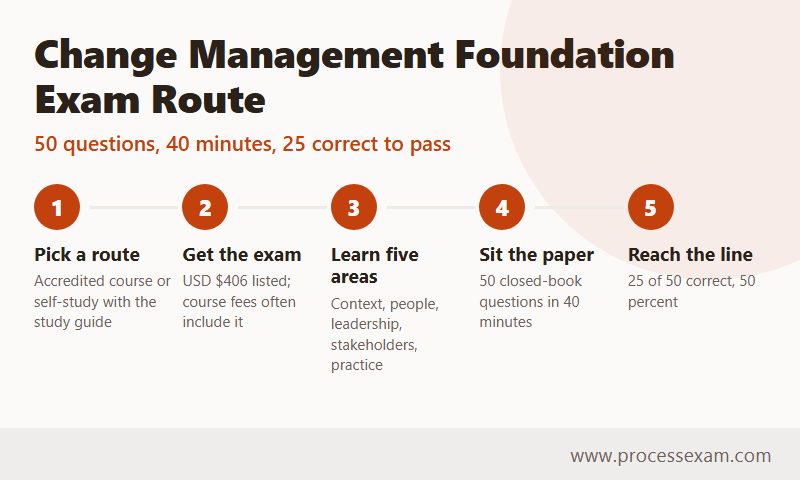
The facts fit in one table. APMG's exam guide confirms the 50 questions, the 40 minutes and the pass mark of 25.
| Exam detail | Change Management Foundation |
|---|---|
| Full name | APMG International Change Management - Foundation |
| Exam code | Change Management Foundation |
| Vendor | APMG International |
| Number of questions | 50, multiple choice |
| Duration | 40 minutes |
| Passing score | 50% (25 of 50) |
| Exam fee | USD $406 |
| Syllabus edition | CM3, third edition (April 2024) |
A few details sit around those numbers. The paper is closed book, so nothing from the study guide can be consulted. APMG says there are no trick questions, which means that if an answer looks simple, it is probably simple. Wrong answers do not lose marks, so every question deserves an answer. The exam can be taken on paper at a training course or on screen, and for self-study candidates it is taken online with a remote invigilator watching through the webcam and microphone.
The fee deserves a note. APMG says that when the exam is part of a course from an Accredited Training Organisation, it is normally included in the course price, and that self-study prices are published on its public exam booking site. Because a course fee and a stand-alone exam fee are different things, compare the total cost, not only the exam line. The APMG public exam booking site is where self-study candidates buy the exam.
What do the five CM3 syllabus areas ask you to know?
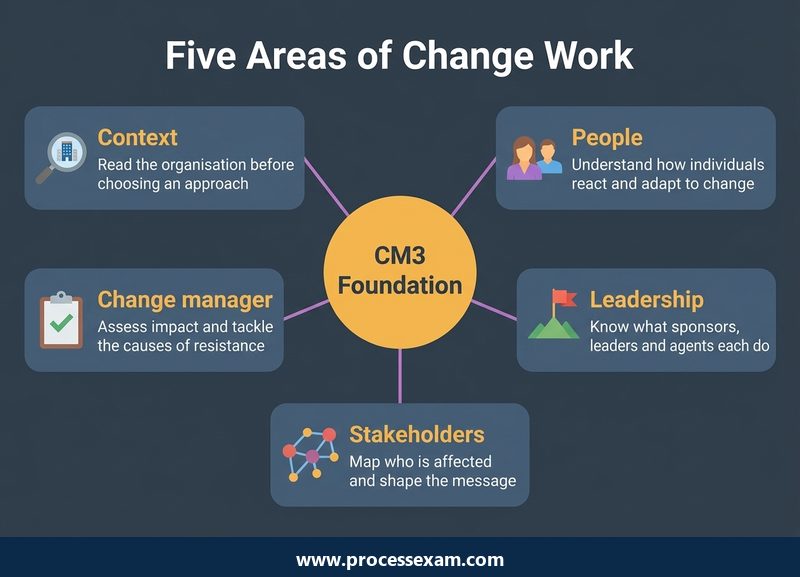
APMG's exam guide says the syllabus for both Foundation and Practitioner is built around five topic areas. The Foundation paper tests the base knowledge of each. The extra skills that APMG places at Practitioner level are noted below so you do not spend Foundation time on them.
1. Organisational context and approach
This area is about reading the situation before you act. You learn how to assess an organisation's circumstances and culture, and the reasons it might have for starting a change. It also covers well-known change approaches, the 'always on' pace of modern change, agile thinking, change strategy, delivery strategy and the relationship between change management and project management. A good test of readiness is whether you can explain, in two sentences, how a change manager's work differs from a project manager's, because that comparison is an easy source of questions. Co-design, co-creation and co-production belong to Practitioner level.
2. People and change
Here the focus is on how individuals react. Expect human responses to change, motivation and drive, resistance and resilience, with insights from neuroscience mixed in. There is also an introduction to learning and change, meaning how people's competence is built and kept. Candidates sometimes dismiss this area as soft, but it supplies a lot of definitions and models that the exam turns into short questions. Setting learning objectives, designing instruction, active listening and feedback are Practitioner topics.
3. Change leadership and teams
This area is about who does what. You learn what sponsors, line leaders, change agents and change managers each need to do for a change to work, the demands that change places on leaders, and how change teams are built, led and used. A reliable way to revise it is a role grid with the four roles down the side and three columns across: what the role decides, what it does day to day and what it must not leave to others.
4. Stakeholder engagement and communication
The area covers finding stakeholders, analysing their needs and influence, and building engagement with them. Communication runs through it: managing the change message, overcoming barriers, and appealing to both heads and hearts. Practise this with a real project at work. Pick a change you know, list ten stakeholders, rank them by influence and by how much the change affects them, then decide what each one needs to hear and from whom. The exercise teaches the logic that the questions test.
5. The work of the change manager
This is the practical area. It includes assessing the scope and severity of change impact, finding and addressing the causes of resistance, and the value of change analytics. The levers of change, critical mass and constructive handling of conflict are listed by APMG as Practitioner content. Because the Foundation exam is closed book, you need to hold the vocabulary of impact assessment in your head, not look it up.
APMG does not publish a per-area question split for the Foundation paper in the pages checked for this article, so do not plan your time around invented weightings. Give each of the five areas at least one full study session and spend extra time wherever your practice results are weakest.
What does a Foundation question look like, and how should you read it?
APMG's exam guide shows one genuine sample question, which is useful because it reveals the register. It asks what the objective of the 'change formula' by Beckhard and Harris is, and offers four options: to calculate the cost and benefit of a change, to identify areas to focus on to increase motivation for change, to help create detailed plans for a change initiative, or to identify skills and training requirements. The option that fits the formula is the one about finding where to focus to raise motivation for change, because the formula weighs dissatisfaction, vision and first steps against resistance.
Look at how that question is built. It does not ask you to recite the formula. It asks what the formula is for. The three wrong options each describe a different tool that a change manager might use: a business case, a project plan and a training needs analysis. This pattern repeats across the syllabus, so for every model you study, write down three things: what it is for, what it is not for and which other tool it is most often confused with.
A reading routine for the 40 minutes
- Read the stem and decide what kind of thing is being asked for: a purpose, a role, a definition or a next step.
- Cover the options and form your own answer in a few words before reading them.
- Eliminate options that describe a different tool or role from the one the stem names.
- If two options remain, choose the one that is more general in purpose; Foundation questions tend to test the main idea, not an edge case.
- Mark an answer and move on; you cannot lose marks for guessing.
The paper has 50 questions in 40 minutes, so you have under a minute for each. APMG's own pacing advice is to be a quarter of the way through the paper after a quarter of the time and halfway through at the halfway point, which keeps the second half from being rushed. If you write answers on the question paper before copying them to an answer sheet, leave time to transfer them, because only the marked answer sheet is counted.
Should you take a course or study alone with the study guide?
Both routes are open, and the exam is the same either way. APMG says most people learn through an Accredited Training Organisation, and that a typical course lasts three days for Foundation and two for Practitioner. These courses are often built to take you from Foundation to Practitioner and include both exams, although some teach the levels separately. You can attend in a classroom, in a virtual classroom or by self-paced e-learning.
Choosing a course
APMG reviews its accredited organisations regularly, checking that their candidate support is reliable, their course materials cover the syllabus fully and their trainers are accredited both as trainers and for their knowledge of the syllabus. Within that framework, courses differ in format, group size and any specialist emphasis, so ask each provider three questions: which edition of the syllabus it teaches, whether the exam fee and a resit are included, and how soon after the course the exam takes place.
Choosing self-study
For self-study you buy the exam first. APMG then emails instructions for reading the study guide online or downloading a copy. Its Spanish-language exam guide adds that you have up to twelve months from the purchase date to study the guide and take the exam; check the current period when you register. Because the exam is delivered online with a remote invigilator, you can book it at any time of day, any day of the week, once you have access to the candidate portal. Self-study suits you if you already work in change, you read well alone and you can keep a routine without a trainer. It suits you less if you want group discussion of case examples, which many people find helps with the stakeholder and leadership areas.
APMG also provides a free, automatically marked Change Management sample exam. Take it early, not on the last evening, because it shows how the paper is worded and where your gaps are while there is still time to fix them.
How long does preparation take when you also have a full-time job?
There is no APMG rule on study hours, so the plan below is a suggestion. It assumes about five hours a week and that you are not starting from nothing: you have been near a change project at work. If the vocabulary is entirely new, stretch each block by a week. If you are finishing a three-day course, use the plan after it, to consolidate.
| Week | Focus | What to finish |
|---|---|---|
| 1 | Organisational context and people | Read both areas once; build a one-page sheet of models and what each is for; take the free sample exam cold to find your baseline |
| 2 | Leadership, stakeholders, change manager's work | Read the other three areas; complete the role grid and the stakeholder exercise on a real change at work |
| 3 | Recall | Close the study guide and write the model sheet from memory; correct the gaps; do a first timed set of practice questions |
| 4 | Timing and weak spots | Two timed 50-question sets in 40 minutes; log every wrong or guessed answer by area; revisit those areas only |
Three techniques make the time count. The first is retrieval: rather than rereading, close the book and write down everything you remember about each area, then check. The second is the error log, a simple list of every question you missed with the reason, such as confused two models, misread the stem or did not know the term. After two practice sets, patterns show up and they tell you where the next study session should go. The third is teaching: explain the change formula, the roles of a sponsor and a change agent, or a stakeholder map to a colleague. If you cannot do it simply, you do not yet know it well enough for a closed-book paper.
Practice material is most helpful when it matches the current edition. A full-length set such as the Change Management Foundation practice exam lets you rehearse the 50-question, 40-minute format, and you should read each explanation, including those for questions you got right, to see why the other options fail.
What should the final week and the exam itself look like?
The last week is for consolidation, not for new reading. By now you should have covered all five areas at least once and taken at least one timed set.
Seven to three days out
Take one full timed set and sort the misses by syllabus area. Spend the next days on the area with the most misses, using the study guide and your own sheet instead of more questions on the same topic; repeating questions on a weak area often repeats the same misunderstanding. Then take a second timed set on fresh questions and compare. A shorter error list is the sign that your plan is working. A full-length paper from the exam store is one way to get fresh questions for that second attempt.
The day before
Read your one-page sheet and the error log, check your exam time and the delivery format, and stop. For an online exam, test your webcam, microphone and connection, and clear the desk and room as the invigilator will ask. A rested candidate reads short questions more accurately than a tired one who studied late.
During the paper
- Keep your eye on the clock using the checkpoints above and answer every question, since a blank cannot score.
- Trust the plain reading. APMG states there are no trick questions, so do not hunt for hidden meaning in a simple stem.
- Avoid changing answers without a reason. APMG's guidance is that unless you spot a clear slip, your first answer is probably the right one.
- If you work on a paper copy, transfer answers to the answer sheet with time to spare, because only the sheet is marked.
After the exam
APMG says that for paper-based Foundation exams, results can often be marked on site immediately, especially on a training course. For online exams, provisional results appear at the end of the session and are normally confirmed within two working days. If you do not pass, a resit can be arranged through your training organisation or APMG regional office, and a fee may apply; self-study candidates buy a new exam. Check the current rules on APMG's pages rather than assuming a free retake.
What does the Foundation certificate open up for a change career?
It gives you a shared vocabulary and independent proof that you know the principles, and it is the required step towards the Practitioner level. APMG describes Foundation as the check on what you know and understand, and Practitioner as the check on whether you can apply that knowledge to a real situation. The Practitioner paper is longer, built on a short written scenario and, unlike Foundation, lets you consult the study guide.
APMG's page names the people it is aimed at: current and aspiring change managers, project managers and their teams, professionals who regularly work around change, such as those in HR, communications and learning and development, and managers who lead teams through change. For someone in that last group, the exam is rarely about a job title. It is about being able to say what you will do with a team through a change, using terms that colleagues and sponsors recognise.
The credential also has limits worth knowing. A Foundation certificate shows knowledge; it does not show that you have run a change. Employers who hire change managers usually look for evidence of delivery as well, so pair the certificate with a short account of a real change you supported: what shifted, who was involved and what you measured. If you intend to follow the Practitioner route, ask your training organisation about a combined course, because it may be packaged more cheaply than two separate bookings. And since the Change Management Institute is a partner of the qualification, its membership and accreditation route are worth looking at once you pass.
Keep your expectations realistic. No salary figure is quoted here because APMG does not publish one and the pay for change roles varies widely by country and sector. What the certificate can do is widen the conversation: it makes it easier to move from supporting a project to leading the people side of one.
Frequently Asked Questions
How many questions are on the Change Management Foundation exam?
The Foundation paper has 50 multiple-choice questions and is taken closed book in 40 minutes. APMG sets the pass mark at 25 correct answers, which is 50%. There are no trick questions, and a wrong answer does not lose marks, so answer every question.
What is the pass mark for Change Management Foundation?
The pass mark is 50%, which means 25 of the 50 questions must be answered correctly. APMG confirms this in its exam guide. The paper is closed book, so you cannot refer to the study guide, and you have 40 minutes to finish.
How much does the Change Management Foundation exam cost?
The exam fee listed for Change Management Foundation is USD $406. Prices differ by route: APMG says exams taken on an accredited course are normally included in the course fee, and self-study prices are published on its public exam booking site, so check both before you buy.
Which version of the Change Management exam is current?
The current version is the third edition, CM3, which APMG launched in April 2024. Its Foundation and Practitioner exams share five syllabus areas and are based on a study guide written for the course. Check that any course or book you buy follows CM3, not the earlier edition.
Do I need Foundation before the Practitioner exam?
Yes. Foundation is the first level and the route to Practitioner. Foundation tests what you know and understand, while Practitioner tests whether you can apply it to a scenario. Many accredited courses cover both levels and include both exams, so ask your training provider how they are packaged.
- APMG International Change Management Foundation Exam Questions |
- APMG International Change Management Foundation Study Guide |
- Change Management Foundation Certification |
- Change Management Foundation Certification Cost |
- Change Management Foundation Certification Requirements |
- APMG International Change Management Foundation Level Question Bank |
- APMG International Change Management Foundation Level Book |
- APMG International Change Management Foundation Level Study Guide |
- Change Management Foundation Level Certification |
- Change Management Foundation Level Certification Cost |
- APMG International Change Management Foundation Sample Questions |
- Change Management Foundation PDF |
- APMG International Change Management Foundation Level Exam Questions |
- APMG International Change Management Foundation Level Sample Questions |
- Change Management Foundation Level PDF |
- Change Management Foundation Practice Test |
- Change Management Foundation Exam Questions Download |
- Change Management Foundation Test Questions


