
CCRM Certification: Is Credit Risk Experience Enough?
Years in a credit team do not guarantee a pass on PRMIA's CCRM, because the exam samples the whole credit and counterparty field, not the corner you work in. It has 60 multiple-choice questions in 120 minutes, and you need 60% to pass. Most analysts are strong on two or three of its six areas and rusty on the rest, so this guide maps the gaps.
The Credit and Counterparty Risk Management certificate from the Professional Risk Managers' International Association (PRMIA) is aimed at people already working in risk. That is exactly why it surprises them. Experience teaches you your own book, your own systems and your own bank's habits. The exam asks what the discipline says, in every area, and it asks it in a form where four answers look plausible. In October 2026 PRMIA's CCRM page still showed enrolment open and carried no retirement notice, so this is a live credential and the figures below are current.
Why can years in a credit team still leave gaps on the CCRM?
Because jobs are narrow and syllabi are wide. A relationship-side credit analyst may spend a decade on classic corporate credit analysis and never price a credit derivative. A model validator may know probability of default models in detail and never negotiate a netting agreement. A collateral manager may know margin calls better than anyone and never see a securitization waterfall. Each of them is an expert, and each of them would find at least one area of the CCRM unfamiliar.
PRMIA's candidate guidebook says the certificate is intended for people with at least two years in a risk-related role in financial services, and it names credit risk staff, financial controllers, operations and technology managers, and compliance and legal officers as the relevant audience. That is a mixed room. A controller who has never underwritten a loan and a credit officer who has never read a CVA report can sit the same paper, and the paper does not bend to either of them.
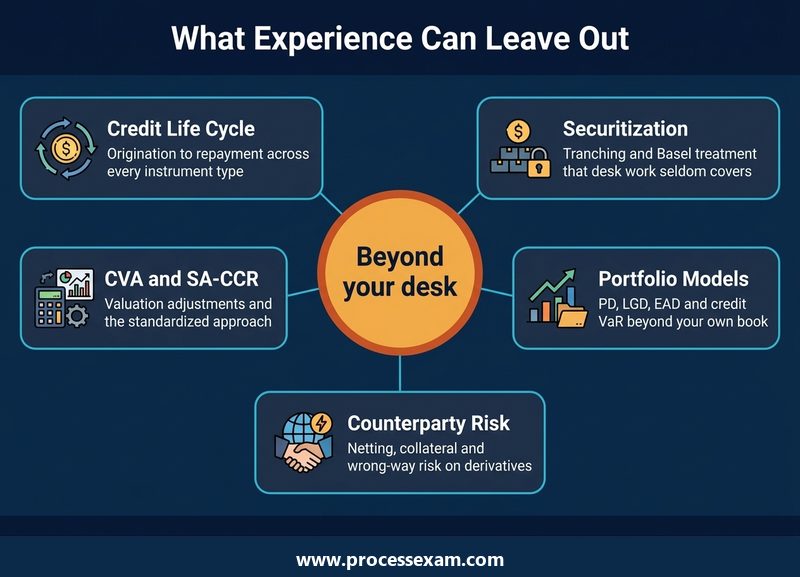
Three kinds of knowledge experience rarely gives you
Breadth. Your employer decides which products you meet. The exam does not. Structured credit, credit derivatives and central clearing appear whether or not your desk touches them.
Method over habit. Work teaches shortcuts: the internal rating scale, the house limit framework, the template in the credit paper. The exam asks for the underlying method, such as how expected loss is built from three inputs or how an exposure profile becomes a valuation adjustment. When the house habit and the method disagree, the exam follows the method.
Current regulation. PRMIA's guidebook says credit and counterparty risk have changed with the latest Basel Accord, and the syllabus names the move to the standardized approach for counterparty credit risk, known as SA-CCR. If your institution still runs an older exposure method, you may have never needed to learn the new one.
What experience does give you
It would be wrong to swing the other way. Real exposure to a credit committee, a distressed borrower or a margin dispute makes the scenarios in the case-study section easier to read, and it makes the definitions stick. Candidates with hands-on exposure often need less memorisation and more filling of holes. The gaps are specific, and that is good news, because specific gaps can be closed in a few weeks.
Which of the six CCRM exam areas does everyday work cover, and which does it skip?
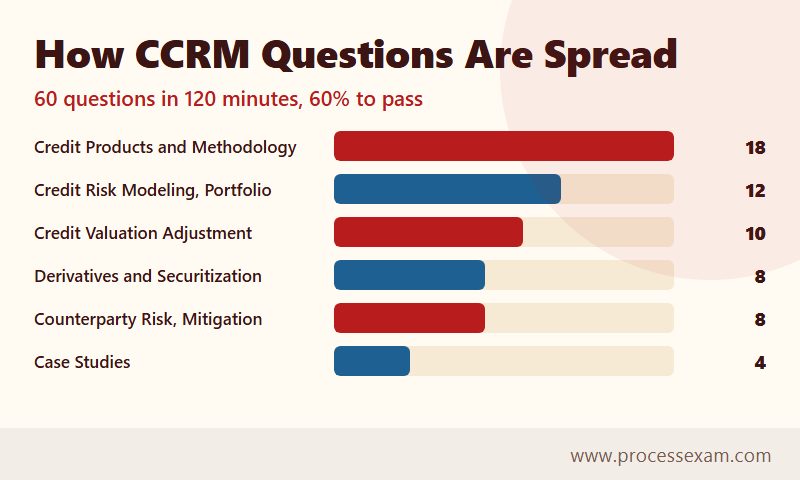
PRMIA's guidebook divides the 60 questions into six rows, five topic areas and one block of case studies. The table sets each row beside the kind of job that usually covers it and the kind that usually does not. The right-hand column is a reading of the syllabus, not a statistic, so use it to decide where to start rather than to rule anything out.
| Exam area | Questions | Jobs that meet it daily | Where it is often new |
|---|---|---|---|
| Classic credit products, life cycle and credit risk methodology | 18 | Credit analysts, relationship and underwriting teams | Controllers, operations and technology staff |
| Credit derivatives and securitization | 8 | Structured credit, trading and treasury support | Most retail and corporate lending roles |
| Credit risk modeling and portfolio management | 12 | Model developers, validators, portfolio managers | Front-line analysts who only use the model output |
| Counterparty risk and risk mitigation | 8 | Derivatives credit, collateral and legal teams | Loan-only credit teams |
| Credit valuation adjustment (CVA) | 10 | XVA desks, market risk and finance teams | Almost everyone else |
| Case studies | 4 | Anyone who has read a case and weighed trade-offs | Candidates who skip the cases PRMIA publishes |
Two things stand out. The largest block, 18 of 60 questions, is the one most credit professionals expect, and it is where experience pays. But the next three areas together hold 30 questions between them, and they are the ones jobs rarely cover. The 36 marks you need to pass are therefore more reachable by closing the gaps in modeling, counterparty risk and CVA than by polishing the area you already know.
Classic credit products, life cycle and methodology
The syllabus asks you to describe the whole credit life cycle from origination to repayment, to recognise the main credit instruments with their building blocks and users, and to apply classic credit risk methodology to credit analysis. This is the comfortable area for lenders, and the trap is overconfidence. Expect questions that name an instrument and ask who typically uses it or what risk it carries, not only questions about how to read a balance sheet. PRMIA's guidebook also mentions environmental, social and governance credit instruments among the products holders should understand.
Credit derivatives and securitization
Eight questions cover how securitizations are created, which securitization instruments exist and how the latest Basel Accords treat them. Think of the chain from a pool of loans to tranches with different risk, then ask what that does to the credit risk each investor holds. A credit default swap is the simplest credit derivative: the buyer pays a periodic premium and receives a payment if the reference entity defaults. Make sure you can explain who is protected from what, and why the premium rises as the reference entity weakens.
Credit risk modeling and portfolio management
Here the syllabus names probability of default (PD), exposure at default (EAD), loss given default (LGD) and expected loss (EL), then credit value-at-risk models, the effect of the Basel Accords on modeling, and credit portfolio management. If you only consume model outputs, learn what each input means and how they combine. If you build models, make sure you can still explain them in words, because the exam rewards explanation and not code.
Counterparty risk and risk mitigation
Counterparty risk is credit risk on a contract whose value changes: the amount you stand to lose depends on market movements as well as the other side's default. This is why derivatives desks think about it differently from loan officers. The syllabus lists the basics of counterparty risk, risk appetite, and the tools and methods used to mitigate credit risk, which in practice means netting, collateral and limits.
Credit valuation adjustment and the standardized approach
Ten questions sit under CVA. The reading list covers XVA items, meaning credit valuation adjustment, debit valuation adjustment and funding valuation adjustment, then non-traditional aspects of trading derivatives, right-way and wrong-way risk, the role of central clearing counterparties and SA-CCR. CVA is the price of counterparty credit risk, and Wikipedia's article on credit valuation adjustment is a quick neutral way to see how it is defined before you open the PRMIA text. The syllabus page on ProcessExam lists the same objectives in a CCRM syllabus outline that you can tick off.
Case studies
Four questions rely on case studies that PRMIA publishes on its exam preparation resources page. They are the cheapest marks on the paper for anyone who bothers to read them in advance, and the most easily skipped.
How is the CCRM exam run, and what does it cost?
The exam is taken on a computer, and each item offers four answer choices of which exactly one is right. PRMIA contracts Pearson VUE to deliver it, either at a test centre or by online remote proctoring, and the exam is offered in English only. The facts are below, with the fee quoted exactly as it is listed.
| Exam detail | CCRM |
|---|---|
| Certificate | PRMIA Credit and Counterparty Risk Management (CCRM) |
| Vendor | PRMIA |
| Number of questions | 60 |
| Duration | 120 minutes |
| Passing score | 60% |
| Fee (USD) | Sustaining Member Price - $549 Contributing Member Price - $572 Non-member Price - $599 |
| Delivery | Pearson VUE, test centre or remote proctoring |
PRMIA's guidebook turns the 60% pass mark into a number: 36 of 60 questions correct. Two hours for 60 questions leaves two minutes a question, which is generous. The paper rewards careful reading more than speed, and you can flag an item and come back to it before the clock runs out.
What the fee buys and how the enrolment window works
PRMIA's guidebook describes a program fee that includes the exam authorization and a digital copy of the required textbook, Practices for Credit and Counterparty Credit Risk Management. The enrolment period is 12 months from the day the fee is paid, and the exam must be attempted inside that window. Sustaining members receive member pricing, which explains why the fee has three tiers. PRMIA's candidate guidebook sets out these rules, so read it before you pay and check the current price on PRMIA's own enrolment page, because fees can change.
Booking, rescheduling and results
After you pay, PRMIA sends an email within two or three business days with instructions to reach the textbook and book the exam. You then create or reuse a Pearson VUE account whose profile details match your PRMIA profile exactly, because that match links the two records. You can move an appointment without charge if you cancel at least one business day before it; leave it later and the fee is forfeited. Results normally arrive within 15 business days of the test date, by email from PRMIA, and the digital certificate follows a pass.
Tools in the room
An online scientific calculator is built into the test system, but PRMIA says it is not required, and no other materials may come into the room. Practise the arithmetic you will actually meet by hand, and use the built-in calculator only for multiplication chains. Pearson VUE keeps its own booking pages and identification rules at its PRMIA exam page, which is worth reading a week before the date.
If the first attempt does not go well
A candidate who fails must wait 90 days from the date of the failed exam before sitting again, and a retake needs a new exam authorization. PRMIA's pages quote the retake price differently from one document to the next and say members pay less, so confirm the current amount with PRMIA support before you plan around it. The 90-day gap is useful in itself: it is long enough to rebuild a weak area properly.
Do you need two years of experience before you can enrol?
No. This is the most common misreading of the guidebook. PRMIA describes the certificate as intended for people with at least two years of risk-related experience, but the stated prerequisite for enrolling is only an account with PRMIA. PRMIA adds that you can enrol and earn the certificate without paying for membership, though candidates must commit to PRMIA's standards of best practice, conduct and ethics, which the exam does not assess.
So the rule runs one way. Experience is a recommendation that helps you pass; the account is the requirement that lets you start. A graduate with no risk job could enrol, read the textbook and pass, and a ten-year veteran could enrol and fail. What changes is how much work lies ahead of each of them.
A quick self-check before you pay
Write down, from memory, one sentence for each of the following: how a securitization transfers credit risk; what the three inputs of expected loss are; why a derivative's counterparty exposure can be zero today and large next year; and what a CVA charge represents. If you can write all four with no hesitation, you are probably past the halfway mark. If two or more leave you blank, plan for the full three-month routine described later.
Which calculations should you be able to do without a template?
The exam is multiple choice, but several questions turn on a small calculation or on knowing the form of a formula. These four examples use invented round numbers to show the logic, not real market data, and are good warm-ups. Ignore the figures and keep the structure.
Expected loss
Expected loss equals probability of default multiplied by loss given default multiplied by exposure at default. With a one-year PD of 2%, an LGD of 45% and an EAD of 10,000,000, the expected loss is 0.02 x 0.45 x 10,000,000 = 90,000. The exam may give you three numbers and ask which combination changes the answer most, or it may give you the result and ask for a missing input.
Netting
Suppose you hold two trades with the same counterparty under a legally enforceable netting agreement: one is worth +8 million to you and the other -5 million. With netting the exposure is the net 3 million. Without netting you would count each positive value separately and the exposure would be 8 million. The difference of 5 million shows why legal certainty over netting is a risk-mitigation topic and not paperwork.
A simple CVA estimate
One common approximation is CVA = LGD x the sum of expected exposure at each date x the probability of default in that period, ignoring discounting. With three periods, expected exposures of 4 million, 5 million and 3 million, a 1% default probability in each period and an LGD of 60%, the sum of exposure times probability is 40,000 + 50,000 + 30,000 = 120,000, and CVA is 0.6 x 120,000 = 72,000. The point to remember is that exposure and default probability multiply, so a rising exposure profile and a worsening credit both raise the charge.
SA-CCR in one line
Under the standardized approach the exposure at default is built as a multiplier, called alpha, times the sum of a replacement cost and a potential future exposure. Alpha is set at 1.4 in the Basel rules, so a replacement cost of 2 million and a potential future exposure of 3 million would give 1.4 x 5 million = 7 million. You will not need to compute the full add-on, but you should understand why the framework separates what a trade is worth today from how much it could be worth later.
Wrong-way and right-way risk
Wrong-way risk means exposure to a counterparty grows just as that counterparty becomes more likely to default, such as a bank buying protection from a firm that is itself exposed to the same event. Right-way risk is the opposite relationship. Both appear in the CVA reading, and both are easier to remember through one concrete example each than through the definition.
How do you fit CCRM study around a full working week?
PRMIA's FAQ suggests about four hours a week for three months, which is roughly 50 hours in total. Treat that as a starting figure for someone new to most of the material, and trim it if the self-check above went well. A working analyst has little spare time, so the routine below uses what you already have: a commute, a lunch break and one longer weekend session.
A routine in three blocks
Weeks one to four: build the frame. Read textbook chapters 1 to 6, which PRMIA maps to the first three areas: chapters 1 to 3 for classic credit, chapter 4 for securitization and chapters 5 and 6 for modeling and portfolio management. After each chapter, write five lines in your own words. Do not copy the text. If you cannot explain a section simply, you have not learned it yet.
Weeks five to nine: attack the gaps. Chapters 7 and 8 cover counterparty risk and mitigation, and chapters 9 to 11 cover CVA and the standardized approach. These carry 18 questions between them, and most candidates need the most time here. Redo the four calculations above with different numbers each week until they feel dull.
Weeks ten to twelve: test under pressure. Read the published case studies, take timed practice sets and review every miss by area. A CCRM practice exam from ProcessExam is one way to rehearse the 60-question format and show which of the six areas your day job has left thin. Keep a short error log, and when the same area appears three times, go back to the text and not to more questions.
Using your own job as study material
You have a source most candidates lack. When a chapter introduces an exposure measure, find where your institution reports it. When the text describes a mitigation tool, look at one real agreement or limit. Connecting each topic to one real document you have seen makes it memorable, and it shows you quickly which areas you have never touched, which are the ones to spend extra time on.
Reading list by area
PRMIA's syllabus appendix maps each exam area to textbook chapters: chapters 1 to 3 for classic credit and methodology, chapter 4 for credit derivatives and securitization, chapters 5 and 6 for modeling and portfolio management, chapters 7 and 8 for counterparty risk and mitigation, chapters 9 to 11 for CVA and the standardized approach, and the published case studies for the final four questions. Use it as a checklist. A candidate who has read an area's chapters twice and can explain them aloud is in better shape than one who has skimmed everything once.
What does the certificate add once your CV already shows the experience?
It adds a neutral statement that you know the whole subject, from an independent body, in a form a recruiter outside your firm can read. Experience is evidence only to people who can see inside your employer; the certificate travels. It can help most when you change sector, move from a loan book to derivatives, or apply to a firm that has never heard of the one you work for.
What it is, and what it is not
PRMIA's FAQ says plainly that the CCRM is a certificate and not a professional designation, and that passing does not grant the PRM title or exemptions from the PRM exams. It is built on elements of the Professional Risk Manager designation, so it can be a stepping stone toward it. There are no recertification requirements: holders are expected to keep to PRMIA's ethics standards, and the guidebook says there are no maintenance requirements.
Roles it supports
The certificate suits credit risk analysts, counterparty risk managers, portfolio risk staff and anyone in controllership, operations or compliance who needs to talk credit with the front office. It does not replace the track record that gets you promoted. Think of it as the document that makes your experience easier to trust. No salary uplift is quoted here, because there is no reliable figure that isolates this certificate from the job and the seniority of the person holding it.
When it may not be worth it
If you are already a PRM holder, or if your employer's own training already covers all six areas to a recognised standard, the extra credential may add little. If your role is entirely outside financial services, the content will be interesting but may not change your prospects. Decide by asking what a specific employer you want to reach would recognise, and then decide whether you are choosing the certificate for the knowledge, which is real, or for the signal, which depends on your audience.
Where to go next
Open PRMIA's CCRM frequently asked questions for the current rules on authorization, retakes and results, then read the guidebook once more with your own gap list beside it. A gap list and a calendar date are the two things that turn good intentions into a pass.
Frequently Asked Questions
How many questions are on the CCRM exam and how long does it last?
The CCRM exam has 60 multiple-choice questions and a time limit of 120 minutes. Every question gives four options with one correct answer. It is computer-based, available in English only, and delivered by Pearson VUE at a test centre or through online remote proctoring, so two minutes per question is the working pace.
What is the passing score for the CCRM exam?
The passing score is 60%. PRMIA's candidate guidebook states this as 36 correct answers out of 60. Results normally arrive within 15 business days of the test date and are shown in your PRMIA account. A candidate who fails must wait 90 days before sitting the exam again.
How much does the CCRM certification cost?
The fee is listed in three tiers: Sustaining Member Price - $549, Contributing Member Price - $572 and Non-member Price - $599, in US dollars. PRMIA's guidebook says the program fee includes the exam authorization and a digital textbook. Check PRMIA's enrolment page for the current amount before you pay.
Do you need work experience to take the CCRM exam?
No. PRMIA states that the only prerequisite is an account with PRMIA, and paid membership is not required. The certificate is intended for people with at least two years of experience in a risk-related role in financial services, but that is a recommendation rather than an entry rule.
Is the CCRM a professional designation like the PRM?
No. PRMIA describes the CCRM as a certificate, not a professional designation. Passing does not give you the PRM title or exemptions from PRM exams. There are no recertification requirements, though holders are expected to follow PRMIA's standards of best practice, conduct and ethics.
- Risk Management |
- CCRM Question Bank |
- CCRM Body of Knowledge (BOK) |
- PRMIA CCRM BOK PDF |
- CCRM Exam Questions Download |
- CCRM Test Questions |
- Credit and Counterparty Risk Management Mock Exam |
- Credit and Counterparty Risk Management Simulator |
- PRMIA Credit and Counterparty Risk Management Test Questions |
- Credit and Counterparty Risk Management Certification Cost |
- Credit and Counterparty Risk Management Certification Requirements |
- PRMIA Credit and Counterparty Risk Management Book |
- Credit and Counterparty Risk Management PDF |
- PRMIA Credit and Counterparty Risk Management Sample Questions


