
How to Prepare for the ASQ CCQM Exam: A Study Guide for Site Engineers
A site engineer who signs off pours, raises nonconformance reports and walks punch lists every week can still be caught out by the ASQ CCQM, because most of its scored questions ask you to design, evaluate or decide rather than recall. The exam is open book, has 165 questions, runs for 258 minutes and passes at 550/750. This guide shows which parts you already know from site work and which you have to learn on purpose.
Is the CCQM within reach if you are a site engineer or QA officer today?
Possibly, but check the experience rule before you buy a single book. ASQ's CCQM page sets an eight-year bar: full-time, paid work that touches the Body of Knowledge. Within that total, three years have to be spent in a decision-making position, meaning a role where you can shape, carry out or steer projects and processes and are accountable for how they turn out. One year of internship or apprenticeship time is allowed to count.
A qualification shortens the eight years, but only one waiver can be claimed. The middle column below is our own subtraction from ASQ's waivers, not a figure ASQ prints.
| If you claim this qualification | Experience you still need (our subtraction) | Years ASQ takes off |
|---|---|---|
| Trade or technical school diploma | 7 years | 1 year |
| Associate degree | 6 years | 2 years |
| Bachelor's degree | 4 years | 4 years |
| Master's or doctorate | 3 years | 5 years |
In every row, three of the remaining years must still be decision-making. That is where site staff most often come up short, because a degree-qualified engineer in year three may have done excellent work without ever owning a decision. Ask yourself whether you have written or approved an inspection and test plan, decided the disposition of a nonconformance, issued or lifted a stop-work notice, or chosen which subcontractor activities get a hold point. Those are the kinds of calls that show authority rather than participation.
If you are two or three years short, the Body of Knowledge still works as a career map. Read it now, take the decision-making jobs it describes when they come up, and apply when the years add up. Applications go through ASQ's certification application page, where the testing window is chosen at the same time.
What does the CCQM exam look like from the candidate's chair?
It is a single-part, multiple-choice paper in English, delivered on a computer. ASQ lists online remote-proctored delivery alongside test centres (checked October 2026). The paper carries 165 items in all. ASQ scores 150 of them and uses the other 15 as trial items, and nothing on screen marks which is which.
| Exam detail | ASQ CCQM |
|---|---|
| Exam name | ASQ Certified Construction Quality Manager (CCQM) |
| Exam code | CCQM |
| Vendor | ASQ |
| Number of questions | 165 in total, of which 150 are scored |
| Duration | Total appointment time- 270 / Exam Time - 258 |
| Exam fee | ASQ MEMBERS - $450 / NON-MEMBERS - $550 / RETAKES - $350 |
| Passing score | 550/750 |
| Format | Open book, multiple choice, English |
Spread across 165 items, the 258-minute clock leaves about ninety seconds each, and the remainder of the appointment goes on check-in and the tutorial. For a site engineer used to answering by looking at the work in front of them, the real adjustment is that every question describes a situation you cannot walk around. You decide from the wording alone.
ASQ's page gives the initial fee as $550 with a members' reduction, consistent with the two figures above. A retake is $350, so it is worth deciding early whether a slip would be your own preparation or a project milestone that you can plan around.
Which Body of Knowledge parts will feel like home, and which will not?
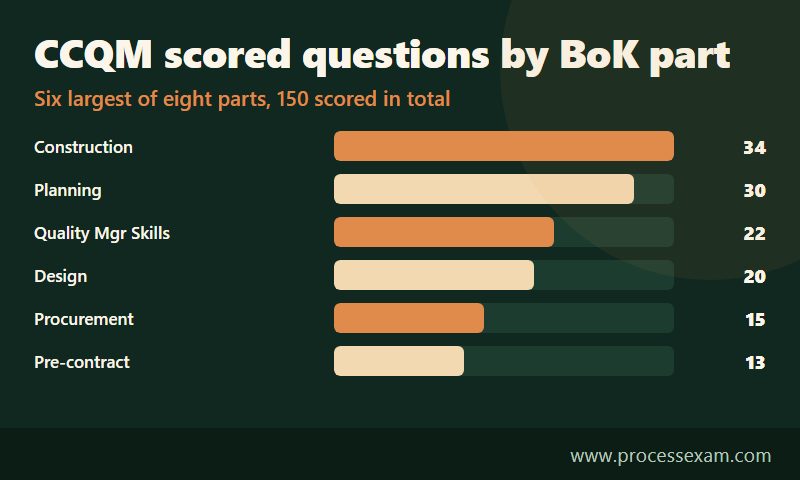
ASQ divides the 150 scored questions across eight parts. The table adds a last column that is only our reading of how much each part overlaps with ordinary site work, so treat it as a starting guess and replace it with your own.
| Body of Knowledge part | Scored questions | Share of 150 | Overlap with daily site work |
|---|---|---|---|
| I. Pre-contract Phase | 13 | 9% | Low |
| II. Planning Phase | 30 | 20% | Medium |
| III. Design Phase | 20 | 13% | Low to medium |
| IV. Procurement | 15 | 10% | Low |
| V. Construction | 34 | 23% | High |
| VI. Project Turnover and Closeout | 11 | 7% | High |
| VII. Operations and Maintenance | 5 | 3% | Low |
| VIII. Quality Manager Skills | 22 | 15% | Medium |
The shares are rounded. Our ASQ CCQM exam syllabus page lays the same eight parts out topic by topic if you want a working copy beside the BoK itself.
The two parts that reward what you already do
Construction is the largest part, and it reads like a list of your own paperwork: construction plans and specifications, permits, submittals (action and deferred or delegated), material evaluation, requests for information, field change requests and design change requests. It continues into risk-based inspection and testing, nonconformance reports, corrective action requests, CAPA, criteria for stop-work notices, destructive and nondestructive tests, laboratory accreditation, mock-up and punch-list inspection, and the five-level and eight-level commissioning frameworks.
Turnover and Closeout is the second easy win: demobilising quality resources, verifying quality deliverables, closing out nonconforming work, final certification at beneficial occupancy, substantial completion and final completion, and the handover pack of as-built drawings, operation and maintenance manuals, attic stock, commissioning reports, owner training material and warranties. Anyone who has chased a closeout pack knows this material.
The parts that read like another profession
Pre-contract is the commercial manager's world. The BoK names delivery methods such as design-bid-build, design-build, construction manager at risk and design, build, finance and maintain, contract families from AIA, DBIA and FIDIC, liquidated damages, payment mechanics such as schedule of values, retainage and guaranteed maximum price, and bid evaluation and prequalification, where audits feed the shortlist.
Planning moves from one inspection to the whole system: a project quality strategy with key performance indicators, environmental, social and governance practice (LEED, ENERGY STAR and Cradle to Cradle appear as examples), a quality management system tested against ISO 9001, ISO 10006, ISO 14001 and ISO 45001, the project quality management plan, resource mobilisation, training needs, third-party inspection, measurement systems analysis and audits.
Design, Procurement and Operations and Maintenance are the thin spots for most site teams. Design runs through inputs, the design process, outputs, quality controls in design, and measurement and monitoring. Procurement covers quality requirements, resource management, risk management and quality reporting. Operations and Maintenance covers sustaining quality requirements and business continuity, and with only five questions it is the cheapest part to skim.
Quality Manager Skills looks soft and is not. It holds the ASQ Code of Ethics, stakeholder analysis, team development stages, a responsible-accountable-consulted-informed matrix, change management, cost of quality, customer satisfaction and the seven classic quality tools. Site people usually know the tools by habit and the vocabulary by accident, so the wording of the questions can still surprise them.
Why do the verbs in the Body of Knowledge matter more than the topic names?
Every topic in ASQ's CCQM Body of Knowledge ends with a bracketed word: the highest cognitive level at which it can be tested. ASQ takes the scale from the revised Bloom's taxonomy and ranks it from Remember through Understand, Apply, Analyze and Evaluate to Create. The document is effective from February 2025.
We counted the descriptors across the 98 topic entries. The tally is ours, not ASQ's, and it is worth reading as a rough picture rather than a weighting:
| Cognitive level in the BoK | Topic entries (our count) |
|---|---|
| Remember | 0 |
| Understand | 8 |
| Apply | 18 |
| Analyze | 24 |
| Evaluate | 35 |
| Create | 13 |
Not one entry stops at recall, and 72 of the 98 sit at Analyze or above. In the Construction part, 11 of the 17 entries are marked Evaluate. In the Planning part, 10 of the 16 are marked Create. A candidate who has memorised the names of the documents has prepared for the wrong exam.
The practical consequence is that you study each topic by asking what the question would want you to do with it. The table translates four ordinary site habits into the way the exam is likely to frame them.
| What you do on site | What the exam asks you to do with it |
|---|---|
| Raise a nonconformance report | Design the system: who can raise one, how it is dispositioned, when it escalates to a stop-work notice, how CAPA is tracked |
| Witness a concrete or weld test | Judge when destructive or nondestructive testing is the right method and whether the tester and laboratory are accredited |
| Review a subcontractor submittal | Weigh it against the quality plan and the interdependency between trades before it is approved |
| Close the punch list | Decide what proves completeness of the quality deliverables and what final certification needs at each closeout stage |
Notice that none of these rows describes a different job. They describe the same job one level up, from doing the check to owning the rule behind it.
How should each site role build its own study plan?
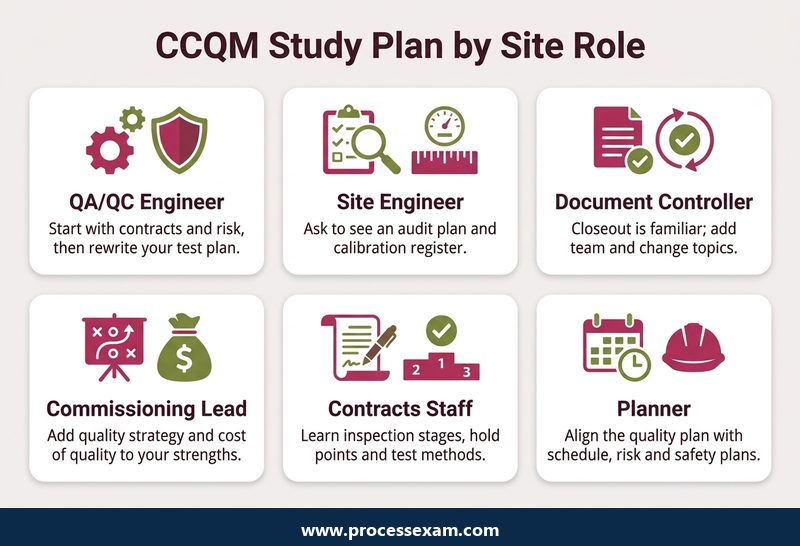
A plan that starts from the syllabus order wastes the strengths you already have. Start from your role, spend your first week on the parts that are new to you, and only then return to the familiar parts to sharpen the verbs.
QA/QC engineer or inspector
You are strong on Construction and Turnover and weakest on contracts and risk. Begin with Pre-contract, then Procurement, and read the payment documentation topics slowly: schedule of values, percent completion by cost or by work, retainage and billing terms. Then rewrite your own project's inspection and test plan as the Planning part would expect it, with a risk basis, stated priorities and criteria for changing them when scope moves.
Site or project engineer
You live in drawings, RFIs and method statements, so Design and Construction submittals come naturally, but audits, measurement systems and training plans may never have crossed your desk. Sit with your QA lead for an afternoon and ask to see an audit plan, a calibration register and a training matrix, then find the matching topics in Planning. Pay extra attention to constructability and functionality reviews in Design.
Planner, document controller or commissioning coordinator
Turnover, documentation and the levels of commissioning are likely your best ground. Your gaps are usually Quality Manager Skills and the Planning strategy topics. Practise explaining a quality plan in terms of how it aligns with the health, safety and environment plan, the communication plan, the schedule and the risk management plan, because the BoK asks for that alignment explicitly.
Commercial, procurement or contracts staff moving into quality
You will find Pre-contract and Procurement friendly and Construction foreign. Spend the most time on inspection stages (source, initial, intermediate and continuous), hold points, acceptance criteria for mock-ups and punch lists, and the difference between destructive and nondestructive testing. A site walk with an inspector will teach you more in an hour than a chapter will.
Whatever your role, give the weekly rhythm a fixed shape: one new part, one revision pass over an older part, and one set of scenario questions written in your own words. Ten to twelve weeks is a sensible frame for someone working full time. Shorten it only if your own review shows few unfamiliar topics.
Which references can you take in, and how should you prepare them?
Because the CCQM is open book, the reference stack is part of the preparation. ASQ's page lists the rules, and they are strict. All reference material, notes included, has to be bound and stay bound throughout the exam. ASQ counts a document as bound if it is stitched or glued, or held by a fastener that goes through every page: ring, spiral and snap binders, brads or screw posts. Hand-stapled sheets and loose pages are refused. Sticky notes count only as tabs on a book, and you must stick them on at home, not at the desk. The test centre administrator inspects everything before you enter the room, and programmable calculators such as the TI-89, unbound notes and wheel or slide charts are on the prohibited list.
The page does not name a mandatory textbook, so there is no single book to buy. What it does give you is the Body of Knowledge, and the BoK names the sources the questions draw on. A practical reference stack for a site candidate therefore looks like this:
- A printed Body of Knowledge, annotated. Number your notes against its parts and letters so you can jump from a question to the right entry.
- Your own one-page summaries. One page per topic, written as a decision rule rather than a definition, bound in a ring or screw-post binder.
- A glossary for the commercial vocabulary. Liquidated damages, liquidated and ascertained damages, general damages, guaranteed maximum price, retainage, schedule of values and the delivery-method acronyms are easy to forget and cheap to look up.
- Short notes on the standards the BoK names. ISO 9001, ISO 10006, ISO 14001 and ISO 45001 are listed, as is the PMBOK Guide. Write your own summaries of what each is for and how it relates to a project quality plan, and keep the standards themselves out of the room unless you hold a licensed, bound copy.
- Frameworks you can compare quickly. A side-by-side of the five-level and eight-level commissioning models, and the seven classic quality tools, make good single-page tables.
Build the stack early and study from it, so the tabs and index are your memory aids and not something you meet for the first time at the exam. A heavy stack is a trap: if you have to search for the answer to a question, you have already used up the ninety seconds the clock allows.
What traps catch first-time CCQM candidates?
Most traps come from site habits that are useful at work and harmful in this exam.
- Answering from your own contract. The question describes a delivery method and a standard; your answer has to fit that one, even if your employer works differently.
- Mixing up quality assurance and quality control. On site both are called "QA/QC" and are often one person. The BoK lists them as separate practices to develop, and questions test the difference.
- Trusting local vocabulary. Punch list, snagging and defects list are the same idea in different places, and the BoK uses the US terms; contract forms from AIA, DBIA and FIDIC are named on purpose.
- Reading a Create or Evaluate topic like an Understand topic. Rereading definitions will not help. Write short scenarios and decide what you would put in the plan, and why.
- Dismissing the ethics and team topics. The ASQ Code of Ethics is tested at Analyze, and team stages and RACI are named explicitly.
- Spending reference time on the 15 unscored items. You cannot spot them, so the only safe rule is the same effort on every question and a firm decision on any that need a long search.
- Treating the BoK subtext as optional. ASQ says the subtext is not all-inclusive, but it shows the kind of content the questions cover; candidates who skip it study a different syllabus.
Which testing window should you aim for, and how do you use the weeks before it?
ASQ runs computer-based windows through the year and publishes each window with an application deadline weeks earlier (checked October 2026). The next listed window is December 1 to 31, 2026, with an application deadline of November 9, 2026; later windows follow in February 2027 (deadline January 11) and April 2027 (deadline March 8). Work backwards from the deadline, not the window: eligibility has to be accepted before you can book.
For a candidate who needs the full frame, a sensible split is the first half on the parts that are new to your role, the next quarter on rewriting the stack and the summaries, and the last quarter on full runs with the references open. In the final week stop adding material. Tab the stack, check that every document is bound, and rehearse finding three random topics fast.
Once your notes are written as decisions, try them on realistic items. The CCQM practice exam is written to the 165-question format, so you can check whether you reason through the Analyze and Evaluate items the way the BoK expects, and then decide which window you honestly need.
Finally, a note on where this fits in a career. The credential does not replace site experience; it recognises that you can run the system around it. Used as a map, the Body of Knowledge tells you which jobs to ask for next: the contract review, the audit, the commissioning plan. Candidates who prepare that way usually find the exam is the smaller part of what they learned.
Frequently Asked Questions
Can a site engineer take the ASQ CCQM exam?
Yes, if the experience rule is met. ASQ requires eight years of paid, full-time experience in the Body of Knowledge, with at least three in a decision-making position. One education waiver can reduce the eight years: one for a trade diploma, two for an associate degree, four for a bachelor's degree, five for a master's or doctorate.
How many questions are on the CCQM exam, and what is the passing score?
The CCQM has 165 multiple-choice questions, of which 150 are scored and 15 are unscored. The listed exam time is 258 minutes inside a 270-minute appointment. The passing score is 550/750. The paper is computer-delivered and in English only, and ASQ does not tell you which items are unscored.
How much does the ASQ CCQM exam cost?
The fee is listed as ASQ MEMBERS - $450, NON-MEMBERS - $550 and RETAKES - $350. ASQ's page shows the $550 initial fee with a members' reduction, and the reduced retake rate is for candidates repeating the exam. Check ASQ's CCQM page for current fees before you apply.
Is the CCQM exam open book, and what can I bring?
Yes. You bring your own references, but all of them, notes included, must be bound and stay bound. Stitched, glued, ring, spiral and screw-post binding is accepted; hand-stapled pages are not. Sticky notes are allowed only as tabs attached beforehand, and programmable calculators are prohibited. The test centre administrator inspects everything before you enter.
Which Body of Knowledge parts carry the most CCQM questions?
Construction carries the most with 34 scored questions, then Planning with 30, Quality Manager Skills with 22 and Design with 20. Procurement has 15, Pre-contract 13, Project Turnover and Closeout 11, and Operations and Maintenance 5. Together these make up the 150 scored questions in ASQ's Body of Knowledge.
- Management |
- ASQ Construction Quality Manager Test Questions |
- CCQM Question Bank |
- CCQM Body of Knowledge (BOK) |
- Construction Quality Manager Simulator |
- Construction Quality Manager Mock Exam |
- ASQ Construction Quality Manager Book |
- ASQ CCQM BOK PDF |
- Construction Quality Manager Certification Cost |
- Construction Quality Manager Certification Requirements |
- ASQ Construction Quality Manager Sample Questions |
- CCQM Exam Questions Download |
- CCQM Test Questions |
- Construction Quality Manager PDF |
- CCQM Handbook


