
CBAP Requirements Checklist and Application Process
Some CBAP applications come back marked approved pending audit. It is not a rejection. IIBA is asking you to prove the numbers you typed in: your professional development documents go in for validation, and both of the references you named are contacted directly. Everything below is written so that, if yours is the application that gets pulled, the evidence is already in a folder and the answer is already yes.
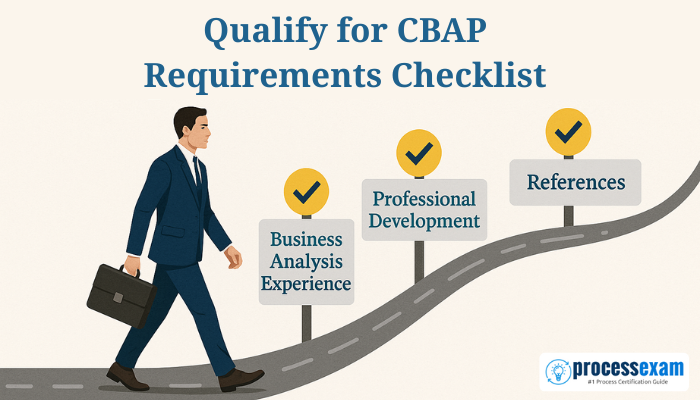
The Certified Business Analysis Professional is IIBA's senior credential, assessed against A Guide to the Business Analysis Body of Knowledge — the BABOK Guide, version 3 on the current product. Most guides to it start with the exam. This one starts with the paperwork, because the paperwork is what decides whether you ever book a seat.
What follows is the application route in the order you will walk it: what an audit asks for, what evidence to gather before you submit, how IIBA counts experience and training, what each fee buys, and which deadlines begin ticking the moment you pay.
What happens when IIBA marks a CBAP application "approved pending audit"?
An audit is a verification step, not a penalty. IIBA's handbook describes the sequence plainly: when an application is approved pending audit, you complete the audit process and submit your professional development documents for validation, and your personal and work history references are contacted. When the application passes, you receive an email confirming approval and the next steps to purchase the exam.
Two details in that sentence deserve attention. The first is documents. Not a description of a course, not a link to a landing page — the certificate, the agenda, the attendance record, something with a provider name and a date on it. The second is that your references hear from IIBA, not from you. A colleague who agreed over coffee eight months ago and forgot about it is a weak link in a process you no longer control.
Why an audit is worth designing for
IIBA also reserves the right to conduct random audits after certification, not just before the exam. That changes how you should treat the entries in your log. The useful posture is not "will I be audited?" but "could I evidence this line if asked in three years?". Applicants who work that way find the audit a formality. Applicants who rounded hours upward and guessed at course dates find it an expensive delay, because the application term keeps running while the correspondence goes back and forth.
What a stalled application actually costs
The application fee is non-refundable and non-transferable, and the application expires twelve months after purchase. If it lapses, IIBA requires you to pay the application fee again, re-verify that you meet the requirements, and pay the exam fee. An audit you cannot answer quickly is therefore not just an inconvenience; it eats the window you already paid for.
What evidence should you have ready before you submit?
Assemble the folder first and fill in the online form second. It inverts the usual order, but it is the order that survives scrutiny, and it takes a weekend rather than the evening you were planning to spend.
The paper you cannot recreate later
- Training certificates and agendas for every course you intend to count toward the 35 professional development hours, each showing the provider, the dates and the hours delivered.
- A dated record of your work history — project names, your role on each, the start and end months, and which business analysis tasks you performed. Old calendars, status reports and project closure documents are better memory than memory is.
- Named artefacts per knowledge area: the requirements package you wrote, the elicitation sessions you ran, the traceability matrix you maintained. These are what turn a claimed hour into a defensible one.
The two people you will name
IIBA is specific about references. You need two, each of whom has known you for at least six months, and each must be one of three things: a credentialed CCBA or CBAP holder, a career manager, or an internal or external client. They must supply a work email address — a personal Gmail or Hotmail address is not accepted.
That work-email rule quietly rules out more people than candidates expect: the manager who has since retired, the client contact who left the firm, the mentor who now consults under a personal address. Choose references who are still reachable at an employer, tell them the request is coming, and tell them roughly what you have claimed so their answer and your log describe the same work.
How much business analysis experience does IIBA count, and from when?
The headline figure is 7,500 hours of business analysis work, which IIBA equates to five or more years, and it must fall within the last ten years. Work older than that window does not count at all, however good it was. This is the requirement that decides whether the CBAP is your certification today or the one you aim at next year.
Where the 900-hour minimums sit inside the 7,500
The total alone is not enough. Inside the 7,500 you also need a minimum of 900 hours in four of the six BABOK knowledge areas — a floor of 3,600 hours that must be spread rather than concentrated. The six areas are:
- Business Analysis Planning and Monitoring
- Elicitation and Collaboration
- Requirements Life Cycle Management
- Strategy Analysis
- Requirements Analysis and Design Definition
- Solution Evaluation
The remaining 3,900 hours can sit anywhere across the six. In practice, most applicants find four areas easily and then discover the shape of their career: analysts from delivery-heavy environments are rich in requirements analysis and life cycle management but thin in strategy analysis and solution evaluation, because those tasks were done by someone with a different job title. If two of your six areas are near empty, the honest fix is to volunteer for that work for a year, not to redistribute hours on paper.
Tasks count, job titles do not
IIBA assesses what you did against the BABOK knowledge areas, so the label on your contract is irrelevant. A product manager who ran elicitation workshops, a project manager who owned the requirements package, a consultant who built the business case — all of that is business analysis work if the tasks map to the guide. The corollary matters just as much: a year spent with "Business Analyst" on your badge while you wrote test scripts is not 1,800 hours of business analysis. IIBA publishes the CBAP competencies and proficiency levels, and reading them next to your own project list is the fastest way to see which of your years actually qualify.
Which courses survive a professional development check?
The training requirement is 35 professional development hours completed in the last four years — a shorter window than the ten years allowed for work experience, which catches people out. A course you took five years ago is worth nothing to this application even though the project you ran six years ago still counts.
The four standards a session has to meet
IIBA does not accept any learning that happens to touch business analysis. The hours must align with the BABOK knowledge areas and meet four education and training standards that together make learning transferable and assessable:
- a moderator or facilitator who leads the group or individual through the material;
- measurable learning objectives that apply directly to the business analysis role;
- opportunities for students to interact with the material and ask questions;
- opportunities to practise the task or objective being presented and be assessed by the facilitator.
Hold an ordinary on-demand video library against that list. There is no facilitator, no route for questions, and nothing that assesses you. Three of the four standards are missing, and a recording of the purchase receipt will not fix it during an audit.
The route that removes the argument
IIBA endorses training delivered by its Training and Academic Partners, and states that those courses have been assessed and validated by IIBA and automatically qualify toward the professional development requirement. It maintains a searchable directory of them, filterable by location and delivery format, alongside the credential details on the official IIBA CBAP page. If you have not yet spent money on training, spending it there converts a judgement call into a certainty. Chapter events and study groups are useful too, but check the format against the four standards before you count the hours.
What does a CBAP application cost, and what does each fee buy?
The fees arrive in two separate transactions, and candidates regularly budget only for the second. The application fee creates and verifies your application; the exam fee buys an attempt. Neither includes the other.
| CBAP detail | What the record shows |
|---|---|
| Certification | IIBA Certified Business Analysis Professional (CBAP) |
| Vendor | IIBA |
| Body of knowledge | BABOK Guide Version 3 |
| Application fee | Application Fee: $145 USD |
| Exam fee | Member - $350 USD, Non-Member - $505 USD |
| Retake fee | Member - $295 USD, Non-Member - $450 USD |
| Recertification fee | Member - $85 USD, Non-Member - $120 USD |
| Number of questions | 120 |
| Duration | 210 minutes |
| Passing score | 70% |
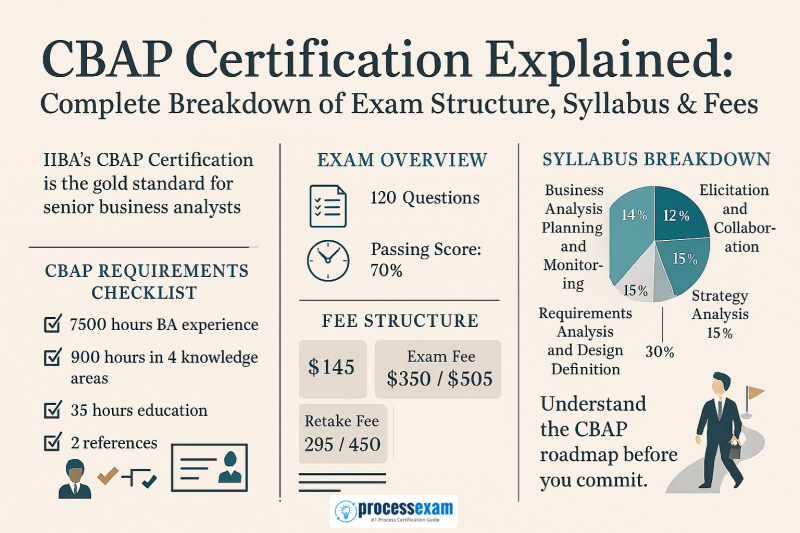
Read the member and non-member columns together before you decide anything. The gap between a member and a non-member exam fee is $155 on a first attempt and $155 again on a retake, and membership also carries free access to the BABOK Guide through IIBA's online library — which is the core study text. For most applicants the arithmetic settles itself.
Budget for the realistic case rather than the best one. An application fee plus a first attempt is the minimum; an application fee, a first attempt and one retake is the figure worth having approved by whoever signs off your training spend, so that a second attempt is a decision about readiness rather than a fresh negotiation.
Which deadlines start running once you pay?
This is the part of the process that quietly defeats organised people, because the clocks overlap and none of them is the one you would guess.
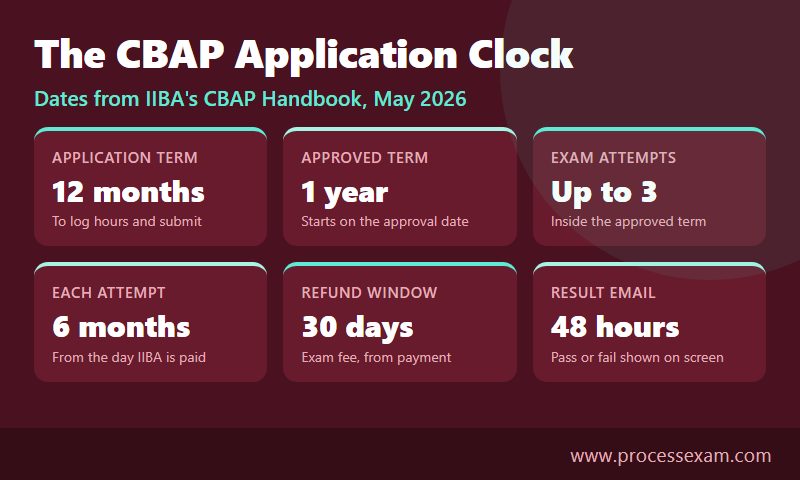
Buying the application starts a twelve-month term in which to enter your hours and references and submit. Submit and be approved, and a new one-year term begins on the date of approval — that is the window in which you may take up to three exam attempts. Each attempt you purchase is valid for six months from the day IIBA receives payment, or until the one-year approved term ends, whichever comes first.
IIBA's own worked example makes the trap visible. An application bought on 1 January 2026 must be submitted by 1 January 2027. Submitted and approved on 15 March 2026, it becomes valid from 15 March 2026 to 15 March 2027. An exam bought on 1 April 2026 must be taken by 1 October 2026. Buy a rewrite on 1 November 2026, though, and you do not get six months — you get until 15 March 2027, because the approved term ends first.
| Clock | Length | Starts when |
|---|---|---|
| Application term | 12 months | The day you buy the application |
| Approved term | 1 year | The day the application is approved |
| Exam attempts | Up to 3 | Within the approved term |
| Each purchased attempt | 6 months | The day IIBA receives payment |
| Exam fee refund window | 30 days | The day IIBA receives payment |
Two practical rules follow. Book the first attempt early enough that two retakes could still fit inside the approved term. And if you have not taken the exam before the application expires, you start again from the beginning — new application, new application fee, new exam fee.
How should you prepare once the application is approved?
Approval is the point at which the paperwork stops and the studying starts, and the exam is a different animal from the application. It runs 120 questions in 210 minutes, delivered online with remote proctoring or at a PSI test centre, and IIBA describes it as competency-based: multiple-choice, case-study and scenario-based questions rather than recall.
Reading the blueprint as a budget
IIBA publishes how the questions are distributed across the six knowledge areas: Business Analysis Planning and Monitoring 14%, Elicitation and Collaboration 12%, Requirements Life Cycle Management 15%, Strategy Analysis 15%, Requirements Analysis and Design Definition 30%, and Solution Evaluation 14%. Treat those percentages as a budget for your study hours. Requirements Analysis and Design Definition alone is nearly a third of the paper and deserves nearly a third of your preparation; splitting your time evenly across six areas is the commonest way to underprepare for the biggest one.
Fitting 120 questions into 210 minutes
That works out at roughly one minute forty-five per question, which sounds generous until a case study arrives with three paragraphs of context attached. The habit worth building is to scan the question stem ahead of the case narrative, so every detail you read afterwards has somewhere to go, and to flag anything that runs long instead of arguing with it. Build that habit on whole timed papers rather than on ten questions at a time.
When you want to know whether the studying has landed, sit a full CBAP practice test against the real 120-question, 210-minute format and look at the areas where you lost marks rather than the total. If you would rather see the question style before committing to a full paper, the free CBAP sample questions show you what a scenario actually looks like.
What to study, and in what order
The BABOK Guide is the source text, and IIBA's KnowledgeHub gives members searchable online access to it together with the Business Analysis Standard. Work through it knowledge area by knowledge area in blueprint-weight order, then move to competencies and proficiency levels, then to timed papers. The full rules on identification, security and exam-day technology for both delivery formats are set out in the IIBA CBAP Handbook, which is worth reading once in full before you schedule anything, and once more the week before you sit.
Leave the last few days for revision rather than new material. The applicants who go in calm are the ones who stopped adding topics a week out and spent the time re-reading their own weakest notes instead.
What happens after the exam, and what keeps the credential alive?
When you finish, the screen tells you whether you passed or failed, and IIBA emails confirmation of the result within 48 hours. If it is a pass, your digital badge and directory profile are available from your IIBA profile page, and your name appears in the professional directory of IIBA credential holders.
If it is not a pass, the route back is defined rather than dramatic. You may purchase a rewrite, up to three attempts in total within the approved term, at the retake fee — and the point made earlier applies: check how much of the approved term is actually left before you assume you have six months.
Keeping it after you have it
The CBAP is not permanent on its own. Credential holders must earn and record 60 Continuing Development Units every three years in IIBA's development log, and pay the recertification fee at renewal. That is a modest commitment compared with the application, but it is a commitment, and it is the reason the credential still means something a decade after it was issued — including the random audits IIBA reserves the right to run on holders, not just applicants.
Seen end to end, the CBAP asks for 7,500 hours in ten years, 900 hours in four of six knowledge areas, 35 training hours in four years, two reachable references, and the discipline to keep the evidence. The exam is the part everyone prepares for. The application is the part that decides who gets to.
Frequently Asked Questions
What are the CBAP application requirements?
IIBA asks for 7,500 hours of business analysis work in the last ten years, including at least 900 hours in four of the six BABOK knowledge areas, 35 professional development hours completed in the last four years, and two references who have known you for at least six months.
How much does a CBAP application cost?
The application fee is $145 USD and is separate from the exam. Master records the exam fee as Member - $350 USD, Non-Member - $505 USD, with a retake at Member - $295 USD, Non-Member - $450 USD. The application fee is non-refundable and non-transferable.
What counts toward the 35 CBAP professional development hours?
Training that aligns with the BABOK knowledge areas and has a facilitator, measurable learning objectives, a way to ask questions, and assessed practice. Courses from IIBA Training and Academic Partners are validated by IIBA and qualify automatically. Unfacilitated on-demand video usually fails those standards.
What happens if IIBA audits my CBAP application?
An application marked approved pending audit goes through a verification step. You submit your professional development documents for validation, and IIBA contacts the personal and work history references you named. Once it passes, you receive an email confirming approval and the steps to purchase the exam.
How long is a CBAP application valid?
The application expires twelve months after purchase, which is your window to log hours and submit. Once it is approved, a new one-year term starts on the approval date, and you may take up to three exam attempts within it. Each purchased attempt lasts six months.
- IIBA Business Analysis Professional Test Questions |
- CBAP Question Bank |
- IIBA Business Analysis Professional Sample Questions |
- CBAP Exam Questions Download |
- CBAP Test Questions |
- Business Analysis Professional PDF |
- IIBA Business Analysis Professional Book |
- Business Analysis Professional Certification Cost |
- Business Analysis Professional Certification Requirements |
- Business Analysis Professional Simulator |
- Business Analysis Professional Mock Exam |
- Core Business Analysis


