
Five ASQ Quality Certifications: What Each One Changes for Your Business
Updated on 8 October 2026. What’s new: experience rules now follow ASQ's current text, including three years for the Quality Inspector with two waived by a diploma or degree
A quality certification is worth paying for when it fills a named gap in your business. ASQ offers five that suit different gaps: the CMQ/OE runs the quality system, the CQA audits it, the CQI inspects product, the CQPA analyses problems and the CQIA gives non-specialists the basic tools. Exam fees run from $334 to $585, so the real question is which job you need done.

Picture a parts maker with 150 staff whose biggest customer has just sent a supplier scorecard with three open findings. The owner does not need five certificates. The owner needs someone who can answer the audit, someone who can find why parts drift, and a floor team that records data the same way every shift. This guide matches each of those needs to one of the five credentials, shows what each person must already have done before ASQ lets them sit the exam, and adds up what a small team costs.
What does an ASQ credential change inside a business, and what can it not do?
An ASQ credential certifies a person. It does not certify the company. That single distinction clears up most of the confusion owners have when they first look at these exams. A customer or regulator who asks whether your organisation is certified to a quality standard is asking about a management system, and an ASQ exam cannot supply that answer. What a credential can do is make sure the people who build, run and check that system have been tested against a published body of knowledge by an outside body.
For three kinds of work the difference is easy to see:
- Answering outsiders. A customer audit, a supplier questionnaire or a tender usually asks who is responsible for quality and how they are qualified. A named holder of the CMQ/OE or CQA is a short, checkable answer.
- Raising the floor. Inspectors and analysts who share one vocabulary for sampling, measurement and root cause write reports that managers can compare from shift to shift.
- Reducing key-person risk. When the one person who understands the quality manual leaves, a second holder of the same credential shortens the gap.
It is just as useful to know what a credential will not do. It will not write your procedures, it will not fix a process that nobody measures, and it will not stand in for management time. Two of the five, the CMQ/OE and the CQA, sit inside a certification programme that ASQ states is accredited by the ANSI National Accreditation Board under the ISO 17024 standard for certifying people. That is useful assurance about the exam, not a claim about your site.
Notice also that none of these exams is a course. Each one is a multiple-choice test of what a competent practitioner already knows, taken open book. Training can help people get there, but a business that sends staff to a classroom and expects the exam to change their habits will be disappointed. The change comes from the work people do afterwards with the shared language the credential gives them.
Which job in the business does each of the five credentials do?
The five credentials read like a ladder, but they are better understood as five different jobs. Some businesses need all five, many need two or three, and a few need only one. The table shows the split before the detail.
| Credential | Main job in the business | Typical output |
|---|---|---|
| CMQ/OE | Lead the quality system and improvement work | Plans, measures, customer and supplier relationships |
| CQA | Audit the system against standards and rules | Audit reports and corrective-action requests |
| CQI | Inspect product and measure on the line | Inspection records and formal data reports |
| CQPA | Analyse quality problems under an engineer or supervisor | Problem analyses and project support |
| CQIA | Apply basic quality tools inside any team | Better-run improvement projects |
CMQ/OE: the person who runs the system
The Certified Manager of Quality/Organizational Excellence is ASQ's management credential. ASQ describes the holder as someone who leads process-improvement work from small firms to multinationals, builds customer and supplier relationships, supports strategic planning and helps develop the measurement systems an organisation uses to judge itself. The programme grew out of the older Certified Quality Manager credential, and ASQ widened the scope and the name after surveying managers and subject experts.
For a business, the CMQ/OE is the credential that suits the person who sits between the floor and the leadership team: the quality manager, the operations manager who owns quality, or the head of a continuous improvement office. The exam has 180 questions and ASQ's page gives a total appointment of 270 minutes. Read the ASQ CMQ/OE page for the current requirements.
CQA: the person who checks the system
The Certified Quality Auditor evaluates quality systems and processes to confirm they meet standards and regulations, and points to where they can improve. Where the CMQ/OE builds and operates, the CQA asks whether what was built does what the documents say. A company needs that independent view for internal audits, for supplier audits and for the preparation before an outside certification body or a customer arrives.
ASQ says 10 to 15 percent of the exam is built on case studies, each giving a short audit scenario with the paperwork an auditor would have in hand. That matters to an employer: it means the credential tests judgement on realistic documents, not only recall. The exam has 165 questions. See the ASQ CQA page.
CQI: the person who measures the product
The Certified Quality Inspector works in support of quality engineers, supervisors or technicians. ASQ lists the work as evaluating hardware documentation, performing laboratory procedures, inspecting products, measuring process performance, recording data and preparing formal reports. This is the most hands-on of the five, and manufacturers, laboratories and anyone who ships a physical part gain the most from it.
The business value is consistency. Two inspectors who both hold the credential have been tested on the same sampling, measurement and reporting ideas, so a rejected lot means the same thing on both shifts. The exam has 110 questions. See the ASQ CQI page.
CQPA: the analyst who supports engineers
The Certified Quality Process Analyst is a paraprofessional role: the holder works beneath quality engineers or supervisors, digs into quality problems and joins improvement projects. ASQ says it may suit a recent graduate or someone with work experience who wants to show knowledge of quality tools and processes. For a small business building its first quality team, it is a realistic way to prove that a junior hire can contribute to problem solving. The exam has 110 questions. See the ASQ CQPA page.
CQIA: the team member who speaks the language
The Certified Quality Improvement Associate is for people who support improvement projects without coming from a traditional quality role, such as an operator, a nurse manager, a finance analyst or a logistics planner. ASQ presents it as proof of foundational knowledge of quality tools, methods and teamwork. In a business, this is the credential to spread widely because it is what turns a quality department's requests into something the rest of the company understands. The exam has 110 questions. See the ASQ CQIA page.
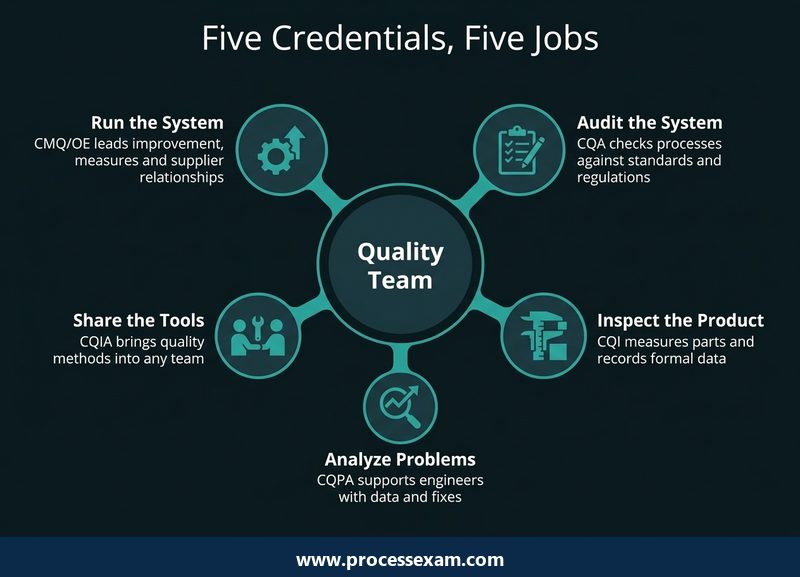
The exam facts for all five sit side by side below. All five use the same 550/750 passing score.
| Credential | Questions | Exam time | Total appointment | Passing score |
|---|---|---|---|---|
| CMQ/OE | 180 | 258 minutes | 270 minutes | 550/750 |
| CQA | 165 | 318 minutes | 330 minutes | 550/750 |
| CQI | 110 | 258 minutes | 270 minutes | 550/750 |
| CQPA | 110 | 258 minutes | 270 minutes | 550/750 |
| CQIA | 110 | 198 minutes | 210 minutes | 550/750 |
These counts are the computer-delivered totals. ASQ's own pages note that some of the questions in each computer exam are unscored trial items: 15 of the 180 on the CMQ/OE and 15 of the 165 on the CQA, and 10 of the 110 on each of the other three. A candidate cannot tell which ones, so every question deserves a real answer.
Which credential answers a customer audit, a supplier problem or regulated work?
Owners rarely start by asking which certification they want. They start with a problem on their desk. The table turns five common problems into the credential that best fits each, and says why.
| The problem you face | Credential to look at first | Why it fits |
|---|---|---|
| A customer audit found gaps in your procedures | CQA | An auditor reads the system the way the customer's auditor will and finds the gaps before they do |
| Nobody owns the improvement plan | CMQ/OE | The credential is built around leading improvement and measuring whether it worked |
| Rejected lots argue between shifts | CQI | Shared measurement and sampling rules end the argument over what counts as a defect |
| Engineers drown in data requests | CQPA | An analyst under the engineer takes the first pass at the problem |
| Improvement projects stall outside the quality team | CQIA | Team members from other functions learn the same tools and terms |
Audits
Audits come in three kinds: internal, supplier and third-party. Internal audits are the cheapest early warning a company has, yet many small firms run them badly because the auditor is the person who wrote the procedure. A CQA, or a staff member working toward one, breaks that habit. Supplier audits matter most when a single purchased part decides whether your own product passes. The auditor needs to read a supplier's records, ask about corrective action and judge whether the answer is credible. Pre-certification audits are the third case: the weeks before an outside body visits are when a trained internal auditor is most useful.
Supplier quality
No ASQ credential on this list is a supplier-quality credential by name, and it would be wrong to claim that one is. Supplier work is spread across the roles: the CQA audits suppliers, the CQI checks what arrives, the CQPA analyses supplier defect data, and the CMQ/OE owns the relationship and the performance targets. If supplier quality is your main exposure, ASQ lists a separate supplier quality credential, and the other five here should be seen as the surrounding team.
Regulated work
If your products fall under a regulator, such as medical devices, food or pharmaceuticals, ASQ publishes sector credentials that go further than the five covered here. Treat these five as the general-purpose layer. A CQA from the general programme can still audit against a standard, but a regulator or customer in a specialised sector may name a sector credential in its supplier requirements. Always read the contract wording before you assume a general credential satisfies it.
Process improvement
For improvement work the CMQ/OE leads, the CQPA and CQIA staff the projects, and the CQI supplies the measurements everything depends on. A project is only as good as its data, which is why inspectors belong in the improvement conversation and not only on the line.
How many years of experience must the person already have?
This is where businesses most often plan wrongly. ASQ will not let a candidate sit the exam on study alone. Every one of the five asks for time in a full-time, paid role in the areas of the body of knowledge, and the two senior credentials add a decision-making test.
| Credential | Experience required | How a degree or diploma helps |
|---|---|---|
| CMQ/OE | 10 years, in a decision-making position | Trade diploma 1 year, associate 2, bachelor's 4, master's or doctorate 5 |
| CQA | 8 years, in a decision-making position | Trade diploma 1 year, associate 2, bachelor's 4, master's or doctorate 5 |
| CQI | 3 years | Any of the diploma or degree levels waives 2 years |
| CQPA | Years of on-the-job experience in the CQPA areas | Can be replaced by an associate degree, or by two years of comparable higher education |
| CQIA | Years of work experience | Can be replaced by an associate degree, or by two years of comparable higher education |
ASQ allows only one education waiver per candidate. For the CMQ/OE and the CQA, What counts as decision-making is the power to set up, run or steer work and to answer for how it turns out, so a senior technician or lead engineer can qualify even without a management title. For the CMQ/OE, experience that qualified someone for ASQ's quality auditor, reliability engineer, software quality engineer or quality engineer credential also counts, provided the ten-year minimum is met.
The practical effect is a pipeline. A new graduate can reach for the CQPA or CQIA almost at once, a technician with a few years on the line can reach the CQI, and the auditor and manager credentials belong to people who have already carried real responsibility. A company that wants an auditor within a year has to start with the person who already has the years, because training alone cannot buy them. Check the current wording on each ASQ page before you commit, since the exact text is what the application is judged against.
What does it cost to certify a small team, beyond the exam fee?
Each exam has a fee for ASQ members, a higher fee for non-members and a lower retake fee. The fees below are the current published figures.
| Credential | Members | Non-members | Retake |
|---|---|---|---|
| CMQ/OE | $485 | $585 | $385 |
| CQA | $450 | $550 | $350 |
| CQI | $360 | $460 | $260 |
| CQPA | $334 | $434 | $234 |
| CQIA | $334 | $434 | $234 |
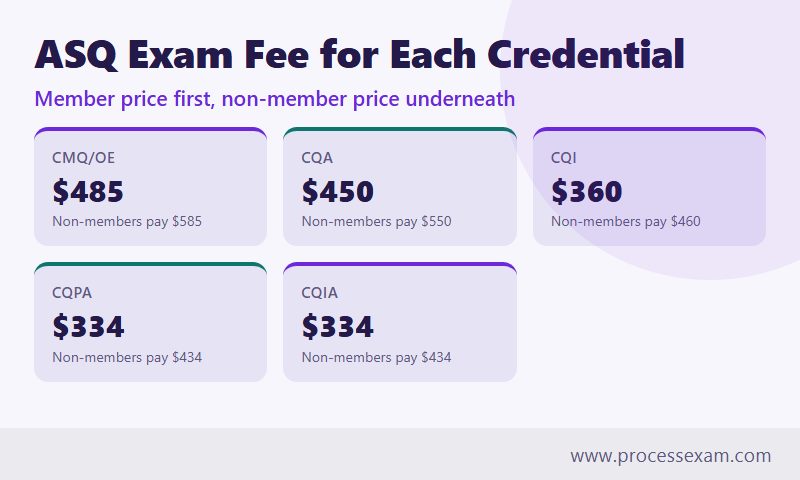
Take the parts maker again and suppose it certifies one CMQ/OE, one CQA, two CQI holders and one CQIA. At member prices that is $485 plus $450 plus $720 plus $334, which comes to $1,989. At non-member prices the same six people cost $585 plus $550 plus $920 plus $434, which is $2,489. The gap is $500, or $100 for each of the five exams, which matches the saving ASQ states for members. Whether joining ASQ pays for itself depends on the membership fee, which ASQ lists separately, so check that figure before you decide.
The exam fee is the smallest line in the real budget. The larger costs are these:
- Time away from work. The appointment times in the facts table run from 210 to 330 minutes, so plan a half day for the CQIA and most of a day for the CQA once travel and check-in are counted.
- Reference books. ASQ exams are open book, so every candidate needs a bound set of references, and the handbook that matches the body of knowledge is the usual core. Budget one set per candidate.
- Preparation hours. A practising inspector needs far fewer than an analyst moving into quality from another function. Plan weeks, not days, and give people protected time.
- A retake. A retake costs less than a first attempt, so keep a small line in the budget for one. ASQ states that the reduced rate applies for two years from the earlier attempt.
Applications close several weeks before each testing window opens. On the ASQ pages read in October 2026, the gap was about three weeks, so a manager who decides in the same month as a window will usually miss it and should aim for the following one.
Which exam version will your people be studying in 2026?
ASQ refreshes each body of knowledge on its own timetable, and three of the five have just changed. A business that buys study material in bulk can easily buy the wrong edition.
| Credential | What ASQ's page says in October 2026 |
|---|---|
| CMQ/OE | 2026 body of knowledge effective 1 July 2026 |
| CQA | 2026 body of knowledge effective 1 April 2026 |
| CQPA | 2026 body of knowledge effective 1 August 2026 |
| CQI | One body of knowledge listed, with no 2026 edition flagged on the page |
| CQIA | One body of knowledge listed, with no 2026 edition flagged on the page |
For the first three, the earlier edition appears beside the new one on ASQ's page, which is easy to mistake for the current one. ASQ also notes that results for the first sitting after a new body of knowledge arrive in four to six weeks rather than the usual few days, so plan the timing of any promotion or contract that depends on a pass.
The practical step is simple: before you buy handbooks or book a course for anyone, download the body of knowledge from the ASQ page for that credential and confirm the edition with the supplier. When you want a feel for the question style on the management exam, the free CMQ/OE sample questions show how scenario wording works, though you should always compare the topics against the edition ASQ currently tests.
How should a manager decide who to certify first?
Treat the choice as a short sequence of questions, in this order.
- Where is the loudest pain? A failed audit points to the CQA. Disputes over product acceptance point to the CQI. A stalled improvement plan points to the CMQ/OE.
- Who already has the years? Use the experience table. Starting with the person who can sit the exam this year beats starting with the credential you would like.
- Who will use it every week? A credential that is used daily stays alive. One that sits in a drawer teaches nobody anything.
- Can the person teach? Pick the first holder of each credential for their willingness to pass knowledge on, because the second and third holders are cheaper to create.
- What does a customer or contract name? If a customer's supplier manual names a credential, that settles the order.
A sensible order for most manufacturers is to certify the person who runs quality first, put the CQIA in front of the wider team early because it is cheap and needs no specialist background, and add the CQA once there is an internal audit programme worth leading. Small service firms often skip the CQI entirely and start with the CMQ/OE and CQIA.
If you are the person preparing for the management exam, a timed run through the CMQ/OE practice exam is a quick way to learn how much of the body of knowledge you already control before you set a date.
Finally, treat the first credential as a pilot. After six months, ask whether audit findings closed faster, whether rejected lots dropped, or whether improvement projects finished. Those results, not the certificate itself, decide whether the second credential is worth buying.
Frequently Asked Questions
Which ASQ quality certification is best for a business?
No single one is best, because each does a different job. The CMQ/OE suits the person who runs the quality system, the CQA audits it, the CQI inspects product, the CQPA analyses problems and the CQIA gives non-specialists the tools. Choose by the gap in your business and by who already has the years.
Is the CMQ/OE worth it?
It is worth it for someone who already leads quality or improvement work and has about ten years in decision-making roles, less a waiver for a degree. The exam fee is $485 for ASQ members and $585 for non-members. It adds little for people who are not heading toward a quality management role.
What is the CQIA certification and who is it for?
The Certified Quality Improvement Associate shows foundational knowledge of quality tools, methods and teamwork. ASQ aims it at people who support improvement projects without a traditional quality role. It has 110 questions, a 550/750 passing score and a fee of $334 for members or $434 for non-members.
How much do the five ASQ quality exams cost?
Member prices are CMQ/OE $485, CQA $450, CQI $360, CQPA $334 and CQIA $334. Non-members pay $100 more on each: $585, $550, $460, $434 and $434. Retakes cost $385, $350, $260, $234 and $234, so a first attempt costs the most.
Do you need work experience for these ASQ certifications?
Yes. All five require time in a full-time, paid role, and the CMQ/OE and CQA need it in decision-making positions: ten and eight years before education waivers. The CQI asks for three years. The CQPA and CQIA accept years of experience or, instead, an associate degree or two years of study.
- ASQ Manager of Quality/Organizational Excellence Sample Questions |
- CMQ/OE Exam Questions Download |
- CMQ/OE Test Questions |
- Manager of Quality/Organizational Excellence PDF |
- ASQ Manager of Quality/Organizational Excellence Book |
- ASQ CMQ/OE BOK PDF |
- Manager of Quality/Organizational Excellence Certification Cost |
- Manager of Quality/Organizational Excellence Certification Requirements |
- ASQ Manager of Quality/Organizational Excellence Test Questions |
- CMQ/OE Body of Knowledge (BOK) |
- Management |
- CMQ/OE Question Bank |
- Manager of Quality/Organizational Excellence Simulator |
- Manager of Quality/Organizational Excellence Mock Exam |
- CMQ/OE Handbook


