
Best 10 Steps to Become a Certified Project Manager
You have already run three projects without the job title: a system migration, an office move and a supplier onboarding. Now you want a certificate with your name on it, and you would rather not sit through a 35-hour course to earn it. The IAPM Certified Project Manager (CPM) suits that situation, with one honest caveat: IAPM never reviews your projects. It asks for no experience and no training, only a pass on one online exam.

That caveat shapes everything in this guide. The International Association of Project Managers (IAPM) does not certify what you have done; it certifies what you know, measured against its own Project Managers' Guide. Your informal projects will not appear on any form, yet they are still your biggest study asset, because they give you real situations to hang each topic on. The ten steps below follow IAPM's route in the order you will meet it, from choosing the right level to validating the finished certificate, with the figures you need at each stage.
What does the IAPM Certified Project Manager actually prove?
The CPM is the middle rung of IAPM's traditional project management ladder. Below it sits the Certified Junior Project Manager (IAPM), aimed at students and complete newcomers. Above it sits the Certified Senior Project Manager (IAPM), which adds a check of your practical record. IAPM also runs a parallel agile ladder and a Certified International Project Manager (IAPM) level that builds on a CPM or senior certificate.
According to IAPM's Certified Project Manager page, the certificate attests to knowledge of the hard and soft factors of project management. In plain terms, it shows that you can plan, organise and carry out a project correctly in theory, and that you understand the interpersonal side of leading one. It does not claim that you have managed a portfolio of large projects; that is what the senior level is for.
One detail surprises many candidates. IAPM states that the CPM and the senior exam draw their questions at random from the same pool. The difference between the two levels is the experience check, not the difficulty of the paper. If you pass the CPM today and build up years of responsible project work later, you can apply to upgrade rather than sitting a harder exam.
Not every CPM is the IAPM one
The CPM is sometimes confused with credentials from other bodies because the letters "CPM" are used by several organisations. The IAPM version has three features that set it apart: it is taken entirely online at a time you choose, its fee is set by your citizenship rather than a single global price, and it is valid for life with no renewal cycle. If you see a CPM listed in a job advert, check which body issued it before assuming it is this one.
Do you need project experience or a course to take the CPM?
No. This is the question that decides whether the opening scenario works, so it is worth quoting IAPM directly. Its Certified Project Manager FAQ says there are no access requirements for this level and no requirements concerning professional experience. Anyone who has dealt with project management and wants to prove their knowledge can apply. Training is optional too: IAPM offers its certifications without preparatory courses and leaves the choice of learning method to the candidate.
So your three informal projects are not a qualification in IAPM's eyes. They are not a disadvantage either. IAPM describes experience as "not necessary, but an advantage", and that advantage shows up in the exam room: questions about a steering committee, a work package owner or a project review are easier when you have sat through a messy version of each.
Where experience does start to count
Experience becomes a formal requirement only at the senior level. For the Certified Senior Project Manager (IAPM), IAPM asks for at least five years of project management experience, three of them in a management role or a position with considerable responsibility. At registration you describe up to five projects, and a formula turns your project data into a score. Candidates who miss the minimum score can take the CPM instead and upgrade later.
That gives the opening scenario a clear plan. Take the CPM now on knowledge alone, keep a simple record of every project you run from here on, and apply for the senior upgrade once the record reaches IAPM's threshold.
What are the 10 steps to become an IAPM Certified Project Manager?
These ten steps cover the whole route. The first five are preparation you control; the last five follow IAPM's own registration and exam process.
Step 1: Confirm that CPM is the right level for you
Read IAPM's overview of certification levels before anything else. If project management is completely new to you, the junior level may be a gentler start. If you already have five years of responsible project work, go straight to the senior application. If you sit in between, with some project exposure and a desire to formalise it, the CPM is the level built for you.
Step 2: Get the Project Managers' Guide (IAPM)
IAPM's exams are built on its own reference text. The IAPM certification bases page describes the Project Managers' Guide (IAPM) as the basis of the certification programme, defining the knowledge elements needed at each level, from project check to project close-out. IAPM provides it free of charge, so download it first and use its chapter list as your master checklist.
Step 3: Map your informal projects onto the guide
This step turns hands-on experience into exam readiness. Take each project you have run and write one line per guide topic: who were the stakeholders, was there a project charter, what did the work breakdown look like, how did it close? Where you have no answer, you have found a gap. Where your company did something different from the guide, note it, because the exam marks the guide's answer, not your employer's habit.
Step 4: Study with IAPM's free web-learning platform
IAPM runs a web-learning platform covering the CPM and senior levels. Its chapters include short stories to set the scene, a transfer project and "test yourself" questions. IAPM itself warns that reading the guide is not enough to pass, so use the platform, recommended literature or a training partner to learn each topic in detail.
Step 5: Decide whether to take the self-test
The self-test is optional and charged separately from the exam. It has 25 questions to answer in 20 minutes, and within three working days IAPM e-mails you the five areas where you scored lowest, with advice on closing each gap. You can take it only once, and the access link lasts 12 months from registration, so book it when your first pass through the material is complete rather than on day one.
Step 6: Check your fee and any discount
IAPM prices its certifications by the gross domestic product of the candidate's country of citizenship, so two people sitting the same exam can pay different amounts. ProcessExam's exam summary lists the fee as USD $599; select your nationality on IAPM's fee information page to see the figure that applies to you. Pupils, students and active employees of charities can request a 20% discount before registering by e-mailing proof of status; an approved code must be used within 90 days.
Step 7: Register, accept the affidavit and pay the invoice
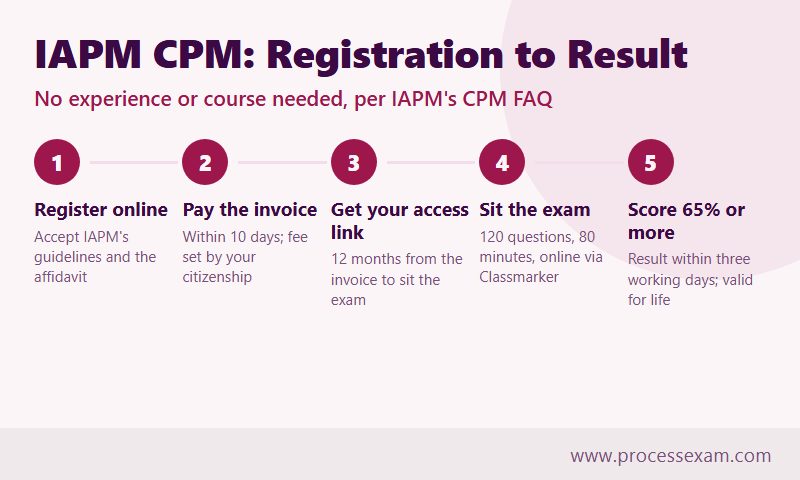
Registration is an online form. Along with your personal details, you accept IAPM's guidelines and an affidavit confirming you will take the exam alone and without aids. IAPM checks the data and sends an invoice, which must be paid within 10 days. Once payment arrives you receive your IAPM Identification Code (IAPMIC) and a personal access link. From the invoice date you have 12 months to take the exam, which leaves room for a proper study plan.
Step 8: Rehearse under the real exam rules
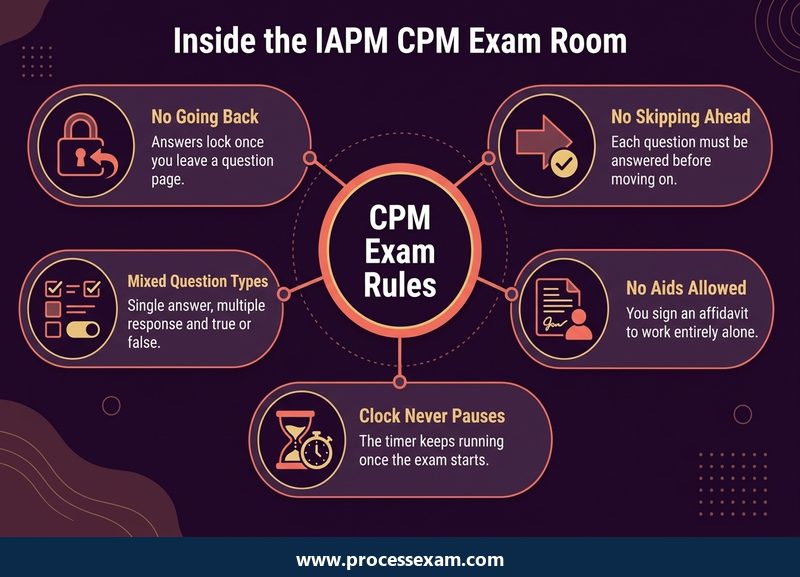
The CPM exam has habits you should practise before the day: you cannot return to a question once you leave its page, you cannot skip ahead, and the clock keeps running. Build at least two full rehearsals of 120 questions in 80 minutes where you move strictly forward. A timed CPM mock exam is a convenient way to test that pace against a full-length question set before you open IAPM's access link.
Step 9: Sit the exam online through Classmarker
IAPM delivers the exam through the Classmarker system. You need a current browser, a stable internet connection, and JavaScript and cookies enabled; no plugins are required, and phones, tablets and all major operating systems are supported. Choose a quiet slot where nobody will interrupt you, because the 80 minutes cannot be paused once they start. If the exam breaks down for a technical reason, contact IAPM support straight away and they will agree the next move with you.
Step 10: Receive your result and put the certificate to work
Classmarker marks the exam electronically and IAPM e-mails the result within three working days, so check your spam folder if nothing arrives. Passing candidates receive a cover letter, the certificate and a report, all in digital form; IAPM no longer posts printed certificates. The certificate carries your IAPMIC, which lets an employer confirm that it is genuine. Add it to your CV and professional profiles as "Certified Project Manager (IAPM)" so readers know which body issued it.
How is the CPM exam built, and what score do you need?
The figures below come from ProcessExam's exam summary for this certification. The question types, delivery and validity lines come from IAPM's own pages.
| Item | IAPM Certified Project Manager |
|---|---|
| Exam Name | IAPM Certified Project Manager |
| Exam Code | CPM |
| Exam Fee | USD $599 (IAPM sets the fee by citizenship) |
| Exam Duration | 80 Minutes |
| Number of Questions | 120 |
| Passing Score | 65% |
| Question types | Multiple choice, multiple response and true/false |
| Delivery | Online through Classmarker, no test centre |
| Validity | Lifelong, no recertification |
Eighty minutes for 120 questions works out at 40 seconds per question. That is a fast pace, and IAPM designs it deliberately: its FAQ explains that there is no time to look up answers even if you wanted to. The pace also explains why the forward-only navigation matters so much. You cannot bank easy questions and return to hard ones later, so every question gets its answer on the first visit.
Reading the result bands
You pass by answering 65% of the questions correctly. IAPM does not stop at pass or fail: the wording on your certificate reflects your score, and a scale on its last page links each wording to a percentage band.
- 65% to 70%: pass
- 71% to 80%: good pass
- 81% to 90%: very good pass
- 91% to 100%: pass with distinction
IAPM also publishes an average: CPM candidates answer just over 71% of the questions correctly. That puts the typical candidate just inside the "good pass" band, only a few points above the pass line. Treat the average as a warning rather than a comfort. A candidate who is aiming just to scrape through has very little margin for a bad run of multiple-response questions.
Why multiple-response questions deserve extra practice
A multiple-response question asks for every correct option, and one missing or extra choice usually makes the whole answer wrong. Candidates who learned on the job tend to spot the most familiar correct option and stop. In practice, read every option against the guide's definition and ask whether each one is fully true, not merely plausible.
Which of the 20 syllabus topics need the most study?
IAPM lists 20 topic areas for the CPM exam, and the CPM syllabus topics are also set out on our summary page. IAPM does not publish a weighting per topic, so do not skip any of them. It helps to study them in four groups that follow the life of a project.
Setting the project up
Project Check, Project File, Project Environment, Stakeholders and Project Charter cover the questions a project manager answers before work begins: is this really a project, where is its documentation kept, who and what surrounds it, and what has the sponsor formally agreed? Informal projects often skip the charter altogether, so if yours did, give this group extra attention.
Organising the people
Steering Committee and Core Team, Communication, Sub-Project Manager and Work Package Owner, and Project Organisations deal with who decides, who does the work and how information flows between them. Expect questions that test the exact responsibilities of each role. Candidates who ran projects alone are most likely to lose marks here, because a one-person project never needed a steering committee.
Planning the work
Creation of the Specification, Creation of the Phase Model, Creation of the Work Breakdown Structure, Work Packages, Process and Time Schedule, Cost Breakdown and Budget, and Risk Analysis form the largest group. These are the most technical topics and the most rewarding to practise with small worked examples: draw a work breakdown for a project you know, then derive the schedule and a simple budget from it.
Running, closing and the human side
Project Start-Up, Project Review and Project Close Out cover the moments that turn a plan into a delivered result, and Soft Skills covers leadership, conflict and motivation. Do not treat soft skills as common sense. The exam asks about them in the guide's terms, and an answer that sounds reasonable from experience can still differ from the textbook model.
What trips up candidates who learned project management on the job?
People who arrive with informal experience bring real strengths, but they also bring habits that cost marks. These are the patterns worth guarding against.
- Answering from your own company's practice. If your employer never wrote a specification, it is easy to underestimate the topic. The exam wants the Project Managers' Guide (IAPM) process, even where your office took a shortcut.
- Using your own vocabulary. Terms such as "phase model" and "work package owner" have precise meanings in IAPM's material. Build a glossary as you study and test yourself on it.
- Treating the guide as the whole course. IAPM says plainly that the guide is an overview of exam-relevant topics, not a complete textbook. Pair it with the web-learning platform or recommended literature.
- Practising with a back button. Many practice tools let you revisit questions. Turn that option off, or simply refuse to use it, so your rehearsal matches the forward-only exam.
- Taking the self-test too early. It can be used once only. Taken before you have studied, its feedback just confirms that everything is new.
- Booking a slot with interruptions. The timer does not pause, so a doorbell or a work call costs real minutes. Protect the full 80 minutes plus time to set up.
A six-week study rhythm for a working candidate
If you can give the exam around five or six hours a week, a six-week rhythm works well. Spend the first two weeks on the set-up and organisation groups while you map your own projects against them. Use weeks three and four for the planning group, with worked examples. In week five, cover start-up, review, close-out and soft skills, then take the self-test if you have chosen to. Keep week six for timed rehearsals and for revising the areas the self-test or your practice scores flagged.
What happens if you fail, and how long does the certificate last?
A failed first attempt is not the end of the route. IAPM lets you repeat the exam with a new set of questions, and the fee is charged again. If the second attempt also falls short, a 12-month waiting period applies before you can try a third time. IAPM's FAQ adds that a candidate who fails that third attempt loses eligibility for IAPM certification exams altogether, so treat the retake rule as a reason to sit only when your rehearsal scores are comfortably above the line.
A certificate that does not expire
Once you pass, the certificate is valid for life. IAPM compares it to a school-leaving exam or a driving test: taken once, kept for good. It deliberately avoids recertification because it does not see itself as a supervisory body, and it expects each project manager to keep learning on their own. That means no continuing-education points to log and no renewal fee to budget for.
Lifelong validity also means your certificate reflects your knowledge on the day you passed. Keep it current in the eyes of employers by adding newer evidence alongside it, such as projects you have led since, and, when your experience allows, the senior upgrade.
Where to go after the CPM
Two paths build directly on the certificate. The upgrade to Certified Senior Project Manager (IAPM) needs no new exam once your experience meets the senior rule. The Certified International Project Manager (IAPM) accepts the CPM as its entry requirement and adds topics such as cultural dimensions and communication in international projects.
Where can an IAPM certificate take your career?
A certificate does not replace experience, but it changes how that experience is read. For someone who has run projects without the title, the CPM gives a hiring manager a neutral, checkable statement that you know the vocabulary and the method, which makes it easier to argue that your informal projects were real project management.
IAPM reports that in its certificate surveys, about a quarter of respondents increased their salary or changed their position after certification. That is IAPM's own figure, gathered from its own holders, so read it as an indication rather than a promise. The practical value depends on your market: look at project coordinator and project manager adverts in your region and note which credentials they name.
Making the certificate visible
- List it with the issuing body in brackets so it is not mistaken for another organisation's CPM.
- Pair it with one sentence per informal project: goal, size and result. The certificate proves knowledge; the sentences prove application.
- Tell employers that the IAPMIC on the certificate allows them to check it with IAPM.
- Keep a running project log from now on, so the senior upgrade is ready when you are.
Followed in order, the ten steps take you from informal project work to a lifelong, verifiable certificate without a mandatory course or an experience audit. The work that remains is the part no body can do for you: learning the guide well enough to answer 120 questions at a steady pace, one question at a time.
Frequently Asked Questions
How do I become a certified project manager with IAPM?
Download the free Project Managers' Guide (IAPM), study its 20 topics, register online, accept the affidavit and pay the invoice within 10 days. You then have 12 months to sit the online exam: 120 questions in 80 minutes, with 65% needed to pass. IAPM e-mails the result within three working days.
Do I need project management experience for the IAPM CPM?
No. IAPM sets no access requirements and no professional experience requirement for the Certified Project Manager level, and no course is mandatory. Experience helps you answer scenario questions, but it is only checked at the senior level, which asks for five years of project work, three of them with significant responsibility.
How much does the IAPM Certified Project Manager exam cost?
ProcessExam's exam summary lists the fee as USD $599. IAPM itself sets the fee according to the gross domestic product of your country of citizenship, so select your nationality on IAPM's fee page to see your figure. Pupils, students and charity employees can request a 20% discount before registering.
What happens if I fail the CPM exam?
You can repeat the exam with new questions, paying the fee again. If the second attempt also fails, you must wait 12 months before a third try. IAPM states that failing the third attempt ends eligibility for its certification exams, so sit again only when timed practice shows a clear margin above 65%.
Does the IAPM CPM certificate expire?
No. IAPM certificates are valid for life, and there is no recertification, renewal fee or continuing-education requirement. The certificate is issued in digital form with your IAPM Identification Code, which employers can use to confirm it with IAPM. Later, you can upgrade it to the senior level once your experience qualifies.
- Traditional Management |
- IAPM Project Manager Test Questions |
- CPM Question Bank |
- CPM Body of Knowledge (BOK) |
- Project Manager Simulator |
- Project Manager Mock Exam |
- IAPM CPM BOK PDF |
- Project Manager Certification Cost |
- Project Manager Certification Requirements |
- IAPM Project Manager Book |
- CPM Exam Questions Download |
- CPM Test Questions |
- Project Manager PDF |
- IAPM Project Manager Sample Questions


