
ASQ Master Black Belt (CMBB): Requirements, Portfolio, Exam
Updated on 23 September 2026. What’s new: exam time corrected to 5 hours and 20 minutes inside the five-and-a-half-hour appointment ASQ lists for the CMBB
Most ASQ certifications begin with an application and end with an exam. The Certified Master Black Belt (CMBB) begins with a judgement. Before you can book a seat, a panel of practising Master Black Belts reads a portfolio of your Black Belt work and scores it against three indicators. Fail there and the exam never happens. That review, not the 110-question paper, is where most CMBB attempts end.

This guide is written for Certified Six Sigma Black Belts who have run enough projects to wonder whether the next credential is within reach. It sets out who ASQ lets apply, what the portfolio has to prove and how it is scored, what the whole thing costs, when the exam is actually held, how the scored questions are distributed across the Body of Knowledge, and what keeps the credential alive afterwards. Every figure below is either from the exam details we publish or from ASQ's own pages, checked in September 2026.
One structural point is worth fixing in your head before anything else, because it changes how you budget and how you plan your year. The CMBB is two gates with two separate payments. The first buys a reading of your career evidence. The second buys a seat in a Prometric test centre. Passing the first tells you nothing about the second, and paying for the first does not reserve the second.
Why does the CMBB start with a portfolio review rather than an exam?
ASQ's other Six Sigma credentials ask you to declare your experience and then prove your knowledge in a test centre. The Master Black Belt inverts that order, because the thing it certifies is not knowledge of tools. It is a record of having deployed them across an organisation, taught them to other people, and made judgement calls about which improvement work deserved money and which did not. None of that can be examined with multiple-choice questions, so ASQ examines it by reading the evidence.
The review is carried out by a panel of subject matter experts who hold the Master Black Belt themselves. ASQ describes the panel as operating independently, under the society's guidance, with final responsibility for judging whether the material you submit is good enough and relevant enough. In practice that means two things for you. The panel knows what real Black Belt work looks like, so thin evidence is recognised immediately. And the decision is not a formality you can talk your way through after the fact.
Scope is policed as well as quality. Work carried out at Green Belt level is not counted towards the portfolio at all, so a long list of small local improvements will not carry an application. ASQ publishes the full route, the fees and the current deadlines on its Master Black Belt certification page, and the wording there is the version to trust if anything in a training provider's brochure disagrees with it.
The money reflects the two-gate structure. The portfolio review is charged separately from the exam: ASQ lists $800 for the review, or $700 for ASQ members, and states that the review fee is not refundable. You pay it to have your evidence read, whatever the panel concludes. Budget for it as a genuine cost of applying rather than as part of the exam price, and expect a wait: ASQ tells candidates to allow up to six weeks after the portfolio submission deadline before a result arrives, and describes the review itself as typically taking two to three weeks.
Who is eligible to submit a CMBB portfolio?
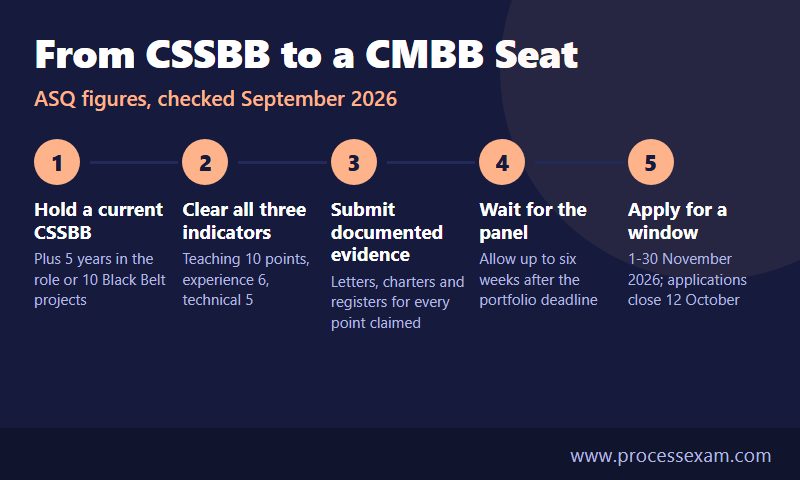
There is a hard prerequisite and then a choice of two experience routes. The prerequisite is a current ASQ Certified Six Sigma Black Belt. Not a Black Belt certificate from a training company, not a lapsed ASQ one, and not an equivalent from another body: ASQ asks for its own CSSBB, in force at the time you apply. Because the CSSBB is itself a credential that has to be renewed every three years, checking its expiry date is a sensible first act for anyone thinking about the Master Black Belt.
On top of that, you claim one of two experience categories, and ASQ frames them as alternatives rather than as a sliding scale:
- Category 1 — at least five years serving in the role of a Six Sigma Black Belt or a Master Black Belt.
- Category 2 — completion of 10 Six Sigma Black Belt projects.
The distinction between them is time served against volume delivered. Category 1 suits somebody who currently holds the role and can show a continuous stretch in it. Category 2 suits somebody whose Black Belt years are behind them, or who has worked as a consultant across several employers, and whose strongest claim is the count of finished projects rather than a job title held for five unbroken years.
Whichever you claim, you have to evidence it. ASQ asks for a copy of the CSSBB certificate plus proof of the category. A Category 1 claim is normally supported by letters from employers or clients that describe the role you held and confirm the five-year period. A Category 2 claim needs a list and description of the ten projects, with letters from employers or clients attesting to your part in each one. There is also a project affidavit form in ASQ's portfolio pack for exactly this purpose.
Two practical warnings follow from that. First, attestation letters are much easier to collect while the people who can sign them still work where you worked; candidates who leave it until application season routinely lose a project or two to a reorganisation or a retirement. Second, ASQ refreshes the portfolio application pack each year and prints an expiry date in the footer, so download it again rather than filling in a copy saved eighteen months ago.
What must the portfolio prove, and how many points does each section need?
The portfolio is scored, not simply read. ASQ assesses three key performance indicators and sets a separate minimum for each, and you have to clear all three. A towering score in one section does not compensate for a shortfall in another, which is the single most common misunderstanding about the process.
| Portfolio indicator | Minimum points | What the panel is looking for |
|---|---|---|
| Teaching, coaching, mentoring | 10 | Evidence that you have developed other people: belts trained, courses delivered, champions and executives coached, project reviews run |
| Occupational experience and responsibility | 6 | The seniority and breadth of what you have been accountable for in an improvement programme |
| Technical experience and innovation | 5 | Depth of method: the tools you have actually applied, and what you have done that was not simply following a template |
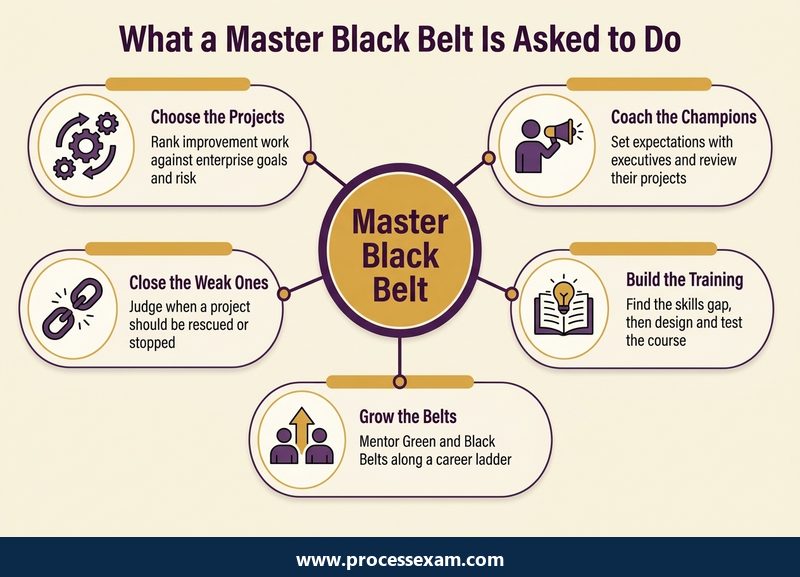
Notice how the weighting falls. The largest minimum, by some distance, sits on teaching, coaching and mentoring. That is the clearest signal ASQ gives about what separates a Master Black Belt from a very good Black Belt: the Black Belt delivers results, while the Master Black Belt multiplies other people who can deliver results. Candidates who come from a heavily technical background, with brilliant analysis and few teaching records, are the ones most likely to be turned back at this gate.
The burden of proof sits with you throughout. Points are claimed against criteria and each claim has to be backed by documented evidence of the kind ASQ lists in its instructions. The panel can issue a request for evidence when a score falls slightly short in one or more indicators, giving you one opportunity to supply something you omitted, but ASQ is explicit that this is discretionary and should never be counted on. An application that fails receives feedback explaining why, along with what resubmission would involve.
Build the evidence file long before you build the application. A simple running log — each course taught with dates and attendee numbers, each belt mentored and for how long, each project with its charter, its measured result and a named sponsor — converts what is otherwise a frantic month of archaeology into an afternoon of assembly.
What does the CMBB cost, and which testing windows can you apply for?
Here are the exam facts in one place, as they stand for the CMBB:
| Exam detail | CMBB |
|---|---|
| Full name | ASQ Certified Master Black Belt |
| Exam code | CMBB |
| Vendor | ASQ |
| Number of questions | 110 |
| Duration | Total appointment time — 330 minutes; exam time — 320 minutes |
| Exam fee | ASQ MEMBERS - $1,499 NON-MEMBERS - $1,599 RETAKES - $1,399 |
| Passing score | 550/750 |
Add the portfolio review to that and the true first-attempt cost for a non-member is the $800 review plus the $1,599 exam; for an ASQ member it is $700 plus $1,499. ASQ notes that the exam price includes a $130 non-refundable element, and the same $130 reappears as the charge for moving an appointment, which has to be done at least five days before the slot. Failing to turn up forfeits what you have paid. If you do sit and do not pass, ASQ offers a reduced retake rate for two years from the attempt, which is where the $1,399 retake figure applies. The full set of figures also sits on our CMBB exam syllabus page alongside the topic list.
Timing is the part candidates underestimate. The CMBB is not available on demand. ASQ runs it twice a year, in the July and November testing windows, and each window closes to applications weeks before it opens. The next one is 1–30 November 2026, with an application deadline of 12 October 2026 (ASQ, checked September 2026); the July 2026 window and its deadline have already gone. Because the portfolio has to clear the panel before you are allowed to register, the deadline that really governs your year is the portfolio one, not the exam one. Confirm both against ASQ's exam dates and deadlines page before you commit, since window dates move from year to year.
Two delivery restrictions matter when you are planning. The Master Black Belt is a test-centre exam only: ASQ does not offer it under remote proctoring at home, and it is not among the exams available on paper. You will be booking a physical seat, in a window that lasts a month, in a year that offers two of them.
How does ASQ split the 100 scored questions across the CMBB Body of Knowledge?
The paper carries 110 multiple-choice items, of which 100 are scored and 10 are unscored trial questions that do not count either way. You cannot tell which is which while you sit there, so the only sane strategy is to treat every item as live. Those 100 scored questions map onto six areas of the Body of Knowledge, and the split is uneven enough to shape a study plan:
| Body of Knowledge area | Scored questions | Representative content |
|---|---|---|
| I. Enterprise-wide planning | 20 | Hoshin Kanri, X matrix, SWOT, PESTLE, Ansoff matrix, Porter's five forces, balanced scorecard, business excellence models; aligning projects to strategy; DMAIC, DMADV, Lean and theory of constraints as methodologies |
| II. Organizational competencies for deployment | 20 | Systems thinking, organisational maturity, executive and team leadership roles, intervention styles, change models such as Kotter's eight steps and ADKAR, voice of the customer and process, financial and business measures |
| III. Project portfolio management | 15 | Project life cycle, governance documents, cross-functional assessment, prioritisation, performance measurement, status communication, supply and demand projections, budgets, hard and soft dollars, activity-based costing |
| IV. Training design and delivery | 10 | Training needs analysis and gap analysis, training plan design, in-house against outsourced delivery, adult learning theory, integration with strategy, evaluating training effectiveness |
| V. Coaching and mentoring responsibilities | 10 | Scoping and resourcing with champions, executive reviews, feedback techniques, belt career ladders, project review guidelines, team facilitation, coaching non-belt participants |
| VI. Advanced data management and analytic methods | 25 | Propagation of errors, attribute and destructive measurement systems, capability for non-normal data, automated against statistical process control, multiple and logistic regression, general linear models, components of variation, simulation, reliability modelling, design of experiments, data governance, predictive analytics, design for Six Sigma tools |
Read that table twice. A quarter of the scored paper sits in the final area, and it is the most technically demanding quarter: Weibull capability for non-normal data, variance inflation factors in multiple regression, Latin squares and balanced incomplete block designs, definitive screening designs, response surface methodology, evolutionary operations, Monte Carlo and queuing simulation, ARIMA forecasting, and the recognition questions on decision trees, random forests, neural networks and text analytics. Meanwhile the two leadership areas together carry only 20 questions, which is often the reverse of where an experienced Black Belt's instincts lie.
The other dimension of the Body of Knowledge is the cognitive level. Every topic carries a descriptor in brackets drawn from the revised Bloom's taxonomy — remember, understand, apply, analyze, evaluate, create — and the Master Black Belt document is weighted towards the top of that ladder. Items marked create and evaluate cover things like designing a deployment action plan, building governance documents, developing a belt career ladder and judging which projects deserve continued funding. Reading a definition is not preparation for a question written at that level; you have to be able to decide something and defend the decision.
What does the performance-based part of the paper ask you to do?
Alongside the multiple-choice items sits a performance-based assessment, and it is the feature that surprises candidates who prepared as though this were a longer CSSBB. ASQ presents you with a situation rather than a question: an organisation weighing up several improvement projects, background material about the parent company, and documents holding the key details of each project. The questions that follow are open-ended.
The kinds of task ASQ describes include evaluating projects against organisation-wide goals, producing presentation content pitched at a named audience, communicating with staff at different levels of the hierarchy, analysing output from projects at various stages of completion, and deciding whether a project should keep its funding or be closed out. Scoring follows four performance-based entries in the Body of Knowledge, covering enterprise-wide planning, organisational competencies for deployment, project portfolio management, and training, coaching and mentoring.
The appointment as a whole is open book, and ASQ's reference rules are strict about form as well as content: material has to be permanently bound, stitched, glued or fastened right through, and inspected before you enter the room, with sticky tabs allowed only if they were attached beforehand. A basic scientific calculator appears on screen, a simple hand-held one can be requested, and anything programmable — a TI-89 and its relatives are named explicitly — stays in the locker. Plan to arrive half an hour early, because a late arrival is refused entry and loses the fee.
The whole exam is delivered in English, and a computer-based result appears as soon as you submit, with written confirmation following within a few business days.
How should a working Black Belt plan the year from portfolio to pass?
Work backwards from the window you want, not forwards from the day you decide to try. For a November attempt, the exam application deadline falls in mid-October; the portfolio result has to be in hand before that, and ASQ asks candidates to allow up to six weeks after the portfolio deadline for notification. Add the weeks you will need to chase attestation letters from former managers, and the honest starting point is the early part of the same year.
| Stage | Roughly when | What to finish |
|---|---|---|
| Audit your position | Six to nine months out | Confirm the CSSBB is current, decide whether you are claiming the five-year role or the ten projects, and list the evidence you already hold |
| Collect evidence | Five to seven months out | Request attestation letters, gather course registers, project charters and results, and draft each portfolio claim against its indicator |
| Submit and wait | Three to five months out | Download the current portfolio pack, complete it, submit, and use the waiting weeks for study rather than for worrying |
| Close the technical gap | Two to four months out | Work through the advanced analytic methods area in depth; it is the quarter of the paper most likely to be rusty |
| Rehearse the exam | Final six weeks | Time yourself on full-length question sets, practise open-ended project scenarios, and finish the bound reference set |
For study material, ASQ points candidates to the Certified Master Black Belt Handbook as the companion to the Body of Knowledge, and the reference list published with the exam gives the wider basis for the questions. Map your revision onto the six areas and their question counts rather than reading cover to cover; twenty-five questions in one area justifies a different amount of attention from ten in another.
Treat the open-book allowance as a skill to rehearse rather than a safety net to lean on. A reference set only helps if you know where a formula lives, so build and tab your bound material weeks in advance and practise looking things up under time pressure. If you want an honest read on whether your statistics have kept pace with your project record, two or three timed runs at a CMBB practice test will find the gaps faster than another pass through the handbook.
Finally, prepare the performance-based section deliberately. Take a real portfolio of projects from your own organisation, write the one-page case for keeping two of them and closing a third, and read it back as though you were the executive receiving it. That exercise rehearses exactly the judgement ASQ scores, and it costs an evening.
What does it take to keep the CMBB once you have earned it?
The Master Black Belt is not one of ASQ's lifetime credentials. It sits on the list that has to be renewed every three years, and there are only two ways to do it: accumulate 18 recertification units within the three-year period, or sit the exam again at the end of it. Every activity you claim has to tie back to an area of the Body of Knowledge for the certification you are renewing, which is a tidy way of ensuring that what keeps the credential alive is the same subject matter it certified.
Units come from three streams. Professional development has no ceiling and covers continuing education at 0.1 unit an hour whether you attend or teach, other certifications, and published work — four units for authoring or editing a book, one for an article, one for a presented paper. Meetings and events pay by the day for conferences and workshops and by the hour for seminars. Employment is capped: full-time work earns 0.3 units a month, 3.6 a year, and no more than 10.8 units across the whole period, so a journal built on employment alone cannot reach 18. Giving back, added in 2024, lets volunteering and mentoring count.
The date discipline matters. ASQ allows a 60-day grace period after your recertification date to file by journal; miss that and the only remaining route is the exam. Keep the journal current as you go rather than reconstructing three years of activity in its final month, and remember that most Master Black Belts are carrying a second journal for the CSSBB underneath it. The full rules, categories and unit values are set out on ASQ's recertification pages.
What you get in return for that maintenance is a credential that says something structurally different from every other belt. A Black Belt says you can run the project. The Master Black Belt says a panel of people who do the job read your evidence, agreed you develop other practitioners, and then watched you answer 100 scored questions and an open-ended business case. That combination is the reason the portfolio exists, and it is why the certification is worth the year it takes to plan.
Frequently Asked Questions
What are the ASQ Master Black Belt certification requirements?
You need a current ASQ Certified Six Sigma Black Belt, plus either five years in a Black Belt or Master Black Belt role or ten completed Black Belt projects. A scored portfolio of that work must then be approved by an ASQ review panel before you may register for the exam.
How much does the ASQ CMBB certification cost?
The exam is $1,599 for non-members, $1,499 for ASQ members and $1,399 for retakes. The portfolio review is charged separately and is not refundable: ASQ lists $800, or $700 for members. Both are payable for a first attempt, so budget the review and the exam together rather than as one price.
When is the next ASQ Master Black Belt exam?
ASQ offers the CMBB twice a year, in the July and November testing windows. The next window runs from 1 to 30 November 2026, with applications closing on 12 October 2026, checked in September 2026. Confirm current dates on ASQ's exam dates and deadlines page before applying.
How many questions are on the CMBB exam and what score do you need?
The paper has 110 multiple-choice items, of which 100 are scored and 10 are unscored, plus a performance-based assessment. The passing score is 550 out of 750. Total appointment time is 330 minutes, with 320 minutes of that available as exam time.
Does the ASQ Master Black Belt certification expire?
Yes. The Master Black Belt is on ASQ's recertification list, so it must be renewed every three years, either with 18 recertification units or by retaking the exam. A 60-day grace period follows your recertification date, after which only the exam route remains open.
- Six Sigma |
- ASQ Master Black Belt Test Questions |
- ASQ Master Black Belt Book |
- Master Black Belt Certification Cost |
- Master Black Belt Certification Requirements |
- ASQ Master Black Belt Sample Questions |
- Master Black Belt PDF |
- CMBB Question Bank |
- CMBB Body of Knowledge (BOK) |
- Master Black Belt Simulator |
- Master Black Belt Mock Exam |
- ASQ CMBB BOK PDF |
- CMBB Exam Questions Download |
- CMBB Test Questions |
- CMBB Handbook


