
ASQ CCQM Certification: Why Construction Quality Is Now a Leadership Role
Construction quality used to be judged at the end, when someone walked the site with a punch list. It is now decided far earlier, in contract terms, design reviews, prequalification criteria and risk registers. ASQ built the Certified Construction Quality Manager (CCQM) credential around that shift: two thirds of its questions sit before and beyond the build itself. The exam has 165 questions, is open book, and is scored 550/750.
That change in where quality is decided is also a change in who does it. A decade ago the job title on a construction site was inspector; the work was measurement, documentation and rework. Today the same person is expected to write the project quality strategy, sit in bid evaluations, question a delegated design, argue a case in front of the owner and report cost of quality to people who hold a budget. The CCQM exam is built for that second job, not the first.
This article sets out what has changed in the discipline, exactly what the exam tests, what it costs, how to prepare for it while holding down a project role, and what the credential is actually worth once you have it.
What changed in construction quality, and why did ASQ create the CCQM?
Three pressures moved construction quality out of the site hut and into the project leadership team.
The first is contractual. Delivery models such as Design-Build, Construction Manager at Risk, EPCM and Design, Build, Finance and Maintain push far more risk onto the contractor and blur the old line between the people who design and the people who build. When the same organisation carries design and construction risk, quality requirements have to be written into the contract, the bid criteria and the subcontract packages at the very start. Someone has to own that, and it is no longer the person with the clipboard.
The second is regulatory and social. Environmental, social and governance commitments, authority-having-jurisdiction oversight, laboratory accreditation, commissioning regimes and public scrutiny of building safety have all turned documentation into evidence. A project that cannot show a traceable chain from specification to inspection to turnover record has a compliance problem, not just a paperwork problem.
The third is economic. Rework, warranty claims and late nonconformances are expensive, and the people funding projects increasingly want them quantified. Cost of quality analysis, once a manufacturing idea, is now a construction conversation.
ASQ's own description of the credential reflects all three. On the ASQ Construction Quality Manager certification page, the certified professional is described as someone who oversees contract development, strategic quality planning, resource management, the design process, required documentation and project closure, and who applies quality control, team building, project management, risk management, environmental and social governance and safety management to improve project outcomes. Notice how little of that sentence is about inspection.
Who should sit the CCQM exam, and are you eligible?
The credential fits people who already carry responsibility for quality decisions rather than quality records. In practice that means construction quality managers and QA/QC managers, project and programme managers who own quality plans, design managers and engineers who run constructability and verification reviews, procurement and supplier quality specialists who set trade partner requirements, commissioning and turnover leads, and consultants who advise owners on quality regimes.
The experience requirement
ASQ asks for eight years of on-the-job experience in one or more areas of the Construction Quality Manager Body of Knowledge, of which at least three years must be in a decision-making position. ASQ defines a decision-making position as one with the authority to define, execute or control projects or processes and to be responsible for the outcome, which may or may not be a supervisory role. The work must have been full-time and paid, and up to one year may be claimed from an internship or apprenticeship.
What education waives
A completed qualification reduces the eight years, and only one waiver may be claimed:
- Diploma from a technical or trade school: one year waived.
- Associate degree: two years waived.
- Bachelor's degree: four years waived.
- Master's or doctorate: five years waived.
The three decision-making years are not waived by education. A candidate with a master's degree still needs three years of genuine authority over projects or processes, so describe that authority plainly in the application: which decisions you made, on what, and who was accountable for the result. Applications are submitted through ASQ's certification application page, where you choose your testing window at the same time.
What are the CCQM exam facts you need before you apply?
The computer-delivered CCQM exam is a one-part, multiple-choice exam offered in English only. ASQ states that 150 of the 165 questions are scored and 15 are unscored; you cannot tell which is which, so treat every question as if it counts.
| Exam detail | ASQ CCQM |
|---|---|
| Full name | ASQ Certified Construction Quality Manager |
| Exam code | CCQM |
| Vendor | ASQ |
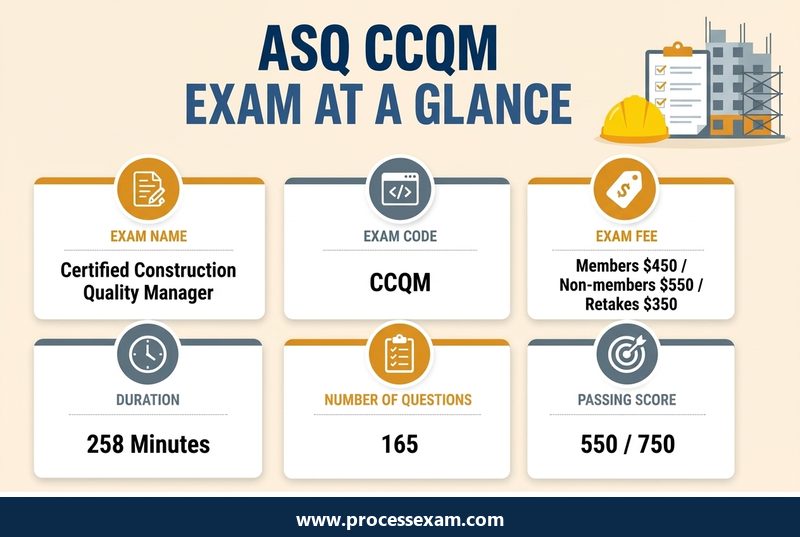
| Number of questions | 165 (150 scored + 15 unscored, per ASQ) |
| Duration (minutes) | Total appointment time- 270 / Exam Time - 258 |
| Exam fee | ASQ MEMBERS - $450 / NON-MEMBERS - $550 / RETAKES - $350 |
| Passing score | 550/750 |
| Body of Knowledge | CCQM Body of Knowledge, effective February 2025 |
| Format | Open book, multiple choice, English, computer-based testing |
What the timing really means
Exam Time - 258 minutes for 165 questions is about one minute and thirty-four seconds per question, inside a total appointment time of 270 minutes that also covers check-in and the tutorial. On an open-book exam that margin is thinner than it looks, because every reference you open costs you question time. The candidates who run short are almost always the ones looking up material they already knew.
What the fees really mean
The fee is listed as ASQ MEMBERS - $450, NON-MEMBERS - $550 and RETAKES - $350. The member rate applies to the initial examination, so if you expect to take more than one ASQ exam, or to use ASQ resources while you study, compare the membership cost against the saving before you apply. The retake rate is the one to keep in mind if the first attempt does not go your way: ASQ allows an application at the reduced retake rate for two years from the previous attempt.
Open book, but strictly bound
All ASQ exams are open book and all reference material, including your own notes, must be bound and stay bound throughout: stitched or glued books, or pages held by fasteners that pass through every sheet, such as ring binders, spiral binders or screw posts. Hand-stapled documents are refused. Sticky notes are permitted only as tabs, attached before you arrive, and the test centre administrator inspects every reference at the door. Exams feature an on-screen basic scientific calculator; a silent, non-programmable hand-held calculator is also allowed.
When you can sit it
ASQ runs computer-based testing windows through the year and publishes the next window and its application deadline on the CCQM page. Checked in September 2026, the page listed the October 1 - 31, 2026 window with an application deadline of September 14, 2026. Check the current window before you plan a study timetable, because the deadline falls weeks before the window opens.
Which parts of the CCQM Body of Knowledge carry the most weight?
The CCQM Body of Knowledge published by ASQ divides the 150 scored questions across eight areas. The distribution is the clearest study signal the exam gives you, and it is where the leadership shift shows up most plainly: the Construction phase is the largest single area with 34 questions, but Planning, Design and Procurement together carry 65, and Quality Manager Skills carries 22 on its own.
| Area | Scored questions |
|---|---|
| I. Pre-contract Phase | 13 |
| II. Planning Phase | 30 |
| III. Design Phase | 20 |
| IV. Procurement | 15 |
| V. Construction | 34 |
| VI. Project Turnover and Closeout | 11 |
| VII. Operations and Maintenance | 5 |
| VIII. Quality Manager Skills | 22 |
| Total scored questions | 150 |
Our ASQ CCQM exam syllabus page lays the same breakdown out topic by topic if you want it beside your study notes.
I. Pre-contract Phase (13 questions)
This area asks whether you understand the commercial frame a project sits in. It covers project delivery methods and the client types that use them, from private and commercial to federal, state, municipal and international, and contract sources such as P3, DBIA, AIA and FIDIC forms, lump sum agreements, subcontracts, consultant agreements and joint ventures. You need to recognise contract terms including liquidated damages and general damages, and understand payment models such as unit rates, reimbursable cost and guaranteed maximum price, along with the documentation behind them: schedule of values, percent completion, retainage and billing terms.
It then moves to contractual requirements, where the cognitive level rises: defining scope, developing schedule and resource plans, analysing quality management inputs such as requests for proposal, engaging stakeholders, applying delegated design and understanding the risk it transfers. The area closes with bid evaluation, prequalification and criteria development, which are analysis-level topics.
II. Planning Phase (30 questions)
The second-largest area, and the one most candidates underestimate. It begins with strategic quality planning, including how a project quality strategy is formulated, how environmental, social and governance practices are built into it, and how the quality plan aligns with the other project plans. It then covers the quality management system itself: applicable industry standards, the Quality Management Plan, and the distinction between quality assurance and quality control as activities rather than as job titles.
Resource planning and analysis follows, covering resource assessment and mobilisation, the roles of quality personnel and internal stakeholders, training needs, third-party inspection and outsourcing, measurement systems analysis, and the tools and infrastructure a quality function needs. The area ends with quality audits: audit types, the audit plan and audit performance.
III. Design Phase (20 questions)
Design is where the largest and cheapest quality gains are available, which is why ASQ gives it 20 questions. The area runs from design inputs, meaning quality objectives, the coordination of functional and nonfunctional requirements and the use of lessons learned, through the design process itself, where stakeholder involvement, the application of the QMS to design feedback, and functionality and constructability reviews appear.
Design outputs cover quality objectives review, cross-disciplinary design review and the setting of criticality levels for inspection. Quality controls in design cover project controls, design review output, design changes and design verification and validation, and the area closes with measurement and monitoring: design monitoring, peer reviews and quality documentation.
IV. Procurement (15 questions)
Procurement carries the exam's dedicated risk management topics. It opens with quality requirements for procurement and the alignment of trade partner requirements, moves through resource management, covering pre-activity meetings, material control, resource identification and mobilisation, and then devotes a full section to risk identification and analysis, risk treatment and risk monitoring. It ends with quality reporting: reviewing and interpreting quality documents, communicating quality insights and evaluating vendor performance.
V. Construction (34 questions)
The largest area, and the one closest to the traditional job. Quality plan deployment covers construction plans and specifications, permits, submittals, material evaluation and requests for information or change. Process management covers a risk-based inspection and testing strategy, quality management processes, and quality control and monitoring. Destructive and nondestructive testing has its own topic.
Compliance management covers laboratory accreditation, compliance monitoring and dealings with the regulatory body or Authority Having Jurisdiction. Quality monitoring and reporting closes the area with acceptance criteria, reporting and analysis, meetings and participation, lessons and improvements, and the levels of commissioning.
VI and VII. Turnover, Closeout, Operations and Maintenance (16 questions)
Turnover and closeout carries 11 questions on documentation management: impact assessment and compliance, required documentation, nonconforming work, verification of quality deliverables, final certification, turnover and closeout documentation, and warranties. Operations and Maintenance adds 5 questions on sustaining quality requirements and business continuity. Sixteen questions is not many, but they are easy marks for anyone who has actually closed out a project, and easy losses for anyone who has not.
VIII. Quality Manager Skills (22 questions)
This is the leadership area, and at 22 questions it outweighs Procurement and rivals Design. It opens with the ASQ Code of Ethics, tested at the analyse level, then stakeholder analysis and alignment, including collaboration and negotiation techniques. Team building covers vision development, the forming, storming, norming, performing and adjourning stages, communication techniques, the RACI matrix, decision-making pitfalls such as groupthink and power dynamics, and conflict resolution.
Change management covers organisational culture and change strategies. Cost of Quality is the most demanding topic in the area, tested at the evaluate level: collecting and interpreting CoQ data, using it as the basis for improvement alongside Lean, Six Sigma DMAIC and Deming's System of Profound Knowledge, and assessing how improvement efforts align with organisational goals. Customer satisfaction covers feedback systems, customer value analysis and experience enhancement, and the area ends with quality tools, learning and best-practice analysis and knowledge management.
Read the cognitive level, not just the topic
Every entry in the Body of Knowledge ends with a cognitive level from Bloom's revised taxonomy: Remember, Understand, Apply, Analyze, Evaluate or Create. That descriptor tells you how a question will be written. An Understand topic can be answered from a reference on your desk. An Analyze or Evaluate topic cannot, because the question will describe a situation and ask you to break it down or judge it. Marking your study notes with these levels is the single fastest way to work out which topics need memory and which need practice.
How should a working quality manager prepare for the CCQM exam?
Almost everyone sitting this exam already has eight years of construction experience, which changes the preparation problem. You are not learning a discipline from scratch; you are closing the gaps between the parts of it you do daily and the parts you have only watched other people do. The plan below assumes about an hour a day across ten to twelve weeks.
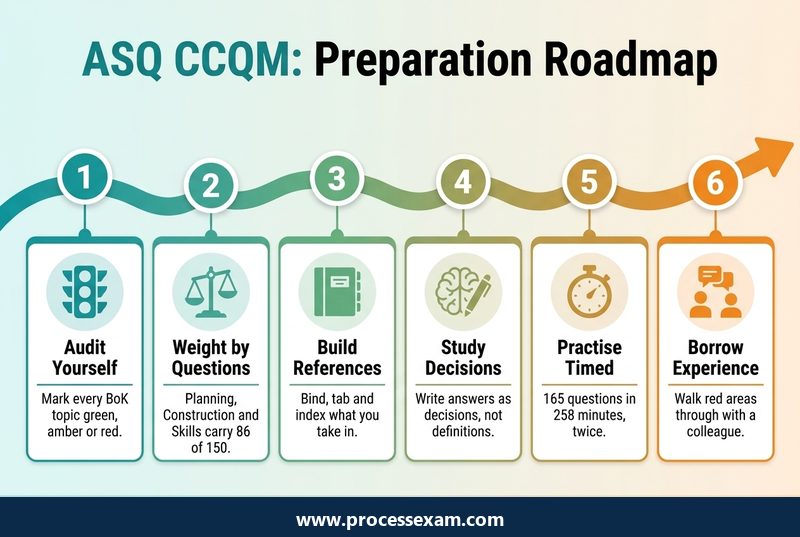
Step 1: Audit yourself against the Body of Knowledge
Print the Body of Knowledge and mark every subtopic green, amber or red: green where you have made decisions yourself, amber where you know the theory, red where you have no working contact. A site-based QA manager typically comes out green on Construction and red on Pre-contract and Cost of Quality; a design manager gets the opposite pattern. The red list is your real syllabus, and it is usually much shorter than the whole document.
Step 2: Weight your time by question count, not by comfort
Planning, Construction and Quality Manager Skills carry 86 of the 150 scored questions between them. Give those three more than half your study time even if two of them feel familiar, and resist spending evenings on Operations and Maintenance, which carries five.
Step 3: Build the reference set you will actually take in
Because the exam is open book, decide early what goes on the desk and then study from those same materials so you know where everything is. Most candidates take the CCQM handbook, a bound copy of their own notes and any standards they rely on. Tab the sections by Body of Knowledge area, add a one-page index at the front, and get the binding done well before exam week. ASQ also publishes a CCQM handbook and a question bank through its own store if you want vendor-aligned material.
Step 4: Turn each red topic into a decision, not a definition
For every unfamiliar topic, write a one-line answer to a decision question rather than a definition. Not "what is delegated design" but "when a subcontractor is given design responsibility, what are the three things I check". Not "what is a schedule of values" but "what does a schedule of values let me verify before I approve a payment". The exam is written the same way, so notes in this form transfer straight into answers.
Step 5: Practise under the clock
Familiarity with the material is not the same as answering 165 questions in 258 minutes with references open. Work in timed blocks from the start, sit at least two full-length runs in the last month, and after each one review every question you got wrong, guessed, or answered slowly. That error log, sorted by Body of Knowledge area, is what you revise in the final week.
If you would rather measure where you stand before committing to a testing window, sit a timed CCQM practice exam built to the same 165-question, 258-minute shape and treat the result as a diagnostic rather than a score.
Step 6: Borrow experience you do not have
Where a whole area is red, twenty minutes with a colleague beats two hours of reading. Ask the commercial manager to walk you through a bid evaluation, the design manager to show you a constructability review comment log, the commissioning lead to explain the levels of commissioning on your current project. You will remember the conversation in the exam room; you will not remember the paragraph.
Which mistakes cost CCQM candidates the most marks?
The failure patterns on this exam are unusually consistent, and almost all of them come from treating it as a site-inspection exam.
- Studying only the Construction area. It is the largest at 34 questions, but the other 116 scored questions are somewhere else entirely.
- Skipping Quality Manager Skills. Twenty-two questions on ethics, stakeholders, teams, change, cost of quality and customer satisfaction, and they are the questions experienced site professionals most often dismiss as soft.
- Treating open book as a substitute for preparation. Roughly ninety seconds a question does not allow a search for every answer; references are for confirming, not for learning.
- Answering from your own project. The exam asks what should happen under the delivery model and standards described in the question, which may not be the model you work under.
- Ignoring cognitive levels. Analyze and Evaluate topics need practice at judging scenarios; reading them again does not help.
- Leaving the application to the deadline. The application deadline sits weeks before the testing window, and ASQ reviews eligibility before you can book.
- Unbound notes. Loose or hand-stapled material is taken off you at the door, however good it is.
What should you expect on exam day and after it?
The final week is for consolidation, not new material. By then every area should have been covered once, and the job is turning that coverage into fast, confident answers.
The last seven days
Sit your final full-length timed run, sort the errors by area, and spend the remaining days on the two areas that produced the most. Check that your references are bound, tabbed and indexed, and that the index points at pages you genuinely use. Build one page of final notes: the eight areas and their question counts, the delivery and contract models, the audit types, the commissioning levels and the cost of quality categories.
The day before
Confirm the appointment time and the test centre address, and pack a valid government-issued photo ID with a signature that matches the name on your application, plus your bound references and a permitted calculator if you want one. Plan to arrive thirty minutes early for check-in; personal belongings go into a locker, and you keep only your ID and the locker key. Then stop revising.
In the exam room
Read the final line of each scenario before the detail, so you know what is being asked before you read the situation. Watch the qualifiers that decide many questions: FIRST, BEST, MOST and NOT. Answer everything you know on the first pass and flag the rest, then come back with the time you have saved. Reach for a reference only to confirm a figure or a definition you half-remember, never to work out an answer from first principles.
After you submit
For a computer-based exam, ASQ shows the result immediately after you submit, with an email confirming it within three to five business days and a separate email about claiming the digital certificate and badge. Candidates who do not pass receive a summary of their performance by email within three to five business days and can reapply at the reduced retake rate for two years. Results for exams with new or updated Bodies of Knowledge are communicated within five weeks instead.
Keeping the credential
CCQM is one of the ASQ certifications that must be renewed every three years, either by collecting 18 recertification units within the period or by retaking the exam. ASQ sets its recertification requirements and fees on its own page, including a sixty-day grace period after the recertification date and the rules for synchronising several ASQ certifications into one renewal. Plan the units as you go; collecting them retrospectively is the usual reason people end up retaking an exam they already passed.
Is the CCQM certification worth it for a quality leader's career?
The honest answer depends on which direction you are moving. If your ambition is to stay in inspection and testing, the eight-year eligibility bar and the strategic weighting of the exam make it a poor fit. If you are moving toward owning quality on a project or across a portfolio, it is one of the few credentials that tests exactly that job.
Three things make it useful in practice. It is independent evidence that you understand the commercial and design side of quality, which is the part employers find hardest to assess in an interview. It comes from ASQ, a body whose certifications are recognised across industries rather than within one contractor's ecosystem, which travels well when you change employer or country. And the preparation itself is genuinely useful: the areas most candidates study hardest, contract models, risk treatment, cost of quality and stakeholder alignment, are the areas that decide whether a quality function is listened to.
It also fits a market that is asking for this specific skill set. Owners are writing tighter quality regimes into contracts, ESG and building safety requirements are pushing documentation upstream, and delivery models keep shifting risk toward the people doing the building. Every one of those trends increases demand for someone who can design a quality system for a project rather than police one.
The roles that gain most are construction quality manager, QA/QC manager, project and design managers with quality accountability, supplier and trade partner quality leads, commissioning and turnover managers, and owner-side quality consultants. If that is the direction you are heading, the credential is aimed squarely at you, and the eight-year requirement means the people holding it are a small, senior group.
Frequently Asked Questions
What are the eligibility requirements for the ASQ CCQM exam?
ASQ requires eight years of on-the-job experience in one or more areas of the CCQM Body of Knowledge, with at least three years in a decision-making position. Education waives part of it: one year for a trade diploma, two for an associate degree, four for a bachelor's degree and five for a master's or doctorate.
How many questions are on the CCQM exam and how long is it?
The CCQM exam has 165 multiple-choice questions, of which ASQ scores 150 and leaves 15 unscored. Master lists the duration as Total appointment time- 270 and Exam Time - 258 minutes, which works out at roughly ninety seconds per question once check-in is excluded.
How much does the ASQ CCQM exam cost?
The CCQM exam fee is listed as ASQ MEMBERS - $450, NON-MEMBERS - $550 and RETAKES - $350. The member rate applies to the initial examination and the retake rate is available for two years after a previous attempt. Confirm current fees on ASQ's CCQM page before applying.
What is the passing score for the CCQM exam?
The passing score for the CCQM exam is 550/750. ASQ reports computer-based results on screen immediately after you submit, with a confirming email within three to five business days. Exams testing a new or updated Body of Knowledge are reported within five weeks instead.
Which CCQM areas carry the most questions?
Construction is the largest area with 34 scored questions, followed by the Planning Phase with 30, Quality Manager Skills with 22 and the Design Phase with 20. Procurement carries 15, the Pre-contract Phase 13, Turnover and Closeout 11 and Operations and Maintenance 5.
Is the CCQM exam open book?
Yes. All ASQ exams are open book, but every reference, including your own notes, must be bound and stay bound: stitched, glued or held by fasteners that pass through every page. Hand-stapled material is refused, and sticky notes are allowed only as tabs attached before you arrive.
How often does the CCQM certification need renewing?
CCQM is renewed every three years, either by collecting 18 recertification units within the period or by retaking the exam. ASQ allows a sixty-day grace period after the recertification date and lets holders of several ASQ certifications synchronise them into a single renewal.
- ASQ Construction Quality Manager Test Questions |
- CCQM Question Bank |
- CCQM Body of Knowledge (BOK) |
- Construction Quality Manager Simulator |
- Construction Quality Manager Mock Exam |
- ASQ Construction Quality Manager Book |
- ASQ CCQM BOK PDF |
- Construction Quality Manager Certification Cost |
- Construction Quality Manager Certification Requirements |
- ASQ Construction Quality Manager Sample Questions |
- CCQM Exam Questions Download |
- CCQM Test Questions |
- Construction Quality Manager PDF |
- CCQM Handbook


