
After You Pass the aPHR: Keep It, Use It, Move Up to the PHR

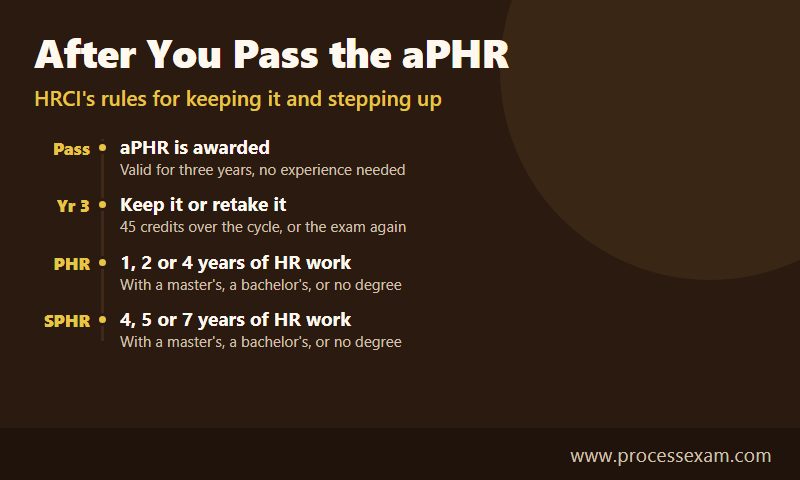
Passing the aPHR is the start of a three-year clock, not the finish line. HRCI keeps the aPHR certification valid for three years, and you hold it by earning 45 recertification credits over that span or by retaking the exam. The real career question comes next: what the credential backs up in your first HR years, and when you can move up to the PHR.
That sequence is the whole subject of this guide. It assumes you have already decided the aPHR was worth taking, or that you are about to sit it and want to know where it leads. Every rule about renewal and experience below comes from HRCI's own pages, read in November 2026, and each is linked so you can confirm the current wording before you plan around it.
What do you actually hold on the day you pass the aPHR?
You hold HRCI's knowledge-based entry credential. HRCI's aPHR page says plainly that "no HR experience is required" to earn it, which is why the aPHR is the usual first step for graduates and career changers. It tests what you know about HR; it does not certify what you have done, and that difference shapes everything that follows.
The exam you passed is worth keeping in view, because a retake is one of the ways to renew it later.
| Item | aPHR detail |
|---|---|
| Certification | HRCI Associate Professional in Human Resources (aPHR) |
| Category | Knowledge Certification |
| Fees | Exam Fee: $300; Application Fee: $100 |
| Questions | 90 (65 scored plus 25 pretest, as HRCI describes them) |
| Duration | 105 minutes plus 30 minutes administration time |
| Passing score | 500 (on a scale of 100-700) |
| Validity | Three years, according to HRCI |
Two habits are worth forming at this point. First, save your result and certificate details somewhere you will find them in three years. Second, write down the date you passed, because every later deadline is counted from it. Where HRCI shows a precise expiry date in your own account, trust that screen over any article, this one included.
How does HRCI keep the aPHR alive across its three-year cycle?
HRCI's aPHR page sets the aPHR requirement at 45 credits over a three-year span, or a retake of the exam. HRCI's individual recertification page explains that every HRCI certification has to be renewed every three years, either by earning credits through professional development or by retaking the exam.
What counts as a credit?
HRCI describes two broad families of activity. The first is HR-related learning: conferences, courses, webinars and reading. The second is professional achievement: implementing a new programme, volunteering your expertise, or carrying out research. The page also names three routes into the credit total. You can add learning to your recertification application yourself, you can take courses from providers in HRCI's approved network, or you can use the HRCI Learning Center, where learning is recorded for you automatically.
That list is a good guide to how a junior HR person can collect credits without a training budget. A webinar on a statute you meet at work is a learning activity. Rolling out a new onboarding checklist for your team is the kind of project HRCI lists under professional achievements. What HRCI does not publish on that page is a table of credit values, so confirm the value of a specific activity in your account before you count on it.
Is there an ethics credit?
HRCI's ethics requirement page says that all certificants must fulfil one ethics credit as part of their total recertification requirement, effective 1 January 2021. That page does not name the aPHR specifically, so do not assume either way. Check in your own recertification record whether one of your 45 must be an ethics credit, and plan that one early; it is the easiest requirement to forget and the hardest to squeeze into the last month.
What HRCI's pages leave open
The recertification page does not state the fee, the reporting deadline or what happens to a certification that lapses. Those details change, so they belong to your account screen and to HRCI's help desk, not to a blog post. Treat any number you see quoted elsewhere for them as unverified until you find it on an HRCI page dated this year.
Which first-year HR tasks do the five aPHR areas prepare you for?
The aPHR exam content outline groups its questions into five functional areas, and each one corresponds to something a new HR coordinator or assistant is asked to do within months. The table below is an illustration of that link, not an HRCI list: the area names come from HRCI, and the example tasks are the kind of work these areas describe.
| aPHR functional area | A first-year task it supports |
|---|---|
| Talent Acquisition | Drafting a job posting, scheduling interviews, tracking where each applicant stands |
| Learning and Development | Organising an induction week and recording who has completed required training |
| Compensation and Benefits | Answering a payslip query or explaining how a benefit enrolment window works |
| Employee Relations | Taking notes in a disciplinary meeting and keeping the file in order |
| Compliance and Risk Management | Spotting that a requested change to a policy touches a legal duty and raising it |
The credential does not hand you authority in any of these areas. What it gives you is a shared vocabulary and a defensible reason for your manager to let you try them. A new hire who can say what progressive discipline means, or why an applicant file must be kept consistent, asks fewer basic questions and is trusted with the next task sooner. Over a year, those small trusts decide whether your job description grows. Describe the credential accurately when you speak about it: it shows tested knowledge of HR fundamentals, and your results at work show the rest. Interviewers for a second HR job tend to ask what you did with the knowledge, so keep two or three short stories ready that connect a task you handled to one of the five areas. To refresh the area content as you go, the aPHR syllabus lists what each area covers, and it makes a handy checklist for the topics you have touched at work and the ones you have not.
How do you build evidence for the PHR while you are still junior?
The PHR asks for a different kind of proof. It asks for time spent in a professional-level HR role, and HRCI is specific about what that means. On its professional-level experience page, HRCI describes such a role by its traits: independent judgement and discretion, specialised HR knowledge with some authority for decisions, in-depth work such as data gathering, analysis and interpretation, contact with a broad range of people including key personnel, and individual accountability for results.
The same page lists three groups who are unlikely to qualify: managers of people whose own job sits outside HR, HR clerks and assistants at the entry level, and anyone who is only thinking of moving into the field. It also says plainly that this definition does not apply to aPHR candidates, which explains why the aPHR needs no experience at all.
The consequence is easy to miss. Time spent as an HR assistant answering routine requests may not count towards the PHR, however long it lasts. HRCI's wording makes the character of the work the test, not the job title and not the length of service. So the useful question to ask yourself every quarter is whether your tasks are moving toward the traits above.
A simple way to keep the record
- Keep a running note of tasks where you made a judgement call and were accountable for the result, with a date and one line on what you decided.
- Note when you analysed data, for example turnover, time-to-hire or training completion, rather than just collecting it.
- Ask your manager each year to describe in writing what you own. A clear job description is better evidence than memory.
- Keep copies of anything you are allowed to keep: a policy you drafted, a process you redesigned, a report you presented.
HRCI's page does not say how it verifies experience or whether it asks for documents, so treat this as good practice and read the application instructions when you apply. The same habit helps in an interview, because a dated list of decisions you owned answers the question of what you did far better than a job title. A degree does not have to be in HR: HRCI states that candidates with a college degree are not required to have a degree in HR.
When is the PHR within reach, and what does the SPHR ask beyond it?
Years of experience depend on your education. HRCI sets them out on each credential's page, and they follow a clear pattern: the more advanced the degree, the fewer years of professional-level HR work you need.
| Your education | PHR experience | SPHR experience |
|---|---|---|
| Master's degree or higher | At least one year | At least four years |
| Bachelor's degree | At least two years | At least five years |
| No degree | At least four years | At least seven years |
Those figures come from HRCI's PHR page and SPHR page, read in November 2026, and in each case the years must be in a professional-level HR role. On that arithmetic, a graduate who passes the aPHR in year one and moves into a role with genuine judgement and ownership could be at the PHR threshold around the end of the aPHR's three-year cycle. An assistant whose work stays routine will have a longer wait. That is the point at which many holders decide whether to pay for renewal. Whichever way you lean, the planning is easier when you write the dates down: the day your three years end, the day you reach the PHR's years of experience, and a review date six months ahead of each. HRCI's pages describe the rules, but nothing on them will remind you.
What the PHR asks on exam day
HRCI's page describes the PHR exam as 90 scored questions plus 25 pretest questions, two hours of exam time plus 30 minutes of administration, a $395 exam fee and a $100 application fee. That is a step up in length and in the kind of question: expect scenarios that ask what a practitioner should do, where the aPHR leans more on what a term or law means. The PHR is valid for three years too, with 60 recertification credits as the alternative to a retake.
What the SPHR adds
HRCI presents the SPHR as designed for leaders who shape HR strategy and policy. Its exam has 115 scored questions plus 25 pretest questions, two and a half hours of exam time plus 30 minutes of administration, and fees of $495 for the exam and $100 for the application. Renewal asks for 60 credits, of which 45 are HR credits and 15 are business credits. For most people, the SPHR is a decision for several years from now, but knowing that it exists helps you pick work that builds toward it.
Should you renew the aPHR once you have the next credential in sight?
The answer depends on what you intend to do next, and HRCI's pages stop short of telling you. They do not say whether passing the PHR changes the aPHR renewal. So confirm with HRCI before you drop anything, and meanwhile think through the cases.
- You are close to a PHR route. Your effort is better spent on the experience record and the PHR application than on a full set of aPHR credits. Check whether any credits you earn would also count toward the PHR's 60.
- You are in a routine support role with no near-term move. Renewal keeps a tested credential on your record while you build experience. Forty-five credits across three years works out at fifteen a year, which two or three well-chosen courses can cover.
- You are changing industry or region. The aPHR is a knowledge credential rooted in US practice, so ask whether your new employer values it before spending on credits. If you are working outside the US, compare it with the international version rather than assuming it transfers.
- Your credits are short and time is nearly up. HRCI lists retaking the exam as the alternative, and that is a real option if you remember the material. It costs an exam and an application fee again, so price it against the credits you still lack.
Choosing the retake route means preparing as you did the first time: working an aPHR practice exam until your scores hold steady across all five areas beats rereading notes in the last fortnight, because the exam rewards recognising what is being asked.
What does a sensible three-year plan after passing look like?
Because HRCI's cycle is three years, three yearly tasks are easier to manage than one frantic last quarter. The plan below is a suggestion, not HRCI's, and it fits the rules described above.
Year one: do the job and start the record
Learn the systems and policies at your workplace, and begin the log of judgement calls and analysis. Pick up your first ten or so credits through activities your employer already provides, such as webinars or internal training that HRCI will accept. Find out now where your account shows credits so you do not need to hunt for it later.
Year two: widen the work and bank credits
Ask for a project that carries accountability, for example redesigning an onboarding step or building a monthly turnover report. It strengthens the experience record and may count as a professional achievement. Collect another fifteen credits or so, and use the ethics credit if your record shows it is required.
Year three: decide with the facts
By the start of the last year you should know three things: how many credits you hold, how many years of professional-level work you can honestly claim, and whether your degree places you at one year, two years or four years for the PHR. If you meet the PHR threshold, apply and prepare for it. If you do not, finish the credits and renew, or choose the retake with enough time to study.
What trips people up in the years after they pass?
- Leaving credits to the last quarter. Webinars and courses have fixed dates, and the ethics credit may not be available when you want it.
- Counting assistant years as PHR years. HRCI names HR clerks and assistants among those unlikely to be eligible, so do not assume the clock is running.
- Confusing the aPHR with the aPHRi. The international version has its own HRCI page; do not renew or report one as the other.
- Quoting old rules. HRCI revises its pages, so confirm any fee, credit count or deadline on the HRCI site the month you act on it.
- Treating the credential as the promotion. It supports a case for more responsibility; the responsibility itself is what earns the later credential.
One more point deserves a line of its own: the aPHR and the PHR are separate HRCI credentials with separate applications and fees, so passing one does not apply you to the other. Plan the money as well as the time, because the PHR's $395 exam fee and $100 application fee are paid again on top of anything you spend keeping the aPHR current.
None of this makes the aPHR less useful. It makes it a first rung that is worth keeping honest, with an eye on the rung above.
Frequently Asked Questions
How long does the aPHR certification last?
HRCI states that the aPHR is valid for three years. To keep it you earn 45 recertification credits over that three-year span or retake the exam. Your HRCI account shows the exact dates that apply to you, so use it as the final word when you plan your renewal.
How do you renew the aPHR certification?
HRCI offers two routes: earn 45 credits from learning activities and professional achievements over the three years, or retake the exam. Credits can come from courses, conferences, webinars, reading, new programmes or research, and the HRCI Learning Center records some learning for you automatically.
Does time as an aPHR holder count toward the PHR?
HRCI counts professional-level HR experience, meaning work with independent judgement, some decision authority and accountability for results. It names HR clerks and assistants among those unlikely to be eligible, so holding the aPHR alone does not start the clock. The nature of your work does.
How much experience do you need for the PHR after the aPHR?
HRCI asks for at least one year of professional-level HR experience with a master's degree or higher, two years with a bachelor's degree, or four years without a degree. The degree does not need to be in HR. Check HRCI's PHR page for the current wording before you apply.
What does the SPHR need beyond the PHR?
HRCI sets four years of professional-level HR experience with a master's degree or higher, five years with a bachelor's degree, or seven years without a degree. It describes the SPHR as designed for leaders who shape HR strategy and policy, with a longer exam than the PHR.
- HRCI HR Associate Professional Exam Questions |
- HRCI HR Associate Professional Question Bank |
- HRCI HR Associate Professional Questions |
- HRCI HR Associate Professional Study Guide |
- HRCI aPHR Quiz |
- aPHR Certification |
- aPHR Questions |
- aPHR Practice Test |
- aPHR Study Guide Material |
- aPHR Sample Exam |
- HR Associate Professional Certification |
- HRCI HR Associate Professional Book |
- HR Associate Professional Certification Cost |
- HR Associate Professional Certification Requirements |
- HRCI HR Associate Professional Sample Questions |
- aPHR Exam Questions Download |
- aPHR Test Questions |
- HR Associate Professional PDF |
- HRCI Associate Professional in Human Resources


