
aPHR Certification With No HR Experience: Cost, Exam, Salary
"HR Assistant, entry level. aPHR or equivalent preferred." If you have never worked in HR, that line reads like a locked door, but it is the one requirement you can meet from scratch. HRCI's Associate Professional in Human Resources asks for no HR experience at all. You apply, pay a $100 application fee and a $300 exam fee, and sit 90 questions in 105 minutes. Pass, and the advert's hardest line is covered.

What the credential will not do is invent a work history for you. It proves you know how an HR department is supposed to run: how people are hired, trained, paid, managed and protected by law. For an employer sorting fifty applications from people with no HR job behind them, that proof is often what separates the short list from the rest. This guide covers who the aPHR suits, what the exam tests, what it costs from first click to renewal, how to prepare without an HR desk to learn at, and what the pay data says about the jobs it opens.
What does "aPHR or equivalent" on a job advert actually ask of you?
Recruiters write "or equivalent" when they want evidence of HR knowledge but do not want to shut out candidates who proved it another way. In practice the equivalents they accept fall into four groups: a degree or diploma with HR modules in it, another HR credential such as HRCI's PHR or SHRM's SHRM-CP, a year or two of HR support work, or a mix of these. Every one of the alternatives except the credential takes years, or a job you do not have yet. The aPHR is the only item on that list you can complete in a couple of months while working somewhere else entirely.
It also helps to read what the rest of the advert is really asking for. Entry-level HR roles tend to list tasks such as keeping personnel files accurate, scheduling interviews, answering benefits questions, preparing offer letters, tracking absences and making sure new starters complete their paperwork. Those tasks line up closely with HRCI's aPHR outline, which is no accident: the outline is written from what early-career HR staff actually do. When you prepare for the exam, you are also rehearsing the vocabulary a hiring manager will use in your interview.
Why employers name it at all
A hiring manager filling an assistant role cannot test every applicant on the Fair Labor Standards Act or the basics of COBRA. A credential with a known exam behind it saves that step. It says the candidate has already been tested on the fundamentals by someone else, which lowers the risk of hiring a person who has never seen an HR process from the inside.
What the advert cannot see
The line on the advert does not tell you how heavily it is weighted. For some employers it is a tie-breaker between two similar candidates; for others it is a filter in the applicant tracking system. You rarely know which, and that uncertainty is itself an argument for holding the credential when you have nothing else on the HR side of your CV.
Who is the aPHR built for if you have never worked in HR?
HRCI states plainly on its aPHR certification page that no HR experience is required for this knowledge-based credential. Its certification handbook names the groups it expects: managers whose main job sits in another function, entry-level practitioners such as HR clerks and assistants, and people planning a move into the profession. Every other HRCI credential, from the PHR upwards, needs professional-level HR experience before you can even apply.
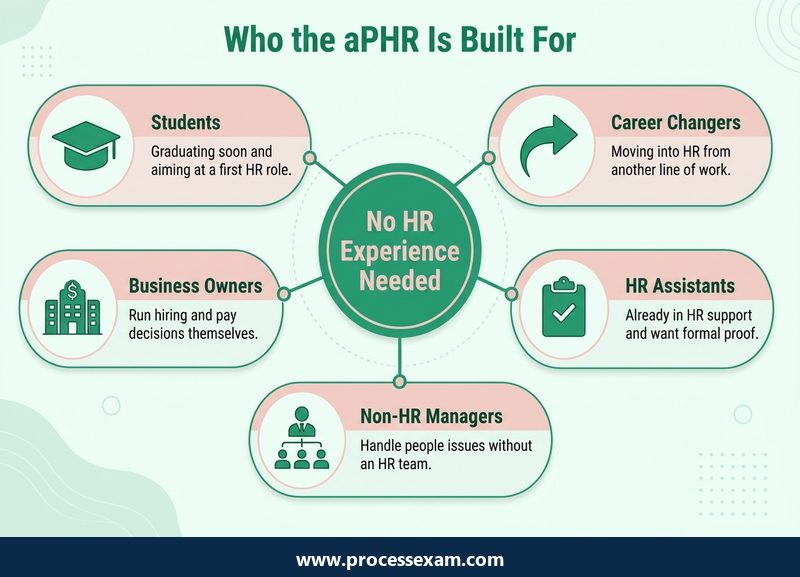
Students and recent graduates
A business, psychology or management student with no HR internship can sit the aPHR before graduating. It turns a general degree into an application that looks aimed at HR, and it gives you concrete topics to talk about when an interviewer asks why you want the field.
People changing careers
Retail supervisors, office administrators, customer service leads and teachers often find they have been doing parts of HR for years: rotas, training new colleagues, handling complaints. The aPHR gives that background a formal frame and fills the gaps, especially employment law and benefits, that informal experience rarely covers.
HR assistants and clerks already in the door
Someone six months into an HR support role sees one corner of the function. Studying the full outline shows how that corner connects to the rest, and the credential is something concrete to point to in a first review.
Managers and owners who handle HR themselves
In a small company the operations manager or the owner may be the whole HR department. For them the aPHR is less about a job advert and more about avoiding expensive mistakes in hiring, pay and discipline.
You would not be alone in any of these groups. HRCI's exam statistics report that 2,145 people tested for the aPHR between 1 January and 31 December 2025, and that 10,184 people held the credential as of 5 January 2026.
What will the aPHR exam ask you, area by area?
HRCI builds the exam from its aPHR Exam Content Outline, which splits the paper into five functional areas. The weightings tell you where the marks are, and the list of topics under each tells you which parts will feel new if you have never worked in an HR office. The outline is summarised on our aPHR syllabus page, and HRCI's own document is the one to trust if the two ever differ.
| Functional area | Weighting | What usually feels new to a beginner |
|---|---|---|
| Talent Acquisition | 19% | Job analysis, sourcing channels, cost-per-hire and time-to-fill |
| Learning & Development | 15% | The ADDIE model, needs analysis and measuring training effect |
| Compensation & Benefits | 17% | Pay grades, HSAs and FSAs, 401(k) rules, garnishments |
| Employee Relations | 24% | Progressive discipline, investigations, engagement and retention |
| Compliance & Risk Management | 25% | US employment statutes and what each one requires of an employer |
Talent Acquisition (19%)
This area follows a hire from the moment a manager says the team needs someone to the day the new starter signs the last onboarding form. Expect questions on forecasting staffing needs, writing job descriptions, choosing where to advertise, screening and interviewing without bias, reference and background checks, offer letters, and the recruiting data an applicant tracking system produces.
Learning & Development (15%)
The smallest area, but a precise one. You need to know what orientation is meant to achieve, how instructional design works (ADDIE and needs analysis in particular), which delivery format suits which situation, the basic steps of a change management process, and how a learning management system tracks whether training worked.
Compensation & Benefits (17%)
Here beginners meet a wall of acronyms. The outline covers pay structures and adjustments, health plan designs such as high-deductible plans with health savings accounts, flexible spending accounts, disability cover, retirement plans including 401(k) and 457(b) rules, and the parts of a pay statement from deductions to final pay.
Employee Relations (24%)
This area is about keeping people productive and treated fairly: mission and values, HR policies, engagement surveys and stay interviews, the full employee lifecycle through performance management and progressive discipline to separation, complaint handling and investigations, and diversity and inclusion work.
Compliance & Risk Management (25%)
The heaviest area, and the one most career changers underestimate. It spans the laws on hiring and non-discrimination (Title VII, the ADA, I-9 work authorisation), union environments (the NLRA and the WARN Act), pay and benefits (the FLSA, ERISA, COBRA, USERRA and the Affordable Care Act), and workplace safety and privacy (OSHA and HIPAA among them), plus risk steps such as evacuation plans and data protection. HRCI reminds candidates that they are expected to know the laws in force on the day they test.
How much does the aPHR cost, all in?
HRCI's exam fees page lists a $100 application fee and a $300 exam fee for the aPHR. Those two charges are the fixed part. The rest of the bill depends on choices you make along the way.
| Exam detail | aPHR |
|---|---|
| Full name | HRCI Associate Professional in Human Resources (aPHR) |
| Exam code | aPHR |
| Vendor | HRCI |
| Category | Knowledge Certification |
| Exam fee | Exam Fee: $300 / Application Fee: $100 |
| Duration | 105 Minutes plus 30 minutes administration time |
| Number of questions | 90 |
| Passing score | 500 (on a scale of 100-700) |
Costs that sit outside HRCI's two fees
- Second Chance Insurance. An optional add-on that lets you retake a different version of the exam if the first attempt fails. It can only be bought with the application, never afterwards, and it is not refunded if you do not use it.
- Study materials. HRCI's outline is free. Textbooks, courses and practice exams are not, and this is where budgets vary most.
- Withdrawal. Once HRCI approves your application, the fee is not returned if you change your mind, so apply when you are ready to book.
- Renewal. The credential lasts three years. You keep it by earning 45 recertification credits in that time or by sitting the exam again, and some credit-bearing activities carry their own fees.
Some employers pay for the exam once you are on staff. If you are already in an HR support role, ask before you pay yourself; if you are applying from outside HR, the cost is usually yours, which is one more reason to prepare properly and pass at the first sitting.
How does the aPHR exam work, from application to result?
HRCI tests all year round, so there is no window to wait for and no annual deadline to chase. The sequence is the same for everyone, and knowing it in advance stops the process from eating into your preparation time.
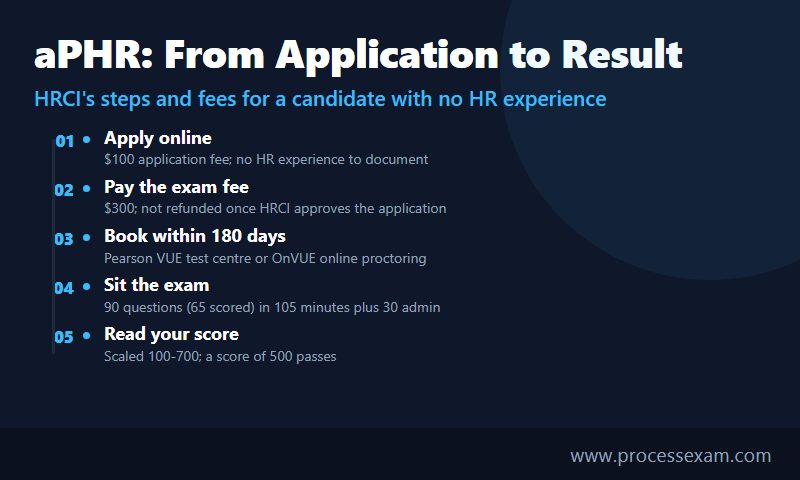
Applying and booking
You apply online through HRCI, and because there is no experience to document the aPHR application is the simplest HRCI has. Once it is approved you have 180 days to schedule and sit the exam with Pearson VUE. You can choose a physical test centre, or HRCI's online proctored option through OnVUE from your own room if it is offered where you live. Because the clock starts at approval, apply roughly two months before you expect to be ready rather than on the day you start studying.
What the paper looks like
Of the 90 questions, HRCI's page shows 65 as scored and 25 as pretest items that count for nothing but look identical to the rest. You get 105 minutes of testing time, plus 30 minutes set aside for administration such as the tutorial and agreement screens. HRCI's handbook lists the item types it uses across its exams: standard multiple choice with four options, multiple response, fill in the blank, drag and drop, and short scenarios that ask several questions about one workplace situation.
How it is scored
Results are reported on a scale that runs from 100 up to 700, and you need 500 to pass. Scaling exists so that a slightly harder version of the exam does not penalise the person who happened to get it. If you do not pass, the report shows how far you were from 500 and gives a rough picture of your performance in each area. HRCI then requires a 90-day wait from the failed attempt before a retake appointment, and without Second Chance Insurance you apply and pay again.
How can you prepare for the aPHR without HR experience?
Candidates with a few years in HR can lean on memory: they have seen a disciplinary meeting or a benefits enrolment. You cannot, so your preparation has to manufacture that familiarity. Three habits do most of the work.
Turn every law into a sentence about a real workplace
Learning "FLSA: minimum wage, overtime, record-keeping" gets you nowhere on a scenario question. Writing "a non-exempt shop assistant who works 44 hours this week is owed overtime for four of them, and the employer must keep the time records" does. Do this for every statute in the Compliance area. It doubles the time the area takes and roughly halves the number of questions you will guess on.
Use your own jobs as case material
Everyone who has had any job has been hired, onboarded, paid, reviewed and perhaps disciplined. Go back through those experiences with the outline in front of you. How was the role advertised? What did your first-week paperwork include? What deductions appeared on your pay slip? You have been on the receiving end of HR for years; the exam asks you to look at the same events from the other side of the desk.
Practise under the real clock early
Ninety questions in 105 minutes is comfortable if you know the material and tight if you are reasoning every answer out from scratch. Take a timed set in the first fortnight, not the last, so you learn your pace while there is still time to change it.
A realistic six-week plan for someone studying about an hour a day on top of another job:
| Week | Focus | Finish the week able to |
|---|---|---|
| 1 | Compliance & Risk Management, part one | Explain each hiring and pay statute as a workplace example |
| 2 | Compliance, part two, plus Talent Acquisition | Walk a hire from job analysis to completed onboarding |
| 3 | Employee Relations | Describe progressive discipline and a fair investigation step by step |
| 4 | Compensation & Benefits | Read a pay statement and compare two health plan designs |
| 5 | Learning & Development, then weak spots | Apply ADDIE to a simple training need |
| 6 | Timed practice and review | Score steadily above your target on unseen questions |
For the last fortnight of that plan, our aPHR mock exam mirrors the 90-question, 105-minute format, so each attempt tells you both your score and whether your pace will hold on the day.
What does the aPHR realistically do for a first HR job and your salary?
Neither HRCI nor any public salary survey we could verify publishes a pay figure tied to the aPHR itself, and any exact "aPHR salary" you see quoted should be treated with caution. What is published is pay for the jobs the aPHR helps you reach. The US Bureau of Labor Statistics puts the median annual wage for human resources assistants (except payroll and timekeeping) at $50,610 in May 2025, and the median for human resources specialists at $75,940 in the same month.
Read those two numbers as the start and the next stage of an HR route, not as a promise attached to a certificate. The assistant figure is the realistic reference for a first HR job. The specialist figure is where people typically move once they have experience; BLS notes that specialists usually hold a bachelor's degree and that, while certification is usually voluntary, some employers prefer or require it. Location, industry and employer size then move either figure a long way.
Where the aPHR earns its keep
- Getting through the first screen. When an advert says "aPHR or equivalent", holding it removes the most obvious reason to set your application aside.
- Interview substance. You can talk about onboarding checklists, FLSA classifications or progressive discipline in the interviewer's own language.
- A faster start. A new assistant who already knows what COBRA or an I-9 is needs less supervision in the first months, which managers notice.
- A foundation for the PHR. Once you build the professional-level experience HRCI requires, the aPHR study gives you a head start on the broader exam.
Where it does not
It does not replace experience, it does not guarantee a raise on its own, and outside the United States its heavy focus on US employment law makes it less relevant; HRCI offers the aPHRi for candidates who work under other legal systems. Treat it as the credential that lets you start, and plan to let experience do the rest.
Which mistakes trip up first-time aPHR candidates?
Most failed attempts from people with no HR background come from the same handful of habits.
- Leaving compliance until last. It is a quarter of the exam and the hardest area to learn quickly. Start with it.
- Studying from memory of an old outline. HRCI updates its outlines, and older books still describe areas that no longer exist in that form. Check the current five-area outline before you buy materials.
- Memorising acronyms without their triggers. Knowing that COBRA exists is not the same as knowing when an employer must offer it.
- Applying too early. The 180-day window starts at approval. Applying on day one of study and then running out of time wastes the fee.
- Ignoring the pretest items. You cannot tell which 25 questions are unscored, so every question deserves your full attention.
- Skipping timed practice. Knowing the material slowly is a common way to run short of time on a 105-minute paper.
None of these needs HR experience to avoid. They need a plan, the current outline and honest practice scores, which is exactly what someone answering their first "aPHR or equivalent" advert can build in six weeks.
Frequently Asked Questions
What salary can you expect with an aPHR certification?
HRCI and the US Bureau of Labor Statistics publish no aPHR-specific salary. BLS puts the May 2025 median annual wage at $50,610 for human resources assistants and $75,940 for human resources specialists. The aPHR helps you compete for those roles, while experience, location and industry decide where your own pay lands.
How much does the aPHR certification cost?
HRCI charges a $100 application fee plus a $300 exam fee. Once HRCI approves your application the fee is not refunded if you withdraw. Optional Second Chance Insurance, study materials and later recertification activities add to that figure, so budget for more than the two HRCI fees alone.
Do you need HR experience or a degree to take the aPHR?
No HR experience is required. HRCI describes the aPHR as a knowledge-based credential for people starting in HR, managers outside HR and those moving into the profession, and its handbook says an HR-themed degree is not required. You apply online, receive approval and book your exam within 180 days.
How many questions are on the aPHR exam, and what is the passing score?
The aPHR has 90 questions, 65 scored and 25 unscored pretest items mixed in, with 105 minutes of testing time plus 30 minutes for administration. Scores are scaled from 100 to 700, and a 500 or higher passes. Pretest items look identical, so answer every question with care.
Should you take the aPHR or wait until you qualify for the PHR?
Without professional-level HR experience the PHR is not open to you, so the aPHR is the HRCI credential you can actually sit now. Once you build the experience the PHR routes require, it becomes the natural next step. Meanwhile the aPHR stays valid for three years and renews with 45 recertification credits.
- HRCI HR Associate Professional Exam Questions |
- HRCI HR Associate Professional Question Bank |
- HRCI HR Associate Professional Questions |
- HRCI HR Associate Professional Study Guide |
- HRCI aPHR Quiz |
- aPHR Certification |
- aPHR Questions |
- aPHR Practice Test |
- aPHR Study Guide Material |
- aPHR Sample Exam |
- HR Associate Professional Certification |
- HRCI HR Associate Professional Book |
- HR Associate Professional Certification Cost |
- HR Associate Professional Certification Requirements |
- HRCI HR Associate Professional Sample Questions |
- aPHR Exam Questions Download |
- aPHR Test Questions |
- HR Associate Professional PDF |
- HRCI Associate Professional in Human Resources


