
Agile Project Management Foundation: Your Path to Mastery
The APMG International Agile Project Management - Foundation certification (AgilePM Foundation) validates an individual's understanding of the core principles, processes, and products of Agile Project Management, as defined by the DSDM® framework. This credential is an essential step for professionals aspiring to lead or participate effectively in agile projects, providing a structured approach to delivering project success in dynamic environments. The article serves as an advanced guide, detailing the certification's relevance, exam specifics, and robust preparation strategies, including resources from Agile Project Management Foundation practice questions. It is designed for project managers, team members, and business analysts seeking to enhance their agile capabilities and demonstrate a foundational understanding of the methodology.
Certifying Agile Acumen: Exam Overview
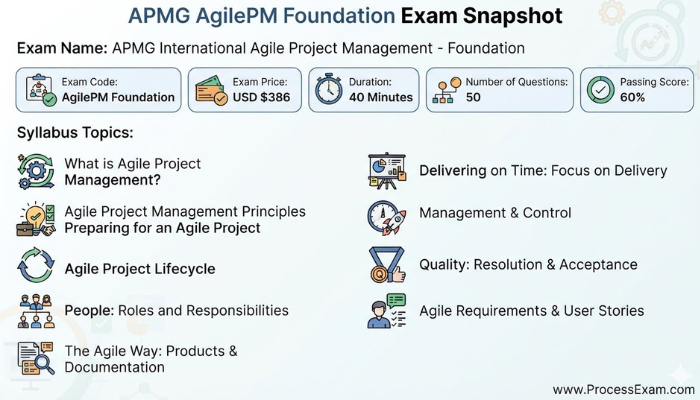
The APMG International AgilePM Foundation certification establishes a globally recognized benchmark for individuals seeking to demonstrate their foundational knowledge in Agile Project Management. This certification is crucial for those who need to understand and apply agile principles within a project context, particularly within organizations adopting a DSDM-based approach. The exam details provide a clear pathway for aspiring agile practitioners to achieve this foundational understanding.
The AgilePM Foundation examination is structured to assess candidates on fundamental concepts and terminology.
-
Exam Name: APMG International Agile Project Management - Foundation
-
Exam Code: AgilePM Foundation
-
Exam Price: USD $386
-
Duration: 40 Minutes
-
Number of Questions: 50
-
Passing Score: 60%
This format ensures a concise yet comprehensive evaluation of a candidate's grasp of the AgilePM framework. Achieving the required passing score demonstrates a candidate's readiness to apply basic Agile Project Management principles effectively.
Foundational Knowledge Domains: Syllabus Breakdown
Mastering the AgilePM Foundation syllabus is paramount for any candidate aiming for certification success. The syllabus outlines key areas of study, providing a comprehensive view of the DSDM Agile Project Management framework. A thorough understanding of each topic ensures that certified professionals can contribute effectively to agile projects and communicate using a common language.
The core curriculum covers a range of essential subjects:
-
Key Concepts: Understanding the philosophy, principles, and lifecycle of Agile Project Management. This includes an introduction to the DSDM approach, its iterative nature, and how it differs from traditional project management.
-
Scrum Overview: While AgilePM has its own framework, a basic understanding of Scrum helps contextualize agile methodologies. This section typically covers Scrum roles, events, and artifacts, providing a broader agile perspective.
-
AgilePM Fundamentals: Deep dive into the core DSDM principles, the project lifecycle, and the critical success factors. This forms the backbone of the AgilePM approach.
-
Individuals and Interactions: Focusing on the importance of people, self-organizing teams, and collaborative environments in agile projects. It emphasizes the human element and soft skills vital for agile success.
-
Collaboration and Communication: Exploring techniques and practices for effective teamwork, stakeholder engagement, and information flow within an agile project. It covers workshops, daily stand-ups, and other communication methods.
-
Project Lifecycle Framework: Detailing the phases of an AgilePM project from Pre-Project to Deployment and Post-Project, including the purpose and activities within each phase.
-
Requirements, Estimating and Prioritisation: Methods for eliciting, analyzing, and managing requirements in an agile context, including techniques like MoSCoW prioritization and estimating approaches such as Planning Poker.
-
Planning and Control: How AgilePM projects are planned, monitored, and controlled, encompassing timeboxing, iteration planning, and progress tracking.
-
Risk Management and the Project Approach: Identifying, assessing, and mitigating risks within an agile framework, alongside defining the overall project approach and tailoring DSDM to specific project needs.
-
Governance, Compliance and the AgilePM Products: Understanding the governance structures for agile projects, ensuring compliance with organizational standards, and familiarizing with the key products (e.g., Business Case, Solution Increment) generated throughout the project lifecycle.
These topics collectively equip candidates with the knowledge to apply AgilePM principles effectively, ensuring project alignment with business objectives.
Advancing Project Leadership: Career Benefits
Obtaining the APMG International AgilePM Foundation certification offers substantial advantages for career development, positioning professionals at the forefront of agile transformations. It signifies a validated understanding of a robust project management methodology, highly sought after in today's dynamic business landscape. The benefits extend beyond theoretical knowledge, impacting practical application and professional credibility.
Enhancing Employability and Market Value
Holding the AgilePM Foundation certification immediately distinguishes candidates in the job market. Organizations increasingly seek professionals who can navigate complex projects with agility and efficiency. This certification demonstrates a commitment to modern project management practices, making individuals more attractive for roles such as project managers, team leaders, business analysts, and agile coaches. It opens doors to new opportunities and can lead to higher earning potential. The global recognition of APMG International certifications further bolsters its value, ensuring your credentials are understood and respected across industries and geographies.
Driving Project Success and Efficiency
The AgilePM Foundation equips practitioners with a structured framework for delivering projects successfully. By understanding DSDM principles, professionals can:
-
Improve project visibility and control through iterative development.
-
Enhance stakeholder collaboration and communication, leading to better alignment with business goals.
-
Mitigate risks proactively by fostering early and continuous feedback loops.
-
Increase project delivery speed and flexibility, adapting to changing requirements with ease.
-
Foster a culture of continuous improvement within project teams.
These capabilities directly translate into more efficient project execution, higher quality deliverables, and ultimately, greater organizational success. For those interested in understanding the broader impact of such certifications, official certification guidance often highlights the value of foundational project management credentials.
Strategic Preparation Methods: Achieving Mastery
Successful completion of the AgilePM Foundation exam requires a structured and diligent preparation approach. Merely skimming through the syllabus is insufficient; true mastery comes from deep understanding and consistent practice. This section outlines effective strategies and resources to maximize your chances of success.
Utilizing a Comprehensive Study Guide
A well-structured study guide is indispensable for organizing your learning. It should map directly to the official APMG International AgilePM Foundation syllabus, ensuring all topics are covered systematically. Focus on understanding the "why" behind each principle and practice, not just memorizing definitions. Integrate various learning techniques:
-
Active Reading: Don't just read; engage with the material by taking notes, summarizing sections, and formulating questions.
-
Concept Mapping: Create visual diagrams to connect different AgilePM concepts and show their relationships.
-
Scenario Analysis: Think about how AgilePM principles would apply in real-world project scenarios.
Regular review sessions are critical to reinforce learning and commit key information to long-term memory.
Engaging in Quality Training Courses
While self-study is possible, an accredited Agile Project Management Foundation training course can significantly enhance your preparation. These courses, often led by experienced instructors, provide:
-
Structured Learning Paths: Guided sessions that break down complex topics into manageable modules.
-
Interactive Sessions: Opportunities to discuss concepts, ask questions, and engage in practical exercises.
-
Peer Learning: Insights from fellow students and collaborative problem-solving.
-
Exam-Focused Content: Many courses are specifically designed to prepare candidates for the exam format and question types.
Choosing an APMG International accredited training provider ensures the course content aligns with the official syllabus and quality standards. You can find accredited providers through the official APMG International website, such as the APMG International official page.
Leveraging Practice Questions and Mock Exams
Perhaps the most critical component of effective preparation is extensive practice with exam-style questions. AgilePM Foundation practice questions help candidates:
-
Familiarize with Format: Understand the question styles, terminology, and typical scenarios.
-
Identify Knowledge Gaps: Pinpoint areas where further study is needed.
-
Improve Time Management: Practice completing the exam within the 40-minute time limit.
-
Build Confidence: Reduce exam day anxiety by knowing what to expect.
When reviewing practice questions, pay close attention to the explanations for both correct and incorrect answers. This deepens your understanding of the underlying principles. Aim to consistently score above 75-80% on practice tests before attempting the actual exam to build a comfortable buffer over the 60% passing score.
Distinguishing Agile Roles: AgilePM vs. Scrum
Understanding the nuances between different agile frameworks and roles, such as Agile Project Management Foundation vs Scrum Master, is crucial for professionals navigating the agile landscape. While both aim to deliver value iteratively, their scope, structure, and roles differ significantly.
AgilePM Foundation's Structured Approach
AgilePM, based on the DSDM framework, provides a comprehensive, scalable project management methodology. It integrates agile principles within a structured governance framework, making it suitable for larger, more complex projects within organizations that require robust control and compliance.
-
Scope: AgilePM covers the entire project lifecycle, from initial concept to deployment and benefits realization. It is a project management methodology that embraces agility.
-
Roles: It defines a broader set of roles, including Business Sponsor, Business Visionary, Project Manager, Technical Coordinator, Business Analyst, Team Leader, and Solution Developer. Each role has specific responsibilities throughout the project.
-
Focus: Emphasizes project governance, defined processes, and clear documentation, balancing agility with necessary structure and control.
The AgilePM Foundation focuses on equipping individuals with the knowledge to manage projects using this structured agile approach.
Scrum Master's Facilitative Role
Scrum is a lightweight framework for developing and sustaining complex products, primarily focusing on managing product development within a single team. The Scrum Master is a servant-leader who coaches the Scrum Team, Product Owner, and organization in Scrum practices.
-
Scope: Scrum focuses on product development cycles (sprints) within a self-organizing team, without explicit project management layers.
-
Roles: It defines three core roles: Product Owner, Scrum Master, and Development Team. The Scrum Master facilitates the Scrum process and removes impediments.
-
Focus: Emphasizes empiricism, self-organization, and rapid adaptation within a time-boxed iteration, with minimal prescriptive processes beyond the core framework.
While a Scrum Master certification validates expertise in facilitating Scrum teams, the AgilePM Foundation provides a broader project management context. Many organizations benefit from professionals who understand both, enabling them to adapt their approach based on project needs and organizational context.
Navigating the Certification Pathway: Exam Essentials
Achieving the AgilePM Foundation certification involves more than just studying; it requires understanding the practicalities of the examination process, including its format, requirements, and what to expect on exam day.
Understanding the Exam Format and Duration
The AgilePM Foundation exam format is designed to quickly assess core knowledge. It consists of 50 multiple-choice questions, to be completed within a 40-minute duration. Each question typically has four possible answers, with only one being correct. This structure tests not just knowledge recall but also the ability to apply concepts rapidly under time pressure. Candidates are advised to manage their time carefully, allocating approximately 45-50 seconds per question. There are no negative markings, so it is always beneficial to attempt every question.
Passing Score and Certification Requirements
To successfully pass the AgilePM Foundation exam, candidates must achieve a minimum score of 60%, meaning at least 30 out of 50 questions must be answered correctly. There are no formal prerequisites to take the AgilePM Foundation exam, making it accessible to anyone interested in learning about Agile Project Management. However, having some prior experience in a project environment or a basic understanding of project management concepts can be advantageous.
Estimating Study Time and Effective Preparation
The question of how long to study for APMG International AgilePM Foundation varies significantly based on individual learning pace, prior experience, and study intensity. Generally, for individuals new to agile or project management, a dedicated study period of 20-35 hours is recommended. This could be spread over 2-4 weeks, dedicating a few hours each day or concentrating study over a long weekend. For those with some prior agile exposure, 15-20 hours of focused study might suffice.
Effective preparation involves:
-
Consistent Review: Regularly revisit challenging topics to reinforce understanding.
-
Practice, Practice, Practice: Utilize mock exams and practice questions to solidify knowledge and improve speed.
-
Rest and Recharge: Ensure adequate rest before the exam to maintain focus and cognitive function.
Understanding these logistics is a critical step in a successful certification journey, preparing you not just intellectually but also practically for the exam day.
Sustaining Agile Excellence: Post-Certification Application
Earning the AgilePM Foundation certification is a significant milestone, yet it marks the beginning, not the end, of a journey in Agile Project Management. Sustaining agile excellence involves continuous learning, practical application, and active engagement with the agile community. The real value of the certification lies in its application in real-world scenarios.
Applying Principles in Real Projects
The true test of your AgilePM Foundation knowledge comes with its application. Actively seek opportunities to implement DSDM principles in your projects, whether in a formal Project Manager role or as a contributing team member. This could involve:
-
Advocating for the use of DSDM practices like MoSCoW prioritization or timeboxing.
-
Facilitating effective communication and collaboration within your team.
-
Helping to establish appropriate governance and control mechanisms for agile projects.
-
Mentoring colleagues on agile best practices and the DSDM framework.
Practical experience solidifies theoretical understanding and builds confidence in your agile capabilities, turning knowledge into actionable skills.
Embracing Continuous Professional Development
The agile landscape is constantly evolving, with new tools, techniques, and frameworks emerging regularly. To remain proficient and relevant, certified professionals should commit to continuous professional development. This might include:
-
Pursuing higher-level certifications such as AgilePM Practitioner.
-
Attending agile conferences, workshops, and webinars.
-
Reading industry publications and engaging with agile thought leaders.
-
Participating in agile communities of practice to share knowledge and learn from others.
This ongoing commitment ensures that your Agile Project Management Foundation mastery remains current and impactful throughout your career.
Conclusion
The APMG International AgilePM Foundation certification provides a robust and globally recognized foundation in Agile Project Management, empowering professionals with the DSDM framework's principles and practices. From enhancing employability and driving project success to offering a clear understanding of agile methodologies, its value is undeniable in today's fast-paced business environment. Achieving this certification not only validates your core agile knowledge but also sets a strong trajectory for career growth and continuous learning within the agile domain.
For those ready to solidify their Agile Project Management Foundation and pursue excellence, thorough preparation is key. Leverage official resources, engage in accredited training, and utilize high-quality practice questions. Begin your journey toward mastering AgilePM concepts and boosting your project management prowess. Explore comprehensive study materials and practice tests to ensure your readiness and achieve your certification goals with confidence. Visit ProcessExam for preparation resources and take the next step in your agile career.
Frequently Asked Questions
1. What is the APMG International AgilePM Foundation certification?
The APMG International AgilePM Foundation certification validates an individual's fundamental understanding of the DSDM Agile Project Management framework, including its principles, processes, and products. It signifies the ability to participate effectively in agile projects.
2. Who should consider taking the AgilePM Foundation exam?
This certification is ideal for project managers, team leaders, business analysts, aspiring agile practitioners, or any professional involved in projects who wishes to gain a foundational understanding of agile project management using the DSDM approach.
3. Are there any prerequisites for the AgilePM Foundation exam?
No, there are no formal prerequisites to sit for the APMG International AgilePM Foundation exam, making it accessible to professionals at various stages of their careers without prior certification requirements.
4. How long does it typically take to study for the AgilePM Foundation exam?
Study time varies by individual experience, but generally, 20-35 hours of focused study is recommended for those new to agile, or 15-20 hours for candidates with some existing agile knowledge. This can be spread over a few weeks.
5. What career opportunities can the AgilePM Foundation certification unlock?
The certification enhances employability for roles such as Agile Project Manager, Agile Team Member, Business Analyst, or Scrum Master, by demonstrating a structured understanding of agile project delivery and improving project efficiency and stakeholder collaboration.
- Project Management |
- APMG International Agile Project Management Foundation Exam Questions |
- APMG International Agile Project Management Foundation Question Bank |
- APMG International Agile Project Management Foundation Questions |
- APMG International Agile Project Management Foundation Test Questions |
- APMG International Agile Project Management Foundation Study Guide |
- APMG International AgilePM Foundation Quiz |
- APMG International AgilePM Foundation Exam |
- AgilePM Foundation |
- AgilePM Foundation Question Bank |
- AgilePM Foundation Certification |
- AgilePM Foundation Questions |
- AgilePM Foundation Practice Test |
- AgilePM Foundation Study Guide Material |
- AgilePM Foundation Sample Exam |
- Agile Project Management Foundation |
- Agile Project Management Foundation Certification |
- APMG International Agile Project Management - Foundation |
- AgilePM Foundation Level Simulator |
- AgilePM Foundation Level Mock Exam |
- APMG International AgilePM Foundation Level Questions |
- APMG International Agile Project Management Foundation Book


