
SAFe Agilist SA Exam: What the AI-Empowered Edition Changed
Updated on 12 October 2026. What’s new: rewritten for the AI-Empowered SAFe Agilist exam Scaled Agile sells now, with 80% to pass and two attempts within 60 days of the course.
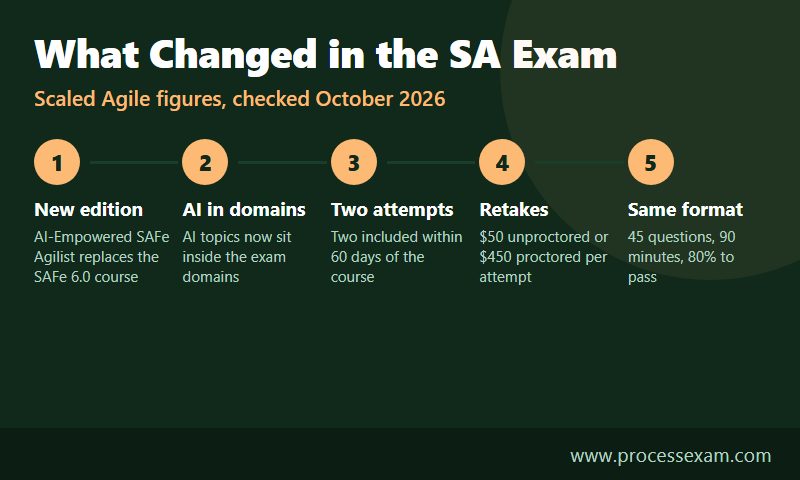
Anyone who earned the SAFe Agilist credential a few years ago would not recognise today's exam. Scaled Agile now sells the AI-Empowered SAFe Agilist (SA), taken after the Leading SAFe course: 45 multiple-choice questions, 90 minutes and 80% to pass, with AI topics woven into the domains and two attempts included within 60 days. This guide was checked against the vendor's own pages in October 2026 and separates what moved from what stayed.

Most of the advice still circulating about the SA exam was written for the SAFe 6.0 course, and some of it quotes figures that no longer apply. The sections below compare the two editions side by side, set out the current format and the domain weightings, walk through what each domain asks of a leader, explain the attempts and retake fees, and finish with a way to sort your old notes into keep and replace. One warning belongs up front: Scaled Agile's own pages do not agree with each other on every domain percentage, so this guide shows both sets.
What changed between the older Agilist exam and today's?
Three things changed, and one thing did not. The edition changed: the course and exam are now called AI-Empowered SAFe Agilist, and Scaled Agile's certification page describes a course that teaches leaders to use AI as an accelerant for value and flow, including the SAFe CoPilot AI assistant and role-specific prompting. The domain structure changed: the exam still has six domains, but they are re-cut, so the weight moved. The study material changed: AI shows up as named topics inside the domains instead of sitting beside them. The format did not change. The earlier SAFe 6.0 study guide, which Scaled Agile still lists, also gives 45 questions, 90 minutes and 80%.
The re-cut matters more than the headline. Compare the two study guides domain by domain.
| SAFe 6.0 Agilist domain | Share | AI-Empowered domain | Share |
|---|---|---|---|
| Digital Age and Business Agility | 12-14% | Adapt and Thrive with SAFe | 7-9% |
| Lean-Agile Leaders | 29-33% | Build a Foundation with Mindset, Values and Principles | 21-23% |
| Team and Technical Agility | 6-8% | Establish Team and Technical Agility | 10-12% |
| Agile Product Delivery | 29-33% | Product Development Flow | 25-28% |
| Lean Portfolio Management | 12-14% | Explore Lean Portfolio Management (LPM) | 21-23% |
| Leading the Change | 6-8% | Lead the Change | 7-9% |
Read the table as a shift of attention. The old exam leaned hardest on leadership mindset and on product delivery, each close to a third of the paper. The current guide spreads the weight: leadership and mindset drop to roughly a fifth, Lean Portfolio Management almost doubles, and team and technical agility grows. A candidate who spent most of the old study time on mindset slogans and let the portfolio material slide would now be exposed in exactly the domain that gained the most. The SAFe Agilist certification page on Scaled Agile's own site is where to confirm which edition your course date puts you in.
What does the current exam ask, and how are the marks split?
The figures below come from Scaled Agile's study guide for the AI-Empowered SA exam, dated 27 May 2026, and from its certification page, both read in October 2026.
| Exam detail | SAFe Agilist |
|---|---|
| Certification | Certified SAFe Agilist (SA) |
| Exam code | SA |
| Vendor | SAFe (Scaled Agile, Inc.) |
| Course | Leading SAFe |
| Edition checked in October 2026 | AI-Empowered SAFe Agilist |
| Passing score | 80% |
| Time allowed | 90 minutes |
| Questions on the paper | 45 |
| Question type | Multiple choice with one correct answer |
| Delivery | Online and closed book, with no outside help |
| Attempts included | Two, if sat inside the 60-day window that follows the course or the exam purchase |
| Fee for each retake | $50 without a proctor, $450 with one |
Eighty percent of 45 questions is 36 correct answers, so you can miss nine. Ninety minutes for 45 questions is two minutes each, which is generous for single-select multiple choice, and the timer shows once questions appear. When the clock reaches zero the exam is submitted as it stands, and a question left empty earns nothing, so a considered guess always beats a blank. Scores are simply the number of questions answered correctly.
How much does each domain carry?
Scaled Agile publishes the weights as ranges, and its two pages differ on three of them. The study guide is the document that sits with the exam itself, so plan on its column, and treat the certification page as a second opinion. The last column converts the study guide's ranges into an approximate number of questions out of 45.
| Domain | Study guide | Certification page | About how many of 45 |
|---|---|---|---|
| Adapt and Thrive with SAFe | 7-9% | 7-9% | 3 to 4 |
| Build a Foundation with Mindset, Values and Principles | 21-23% | 18-21% | 9 to 10 |
| Establish Team and Technical Agility | 10-12% | 7-9% | 5 |
| Product Development Flow | 25-28% | 25-28% | 11 to 13 |
| Explore Lean Portfolio Management (LPM) | 21-23% | 25-28% | 9 to 10 |
| Lead the Change | 7-9% | 7-9% | 3 to 4 |
Whichever column you trust, Product Development Flow and Lean Portfolio Management together hold close to half the marks, and mindset and values is the third big block. Those three account for roughly 30 of the 45 questions. The three small domains share the rest, which is why skipping them is tempting and why it is a mistake: a domain worth three or four questions can still be the difference between 35 and 36.
What does each of the six domains expect a leader to know?
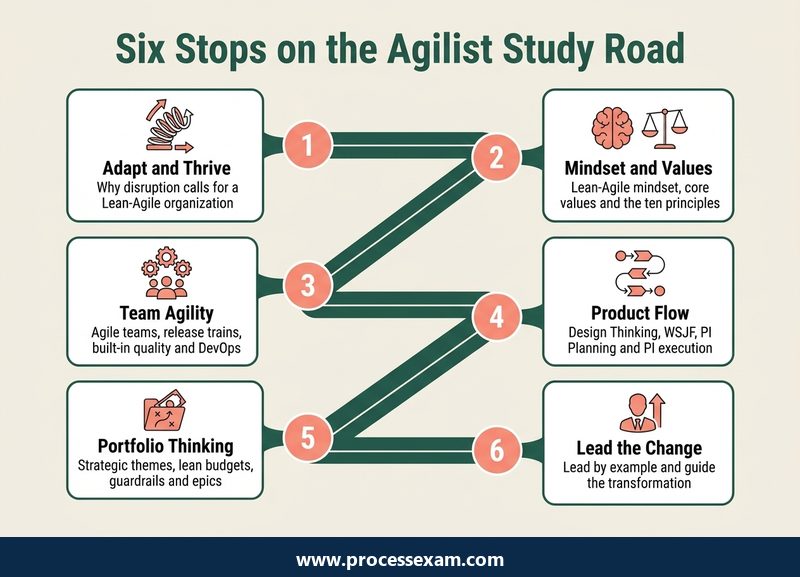
Scaled Agile's exam is written around the Leading SAFe lessons, one lesson per domain, and the topics are listed in the study guide. Each heading below follows the guide's order. Where a topic has a public home, the SAFe Framework site is the place to read the definition in the vendor's own words.
Adapt and Thrive with SAFe
This is the opening argument of the whole course: why organisations need to change how they work, and what a Lean-Agile organisation looks like. Expect questions about disruption, the pressure to deliver value faster, and the idea of business agility as an organisational capability instead of a team practice. It is a small domain, and the questions are usually the most reading-comprehension-like on the paper. Answer from the course's framing, not from your own company's history.
Build a Foundation with Mindset, Values and Principles
Here the exam tests the Lean-Agile mindset, the SAFe core values of alignment, respect for people, transparency and relentless improvement, and the ten SAFe Lean-Agile principles. The questions tend to give a short workplace situation and ask which principle or value it illustrates or which action respects it. Learn the principles well enough to tell neighbours apart, for example the principle about visualising and limiting work in process, reducing batch sizes and managing queue lengths, against the one about applying cadence and synchronising with cross-domain planning. This domain also carries the first named AI topic, empowering agility with AI, so expect at least a question about how a leader uses AI without handing over accountability.
Establish Team and Technical Agility
The topics are cross-functional Agile teams, organising around the flow of value with Agile Release Trains, built-in quality practices, and building and maintaining a continuous delivery pipeline with DevOps. A leader is not expected to configure a pipeline, but is expected to know the stages, such as continuous exploration, integration, deployment and release on demand, and what built-in quality means for flow. The questions ask what a leader should expect from teams and trains, not how to code.
Product Development Flow
The largest domain starts from the customer and Design Thinking, moves through ranking the ART backlog, and ends in PI Planning and running the PI itself. Know why Weighted Shortest Job First is used and what goes into it (cost of delay against job size), what PI Planning produces (committed PI objectives and a visible plan with risks and dependencies), and what the system demo and the Inspect and Adapt event are for. A leader's role in these events is the thing being tested: attending, setting context, removing impediments, not dictating the plan. Questions in this domain are scenario-heavy, so working through the flow once from backlog to demo, in order, pays off.
Explore Lean Portfolio Management (LPM)
The study guide lists defining a SAFe portfolio, connecting it to enterprise strategy, establishing the portfolio vision and flow, and lean budgets and guardrails. Scaled Agile's certification page adds that the course teaches applying AI tools to portfolio work. Expect questions on strategic themes, how funding moves to value streams instead of projects, what guardrails do, how epics are described and approved, and how the portfolio Kanban shows flow. The shift from project budgeting to funding a stream of work is a concept the exam returns to repeatedly, in different clothes.
Lead the Change
The final domain asks what a leader does personally: lead by example, and lead the change itself. It includes the named topic of empowering leaders with AI. Questions describe a stalled transformation or a sceptical middle layer and ask which leadership action is most useful. The consistent pattern in SAFe answers is that leaders model the behaviour first and use authority second.
How do the two included attempts and the retake fees work?
Scaled Agile's study guide says the first two attempts are included in the course registration fee or the exam fee when taken within 60 days of course completion or exam purchase. Additional attempts cost a fee: $50 for an unproctored exam and $450 for a proctored one. The vendor's retake FAQ, updated on 6 May 2026, names SAFe Agilist (SA) among the foundational exams covered by the policy that took effect on 14 April 2026, and the waiting periods between attempts are below.
| Attempt | When you can take it |
|---|---|
| First and second | Included, if sat inside the 60-day window |
| Third (first retake) | Immediately after the second failed attempt |
| Fourth (second retake) | 10 days after the first retake |
| Fifth (third retake) | 30 days after the second retake |
| Any later retake | A 30-day wait between attempts |
Two details save money and nerves. First, the 60-day clock covers the included attempts only, so a candidate who waits for a perfect moment can quietly turn a free second attempt into a paid third. Second, the practice test is unlimited and reflects the exam's number of questions, level of difficulty, timebox and domains, and Scaled Agile says passing it does not guarantee passing the real exam. The practice test returns question-level feedback, and the vendor tells candidates not to close the feedback window until they have reviewed it, because each wrong answer comes with a pointer to the lesson that explains it.
Older articles often say the first attempt is covered only if taken within 30 days, or that a retake is a flat $50. Scaled Agile's current wording is the one above, and since it adds that details can change at any time, glance at the page again the week you book.
Who should sit the Agilist exam, and what does the credential bring with it?
Scaled Agile aims the AI-Empowered SA at current or aspiring leaders who need to drive transformation in complex environments, and its certification page names four groups: executives, directors, product managers and Agile coaches. That list is a useful filter. If your day involves setting priorities across several teams, funding work, or deciding how an organisation will change how it plans and delivers, the Leading SAFe vocabulary is vocabulary you will use. If you are a developer or tester who wants to work well inside a team, a team-level SAFe course is a closer fit, and the Agilist exam will feel abstract.
The credential carries practical extras. The vendor lists access to the SAFe community forums, role-based networking circles, the SAFe Skills Library, SAFe assessments, toolkits for preparing and running PI Planning, a digital badge, and PMI PDUs and Scrum CEUs. The course is taught in eight languages, from English and Japanese to Brazilian Portuguese. Keeping the certification active requires at least 12 Continuing Education Units each year, according to the certification page, so it is a credential you maintain rather than one you collect once.
As for career value, a certificate does not do the leading for you. What it does is give a hiring manager or a transformation sponsor a shared reference point: you can say that the train is on a Planning Interval cadence and that the epic needs a lean business case, and be understood in one pass. That shared vocabulary is the real return on the course, and the exam is the proof that you absorbed it.
Which old study notes can you keep, and what must you replace?
Not everything written for the SAFe 6.0 exam has expired. Sort what you have into piles.
| Material | Verdict | Why |
|---|---|---|
| Notes on core values, principles and the Lean-Agile mindset | Keep | Still the heart of the second domain, now sitting beside AI topics |
| WSJF, PI Planning, system demo, Inspect and Adapt | Keep | Product Development Flow is still the biggest domain |
| Portfolio notes written as a short appendix | Expand | LPM now carries about a fifth of the paper |
| Anything quoting a pass mark or attempt rule other than those in the tables above | Replace | Check the vendor's current figures |
| Notes with no mention of AI | Add to | Named AI topics appear in the mindset and change domains, and the vendor's page lists AI use for leaders |
A three-week rhythm after the course
Because the attempts are tied to a 60-day window, a three-week plan leaves a comfortable margin for a second try. In the first week, re-read the study guide domain by domain and write one page per domain in your own words, spending extra time on LPM. In the second week, take the vendor's unlimited practice test under timed conditions, review every answer in the feedback window, and mark each wrong answer with the domain it belongs to. In the third week, drill the domains where your errors cluster, sit the exam while the course is still fresh, and keep the second attempt as insurance instead of a plan.
With the course notes sorted, the SA practice exam lets you answer 45 questions against the 90-minute clock before either included attempt is spent, and the free SA sample questions give a feel for the wording before you book.
Where does a manager's instinct pick the wrong answer?
The Agilist exam is aimed at people who already manage, and that is its trap. A seasoned manager reads a scenario and reaches for the response that worked in a past job: assign the work, escalate the risk, tighten the report. SAFe answers are written the other way round. Four patterns recur.
Decide versus enable
When a scenario shows a team stuck on a decision, the correct answer is rarely that the leader decides. It is usually to push decision-making to the people closest to the work, with clear guardrails, and to remove the blocker that stopped them. The mirror image also appears: where only the leader can move a policy, funding rule or organisational boundary, the correct answer is that the leader acts, quickly.
Plan versus commit
Questions on PI Planning separate a plan from a commitment. Teams commit to the PI objectives, with confidence votes and a visible risk board, and the plan then adjusts when new facts arrive. An answer that treats the plan as a fixed contract and punishes missed estimates will be wrong.
Project budget versus value stream funding
In the portfolio domain, an answer built around approving a project, tracking cost against baseline and closing the project once the scope is delivered is the old model. The SAFe answer funds a stream of value, uses guardrails and keeps adjusting. Reading the question for the word project can help you spot which model it is testing.
AI as an assistant versus AI as the decider
The AI topics in the exam, empowering agility with AI and empowering leaders with AI, sit inside a vendor course description that talks about human-in-the-loop oversight and evaluating AI-generated insights against Lean-Agile principles. An option where a leader accepts a generated recommendation without review is the kind of choice to rule out. The better option uses AI to speed up analysis and keeps the leader accountable for the outcome.
A short habit helps on all four: before you pick an answer, ask who ends up owning the outcome in each option, and choose the one where ownership sits with the team or the leader who can actually act on it.
Frequently Asked Questions
What is the SAFe Agilist (SA) certification?
SA is the Certified SAFe Agilist credential from Scaled Agile, earned by passing the exam that follows the Leading SAFe course. It is aimed at executives, directors, product managers and Agile coaches who lead change, and in 2026 it is sold as the AI-Empowered SAFe Agilist, with AI topics inside its six domains.
How many questions does the SA exam have, and what score do you need?
The exam has 45 multiple-choice, single-select questions to answer in 90 minutes, and you need 80% to pass, which is 36 correct answers. It is web-based and closed book. Unanswered questions count as wrong, and the exam submits itself when the timer ends, so answer everything before time runs out.
What changed in the AI-Empowered SAFe Agilist exam?
Scaled Agile re-cut the six domains and added named AI topics, for example empowering agility with AI and empowering leaders with AI. Lean Portfolio Management now carries about a fifth of the paper, up from about an eighth. The format itself, 45 questions in 90 minutes with an 80% pass mark, matches the earlier SAFe 6.0 guide.
How many attempts do you get, and what does a retake cost?
The first two attempts are included when taken within 60 days of course completion or exam purchase. After that, a retake costs $50 for an unproctored exam or $450 for a proctored one. The third attempt is available immediately, the fourth after 10 days, the fifth after 30 days, and later ones after 30 days each.
How do you keep the SAFe Agilist certification active?
Scaled Agile's certification page says you must earn at least 12 Continuing Education Units each year to maintain the credential. Certified professionals also get access to the SAFe community, the Skills Library, assessments, toolkits and a digital badge, so the yearly learning requirement is the price of keeping those benefits.
- Scaled Agile |
- SAFe Agilist Sample Questions |
- Agilist PDF |
- SAFe Leading Exam Questions |
- SAFe Leading Sample Questions |
- Leading |
- Leading PDF |
- SAFe Agilist Test Questions |
- Leading Simulator |
- Leading Mock Exam |
- SAFe Agilist Book |
- Agilist Certification Cost |
- Agilist Certification Requirements |
- SAFe Leading Question Bank |
- SAFe Leading Book |
- SAFe Leading Study Guide |
- Leading Certification |
- Leading Certification Cost |
- Leading Certification Requirements


