
ASQ CQIA Certification Exam: How to Pass It First Time
Updated on 21 September 2026. What’s new: CQIA exam fees corrected to $334 for ASQ members, $434 for non-members and $234 for retakes.
To pass the CQIA you need to answer 110 multiple-choice questions in 198 minutes and reach a scaled score of 550 out of 750. Forty of the 100 scored questions come from a single domain, Improvement, so weight your study time towards it and train yourself to read quality tools at a glance.

That sentence hides a good deal of detail, and the rest of this article unpacks it: what the American Society for Quality asks about in each of the five Body of Knowledge domains, who is allowed to sit the exam, what it costs, how to build a study plan around the question weights, and what separates candidates who finish comfortably from those who run out of time.
The ASQ Certified Quality Improvement Associate is a foundation-level credential in ASQ's Foundation Quality category. It does not assume you lead a Six Sigma programme or audit suppliers for a living. It assumes you work somewhere quality matters, whether that is manufacturing, healthcare, logistics, financial services or software, and that you want independent proof you understand the vocabulary, the tools and the team behaviours that improvement work depends on.
What does the ASQ CQIA exam actually test?
ASQ publishes the exam content as a Body of Knowledge, and the document in force is the 2020 CQIA BoK, which ASQ still lists as current as of September 2026. It spreads 100 scored questions across five domains. The split is uneven enough that it should shape your whole preparation.
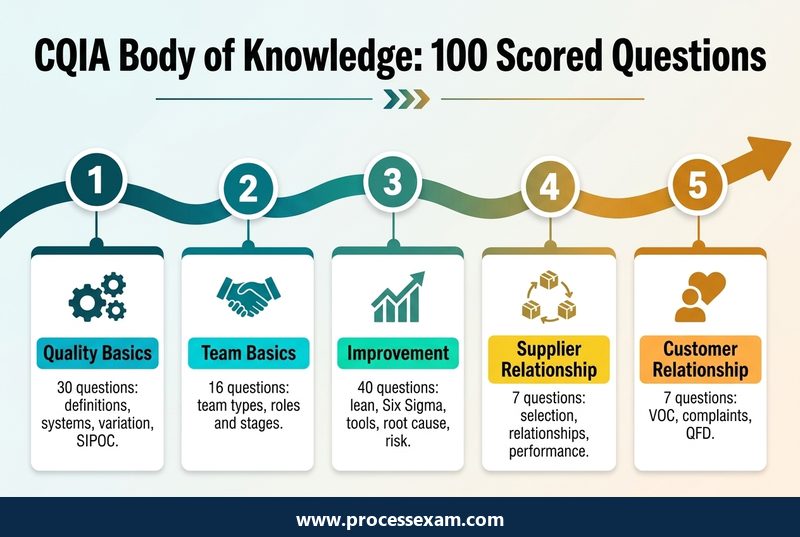
| Body of Knowledge domain | Scored questions | Share of the scored exam |
|---|---|---|
| I. Quality Basics | 30 | 30% |
| II. Team Basics | 16 | 16% |
| III. Improvement | 40 | 40% |
| IV. Supplier Relationship | 7 | 7% |
| V. Customer Relationship | 7 | 7% |
Read that table twice before you open a textbook. Improvement on its own carries more questions than Team Basics, Supplier Relationship and Customer Relationship combined. Candidates who divide their study time evenly across five domains give a quarter of their effort to fourteen questions and shortchange the forty that decide the result.
ASQ also marks every BoK entry with a cognitive level drawn from Bloom's revised taxonomy: Remember, Understand, Apply, Analyze, Evaluate or Create. Those tags are a study instruction in disguise. A topic marked Remember will be asked as recall. A topic marked Apply will be asked as a short situation where you must choose the right tool or the right next step. Nothing in the CQIA BoK goes above Analyze, which is why the exam rewards fluency with the basics rather than deep statistical work.
I. Quality Basics, 30 questions
This domain builds the vocabulary everything else uses. You are asked to distinguish between the common definitions of quality, explain what a quality plan is for and who contributes to it, and separate quality assurance from quality control and from continuous improvement. Those three are confused constantly in the workplace and the exam knows it.
Beyond definitions, the domain covers how organisational culture helps or blocks initiatives such as lean, Six Sigma, ISO 9001, Baldrige and change management; the difference between employee involvement and employee empowerment; the difference between a system and a process, including the SIPOC components of supplier, input, process, output and customer; common cause against special cause variation; and how standards such as ISO 9001 deliver consistency.
Two smaller parts of this domain are easy marks if you prepare them and easy losses if you skip them. The first is the benefits of quality to different stakeholders, including employees, organisations, customers, suppliers, the community and other interested parties. The second is the foundations of quality: the key teachings of Walter Shewhart, W. Edwards Deming, Joseph Juran, Kaoru Ishikawa, Philip Crosby and Armand Feigenbaum. Learn one signature idea per thinker and you will recognise the questions immediately.
II. Team Basics, 16 questions
Improvement happens in teams, so ASQ devotes sixteen questions to how teams are formed and run. You need to explain why teams solve certain problems better than individuals, and tell apart process teams, continuous improvement teams, workgroups, self-managed teams, ad hoc project teams, cross-functional teams and virtual teams.
Roles and responsibilities are examined as a straightforward list: sponsor, champion, facilitator, leader, member, scribe and timekeeper. Know what each one is accountable for, because questions often describe a behaviour and ask whose job it was.
The rest of the domain covers launching and sustaining a team, selecting members by knowledge, skill set, representation and diversity, and the classic stages of team development. Group dynamics questions tend to be scenario-shaped: a team is stuck, and you must identify the stage it is in or the intervention that fits.
III. Improvement, 40 questions
This is the domain that decides your result. It opens with process improvement approaches: Six Sigma concepts and the DMAIC phases of define, measure, analyze, improve and control; lean concepts and the tools used to remove waste, including set-up and cycle-time reduction, pull systems such as kanban, continuous improvement through kaizen, just-in-time, 5S, value stream mapping and error-proofing through poka-yoke; benchmarking as a route to best practice; and the difference between incremental and breakthrough improvement, along with the situations each one suits.
It then moves to improvement techniques you must be able to select and use: brainstorming, the plan-do-check-act cycle, affinity diagrams, cost of poor quality and internal audits. Next come the basic improvement tools, which you must select, interpret and apply: flowcharts, histograms, Pareto charts, scatter diagrams, check sheets, control charts and decision trees.
The domain closes with root cause analysis using tools such as the 5 Whys and the fishbone diagram, and with risk management through failure modes and effects analysis and SWOT analysis, including how risk is used to prioritise activities and projects. If you have limited study time, this paragraph and the two above it are where it should go.
IV. Supplier Relationship, 7 questions
A short domain with a clear scope. You should be able to identify supplier selection criteria and the approval process, describe supplier relationships along with their challenges and the effects of a diverse supply base, and identify supplier performance measures such as quality performance, on-time delivery and level of service. Seven questions is not many, but they are among the most predictable on the paper.
V. Customer Relationship, 7 questions
The final domain asks you to distinguish internal from external customers and describe how each influences products, services and processes. It then covers the voice of the customer: methods for collecting satisfaction feedback, including formal surveys, informal feedback, warranty claims and focus groups; the complaint handling process, from identifying a complaint through documentation, action taken and resolution; and quality function deployment as the method that translates customer expectations into priorities.
If you want the sub-topics laid out item by item, ASQ's downloadable CQIA Body of Knowledge is the source document, and our CQIA exam syllabus breakdown maps the same five domains to the topics you will be examined on.
Who can sit the CQIA, and what does it cost?
This is where a lot of older advice about the CQIA is simply wrong. The exam is often described as having no entry requirements. ASQ's certification page says otherwise: you must have two years of work experience, or an associate's degree, or two years of equivalent higher education. There is no requirement for the experience to be in a quality role, which is what makes the credential accessible, but the requirement exists and you confirm it when you apply.
Here are the exam facts in one place.
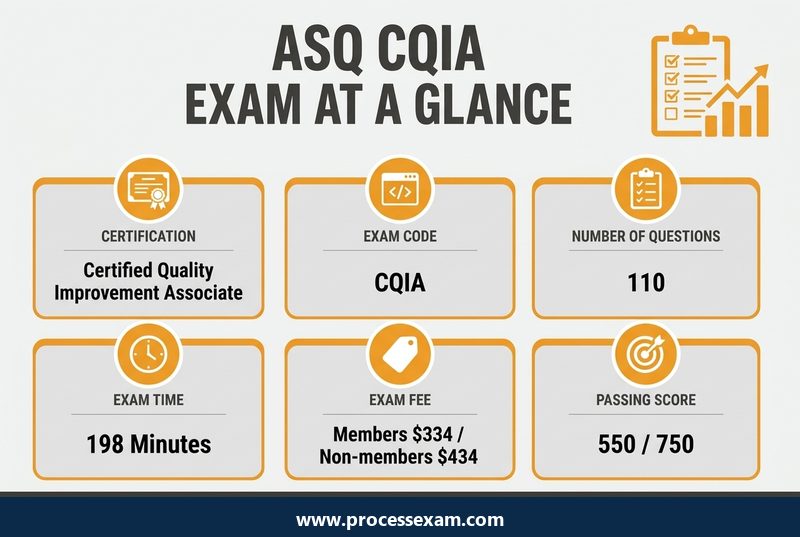
| Exam detail | ASQ CQIA |
|---|---|
| Certification | ASQ Certified Quality Improvement Associate (CQIA) |
| Exam code | CQIA |
| Vendor | ASQ |
| Category | Foundation Quality |
| Number of questions | 110 |
| Duration | Total appointment time- 210 minutes; Exam Time - 198 minutes |
| Exam fee (USD) | ASQ MEMBERS - $334; NON-MEMBERS - $434; RETAKES - $234 |
| Passing score | 550/750 |
The fee structure is worth a moment of arithmetic. The gap between the member and non-member price is $100, which is the reason so many candidates join ASQ before they book. Work out the cost of membership against that saving and against whatever member resources you would actually use, then decide. A retake costs $234, so the difference between passing first time and passing second time is real money as well as several more weeks of study.
Registration itself is short. Create or sign in to your ASQ profile, choose the Quality Improvement Associate exam, confirm that you meet the education or experience requirement, pick a computer-delivered appointment in the window you want, and pay. ASQ sets out the steps and the current application windows on its certification application page, and the exam's own details live on the ASQ CQIA certification page. Check both before you book, because fees, windows and delivery options change.
How is the CQIA scored, and how hard is it really?
The computer-delivered CQIA is a one-part exam of 110 multiple-choice questions. ASQ scores 100 of them and uses the other 10 unscored, which are there to trial future questions. You are not told which is which, so treat every question as if it counts.
Scoring is scaled, not a raw percentage. The scale runs to 750 and the pass mark is 550. Scaled scoring lets ASQ keep the standard constant across different forms of the exam, so a slightly harder form does not need a higher raw score to pass. The practical consequence is that you cannot convert 550 out of 750 into a fixed number of correct answers, and you should treat any such conversion you see quoted as a guess.
Now the timing. Exam time is 198 minutes for 110 questions, which is about one minute and forty-eight seconds per question, and the total appointment time is 210 minutes once check-in and orientation are included. That is a generous allowance by certification standards, but it is also more than three hours of sustained concentration, and fatigue in the last third is a genuine risk. Plan a pace rather than assuming the clock will look after itself.
Is the exam hard? It is a foundation-level credential, and the cognitive levels in the BoK top out at Analyze, so you will not be asked to run a regression or calculate control limits from scratch. What makes candidates stumble is breadth and precision. The BoK names dozens of tools and concepts, and questions frequently turn on a distinction that sounds trivial until you are asked to choose: assurance against control, involvement against empowerment, common cause against special cause, incremental against breakthrough. A candidate who has read everything once and can distinguish nothing reliably will struggle.
ASQ does not publish a pass rate for the CQIA, so treat any pass-percentage figure you find online as unverified. Your own performance under timed conditions is a far better signal of readiness than someone else's statistic.
How should you plan your CQIA study around the question weights?
A plan built on the domain weights beats a plan built on chapter order. The six-week schedule below assumes five to seven hours of study a week and no prior certification study. Compress it to four weeks if you already work in a quality function, or stretch it to eight if the vocabulary is new to you.
| Week | Focus | What you should be able to do by the end |
|---|---|---|
| 1 | Quality Basics, part one | Define quality, quality plans and quality systems; separate assurance, control and improvement; explain SIPOC and variation |
| 2 | Quality Basics, part two | Explain culture, involvement and empowerment, standardisation, the benefits of quality, and one signature idea from each of the six quality thinkers |
| 3 | Improvement, methods | Walk through DMAIC; name and use the lean tools; explain benchmarking and incremental against breakthrough improvement |
| 4 | Improvement, tools | Read and interpret all seven basic tools; apply PDCA, affinity diagrams, COPQ, 5 Whys, fishbone, FMEA and SWOT |
| 5 | Team, Supplier and Customer | Name every team role and team stage; list supplier selection criteria and performance measures; explain VOC, complaints and QFD |
| 6 | Timed practice and repair | Sit full-length timed papers, log every wrong answer by domain, and close the two weakest topics |
Three habits make that schedule work. Study in the order of the weights, not the order of the book. Write your own one-line definition for every term in the BoK rather than highlighting someone else's. And end each week by answering questions on what you covered, because recognition is not the same as recall.
Week six is the one people cut short, and it is the one that matters most. Sitting a timed CQIA mock test under real conditions does something reading cannot: it shows you where your pace collapses, which domains you only thought you knew, and whether three and a quarter hours of concentration is something you can actually sustain. Do it at least twice, and review every wrong answer by domain so the second attempt fixes something specific.
Keep an error log from the first practice session onwards. One line per question you missed, with the domain, the topic and one sentence on why you got it wrong. By week six that log is a ranked list of exactly what to revise, and it is far more useful than re-reading whole chapters.
Which quality tools must you be able to recognise on sight?
More CQIA questions hang on tool recognition than on any other single skill. A question may show you a situation and ask which tool fits, or name a tool and ask what it produces. Either way, hesitation costs time you will want later. Work through the list below until each row is instant.
| Tool | What it does | When the exam expects it |
|---|---|---|
| Flowchart | Shows the steps and decisions in a process | Understanding or documenting how work actually flows |
| Histogram | Shows the distribution of a measured variable | Asking how spread out or centred the data is |
| Pareto chart | Ranks causes by frequency or cost | Choosing which few causes to tackle first |
| Scatter diagram | Shows the relationship between two variables | Testing whether two things move together |
| Check sheet | Collects counts in a structured way | Gathering data before any analysis |
| Control chart | Separates common cause from special cause variation | Asking whether a process is stable over time |
| Decision tree | Maps choices and their outcomes | Comparing options with different consequences |
| Fishbone diagram | Groups possible causes by category | Searching for the root cause of a defect |
| 5 Whys | Drills from symptom to root cause | A simple problem with one causal chain |
| FMEA | Rates failure modes by severity, occurrence and detection | Identifying and prioritising risk before it happens |
| SWOT | Sets strengths and weaknesses against opportunities and threats | Framing risk and priorities at organisation level |
| Affinity diagram | Sorts many ideas into natural groups | Making sense of brainstorming output |
| Value stream map | Shows value-adding and wasteful steps end to end | Lean questions about where waste sits |
| QFD | Translates customer needs into requirements | Voice of the customer questions about priorities |
Two distinctions inside that table are asked more often than the rest. The first is histogram against Pareto chart: both are bar charts, but a histogram shows the distribution of one measured variable while a Pareto chart ranks categories so you can attack the largest contributors first. The second is fishbone against 5 Whys: the fishbone spreads candidate causes across categories when the problem could come from several directions, while the 5 Whys follows one chain down to its root.
Control charts deserve their own note because they carry the variation concept from Quality Basics into the Improvement domain. Know that points inside the control limits with no pattern mean common cause variation, which is inherent in the process, and that points outside the limits or a non-random pattern signal special cause variation, which has an identifiable and usually removable reason. The exam does not ask you to calculate the limits. It asks you to read what they mean and to say what a manager should do next.
Which mistakes make candidates fail the CQIA?
The failures cluster into a handful of avoidable patterns.
- Studying the domains evenly. Improvement is 40 scored questions and Supplier and Customer Relationship are 7 each. Equal time is the wrong allocation.
- Relying on workplace habit. Your organisation's local definition of a process audit or a quality plan may not match ASQ's. The exam tests ASQ's Body of Knowledge, not your employer's handbook.
- Memorising names instead of uses. Knowing that a Pareto chart exists earns nothing. Knowing when to reach for it earns the mark.
- Ignoring the quality thinkers. Shewhart, Deming, Juran, Ishikawa, Crosby and Feigenbaum are named explicitly in the BoK, and candidates skip them because they feel like history.
- Starting timed practice too late. A first full-length paper in the last two days leaves no time to act on what it reveals.
- Underestimating the sitting. Three and a quarter hours of exam time is long. Candidates who never practise for that length lose accuracy in the final forty questions.
- Relying on outdated figures. Fees and exam windows change. Confirm them on ASQ's own pages rather than trusting a blog post, including this one, for the number on the day you book.
What should you do in the final week and on exam day?
By the last week the learning should be finished. What remains is consolidation, pacing and logistics.
Seven days before
Sit a full-length timed paper and sort every error by domain. Whichever domain produces the most errors gets the next three study sessions. If the errors are spread thinly and evenly, do not add material; work instead on the distinctions that keep catching you out, because scattered errors usually mean imprecision rather than a knowledge gap.
Three days before
Sit a second timed paper on questions you have not seen before and compare the two results. A higher score with a shorter error list means the plan worked. Then stop adding anything new and build a single revision page: the five domains with their question counts, the seven basic tools and what each one shows, the team roles, the lean tools, and the four distinctions that trip most candidates.
The day before
Read your one page and your error log, nothing else. Confirm the appointment time, the address or the remote-proctoring requirements, and what identification you need to bring. If you are sitting remotely, test the equipment and clear the room in advance rather than on the morning. Then stop studying early. A rested candidate reads question stems accurately, and accuracy is worth more than one more hour of revision.
During the exam
Set two checkpoints. At 66 minutes you should be near question 37, and at 132 minutes near question 74. Those markers tell you within seconds whether you are on pace. Read the stem before the options, because CQIA questions often hinge on a single qualifier such as best, first or most likely. Eliminate the options that are simply wrong before weighing the ones that remain, and flag anything that takes more than two minutes instead of stalling on it. Finish a first pass with time in hand, then return to the flagged questions with a clear head.
Afterwards
Your result arrives as a scaled score against the 550 pass mark, with feedback by domain. If you passed, note your renewal obligations while they are fresh. If you did not, the domain feedback is the most valuable study plan you will ever be handed: it tells you exactly where the 40-question domain or the 30-question domain let you down, and a retake costs $234.
Where does the CQIA take your career next?
The CQIA sits deliberately at the entry point of ASQ's certification family. That positioning is its strength. It is the credential you can earn while you are still learning the field, and it proves to an employer that your understanding of quality is structured rather than picked up in passing.
Three groups get the most from it. People moving into a quality role from operations, engineering or administration, who need a recognised way to show the move is serious. People already doing improvement work informally, on kaizen events or problem-solving teams, who want the vocabulary to match the practice. And people in adjacent functions such as purchasing, customer service or project coordination, where supplier performance, voice of the customer and root cause analysis come up constantly.
It also works as a foundation for what follows. The vocabulary in Quality Basics, the tools in Improvement and the team content all reappear, in more depth, in ASQ's process-analyst, auditor and Six Sigma credentials. Candidates who study the CQIA properly rather than skimming it find the next exam materially easier, because they are adding depth to a structure they already have rather than building the structure and the depth at once.
One caution worth stating plainly. A foundation credential opens a conversation; it does not finish one. Pair the certificate with something you have actually improved, even a small change to a local process, and you have an answer to the interview question that follows every certification on a CV: what did you do with it?
Frequently Asked Questions
How many questions are on the ASQ CQIA exam?
The computer-delivered CQIA exam has 110 multiple-choice questions. ASQ scores 100 of them and uses the remaining 10 unscored to trial future questions, and candidates are not told which is which. Exam time is 198 minutes, with a total appointment time of 210 minutes.
What is the passing score for the CQIA?
The CQIA is scored on a scale up to 750, and the pass mark is 550 out of 750. Because the scoring is scaled rather than a raw percentage, there is no fixed number of correct answers that guarantees a pass, and ASQ does not publish a pass rate for the exam.
How much does the CQIA exam cost?
ASQ lists the CQIA fee as $334 for ASQ members and $434 for non-members, with retakes at $234. The $100 difference is why many candidates join ASQ before booking. Confirm the current fee on ASQ's certification pages, because prices and exam windows change.
Do I need work experience to take the CQIA?
Yes. ASQ requires two years of work experience, or an associate's degree, or two years of equivalent higher education. The experience does not have to be in a quality role, which keeps the credential accessible, but you confirm that you meet the requirement when you submit your application.
Which CQIA domain carries the most questions?
Improvement carries 40 of the 100 scored questions, more than Team Basics, Supplier Relationship and Customer Relationship combined. Quality Basics adds 30. Study time should follow that split, with most effort on improvement methods, the seven basic tools, root cause analysis and risk.
How long does it take to prepare for the CQIA?
Most candidates need four to eight weeks at five to seven hours a week. Four weeks is realistic if you already work in a quality function and know the tools. Allow eight if the vocabulary, the lean and Six Sigma methods or the team content are new to you.
Is the CQIA a good first ASQ certification?
It is designed as one. The CQIA sits at the entry point of ASQ's certification family and covers vocabulary, tools and team concepts that reappear in greater depth in ASQ's process-analyst, auditor and Six Sigma credentials, so studying it properly makes the next exam noticeably easier.
- ASQ Quality Improvement Associate Test Questions |
- CQIA Question Bank |
- CQIA Body of Knowledge (BOK) |
- ASQ Quality Improvement Associate Sample Questions |
- CQIA Exam Questions Download |
- CQIA Test Questions |
- Quality Improvement Associate PDF |
- ASQ Quality Improvement Associate Book |
- ASQ CQIA BOK PDF |
- Quality Improvement Associate Certification Cost |
- Quality Improvement Associate Certification Requirements |
- Foundation Quality |
- CQIA Handbook


