Management

Explore 16 resources related to Management on ProcessExam. These resources help certification candidates understand key aspects of exam preparation, including exam structure, study strategies, and expectations for scenario-based or applied assessments. Reviewing these materials can help improve readiness and confidence before attempting the certification exam.

LSSA Lean Six Sigma - Black Belt (LSSA-BB)

LSSA-BB dumps PDF, LSSA Lean Six Sigma Black Belt dumps, free LSSA Lean Six Sigma Black Belt exam dumps, Lean Six Sigma Academy LSSA-BB Braindumps, online free LSSA Lean Six Sigma Black Belt exam dumpsYou can easily pass LSSA Lean Six Sigma Black Belt (LSSA-BB) Certification with the help of our online practice exam. We are here to help you every step of the way to pass your LSSA Lean Six Sigma - Black Belt exam. Our team of experienced and certified professionals with more than 12 years of experience in the field of Management has designed practice exam to prepare for LSSA Lean Six Sigma Black Belt certification. They have carefully maintained exam structure, syllabus, time limit and scoring system same as the actual Lean Six Sigma Academy Certified Lean Six Sigma Black Belt (LSSA-BB) exam. Our Lean Six Sigma Academy LSSA-BB question bank contains most frequently asked and real-time case study based questions prepared by collecting inputs from recently certified candidates.

To get familiar with our online LSSA Lean Six Sigma Black Belt certification practice exam environment, we invite you to try our sample practice exam to build the trust between us.

Try Online Exam »

Five ASQ Quality Certifications: What Each One Changes for Your Business

Updated on 8 October 2026. What’s new: experience rules now follow ASQ's current text, including three years for the Quality Inspector with two waived by a diploma or degree

A quality certification is worth paying for when it fills a named gap in your business. ASQ offers five that suit different gaps: the CMQ/OE runs the quality system, the CQA audits it, the CQI inspects product, the CQPA analyses problems and the CQIA gives non-specialists the basic tools. Exam fees run from $334 to $585, so the real question is which job you need done.

Smiling manager at a desk beside the title 5 Quality Certifications That Can Improve Your Business

Picture a parts maker with 150 staff whose biggest customer has just sent a supplier scorecard with three open findings. The owner does not need five certificates. The owner needs someone who can answer the audit, someone who can find why parts drift, and a floor team that records data the same way every shift. This guide matches each of those needs to one of the five credentials, shows what each person must already have done before ASQ lets them sit the exam, and adds up what a small team costs.

ASQ Certified Manager of Quality/Organizational Excellence (CMQ/OE)

CMQ/OE dumps PDF, ASQ Manager of Quality/Organizational Excellence dumps, free ASQ Manager of Quality/Organizational Excellence exam dumps, ASQ CMQ/OE Braindumps, online free ASQ Manager of Quality/Organizational Excellence exam dumpsYou can easily pass ASQ Manager of Quality/Organizational Excellence (CMQ/OE) Certification with the help of our online practice exam. We are here to help you every step of the way to pass your ASQ Certified Manager of Quality/Organizational Excellence exam. Our team of experienced and certified professionals with more than 12 years of experience in the field of Management has designed practice exam to prepare for ASQ Manager of Quality/Organizational Excellence certification. They have carefully maintained exam structure, syllabus, time limit and scoring system same as the actual ASQ Certified Manager of Quality/Organizational Excellence (CMQ/OE) exam. Our ASQ CMQ/OE question bank contains most frequently asked and real-time case study based questions prepared by collecting inputs from recently certified candidates.

To get familiar with our online ASQ Manager of Quality/Organizational Excellence certification practice exam environment, we invite you to try our sample practice exam to build the trust between us.

Try Online Exam »

Six Sigma Benefits for an Organisation and How Each Is Measured

A finance director asks a fair question before approving a Six Sigma programme: which line of the accounts will move, by how much, and how will anyone know it was the programme that moved it? Most articles on the benefits of Six Sigma answer with adjectives such as efficiency, loyalty and morale. This one answers with measures. An organisation gains fewer defects, lower cost of poor quality, shorter and more predictable cycle times and fewer complaints, and each of those has a number that can be read before and after. It also pays to know when the sums do not work.

Finance and quality managers reviewing defect and cost charts together

The method itself needs one sentence here. Six Sigma is a project-by-project way of finding the cause of a defect with data and removing it, usually following the define, measure, analyse, improve, control sequence known as DMAIC. Everything below is about what that buys a business, and how to prove it.

Which Six Sigma benefits can a finance director actually check?

Five benefits survive scrutiny because each one maps to a figure the business already records or can start recording. The table pairs each with the measure that proves it and the place where the effect should show up.

Pros and Cons of Six Sigma: Where It Pays and Where It Fails

Is Six Sigma worth implementing? Yes, when a process repeats often, its defects cost real money and the data already exists; no when the work is a one-off, the cause is an obvious broken step or the real aim is invention. Almost every disadvantage people list sits on the second side of that line: training time, slow projects, paperwork and a narrow view of quality. This guide prices those costs and shows how organisations reduce them.

Pros and cons of Six Sigma implementation with Black Belt and Green Belt roles

Six Sigma grew at Motorola in the 1980s and then spread to other manufacturers and service firms. Its pitch is simple: pick a process, measure its defects, find the causes with data and fix them for good. The pitch is also where the trouble starts, because each word in it (pick, measure, data, for good) is a place where an implementation can go wrong. The old argument of "pros versus cons" is therefore less useful than a sharper question: under which conditions do the pros appear, and what does it cost to create those conditions?

Where does Six Sigma earn its keep?

Six Sigma pays when four conditions hold together. The process runs often enough to produce plenty of observations. Each defect has a price someone can name, such as rework, scrap, refunds or a missed delivery. One person owns the process and can change it. And the cause is not obvious, so analysis adds something that a quick fix would not.

When those conditions are in place, the method brings real strengths that older improvement drives often lacked:

Six Sigma in HR: What HR Does and Which HR Processes It Can Fix

A calendar invite lands in an HR manager's inbox: "Black Belt kickoff, Tuesday, HR representative required." She has never built a control chart and is not sure why the meeting involves her. The answer is that HR has two jobs in Six Sigma. It supplies the people side of the programme, from choosing belts to explaining the change to staff, and it owns processes of its own, such as hiring, onboarding and payroll, that can be measured and improved in the same way as a production line.
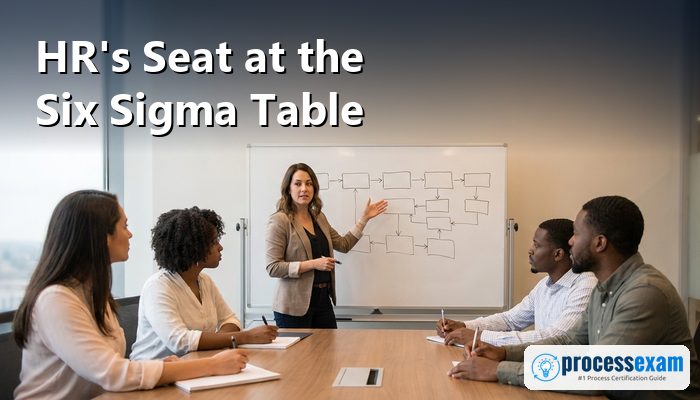
HR manager presenting a process flow to an improvement team

Only one line of method is needed before starting. Six Sigma works through five steps, abbreviated DMAIC: define the problem, measure it, analyse the cause, improve the process, then control the gain. The rest of this article is about how that plays out in an HR department.

Is Six Sigma useful for HR, or is it a factory method?

It began on manufacturing lines, at Motorola in the 1980s, and its vocabulary still sounds like a factory: defects, yield, throughput. But the logic does not care what is being made. Wherever work repeats and the outcome can be counted, the same questions apply. HR runs exactly that kind of work in volume: payslips every month, offers every week, contracts, leave requests, benefit queries, mandatory-training reminders.

Three tests decide whether a given HR process is worth a Six Sigma project.

Syndicate content