
Why Get Six Sigma Certified? Which Reasons Hold Up and Which Do Not
A Six Sigma belt does not raise your pay by itself. Employers pay for a measured result, and the belt is evidence that you can produce one. That is why some of the usual ten reasons to certify hold up and others are oversold. This guide sorts them, shows how to test each against your own job, and puts the ASQ Green Belt (CSSGB) figures in one table so you can price the decision.

Search results for this topic are full of lists that call every reason a benefit. The honest version is shorter. A belt is a credential that tells a stranger you studied a method; whether it changes your career depends on what you do with the method afterwards. The sections below separate the two.
Does a belt raise your pay on its own?
No, and the evidence people point to rarely shows it. Salary figures attached to Six Sigma are usually averages self-reported to job sites. They mix belt-holders who are quality engineers, plant managers and consultants with years of experience, and they do not isolate the belt from the experience, the industry or the city. A higher average among people who hold a credential tells you who tends to hold it, not what the credential did for them.
What the pay link looks like in practice is more specific. Pay moves when one of three things happens after you certify.
- You change role. Some jobs name a belt in the advert, and a few treat it as a filter. Quality engineer, continuous improvement specialist and process excellence analyst adverts are the common ones. Moving into one of those roles can come with a different pay band, and the belt helped you through the door.
- You deliver a result your manager can quote. A project that removed rework or shortened a delay gives your manager something concrete to take into a pay review. The belt taught the method; the number is what gets discussed.
- Your employer ties pay or promotion to the belt. A few organisations do, usually where improvement work is a formal career track. You can find out in one conversation with HR.
If none of the three is available to you, the belt is unlikely to change your pay in the next year, however well you score. If you need a salary figure for your own decision, look at a current salary survey for your role, region and years of experience, and compare adverts that name a belt with adverts for the same job that do not.
Which of the ten usual reasons hold up, and which are oversold?
Most lists of reasons to get certified repeat the same ten claims. Here they are, judged one at a time. The verdict says how far the claim holds for an individual who earns the credential, not for an employer that adopts the method.
| Usual reason | Verdict | What decides whether it is true for you |
|---|---|---|
| Your CV shows a recognised method | Holds up | Recruiters in quality and operations know the belt names; outside those fields they may not |
| You can read and challenge process data | Holds up | The syllabus teaches charts, sampling and hypothesis tests, but only if you keep using them |
| You can qualify for quality and improvement roles | Holds up where adverts name belts | Count the adverts near you before paying the fee |
| You can put a money figure on a project | Holds up, with a project | The exam teaches how; a real project supplies the figure |
| You work in any industry | Partly | Healthcare, banking, logistics and manufacturing use the method; your employer must hold process data worth improving |
| You build leadership skills | Partly | Leading people comes from running a project with a team, not from sitting an exam |
| You help your employer meet standards | Partly | Customer and regulatory standards name their own requirements; a belt helps you work toward them |
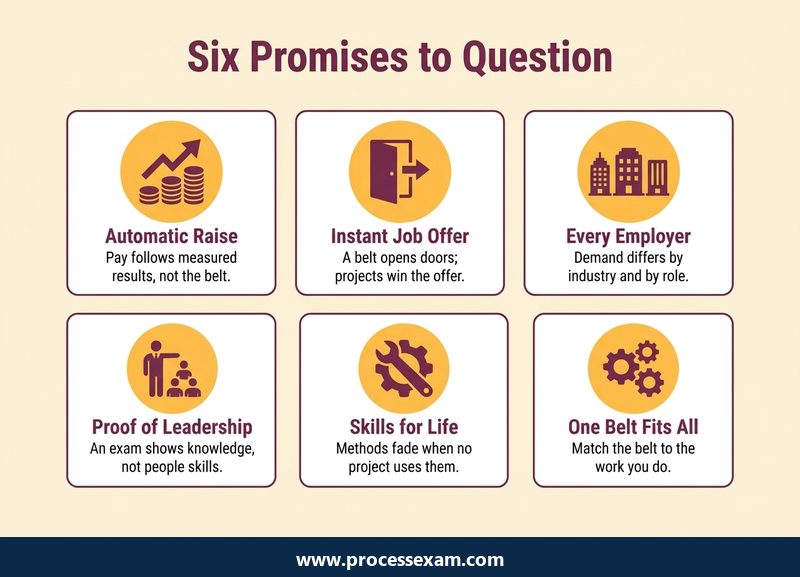
| You get promoted faster | Oversold | Promotion needs an open post and visible results; a belt alone rarely supplies either |
| You earn a lot more | Oversold | Pay follows role, results and employer, as the first section showed |
| You get hired by famous companies | Oversold | Large employers hire for a role and a record; a belt is one line among many |
Two patterns stand out. Every claim that holds up describes something you can do or show: read data, run a project, put a number on the result. Every oversold claim describes something other people do to you: promote, pay or hire. A credential can raise the odds on the second group, but only through the first.
Why do the oversold reasons keep appearing on lists?
Two forces keep them alive. Training providers have an interest in selling the dream of an automatic raise, so their pages lead with it. And survivors speak loudest: people whose careers moved after certifying write about the belt, while people whose careers did not move say nothing. Treat any list that gives the belt credit for a promotion with the same caution you would give a diet plan that credits one food.
Which reasons matter most at your stage of career?
The weight of each reason shifts with where you stand. Early in a career, the strongest reasons are the first two in the table: a recognised method on the CV and the ability to read process data, because you have little else to show yet. Mid-career, the project reason dominates, since managers hiring or promoting at that level ask for results, not training. For someone moving from another field into quality or operations, the role reason carries the most weight, and it is also where the adverts matter most. A senior person who already leads improvement work gains the least from a Green Belt, because the evidence they need is already in their record.
Why do the reasons that hold up all depend on a project?
Every reason on the solid side of the table needs proof, and the proof is a piece of work. An exam shows that you understood the method on one day. A project shows that you applied it to something that mattered to someone who pays for the work. Interviewers know the difference, and they ask about it: what was the baseline, what did you change, how much did it move, and how do you know it stayed that way?
Here is an illustrative case, not a real result, to show the size of number that makes a convincing story. A claims team reworks 11 of every 100 files because of missing documents. A Green Belt candidate samples the rework, finds that most of it traces to one unclear intake form, redesigns the form and checks the rate for eight weeks. It falls to 6 per 100. On 2,000 files a month, that is 100 fewer reworked files. At 20 minutes each, the team recovers about 2,000 minutes, a little over 33 hours a month. Nothing in that story needs a famous employer or a senior title. It needs a defined problem, a before-and-after count and a sponsor who will confirm the figures.
That is the difference between the claims of a belt and the claims of a project. The belt says you know how to do this. The project says you did, here are the numbers and here is the person who will vouch for them. Employers who hire on belts are usually hoping the holder carries a few such stories.
What does a belt without a project still give you?
It is not worthless. Studying the syllabus gives you a vocabulary that lets you follow a quality meeting, question a chart that looks too good and tell a real trend from noise. Those are real skills, and they help even when no project follows. The point is that they are hard for anyone else to see until a project makes them visible, and they fade when nothing uses them.
What does the Green Belt route cost in money and time?
The CSSGB is the belt most individuals choose when they want to prove the method without leading others full time, which makes it a fair yardstick for the decision. Here are the exam details from ASQ's published figures, in one place.
| Exam detail | ASQ CSSGB |
|---|---|
| Full name | ASQ Certified Six Sigma Green Belt (CSSGB) |
| Exam code | CSSGB |
| Vendor | ASQ |
| Number of questions | 110 |
| Duration | Total appointment time - 270; Exam time - 258 (minutes) |
| Exam fee | ASQ members - $383; non-members - $483; retakes - $283 |
| Passing score | 550/750 |
ASQ publishes the current fees, eligibility and booking steps on its Six Sigma Green Belt certification page, and you should read it before you commit, because fees and rules change.
Put the numbers next to the reasons. The gap between member and non-member pricing is $100, so the saving only matters if ASQ membership is useful to you for other reasons. A retake costs $283, about 59 percent of the non-member first-attempt fee, so a first attempt plus one retake comes to $666 as a member or $766 as a non-member. That is before books, any course and the hours you spend. If you study five hours a week for ten weeks, that is 50 hours of your own time, which is the larger cost for most people.
Set that against the table of reasons. Spending that money and time is easy to justify if your adverts name belts, or if your employer is paying, or if a project is waiting for you. It is harder to justify if you are hoping for a raise that nobody has promised. The CSSGB syllabus shows which topics ASQ expects you to know, so you can judge whether the content matches the work you already do before you pay for anything.
Which situations make the belt a poor bet right now?
A belt is a poor bet in four situations, and each is common enough that you may recognise your own.
- Your job produces no process data. The method is built on counting defects, delays and measurements. In a role where nothing is counted, you will have nowhere to apply it, and the knowledge will fade.
- Your employer does not run improvement work. A belt-holder in a team that dismisses improvement projects spends more time arguing for permission than improving anything. Ask whether any such project has run in the last two years and who led it.
- You want a different kind of career. If your goal is project management, IT service management or a leadership role in a sales team, the credential that matches those goals will serve you better. A Six Sigma belt sits close to quality and process work.
- You expect the belt to do the persuading. If the plan depends on the certificate convincing people without a project behind it, the plan depends on the oversold reasons from the table.
None of these says never certify. They say wait until the missing piece is in place: a project, a sponsor or an employer that uses the method. A delay of a few months to line one up is cheap next to an exam fee spent on a credential that stays unused.
How can you test the reasons against your own job in one afternoon?
The five checks below take an afternoon and cost nothing. Do them in order, because each answer changes the next.
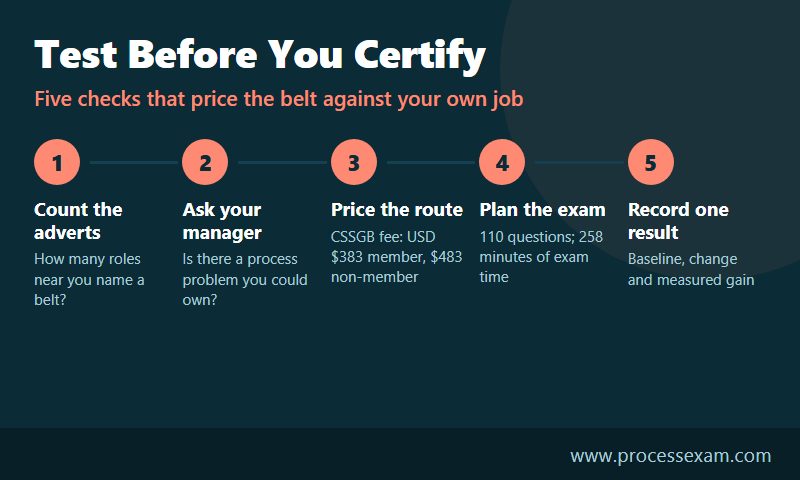
- Count the adverts. Search the job boards for the roles you want in your area and note how many name a Six Sigma belt, how many prefer one and how many never mention it. Ten adverts is enough to see a pattern. If most never mention it, the belt is not your door.
- Ask your manager one question. Ask whether there is a recurring problem in your team that a measured project could fix. A yes gives you a candidate project. A shrug tells you the method has no home in your team yet.
- Ask HR about sponsorship. Some employers pay the exam fee, give study time or recognise belts in their promotion framework. If yours does, the cost side of the decision changes completely.
- Price the full route. Add the exam fee, books, any course and the study hours from the previous section. A number on paper makes the comparison honest.
- Decide what result you will record. Pick one measurable outcome, with a baseline, that you could improve in three to six months. If you can name it, you have the project that makes the belt count.
If three or more checks come back positive, certifying is a sound bet. If most come back negative, spend the next quarter on the project or the conversation, not the exam.
How do you turn the certificate into results on a CV?
Recruiters scan a CV in seconds, so the line that carries the belt has to carry a result as well. Compare two versions. The weak line reads: Six Sigma Green Belt certified. The stronger line reads: cut claim rework from 11 to 6 per 100 files over eight weeks, saving about 33 staff hours a month (Green Belt project, sponsor named). The second line has a number, a time frame and a witness, and the belt is implied by the method.
What should you record while the project runs?
Keep four things on a single page: the problem in one sentence, the baseline you measured, what you changed and the figure after the change, along with how long you watched it. Ask your sponsor to confirm the figures in writing, even by email. That page becomes your interview answer, your CV line and your evidence at a pay review.
Where do belt names help, and where do they not?
Inside quality and operations circles, belt names carry weight and a CV that lists one is read in a particular way. Outside them, a recruiter may not know what a Green Belt is, so spell out the method in plain words: a structured way to find and fix the cause of a recurring defect, using data. The Six Sigma overview on Wikipedia is a neutral place to check how the method is described in general terms. If you later outgrow the Green Belt, ASQ's Black Belt page shows the next rung, where leading teams and larger projects is the expectation.
Before paying ASQ's fee, the CSSGB practice exam shows whether the 110-question format suits the way you work, which is one more piece of evidence for the decision.
What does an honest case for certifying look like?
Here is a version you could say aloud to a sceptical manager. I want to learn a method for finding the cause of recurring problems from data. There is a process in our team with a measurable problem. The exam fee is a known number and I have planned the study hours. I will record a baseline, a change and a result, and I will show you the page when it is done.
That case does not promise a raise, a promotion or a new employer. It promises a method, a project and a measured result, and it is exactly the case the oversold reasons leave out. It is also the case that makes the rest of the ten reasons more likely: a pay review, a role change or a better offer all start from a manager who can point to something you did.
If you take one thing from the table, take this. The reasons that hold up all describe your own work. Start with the work, use the belt to organise it and let the credential confirm what the results already show.
Frequently Asked Questions
Why is Six Sigma certification important?
It gives you a recognised method for finding the causes of recurring defects and a credential that tells quality and operations employers you studied it. Its value rises sharply when you pair it with a documented project that shows a measured before-and-after result.
Does Six Sigma certification increase salary?
Not by itself. Pay tends to move when the belt helps you change role, when a project delivers a result your manager can quote, or when your employer links pay to belts. Check a current salary survey for your own role and region rather than relying on headline averages.
Is Six Sigma certification worth it for beginners?
It can be, if your job produces process data and you can find a project to apply the method to. It is a weak bet if your role has no measurements or your employer does not run improvement work, because the knowledge fades without use.
Why do companies use Six Sigma?
Companies use it to reduce defects, delays and rework by testing causes with data instead of opinion. For you as an individual, that means employers inside such programmes value people who can run measured projects, which is why a belt plus a project reads well.
How much does the CSSGB exam cost, and what score passes?
ASQ lists the CSSGB exam at $383 for members and $483 for non-members, with retakes at $283. The exam has 110 questions, runs 258 minutes of exam time within a 270-minute appointment, and the passing score is 550 out of 750.
- Six Sigma |
- ASQ Six Sigma Green Belt Sample Questions |
- ASQ Six Sigma Green Belt Test Questions |
- CSSGB Question Bank |
- CSSGB Exam Questions Download |
- CSSGB Test Questions |
- Six Sigma Green Belt PDF |
- ASQ Six Sigma Green Belt Book |
- ASQ CSSGB BOK PDF |
- Six Sigma Green Belt Certification Cost |
- Six Sigma Green Belt Certification Requirements |
- CSSGB Body of Knowledge (BOK) |
- CSSGB Handbook


