
What Is SHRM-SCP? Strategic Judgment vs SHRM-CP
Updated on 14 November 2026. What’s new: eligibility now follows SHRM's rule of three years of strategic-level HR work, with no degree needed
SHRM-SCP is the Senior Certified Professional credential from the Society for Human Resource Management, and it is meant for HR practitioners whose work is strategic rather than operational. The surprise for most candidates is that the paper looks identical to the SHRM-CP: the same 134 questions, the same item types, the same scoring rule. What changes is the altitude of the scenarios, and that altitude is what this guide unpacks.

What is the SHRM-SCP, in plain terms?
Think of it as a way of saying that you make decisions for the organisation, not only inside the HR department. SHRM states that the exam is built for people whose work includes developing HR policies and procedures, overseeing integrated HR operations, directing an entire HR enterprise, or leading the alignment of HR strategy with organisational goals. Searchers who type "shrm-scp meaning" or "shrm scp definition" are really asking what level of work the letters describe, and the answer is the strategic level.
The qualification route is a matter of work history, not of a degree or a job title. SHRM's 2026 certification handbook asks for three years of HR duties pitched at the strategic level, each year including at least 1,000 hours, and says candidates need neither an HR title nor a degree. This guide leaves the application mechanics to the companion eligibility and application guide and stays on the part candidates find hardest to picture: what strategic-level judgment looks like on the screen.
| Detail | SHRM-SCP |
|---|---|
| Certification | SHRM Senior Certified Professional (SHRM-SCP) |
| Vendor | SHRM |
| Exam code | SHRM-SCP |
| Category | Human Resources |
| Number of questions | 134 |
| Duration | 220 minutes |
| Exam fee | Member - $399 | Non-member - $499 (standard rate) |
| Result | Pass / Fail (200 Scaled Score) |
| Situational judgment items | 54 of the 134 questions |
SHRM's handbook gives the split behind that last row: 80 stand-alone knowledge questions and 54 situational judgment items, both counted inside the 134. It also says the exam carries 24 unscored field-test items that are mixed in at random, so you cannot tell which questions do not count. Treat every scenario as live.
Is the SCP judgment section a different test from the CP's?
Mechanically, no. The handbook states that the distribution of items by content and by item type is the same for the SHRM-CP and the SHRM-SCP, and that situational judgment items make up 40% of the score on both. Both exams present a realistic workplace scenario and ask you to choose the best of several possible actions. Both award credit only for the best or most effective action, even though, as SHRM itself puts it, more than one strategy may work in real life.
The difference is in what "best" is measured against. The SHRM Body of Applied Skills and Knowledge, which SHRM calls the BASK, lists proficiency indicators for every behavioural competency and HR functional area in two groups: those for all HR professionals, and those for advanced HR professionals. SHRM describes the SHRM-CP as the exam for professionals in operational roles and the SHRM-SCP as the exam for senior-level professionals in strategic roles, and the handbook tells candidates to pay particular attention to the proficiency indicators that distinguish the exams. A scenario written for the SCP is therefore written to reach the advanced column.
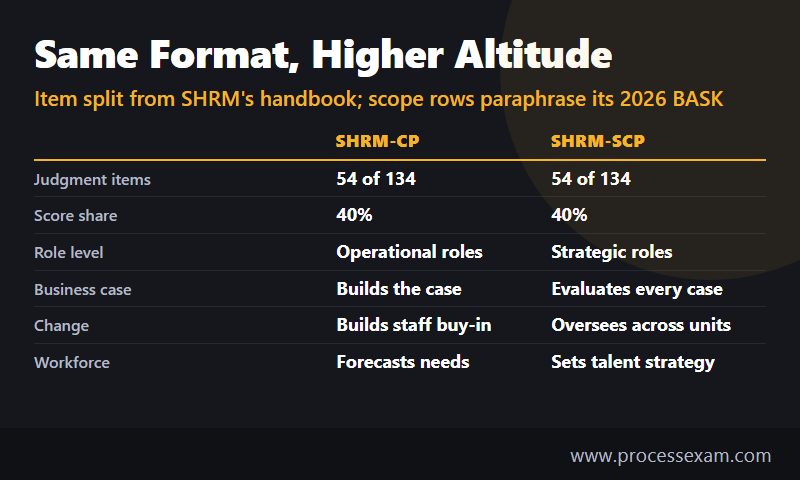
One line in the BASK deserves a second reading. It says the indicators for all HR professionals also apply to advanced ones, and that executives who no longer perform an early-career task should still understand the concept, recognise its strategic importance and be able to mentor others in it. In other words, the SCP does not replace operational judgment with strategic judgment. It adds a layer above it, and the top layer is the one the scenarios are written to test.
What the extra layer looks like in SHRM's own wording
The table below paraphrases three places in the 2026 BASK, checked in November 2026, where the two columns diverge. It is a reading aid, not a quotation of SHRM's exam content.
| BASK area | For all HR professionals | Added for advanced HR professionals |
|---|---|---|
| Strategic Alignment (Business Acumen) | Aligns decisions with the strategic direction and builds the business case for an HR initiative | Aligns HR's long-term goals with business strategy, applies systems thinking, and evaluates every proposed business case for HR initiatives |
| Change Management (Consultation) | Builds buy-in among staff and recommends improvements to programmes and policies | Works with executives to decide when change is or is not needed, defines change objectives and oversees implementation across business units |
| Workforce Management (Organization domain) | Forecasts workforce needs and plans ways to develop the competencies required | Judges how strategy lines up with current and future staffing, and develops strategies to keep the talent supply robust and to restructure the workforce |
What does "strategic" actually mean inside an SCP scenario?
SHRM does not publish a glossary of scenario types, and it says plainly that its sample questions do not predict exam performance, so what follows is our reading of the BASK's advanced indicators and not a list of what will appear. Three themes recur in them, and they are the three most useful lenses for a senior candidate.
Business acumen: the answer has to survive a finance meeting
At the advanced level the BASK expects you to design and evaluate HR initiatives with attention to value added, return on investment, and profit and loss, to use risk assessment when setting direction, and to determine the budget and resource needs of an initiative. It also expects you to apply knowledge of the labour market when planning how to compete for talent. In a scenario, that translates into a simple test: can you defend this action to someone who owns a budget? An option that is kind, fair and well intentioned but has no measure, no cost and no owner is often the weaker choice.
Leading change: deciding whether to change at all
The advanced indicators begin with working out with executives whether change is needed, before any plan is made. Only then do they move on to defining objectives, building support at every level and overseeing delivery across units. A frequent trap is an option that jumps straight to delivery, such as a training roll-out or a new policy, when the scenario has not shown that the change is justified or that leaders agree on it. A strategic answer tends to settle the question of why before it settles how.
Workforce planning: supply and demand, not the next vacancy
Workforce Management is a knowledge area in SHRM's Organization domain, so it is tested chiefly through knowledge items. Its advanced indicators still show the judgment the scenarios borrow: comparing the organisation's strategy with its present and future staffing, planning for long-term leadership needs with business leaders, and developing strategies to restructure the workforce. The BASK's key concepts name forecasting, gap analysis, succession planning, and "build, buy, borrow and bridge" options for closing gaps. A scenario that mentions a planned expansion, an ageing specialist team or a merger is usually inviting a plan, not a single hire.
How does one scenario read at CP level and at SCP level?
Here is an illustration we wrote ourselves; it is not an SHRM question. A distribution company will open a second warehouse in roughly eighteen months and will need about as many supervisors as it has now. At the existing site, supervisors leave faster than they are promoted. The operations director asks HR what to do. Four responses are on the screen.
| Response | What it does | Why it wins or falls short |
|---|---|---|
| Start external recruitment for experienced supervisors well before opening | Fills the future gap with hires | Reasonable, but it ignores why supervisors leave, so the new site inherits the same loss |
| Raise supervisor pay at the current site | Targets the symptom with money | Unmeasured cost, a possible equity problem across both sites, and no evidence that pay is the cause |
| Find out why supervisors leave, then agree a supply plan with the operations director that combines internal promotion, external hiring and a retention measure tied to the opening date | Treats cause, timing and ownership together | Strongest: it uses data, has a business sponsor and a horizon, and can be reported against |
| Hold off until the opening plan is final | Waits for certainty | Gives up the lead time that workforce planning exists to create |
Now picture the same trigger written for the SHRM-CP. A supervisor resigns on Friday; the question asks how to cover next week's shifts and handle the exit conversation. The behaviours are the same competencies, but the decision belongs to a manager and the horizon is a week. The comparison below shows what shifts between the two readings.
| Element of the scenario | Operational reading | Strategic reading |
|---|---|---|
| Who owns the decision | You and the line manager | You and an executive sponsor |
| How far ahead the answer looks | The next few weeks | The next planning cycle and beyond |
| What evidence comes first | The facts of the one case | Patterns across sites, roles and time |
| How success is judged | The case is resolved fairly | A measure moves and the business can see it |
Which clues tell you a scenario wants the strategic answer?
Candidates do not usually miss an SCP scenario for lack of HR knowledge. They miss it by answering at the wrong altitude. Four clues in the wording help you tell which altitude the item is asking for, and the four checks that follow from them are our own working method, not SHRM's.
Horizon: how far does the effect run?
If the stem mentions a planned opening, a merger, a restructuring or a budget cycle, the effect runs for months or years and the best option usually plans for it. If the stem describes a single event on a single day, an answer that restructures the function is probably over-reaching.
Sponsor: who has to be in the room?
Strategic options bring in the person who owns the outcome: an operations director, a finance lead, a business-unit head. The BASK's advanced indicators repeatedly describe working with leaders, executives and business partners. An option that HR could carry out alone for a problem that crosses functions is often incomplete.
Evidence: what do you know, and what do you still need?
The advanced Analytical Aptitude indicators in the BASK centre on evidence-based decisions, and the Business ones on metrics and risk. An option that gathers the missing information before committing resources often beats one that acts on a hunch, provided the scenario leaves a real gap in what is known.
Handover: who delivers, and how will you know?
Senior HR professionals set direction and oversee delivery. The BASK uses verbs such as designs, oversees and evaluates at this level. If two options reach the same outcome, the one in which you set the frame, assign delivery and define the measure usually reads as the senior answer, rather than the one in which you do everything personally.
To see the four clues working together, take a stem that reads: "The business plans to enter a second country next year, and three HR policies conflict with local practice." The word "next year" sets the horizon, "the business" signals that a sponsor outside HR owns the decision, "conflict with local practice" is a gap in evidence about what the local rules and customs really are, and the plural "policies" suggests a framework rather than three separate fixes. An option that rewrites one policy for one country answers the visible problem; an option that agrees a principle for adapting policies, with the right leaders and local advice, answers the one underneath it.
A caution that follows from the BASK's own note: a strategic answer is not automatically a bigger one. If a scenario describes a small, contained problem, an option that launches an organisation-wide programme can be the weakest of the four. Use the four clues to find the right size of response, not simply the largest.
How does a senior HR professional practise this kind of judgment?
Reading more will not build it. Experienced practitioners already make these calls, and the job in preparation is to make the reasoning visible so that you can reproduce it under exam conditions. A practical routine has four parts.
Turn the advanced column into questions about your own year
Download the BASK from SHRM's exam preparation page and read only the "for advanced HR professionals" lists under Strategic Alignment, Change Management, Workforce Management and the Leadership and Navigation competency. Turn each bullet into a question, such as "When did I last decide whether a change was needed at all?" The ones you answer easily show strengths. The ones you cannot answer from your recent work are where your exam judgment is likely to be thinner.
Rewrite three real decisions at the strategic level
Pick three decisions from the past year. For each, write down what you chose, then rewrite the choice the way the four clues would shape it: what horizon, which sponsor, what evidence, what handover. Most senior practitioners find at least one decision where the strategic version would have saved effort, and that gap is the habit the exam rewards.
Argue the option you would not choose
When you work through a scenario, name the executive who would push back on your preferred answer and write the objection in one line. If you cannot answer the objection, the option is probably weaker than it looks. If you can, you have rehearsed the exact reasoning that separates the best answer from the merely good one.
Use SHRM's tools for calibration, then add volume
SHRM publishes sample questions for the SHRM-SCP and notes that performance on them does not indicate performance on the exam, so use them to learn the style, not to predict a score. The handbook also lists app-based Certification Exam Previews, including half-length previews of the SHRM-SCP with rationales. Once the style is familiar, you need volume to see whether the four clues hold up across many scenarios. Run the four checks on every scenario in a SHRM-SCP practice exam and note which check changed your answer each time; the pattern tells you which one to rehearse.
Our SHRM-SCP syllabus lists the six scoring areas the scenarios are written against. The judgment items draw on the three behavioural clusters, Leadership, Business and Interpersonal, and the handbook reports their score shares as 19%, 17.5% and 13.5%, so the Business cluster you have just met is a large share of the behavioural half of the paper.
What does strategic judgment do for your career, and for pay?
The exam is the proof; the habit is the benefit. A senior HR professional who routinely frames a problem by horizon, sponsor, evidence and handover is doing the work the SHRM-SCP describes, and that is what an employer reads into the letters. Leaders hiring for a strategic HR seat want someone who can take an expansion plan or a merger and return a workforce plan with numbers and owners, and the same skill is what the credential sets out to confirm.
The same habit helps in an interview for a senior role. Asked about a decision, most candidates describe what they did. A candidate who also names the horizon they planned for, the executive who sponsored it, the evidence that shaped it and the measure that showed it worked is describing strategic judgment in the exam's own terms, and it shows in the way the story is told.
On pay, we state no figure. SHRM's exam page lists the credential's eligibility, format and delivery but no salary uplift, and a number from a search snippet would be a guess presented as fact. If you need a pay figure for a negotiation, take it from a current salary survey for your own country and role, and use the credential as evidence of the strategic scope of your work rather than as a price tag.
The mechanics sit in the sibling guides: the exam runs in two separately timed sections that you cannot return to once you move on, and the credential needs renewing on a cycle. The judgment habits above are what carry you through the sections themselves.
Frequently Asked Questions
What is the SHRM-SCP?
SHRM-SCP stands for SHRM Senior Certified Professional, a credential from the Society for Human Resource Management for HR practitioners working at a strategic level. Candidates need three years of strategic-level HR work and pass a 134-question exam. It is the senior counterpart of the SHRM-CP, which SHRM aims at operational roles.
How do SHRM-SCP situational judgment questions differ from SHRM-CP ones?
The format is the same: a workplace scenario and several actions, with credit only for the best one. The difference is the standard. SCP scenarios are written to reach the BASK's advanced proficiency indicators, such as aligning HR with business strategy, overseeing change across units and planning the long-term workforce.
How many situational judgment questions are on the SHRM-SCP?
SHRM's handbook lists 54 situational judgment items among the 134 questions, alongside 80 knowledge questions. Situational judgment carries 40% of the score. Twenty-four of the 134 items are unscored field-test items mixed in at random, so you cannot tell which scenarios count and should treat all of them as scored.
How much does the SHRM-SCP exam cost?
The standard exam fee is $399 for SHRM members and $499 for non-members. SHRM runs an early-bird rate in some application periods, so check its exam options and fees page for the window you plan to use. SHRM certification fees are nonrefundable, which makes it sensible to confirm eligibility before applying.
What is the passing score for the SHRM-SCP?
SHRM reports the result as pass or fail, using a scaled score with 200 as the passing point. Raw marks are converted to that scale, so a fixed number of correct answers is not published. Each item scores for the single best or most effective choice, with no partial credit for a second-best answer.
- Human Resources |
- SHRM Senior Certified Professional Test Questions |
- SHRM-SCP Question Bank |
- SHRM Senior Certified Professional Book |
- Senior Certified Professional Certification Cost |
- Senior Certified Professional Certification Requirements |
- SHRM Senior Certified Professional Sample Questions |
- SHRM-SCP Exam Questions Download |
- SHRM-SCP Test Questions |
- Senior Certified Professional PDF |
- SHRM-SCP BASK


