
CPLSA Certification: Pega Lead System Architect Exam and Build Route
Updated on 3 October 2026. What’s new: the Pega Platform '25 exam now has four topics weighted 30%, 30%, 30% and 10%, and the exam fee is USD $190.
Passing the CPLSA exam does not make you a Pega Lead System Architect. Pega treats it as step one of two: a 60-question architecture exam (120 minutes, 65% to pass, USD $190), then a hands-on Design and Build assessment in which you get 14 days to submit a working application. This guide covers both steps, the Pega Platform '25 topic weights and a study plan.

Most people who search for CPLSA expect a single sitting. That expectation is the first thing to fix, because it changes how long the route takes, what it costs and what you practise. The architecture exam is multiple choice and tests judgement. The second step is closer to a small consulting engagement: Pega hands you business requirements and you design, build and document a solution.
The sections below follow the order a candidate meets things: who may start, what the first exam measures, what each topic asks you to decide, how the build assessment works, how to prepare, and what happens when an attempt goes wrong. Everything about Pega's rules comes from the Pega Academy pages linked in the text, read in October 2026.
Is passing the CPLSA exam enough to earn the Lead System Architect certification?
No. The Pega Academy page for the credential says candidates must pass two exams in a fixed order. The first is the Pega Lead System Architecture exam, which Pega also calls the Architecture exam, and which is the paper this site refers to as CPLSA. The second is the CPLSA Application Design and Build assessment. You cannot book the second until the first is behind you.
Pega describes the credential as the top level of its technical certification ladder, reached after the Certified Pega System Architect and Certified Pega Senior System Architect levels. Its own wording is that the Lead System Architect signifies an expert capability that an elite group of people achieve, and the pages are written for someone who leads implementation teams, not someone who configures one application.
| Step | What it is | Format and rules from Pega |
|---|---|---|
| Before you start | System Architect and Senior System Architect certifications | Both required, any version. Pega recommends at least 36 months of field experience after the Senior level |
| Step 1 | Pega Lead System Architecture exam | 60 questions, two hours, 65% to pass, taken through Pearson VUE at a test centre or online with a proctor |
| Step 2 | CPLSA Application Design and Build | Single-phase assessment for Pega Infinity '25, about 50 hours of effort, 14 days to submit, 75% to pass, run by Pega itself |
| After both | Certified Pega Lead System Architect | Invitation to the LSA Community of Practice and to continuing-education events |
Pega also says you only need to pass the architecture exam once, on version 8.x or above, to be eligible for the build assessment. In practice that means an older architecture pass still counts, which matters if you sat the exam years ago and are now coming back to finish the route.
Who can start the CPLSA route, and how much experience should you have first?
The prerequisites are firmer than the old advice on this page suggested. Pega requires a Certified Pega System Architect and a Certified Pega Senior System Architect certification, in any version, before you train as a Lead System Architect. Its exam page lists Certified Pega Senior System Architect as the prerequisite and says the programme is intended for Senior System Architects with at least 36 months of field experience.
Read that carefully. The 36 months is a recommendation, not a gate that the exam software checks. Pega adds that people have different project opportunities, and that at a minimum a candidate should know the features of the latest Pega version before starting. But the reason for the recommendation is practical: the exam asks which design is better for a large organisation, and you only form opinions about that after living with a few projects that went wrong.
Who gets the most from the route
- Senior System Architects who already make design decisions that other developers follow.
- Technical leads who sign off application structure, integrations and release plans.
- Consultants who are asked by clients to review someone else's Pega design.
Who should wait
If most of your Pega time has gone into configuring a single case type, you will find the architecture exam abstract. Spend another project or two on integrations, deployment pipelines and production support before starting. The credential will be there later, and the exam will make far more sense.
The language of delivery is also worth noting: Pega lists the exam in English and Japanese, and its mission page marks advanced English as required. Plan for dense, scenario-style wording in either case.
What does the Pega Platform '25 Lead System Architecture exam measure?
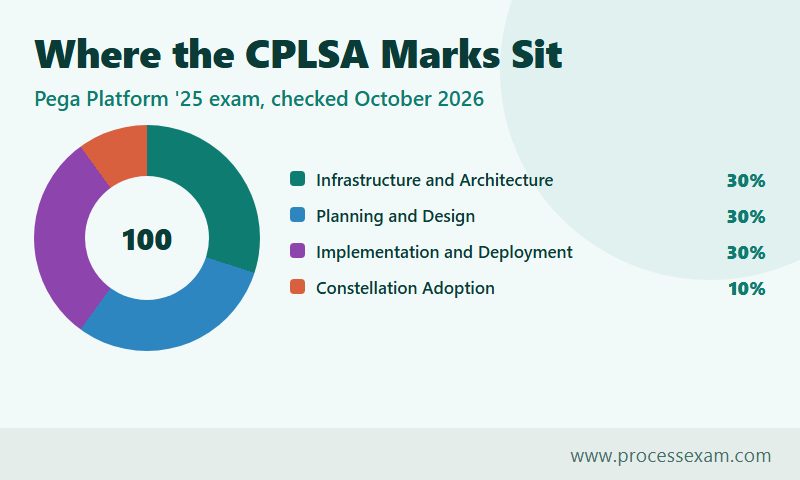
The current paper is PEGACPLSA25V1, written for Pega Platform '25. Pega's exam page, checked in October 2026, lists 60 questions, two hours and a 65% passing score. The exam is built from four topics, and three of them carry 30% of the marks each. The fourth, Constellation Adoption, carries 10%.
| Exam detail | CPLSA |
|---|---|
| Full name | Certified Pega Lead System Architect |
| Exam code | CPLSA (paper PEGACPLSA25V1) |
| Vendor | Pega |
| Version | CPLSA 25, applies to Pega Platform '25 |
| Number of questions | 60 |
| Duration | 120 minutes |
| Exam fee | USD $190 |
| Passing score | 65% |
Sixty questions in 120 minutes gives you two minutes each, which is generous next to the entry-level Pega exam and is there for a reason. The questions are long scenarios with several plausible answers, and the skill being tested is choosing the best one for the stated constraints. A 65% pass mark means 39 correct answers; you may miss 21.
The topic list on our CPLSA syllabus page matches what Pega publishes today, so you can use it as a checklist. If you are using an older study guide, check it against that list first. Earlier versions of this exam were organised around eight areas, such as Pega Platform Design Extended, Application Design Extended, Data Model Design and Reporting Design, and the percentages were different. The '25 paper has been rebuilt into the four topics described next, and a guide written for the old layout will spend time on areas that no longer have their own heading.
What does each of the four topics ask you to decide?
Pega words its objectives as understand, recognise and apply. That wording hints at the question style: you are rarely asked what a feature is called, and often asked when to use it, what it costs you later, and what the alternative would have been.
Infrastructure and Architecture, 30%
This topic is about the system around the application. Pega lists enterprise architecture principles, the deployment architecture of a clustered and distributed system, and the roles of nodes, tiers and node types. You are expected to explain high availability, resiliency and failover, and to weigh trade-offs between performance, scalability and maintainability.
Three themes stand out in the objectives. The first is Pega GenAI, described as a governed, provider-agnostic control plane, with attention to how generative AI plugs into enterprise workflows securely and how to adopt it responsibly. The second is service externalisation: when to move logic out of Pega behind services and APIs so that applications stay modular. The third is event-driven design with Kafka, including considerations for creating cases asynchronously and integrating with streaming and messaging platforms. Security audits, policies and system administration fundamentals complete the list, along with the tools that monitor performance and resilience.
Planning and Design, 30%
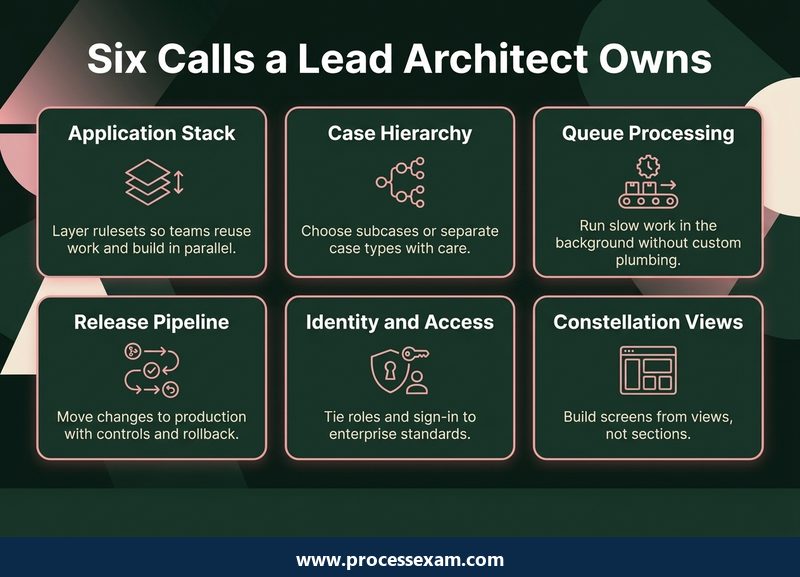
This is the design-for-change topic, and it carries as many marks as the infrastructure topic. It begins with application stack design: how to organise applications, rulesets and layers so that teams can reuse work and build in parallel. Case hierarchy comes next, including parent and child cases, when a subcase is right and when an independent case type is better, and what each choice does to work distribution, scalability and reporting.
Specialisation is a recurring idea. You should be able to compare options for specialising a case, a process or a rule, and to use situational layering so that rules are not duplicated and rework stays small. The data modelling objectives ask about persistence, reference data and reporting needs, and about a data-instance-first approach where it fits. The API design objectives ask when REST is the right integration approach. Authentication and authorisation add OpenID Connect and identity providers, and the monitoring objective names Pega Predictive Diagnostic Cloud, known as PDC, in operational planning.
Implementation and Deployment, 30%
Here the question changes from how to design it to how to run it. Background processing is the first block: when asynchronous execution is justified, and why the standard queue processor is the pattern to reuse before building something custom. Work assignment follows, covering how routing to users, teams and work queues supports operational efficiency.
The deployment objectives are broad. They cover release management responsibilities on projects led by an LSA, deployment strategies for several teams with controlled releases and rollback readiness, and the stages and controls of a CI/CD release pipeline. Web embed interfaces and landing pages appear on the user-interface side. Pega also lists secure-by-design implementation, governance responsibilities for production readiness, and the signs that a system is production-ready beyond functional correctness. Questions in this topic often describe a go-live that went badly and ask which earlier decision caused it.
Constellation Adoption, 10%
Constellation is Pega's newer user interface and design system, and this smaller topic tests whether you can architect around it. The objectives centre on the separation of workflow from presentation, on how the case type data model and field types relate to the Constellation interface, and on building UI with views instead of sections and flow actions.
You should know how to compose simple, partial and complex views, what primary fields and case tabs do, and what tools exist for troubleshooting Constellation behaviour. The final objective deals with coexistence: how traditional UI and Constellation live side by side, and what to consider when moving to Constellation step by step rather than in one release. Ten percent is six questions or so, but candidates who have only worked in traditional UI tend to lose most of them.
How does the Design and Build assessment work, and what does it cost?
Once you pass the architecture exam, the final step is the CPLSA Application Design and Build assessment. Pega describes it as testing your ability to architect, implement and analyse solutions on Pega Platform. You receive a defined set of business requirements, document your analysis and proposed solution in a provided template, design the solution using Pega Blueprint, and implement an extensible, reusable application that meets the requirements.
Pega says that from the Infinity '25 version of the certification, the assessment is a single phase. It typically takes about 50 hours of effort, candidates have two weeks (14 days) to design, build and submit, and the minimum passing score is 75%. A high-level design document is still required, supplemented with the generated Blueprint document, and build files alone are not enough. The assessment is managed by Pega rather than by Pearson VUE, so you register for it through Pega Academy.
The fee, and a mismatch on Pega's own pages
The architecture exam costs USD $190 per attempt. For the build assessment, Pega's CPLSA programme page states USD 500 per attempt for the '25 format and describes the Infinity '25 version as available at a lower fee than the version it replaced. Pega's general certification FAQ page, however, still lists the LSA Design and Application Build at USD 750 per attempt. The two pages disagree, so confirm the amount on the registration page before you pay, and budget for the higher figure until you have seen it.
If the first build score falls short
The retake rules for the build are different from the multiple-choice exam. Pega says a score above 60% can be amended, packaged and resubmitted at no extra cost if the review team approves a build fix; you must schedule and start that fix within 30 days of the result and then have four calendar days to rework it. A score below 60% brings feedback, and you may re-attempt after three months as a new exam with a new fee. Rescheduling is allowed up to three times, each with a maximum extension of 30 days, and an exam not completed within those limits is marked as failed with no refund.
One more rule deserves a mention. Your build work belongs to you and Pega's review team only. The programme page says that sharing work or the scenario with anyone else voids results and brings a three-year ban, and that emails asking you to upload a solution from an address outside the pega.com domain are not from Pega.
How should you prepare for the architecture exam and the build together?
The two steps reward different habits, but the same four missions feed both. Pega's Lead System Architect mission for Pega Platform '25 is made of four required missions: Constellation Adoption, Infrastructure and Architecture, Planning and Design, and Implementation and Deployment. Pega recommends doing them in that order and puts the total at 3 days 11 hours of content. Alongside the missions, Pega offers free preparation sessions for each step, an architecture exam clinic and a Design and Build preparation clinic, which are listed in its class schedule.
The content hours are the shortest part of the effort. A working architect should spread them over six to eight weeks, because the useful learning happens when you stop a mission and argue with yourself about a design choice.
| Stage | Pega mission to open | Evidence you are ready to move on |
|---|---|---|
| 1 | Constellation Adoption (about 12 hours of content) | You can rebuild a small case type using views and explain why no section is needed |
| 2 | Infrastructure and Architecture (about 16 hours) | You can sketch a clustered deployment and say what each node type does |
| 3 | Planning and Design (about 31 hours) | You can justify an application stack and a case hierarchy for a requirement you have not seen before |
| 4 | Implementation and Deployment (about 22 hours) | You can describe a pipeline from development to production, including how you would roll back |
| 5 | Timed practice and the build rehearsal | You finish timed runs with time to spare, and you have designed one application end to end in the Blueprint style |
The hours in the table are Pega's own estimates for each mission, rounded. Treat them as a minimum, since they do not include the thinking you will do between lessons.
How to track progress through the plan
This is the part that gave the original article its name, and it still matters. Because the exam has three heavy topics and one light one, an overall percentage on a practice test hides the real picture. Keep a simple log with one line per test and a score for each of the four topics. Look for the lowest topic rather than the average, and fix that first.
Two habits make the log useful. Write down why each wrong answer was wrong, in a sentence, because a pattern such as reaching for custom code when a standard queue processor was available is a design habit, and it will recur in the build as well. And record how long each run took: a score you reach only by using all 120 minutes leaves nothing for the questions you flag. When you have finished the missions, a timed run on the CPLSA practice exam gives you the first topic-level numbers to put in that log.
A sensible rule of thumb, and it is a suggestion rather than a Pega standard, is to book the exam when your lowest topic sits comfortably above the pass mark on two timed runs in a row. For the build, the equivalent test is whether you could explain every design choice in your documentation to a sceptical reviewer without opening your notes.
Using the documentation and the mission pages
Pega's own pages are the ground truth for scope. The Pega Lead System Architecture exam page carries the topic list and weights, and the Lead System Architect mission page shows which training matches the '25 exam. Check the version tag on any mission you open: the mission page lists several Pega Platform versions, and a mission tagged for an older release will teach a different topic split.
How do you register, and what are the retake rules?
The architecture exam is booked through a Pearson VUE account, and Pega gives two delivery options: sit it at a test centre, or take it online with a proctor watching by webcam from a quiet room at home or at work. Choose online only if your connection and room are dependable, because an interrupted session costs you time you cannot easily spare on a two-hour paper.
Pega's retake policy for the architecture exam is the standard one for Pearson VUE exams. You may sit it up to three times within a 12-month period. There is a three-day wait between the first and second attempts and a 14-day wait between the second and third. That gives a failed attempt a clear purpose: use the waiting days to rework your weakest topic, not to book the next date.
The Design and Build retake rules, covered above, are separate and slower. A candidate who fails the build below 60% waits three months, so it is worth treating the build as the more expensive attempt. Pega says its architecture exam and build can be on different versions as long as the architecture pass is 8.x or later, but it also reserves the right to change that eligibility requirement for future releases, so do not leave the second step for years.
Version tags and what to check on the day of booking
Pega retired the Infinity '24.2 version of the build assessment on 30 June 2026, and the '25 format became available for scheduling from 1 May 2026. If a guide, a video or a colleague talks about a two-phase build with separate design and build submissions, that describes the retired format. Confirm on Pega Academy which version your registration is for before you spend money.
What does the Lead System Architect credential change once you hold it?
Pega's description of the role is the clearest guide. Lead System Architects are responsible for the design and quality of Pega solutions, lead implementation teams, make sure solutions use the technology to give the best business value, and provide technical mentoring and leadership across teams. The credential is evidence that you can do that, not only that you can configure the platform.
In practical terms, it changes three things. It lets a client or employer put you in the architect's chair on a project without testing you from scratch, since Pega itself calls this the highest level of technical achievement in its ladder. It gives you a place in the LSA Community of Practice, which Pega describes as a knowledge-sharing forum for certified LSAs, and invitations to continuing-education events by email. And it pushes your preparation habits towards review work: reading other people's designs, spotting the decision that will hurt in a year, and writing it down.
This article gives no salary figures. Pay for Pega architects depends on country, client and track record, and a certificate alone does not set it. If compensation is part of your decision, check a current salary survey for your region and look at how senior roles in your market are advertised. For the wider ladder, including the System Architect and Senior System Architect levels you need first, Pega's certifications page and the CPLSA programme page show every step in order.
The simplest way to hold the whole route in your head is to treat the architecture exam as a test of what you would decide, and the build as a test of whether you can then deliver it. Prepare for the first with scenarios and logs, and for the second with a full design, built and documented once, before the clock starts.
Frequently Asked Questions
What is the passing score for the CPLSA exam?
The Pega Lead System Architecture exam, known as CPLSA, has a passing score of 65%, which on 60 questions means 39 correct answers. The second step, the Design and Build assessment, is marked separately and needs a minimum of 75% for the Pega Infinity '25 format.
How many questions and how much time does the CPLSA exam have?
The CPLSA exam has 60 questions and a time limit of 120 minutes, which works out at two minutes a question. The questions are scenario based, so the extra time goes on reading long case descriptions and weighing several plausible answers, not on recalling definitions.
How much does it cost to become a Certified Pega Lead System Architect?
The architecture exam costs USD $190 per attempt. The Design and Build assessment is paid separately: Pega's CPLSA page states USD 500 per attempt, while its general certification FAQ still shows USD 750. Confirm the amount at registration, and add retake fees if you need them.
What are the prerequisites for the CPLSA certification?
Pega requires the Certified Pega System Architect and Certified Pega Senior System Architect certifications, in any version, before the Lead System Architect route. It also recommends at least 36 months of implementation experience after the Senior level, though that period is advice rather than a booking check.
Which Pega version does the CPLSA exam cover now?
The current paper, PEGACPLSA25V1, applies to Pega Platform '25, as shown on the Pega Academy exam page in October 2026. It tests four topics: Infrastructure and Architecture, Planning and Design, and Implementation and Deployment at 30% each, and Constellation Adoption at 10%.
- Pega Lead System Architecture Test Questions |
- CPLSA Question Bank |
- Pega Lead System Architecture Book |
- Lead System Architecture Certification Cost |
- Lead System Architecture Certification Requirements |
- Pega Lead System Architecture Sample Questions |
- CPLSA Exam Questions Download |
- CPLSA Test Questions |
- Lead System Architecture PDF |
- PEGACPLSA25V1 Mock Exam |
- PEGACPLSA25V1 Simulator |
- Pega PEGACPLSA25V1 Book |
- Pega PEGACPLSA25V1 Question Bank |
- Pega PEGACPLSA25V1 Study Guide |
- PEGACPLSA25V1 Certification |
- PEGACPLSA25V1 Certification Cost |
- PEGACPLSA25V1 Certification Requirements |
- Pega PEGACPLSA25V1 Exam Questions |
- Pega PEGACPLSA25V1 Sample Questions |
- PEGACPLSA25V1 |
- PEGACPLSA25V1 PDF


