
TOGAF Certification: What's It Worth?
Updated on 21 September 2026. What’s new: updated from TOGAF 9 to the TOGAF Standard, 10th Edition, with current OGEA-101 and OGEA-102 exam fees.
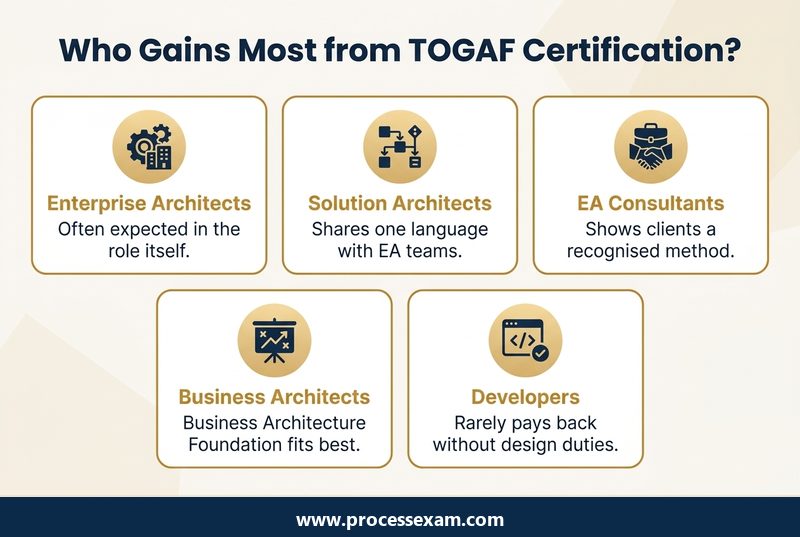
TOGAF certification pays off if your job is deciding how an organisation's business, data, applications and technology fit together: enterprise, solution and domain architects, EA consultants and teams running the TOGAF Standard. It rarely pays off for developers without design duties or small firms with no architecture function.
That is the short answer, and it holds for the full ladder, not just the first exam. The longer answer depends on three things this article works through in turn: which of The Open Group's TOGAF credentials you are looking at, what the 10th Edition of the standard changed about them, and what you would give up in fees and evenings to earn one. The figures quoted below are the published exam details for each credential; nothing here is a guess about what you will earn afterwards, because no honest article can promise that.
One point of framing first. TOGAF is a method for doing enterprise architecture, not a technology. A certificate in it says that you speak the language architecture teams use and, at the higher level, that you can apply the method to a messy situation. Whether that is valuable depends on whether anyone around you speaks the same language.
Which jobs does a TOGAF credential actually pay off in?
The value of TOGAF is highest where three conditions meet: the organisation is large enough to need a shared picture of its systems, change is run as programmes rather than one-off projects, and somebody has to argue for a target state in front of people who control budgets. In that setting the certificate works as a shortcut to trust. A hiring manager or a client does not have to test whether you know what a gap analysis is, what an architecture contract is for, or why a stakeholder map comes before a model.
Roles where it is close to expected
- Enterprise architects and EA team members. TOGAF is the framework most enterprise architecture teams reference, even the ones that tailor it heavily. Holding the Practitioner level removes a question from every interview.
- Architecture consultants. Consultancies bidding for transformation work in government, banking, insurance and telecoms often need to show certified staff. Here the credential has a direct commercial use, because it appears on a bid.
- Domain architects moving up. Data, application, security and infrastructure architects who want enterprise-wide scope use it to show they can think beyond their own domain.
Roles where it helps but is not decisive
- Solution architects. Covered in its own section below, because it is the question this page is asked most often.
- Business analysts and business planners who work alongside architects. For many of them the business architecture credential is a better fit than the enterprise ladder.
- Programme and portfolio managers who sit on architecture boards and need to follow the reasoning, not produce the models.
- IT managers taking over a function that already uses TOGAF vocabulary.
Roles where it rarely pays back
Hands-on developers, testers and operations engineers with no say in design gain little, because nothing in their week uses it. Staff in small firms without programmes, boards or a repository to govern will find the method heavier than the problems they have. And anyone who expects the certificate alone to turn them into an architect will be disappointed: The Open Group's own description of the entry level is that it lets you contribute to an architecture project or work with the results, which is a modest and accurate promise.
What does each TOGAF level prove to an employer?
The Open Group's TOGAF certification portfolio is built on two editions of the standard. The older TOGAF 9 Foundation and TOGAF 9 Certified qualifications remain on it for people who earned them. New candidates work towards the current credentials, which dropped the version number from their names: TOGAF Enterprise Architecture Foundation, TOGAF Enterprise Architecture Practitioner and TOGAF Business Architecture Foundation. Each one proves something different, and that difference is the whole of the value question.
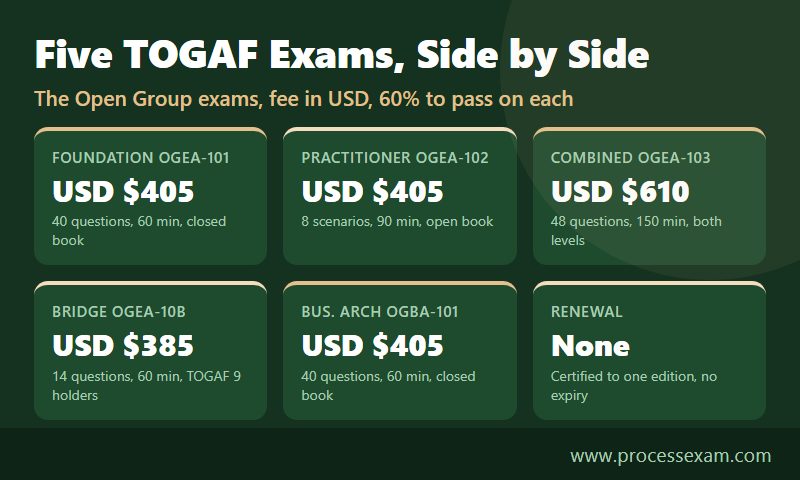
| Credential and exam | Code | Questions | Duration | Fee | Passing score |
|---|---|---|---|---|---|
| TOGAF Enterprise Architecture Foundation (Part 1) | OGEA-101 | 40 | 60 minutes | USD $405 | 60% |
| TOGAF Enterprise Architecture Practitioner (Part 2) | OGEA-102 | 8 | 90 minutes | USD $405 | 60% |
| Combined Part 1 and Part 2 | OGEA-103 | 48 | 150 minutes | USD $610 | 60% |
| Practitioner Bridge (TOGAF 9 Certified only) | OGEA-10B | 14 | 60 minutes | USD $385 | 60% |
| TOGAF Business Architecture Foundation | OGBA-101 | 40 | 60 minutes | USD $405 | 60% |
Foundation: a shared vocabulary
Foundation is a closed-book, multiple-choice test of knowledge and comprehension. According to The Open Group's Enterprise Architecture Foundation datasheet, it is open to everyone with no earlier certificate required, and prior architecture knowledge is described as an advantage rather than a requirement. What it proves is that you can follow an architecture conversation: the phases of the Architecture Development Method, the key terms, the techniques that support the method and the outputs it produces. For an employer, that means a new team member who does not slow the room down.
Practitioner: judgement under pressure
Practitioner is the level the market usually means when it says "TOGAF certified". The Part 2 exam is eight open-book scenario questions, and the Practitioner datasheet describes its focus as application and analysis in addition to knowledge. The credential says you can take a half-finished programme, identify where it sits in the method, and choose what an architect should do next. That is the claim employers pay for, which is why Foundation on its own is best treated as a step rather than a destination. If you are already set on this level, our walkthrough of the scenario-based Part 2 exam covers the format and preparation in detail.
Business Architecture Foundation: a different audience
This credential is often overlooked, and for some readers it is the better buy. It is aimed at people responsible for business planning who want to apply TOGAF's business architecture techniques, and its topics are business capabilities, value streams and value stream mapping, information mapping, organisation mapping and the business scenario method. The business architecture syllabus is a quick way to check whether that list matches your job before you choose it over the enterprise ladder.
The badges on top
Beyond the three core credentials, the portfolio carries specialist badges: Agile Specialist, Digital Specialist, Enterprise Architecture Leader, Environmentally Sustainable Information Systems Specialist, and Integrating Risk and Security. They add depth in one direction. None of them substitutes for Practitioner when a job advert simply asks for TOGAF.
Is TOGAF certification worth it for a solution architect?
Usually yes, though for a different reason than most people expect. A solution architect's day is spent designing one system well. TOGAF does not teach that; your platform skills do. What TOGAF gives a solution architect is the view one level up: why the enterprise architecture team wants the design to reuse a building block, what an architecture contract commits the project to, and how a compliance review will read the design. Solution architects who understand that view spend less time in rework and escalation.
It also matters for the career step after solution architecture. Moving into an enterprise architect or chief architect role means being judged on portfolio decisions, not system designs, and TOGAF Practitioner is a common signal that a candidate has made that shift in thinking. If you plan to stay a deep specialist on one cloud or one product, a vendor's own architect credential will probably do more for you in the short term. If you want the enterprise role within a few years, TOGAF is the better long-term investment.
A practical middle path suits many solution architects: take Foundation, use the vocabulary on real projects for a few months, then sit Part 2 once the scenarios feel familiar rather than theoretical. The exam rewards people who have watched an architecture board make a decision, and a few months of doing so is the most efficient study aid there is.
Did TOGAF 10 make older TOGAF certificates less valuable?
Not formally. Certification under TOGAF is tied to one version of the body of knowledge and carries no renewal date, so a TOGAF 9 Certified qualification earned years ago is still a valid credential and still appears in the portfolio. What changed is the market's reference point. When the TOGAF Standard, 10th Edition replaced version 9.2, The Open Group split the material into Fundamental Content, which holds the core method, and a set of Series Guides that show how to configure it for situations such as agile delivery and digital transformation. The current Foundation datasheet explicitly includes agile delivery and application in a digital enterprise as part of the basic understanding it certifies.
For a candidate deciding what to do, three consequences follow.
- New candidates should not study for TOGAF 9. Study notes, videos and books built on 9.2 describe a structure the current exams no longer use. They are cheaper for a reason.
- TOGAF 9 Certified holders do not have to start again. The bridge exam exists precisely so that the earlier investment counts. Whether it is worth taking now depends on whether clients and recruiters in your market specifically ask for the current edition; in consulting they increasingly do, inside an organisation that trained everyone on 9.2 they often do not. For the preparation itself, see a three-week plan for the bridge.
- The names changed, which confuses job adverts. "TOGAF 9 Certified", "TOGAF Practitioner" and "TOGAF 10 certified" are used loosely for the same level. When an advert asks for one, recruiters will often accept the others, but it is worth listing your credential by its full current name so screening software finds it.
The net effect is that TOGAF 10 raised the value of the current credentials slightly, because they cover how the method is used in agile, product-led organisations, and left the older ones valid but visibly dated.
What does TOGAF certification really cost in money and time?
The exam fees are the visible part. On the figures above, the step-by-step route costs USD $405 for Foundation plus USD $405 for Part 2, which is USD $810 across two sittings. The combined exam covers both parts in one sitting for USD $610. Business Architecture Foundation is USD $405, and the bridge for TOGAF 9 Certified holders is USD $385. Fees may be charged in local currency, so check the price for your country before you book, and remember that tax may be added.
The cheaper route is not always the combined exam
The combined sitting saves money, but it asks you to sit 150 minutes in one go and to pass both parts on the same day. Candidates who are new to architecture often do better taking Foundation first, because it forces them to learn the vocabulary before they meet scenario questions, and a Foundation pass is a credential in its own right if the second step slips. Candidates who already work in an architecture team usually save both money and a second booking by taking the combined exam.
Training versus self-study
The Open Group allows either. Accredited training courses cost considerably more than the exams and include the Practitioner learning studies, which earn an additional applied Open Badge on top of the certification. Self-study is entirely acceptable and is how many experienced architects prepare. The deciding question is often who pays: if a course is funded, take it; if you are paying yourself, self-study with good practice material is usually enough.
Time
Time is the larger cost. As a planning guide rather than a rule, someone new to enterprise architecture should allow four to six weeks of regular evening study for Foundation and a further four to six weeks for Part 2. An architect who already uses the method at work can often be ready for the combined exam in five to seven weeks. The bridge is shorter again, because it assumes the earlier knowledge. Whatever the route, the certificate never needs renewing, so this is a cost you pay once.
When is TOGAF certification a poor use of your money?
A value question deserves a plain list of the cases where the answer is no, or not yet.
- Nobody around you uses it. If your employer has no architecture board, no repository and no appetite for either, the method stays theoretical and the certificate stays in a drawer. It will still help at your next job, but not this one.
- You want to learn to design systems. TOGAF tells you how to organise and govern architecture work, not how to design a resilient database cluster or an event-driven integration. Platform-specific training does that.
- You are years away from any design responsibility. Foundation can be a sensible early signal of interest, but taking Part 2 without having seen real architecture decisions makes the scenario questions much harder and the credential easier to see through in an interview.
- Your market prefers another framework. Some sectors and employers standardise on their own method, a defence or government framework, or a scaled agile framework. In those places TOGAF knowledge still transfers, but a certificate is not what gets you shortlisted.
- You hold TOGAF 9 Certified and nobody is asking. The bridge is good value when clients or employers want the current edition. If they do not, it can wait.
None of these make TOGAF a bad credential. They make it the wrong one for a particular person at a particular time, which is the only way a certification can really be judged.
How hard are the TOGAF exams, and who struggles with them?
Foundation is a fair test of reading and recall. Forty closed-book questions in sixty minutes with a 60% passing score leaves room for mistakes, and candidates who fail it usually tried to learn the method from summaries instead of the standard's own wording. The terms are precise, and two options often differ by a single word.
Part 2 is harder in a different way. Having the standard open does not help much, because the difficulty is judgement: every option in a scenario can sound reasonable, and the marks go to the one that best follows TOGAF guidance for that situation. People who find Part 2 hardest tend to fall into two groups. The first are candidates with no architecture experience, for whom the scenarios read like fiction. The second, perhaps surprisingly, are very experienced architects who answer from how their own organisation works instead of what the standard recommends.
The business architecture exam sits closer to Foundation in style, with the same question count and time, but its content is narrower and more practical: capabilities, value streams and mapping techniques that planners use every week. People from business analysis and strategy backgrounds often find it the most natural of the three.
Which TOGAF exam should you book first?
Match the first booking to where you are now, not where you hope to be.
- New to architecture, or moving into it from development or analysis: start with Foundation. It gives you a credential quickly and makes the later scenario exam readable.
- Already working in or beside an architecture team: go straight to the combined exam, or take Part 2 if you already hold Foundation.
- TOGAF 9 Certified: take the bridge when your market asks for the current edition, and not before.
- Business planner, strategist or business analyst: consider Business Architecture Foundation before, or instead of, the enterprise ladder.
For most readers of this page, that means Foundation is the first move. Before booking it, read The Open Group's datasheet for the exam you choose and make sure every listed topic is familiar. Then measure yourself against the clock: a timed run through an OGEA-101 mock exam shows whether sixty minutes is comfortable for forty questions and which parts of the method you have only skimmed, which is cheaper to learn now than on the day. Book the real exam once your timed scores sit clearly above the pass mark, not the day they first touch it.
Every TOGAF exam is booked through Pearson VUE, and you can sit it in one of their centres or remotely from your own desk. If you choose online delivery, run the system check on the machine and in the room you will use well before the day.
So, what is TOGAF certification worth? For the right person, it is the most widely recognised way to show that you understand how enterprise architecture is done, and it never needs renewing. For the wrong person, it is USD $405 and several weeks spent on a method nobody around them uses. The work is in knowing which of those two people you are before you pay.
Frequently Asked Questions
Is TOGAF certification worth it?
It is worth it for enterprise, solution and domain architects, architecture consultants and people joining teams that use the TOGAF Standard, because it proves a shared method and vocabulary. It rarely pays back for developers without design responsibility or for small firms that have no architecture function, programmes or governance to apply it to.
How much does TOGAF certification cost?
The Open Group exam fees are USD $405 for Enterprise Architecture Part 1, USD $405 for Part 2, USD $610 for the combined Part 1 and Part 2 exam, USD $385 for the Practitioner Bridge and USD $405 for Business Architecture Foundation. Local currency pricing and tax can change the total, and training costs extra.
How long does it take to get TOGAF certified?
As a planning guide, a newcomer to enterprise architecture might allow four to six weeks of evening study for Foundation and a similar period for Part 2. An architect who already uses the method at work can often prepare for the combined exam in five to seven weeks. The bridge takes less time.
How difficult is the TOGAF certification exam?
Foundation is a closed-book test of 40 questions in 60 minutes with a 60% passing score, and it mainly checks precise terminology. Part 2 is harder: eight open-book scenario questions in 90 minutes, where several answers sound reasonable and marks go to the option that best follows TOGAF guidance.
Which TOGAF certification is best for a solution architect?
Most solution architects benefit from TOGAF Enterprise Architecture Practitioner, reached through Foundation and Part 2 or the combined exam. It explains how enterprise architecture teams govern and reuse designs, and it signals readiness for enterprise architect roles. Foundation alone is a reasonable first step for those new to architecture.
- Enterprise Architecture |
- Open Group TOGAF Enterprise Architecture Part 1 Test Questions |
- OGEA-101 Question Bank |
- TOGAF Enterprise Architecture Foundation Mock Exam |
- Open Group TOGAF Enterprise Architecture Part 1 Book |
- TOGAF Enterprise Architecture Part 1 Certification Cost |
- TOGAF Enterprise Architecture Part 1 Certification Requirements |
- Open Group TOGAF Enterprise Architecture Foundation Question Bank |
- Open Group TOGAF Enterprise Architecture Foundation Book |
- Open Group TOGAF Enterprise Architecture Foundation Study Guide |
- TOGAF Enterprise Architecture Foundation Certification |
- TOGAF Enterprise Architecture Foundation Certification Requirements |
- Open Group TOGAF Enterprise Architecture Part 1 Sample Questions |
- OGEA-101 Exam Questions Download |
- OGEA-101 Test Questions |
- Open Group TOGAF Enterprise Architecture Foundation Exam Questions |
- Open Group TOGAF Enterprise Architecture Foundation Sample Questions |
- TOGAF Enterprise Architecture Foundation |
- TOGAF Enterprise Architecture Foundation PDF


