
SysML v2 Certification: Model User Exam Cost, Format and Syllabus
SysML v2 changed what it means to read a systems model. The language now has its own metamodel, a textual syntax that sits beside the diagrams, and one organising idea, definition and usage, that replaces the block-centred habits of v1. OMG's SysMLv2 Model User exam, coded OMG-SYSML2-MU100, tests whether you can read models in that new form. It has 90 questions, costs US$400 plus taxes, needs 63 correct answers to pass, and launched on 2 June 2026.
This guide covers the exam rules and fee, what changed from v1 and why it matters for the paper, the syllabus weights with the specification clauses behind them, the four question formats, a study order, and what the credential leads to. Every exam figure comes from OMG's own pages, linked where they are used, so you can check each one.
How much does the SysML v2 Model User exam cost, and what are its rules?
The fee is US$400 plus any taxes, with the regional currency equivalent shown at checkout. OMG's exam information sheet sets the rest, summarised below. Two details deserve a second look: the time allowance depends on where you live, and there is no sectional pass mark, only a total.
| Item | Detail |
|---|---|
| Certification name | OMG Certified Systems Modeling Language v2 - Model User |
| Exam code | OMG-SYSML2-MU100 |
| Number of questions | 90 |
| Exam duration | 150 minutes in native English-speaking countries; 180 minutes in all other countries |
| Passing score | At least 63 of 90 correct answers, or at least 70% |
| Exam fee | US$400 + taxes |
| Question formats | Multiple choice (single response), multi-choice (multi-response), hotspot, matching |
| Notation used in questions | Natural language, textual notation and graphical notation |
| Prerequisites | None |
| Delivery | Pearson VUE, online proctored or at a secure test centre |
| Certification validity | 3 years from the exam date |
| Standard covered | Systems Modeling Language (SysML) v2.0 |
| Launched | 2 June 2026 |
Source for every row: OMG's SysMLv2 Model User information sheet and the OMG SysMLv2 certification page. The extra thirty minutes outside native English-speaking countries is a language allowance, confirmed by email after your order completes. OMG has not announced translated versions of the v2 series, so write to certification@omg.org before booking if you need one rather than assuming it exists.
OMG publishes a passing score, not a candidate pass rate. The credential is new, so no authoritative pass-rate statistic exists yet, and any site quoting one is unsourced.
Which SysML v1 habits will mislead you on a v2 model?
The certification page calls SysML v2 a ground-up redesign, not an incremental update, and says it addresses long-standing limits in precision, expressiveness and tool interoperability. For a candidate the redesign shows up as five changes, drawn below.
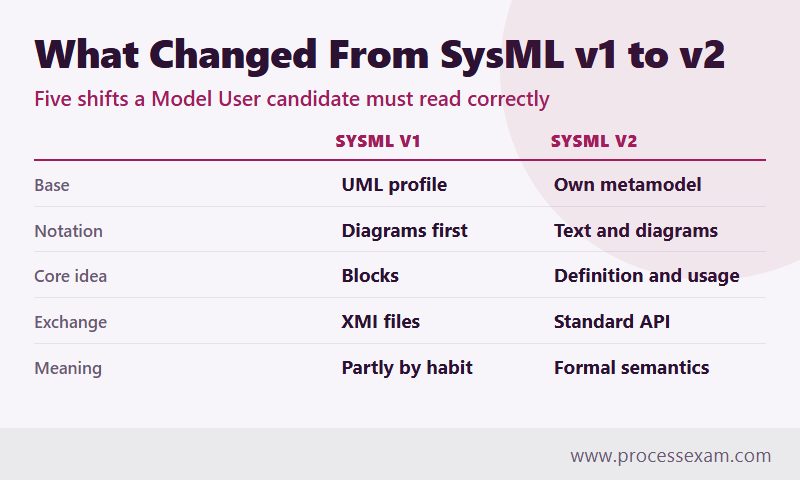
Each change has a matching trap on the paper. Experienced v1 modellers often read new constructs through old meanings, so the table pairs the reflex with what a v2 question expects instead.
| The v1 reflex | What a v2 question expects |
|---|---|
| Reading a part as a part property owned by a block | Reading a usage that is typed by a definition and may specialise or redefine it |
| Treating the diagram as the model | Treating the model as the source, with diagrams and text as two views of it |
| Remembering the nine diagram types | Recognising constructs, whatever view they appear in |
| Assuming meaning follows convention | Following the specification, where the semantics are formally stated |
| Thinking of exchange as exporting a file | Thinking of programmatic access through the standard API |
The textual notation is the one that surprises people. OMG's information sheet says questions use natural language as well as textual and graphical notation, so a snippet of SysML v2 text is a normal exam item, not a bonus one. If you have only ever clicked around a modelling tool, read some textual models before you book.
Is SysML v2 certification the same as OCSMP?
No. OMG calls the v2 exams a separate line that complements OCSMP, the series built on SysML v1. Both stay active, existing OCSMP certifications are not superseded, and newcomers may enter either series depending on the SysML version their organisation uses. Holding one does not exempt you from the other, although OMG's launch announcement lists a discount for people who are currently OCSMP certified.
The practical rule: choose the exam that matches the language your programme models in. If your team runs v1 with no migration plan, OCSMP still reflects daily work. If your organisation has committed to v2, is trialling v2 tools or sits in a defence or aerospace supply chain, this is the exam to take, and it is also the required entry to the Model Builder exams that follow.
Why does a machine-readable model matter to the exam?
Because the exam's central skill is reading someone else's model, and v2 is designed so that the reading is unambiguous. A precisely specified metamodel means two tools interpret the same text the same way. A normative textual syntax means models can be compared, reviewed and version-controlled like code. A standard API lets analysis, simulation and requirements tools read the same model. OMG's Terrance Milligan put the aim this way at launch: a workforce must understand, apply and eventually optimise the standard before next-generation MBSE can be realised. The Model User exam covers the first of those verbs.
How is the syllabus weighted, and which specification clauses are in scope?
Six coverage areas make up the paper. Foundations at 39% and Behavior at 33% add up to 72% of the exam, so those two should absorb most of your study time. The weights come from OMG's information sheet, and question counts are approximate, worked out from the percentages against 90 items. The same areas are listed on the OMG-SYSML2-MU100 syllabus page.
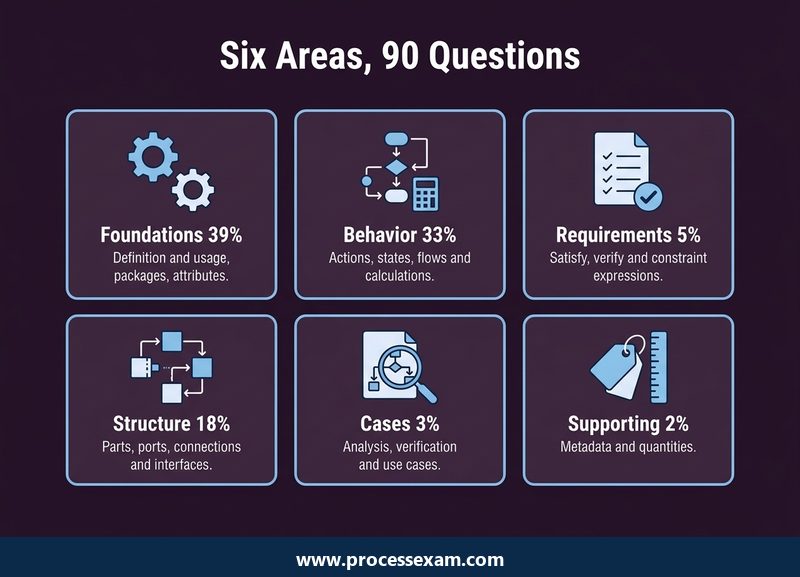
| Coverage area | Sub-topics | Weight | Approx. questions |
|---|---|---|---|
| Foundations | Elements and relationships, dependencies, annotations, namespaces and packages, definition and usage, attributes, enumerations, occurrences | 39% | ~35 |
| Behavior | Flows and messages, actions, states, calculations | 33% | ~30 |
| Structure | Items, parts, ports, connections, interfaces, allocations | 18% | ~16 |
| Requirements and constraints | Constraints, requirements | 5% | ~5 |
| Cases | Analysis cases, verification cases, use cases | 3% | ~3 |
| Supporting concepts | Metadata, quantities | 2% | ~2 |
Which clauses of the specification can be examined?
OMG tags every sub-topic with the clause of the SysML v2 language specification it comes from. That turns a very long standard into a defined reading list, because nothing outside these clauses is examinable.
| Coverage area | Specification clauses |
|---|---|
| Foundations | 7.2, 7.3, 7.4, 7.5.1-4, 7.6.1-4 and 7.6.6, 7.7, 7.8, 7.9.1-4 |
| Behavior | 7.16, 7.17.1-6, 7.17.8 and 7.17.10, 7.18, 7.19 |
| Structure | 7.10, 7.11, 7.12.1 and 7.12.3, 7.13, 7.14, 7.15 |
| Requirements and constraints | 7.20, 7.21.1-2 and 7.21.4 |
| Cases | 7.23.2, 7.24.2, 7.25 |
| Supporting concepts | 7.27.1-2, 9.8.2 |
The gaps are informative. Clauses 7.22 and 7.26 do not appear at all, ports skip 7.12.2, actions skip 7.17.7 and 7.17.9, and analysis and verification cases are limited to the .2 sub-clause of their sections. Quantities sits in clause 9.8.2, a different part of the specification from everything else. Open the SysML v2 language specification, read exactly these clauses and leave the rest. Candidates who read the standard front to back spend most of their hours on material that cannot be tested.
What does Foundations ask for?
This is the largest block and the one most often underestimated, because the name sounds introductory. It holds the ideas that make v2 behave differently from v1: everything is an element, relationships are themselves elements, namespaces and imports decide what a name refers to, and occurrences describe how things exist over time.
If you master one idea, make it definition and usage. You define something once, then use it in context, and each usage can specialise its definition. Parts, actions, ports, requirements and cases are all expressed as definition and usage pairs, so learning the pattern once converts a long list of constructs into a single repeated shape.
What does Behavior ask for?
Flows and messages, actions, states and calculations. Questions often pair a textual snippet with a question about execution order or parameter binding, so reading action declarations, successions and nesting accurately is a high-yield skill. State questions turn on transitions and the entry, do and exit behaviours.
What do the smaller areas ask for?
Structure at 18% covers items, parts, ports, connections, interfaces and allocations, such as mapping a logical function to a physical component. Requirements and constraints are only 5%, but they are compact and quick to learn: a constraint is a Boolean expression that must hold, and requirements bring satisfy, verify and subject relationships. Cases (3%) separate analysis cases, verification cases and use cases, and supporting concepts (2%) cover user-defined metadata and quantities with their units. Together these small areas are about ten questions that cost little to secure.
Which question formats need their own practice?
The paper mixes four formats, and each one punishes a different kind of preparation.
- Multiple choice (single response): one correct option from several. Recall helps most here, so move quickly and bank time.
- Multi-choice (multi-response): more than one correct option, and you must find them all. Multi-response items are normally scored all or nothing, so knowing three of four usually earns zero. Test every option on its own instead of stopping at the first plausible one.
- Hotspot: you click a region of a supplied model or diagram. Defining a construct is not enough; you must locate it. Practise pointing at things in a view, not only naming them.
- Matching: you pair items across two lists, for example notation elements with their meanings. These reward a clear mental map of the vocabulary.
Timing: 150 minutes for 90 questions is about 1 minute 40 seconds per question, and 180 minutes is exactly 2 minutes. Hotspot and matching items take longer than single-response ones, so spend less on straightforward recall to keep time for diagram-based items. With Foundations and Behavior making up 72% of the paper and no sectional minimum, a weak area in either is difficult to offset.
What study order suits a 90-question model-reading exam?
OMG does not publish a recommended study duration. The plan below is editorial guidance built on the published weights and assumes roughly six to eight hours a week. Learn definition and usage first, then work outward, and read real SysML v2 models in both notations from the first day.
Weeks 1 and 2: the core pattern
- Learn definition versus usage until you can explain it without notes and spot it in unfamiliar constructs.
- Cover elements, relationships, dependencies, attributes and enumerations.
- Read a little textual SysML v2 every day, even short snippets.
- Write each construct in your own words; recall beats re-reading.
Weeks 3 and 4: names, time and structure
- Practise resolving a qualified name through packages, namespaces and imports.
- Add occurrences and annotations.
- Move into items, parts, ports, connections, interfaces and allocations, and sketch a small system such as a coffee machine or a drone as parts, ports and connections.
Weeks 5 and 6: behaviour
- Actions: declarations, parameters, succession and nesting.
- States: transitions and entry, do and exit behaviours.
- Flows, messages and calculations.
- Trace execution order by hand through textual action snippets. Multi-response items cluster here.
Week 7: the small areas
- Requirements with satisfy, verify and subject; constraints as Boolean expressions.
- Analysis, verification and use cases; metadata and quantities.
- These areas are roughly a tenth of the paper and the cheapest tenth to secure.
Week 8: calibration
Work through the free OMG-SYSML2-MU100 sample questions to see the question style at no cost, then do full-length sittings at exam pace, 90 items in 150 minutes. Re-read the areas your scores flag, not the ones your instinct dislikes, and confirm you can say something concrete about every sub-topic listed.
Which study materials are worth using?
Start with OMG's own documents: the information sheet for format, coverage and the pass line, the certification page for programme structure and registration, and the specification as the tie-breaker whenever a secondary source disagrees with another. Because SysML v2 is recent, much online SysML content still describes v1. Check whether a resource uses definition and usage and the textual notation; if it is organised around nine diagram types and blocks, it teaches the wrong model.
Once you can read both notations, the OMG-SYSML2-MU100 practice exam is the place to find out whether hotspot and matching items still catch you out. Avoid anything sold as real exam questions: besides breaching OMG's exam agreement, a text list of questions does not transfer to hotspot items over graphical notation.
Which checks confirm you are ready?
- I can explain definition versus usage and identify both in unfamiliar constructs.
- I can resolve a qualified name through packages, namespaces and imports.
- I can match the same model in textual and graphical notation.
- I can trace action succession and parameter flow through a snippet.
- I can read a state machine, including triggers and entry, do and exit behaviours.
- I can separate items, parts, ports, connections, interfaces and allocations.
- I can tell an analysis case from a verification case and a use case.
- I have read every clause in the map above and none outside it.
- I have completed a full 90-question run at exam pace and drilled multi-response and hotspot items.
How do you book the exam, retake it and keep the credential current?
You register through Pearson VUE. Create or sign in to your account, then book, pay, cancel and reschedule there; receipts and score reports live in the same place. Choose a secure test centre or an online proctored sitting, and if you test online run the system test on your computer before scheduling.
Discounts. OMG's launch announcement lists discounts and promo codes for academics, INCOSE members, military personnel, EDM Association members and people who are currently OCSMP certified, plus single and bulk vouchers. Check the OMG launch announcement and OMG's exam discounts page before paying full price.
Cancelling. Cancel through Pearson VUE with more than a day to spare and the fee comes back in full; cancel inside that window and the fee is lost.
If you do not pass. Your score report carries a 20% discount code for a retake. It is also the only feedback you receive on coverage-area performance, so use it to target your next round of study.
After a pass. A Credly digital credential arrives within hours, and a PDF or hard copy of the certificate is available. Check your junk folder for the Credly email. Accommodations for learning or physical disability are arranged with certification@omg.org before you schedule.
Validity. The certification expires three years after the exam date. Taking the same exam again or a higher-level one extends it, which is a practical reason to treat Model User as a step toward the Model Builder exams and not an endpoint.
Who needs the Model User credential, and which exam follows it?
OMG names engineers, project managers and analysts working in MBSE-driven organisations as the intended candidates. In practice that covers systems engineers and architects joining a v2 modelling effort, requirements engineers who consume models, verification engineers reading satisfy and verify relationships, project managers who decide from model content, and students, since there is no experience or degree requirement. It is not a tool certification: it does not test Cameo, Rhapsody, SysON or any other environment, nor methodology such as OOSEM or MagicGrid.
The sponsor list shows where demand is forming. OMG's announcement names the U.S. Department of War as Diamond sponsor, Dassault Systèmes as Platinum sponsor, and Lockheed Martin and Sierra Nevada Corporation as Gold sponsors, a defence and aerospace concentration where digital engineering mandates are furthest along. Sandy Friedenthal, co-chair of the OMG Systems Modeling Community, said the exam lets practitioners show readiness to take part in a SysML v2 modelling effort.
There is no salary data for this credential: it launched in June 2026 and no survey has isolated it, so treat any figure quoted for it with suspicion. The defensible argument is timing. The language was formally adopted in 2025, the first credential followed in 2026, and organisations moving to v2 need people who can already read v2 models, which very few hold yet.
The next credential in the series is SysMLv2 Model Builder Fundamental, expected in early 2027 according to OMG's announcement. OMG's programme page identifies the Model User exam as a prerequisite to the upcoming Model Builder exams, and where Model User tests interpretation, Model Builder will test authorship: building valid, well-structured models. Because validity runs three years, sitting Model Builder Fundamental when it opens would also extend your standing at a higher level.
Frequently Asked Questions
How much does the SysML v2 certification exam cost?
The OMG SysMLv2 Model User exam, OMG-SYSML2-MU100, costs US$400 plus any taxes, with the regional currency equivalent shown at checkout. OMG lists discounts for academics, INCOSE members, military personnel, EDM Association members and current OCSMP holders, and a failed attempt returns a 20% retake discount code on the score report.
How many questions are on OMG-SYSML2-MU100 and what is the pass mark?
The exam has 90 questions and needs at least 63 correct answers, or 70%, to pass. You get 150 minutes in native English-speaking countries and 180 minutes elsewhere. Question types are single-response, multi-response, hotspot and matching, posed in natural language and in textual and graphical SysML v2 notation.
Is SysML v2 certification different from OCSMP?
Yes. OMG treats the SysMLv2 exams as a separate line that complements OCSMP, which covers SysML v1. Existing OCSMP certifications are not superseded and newcomers may enter either series. The v2 Model User exam is also the stated prerequisite for the upcoming SysMLv2 Model Builder exams.
Do you need modelling experience or prerequisites for the SysMLv2 Model User exam?
OMG lists no prerequisites, so there is no experience, degree or earlier-exam requirement. The exam tests whether you can read SysML v2 models, not build them or use a particular tool, which is why students and early-career engineers can sit it. Familiarity with the textual notation is the practical requirement.
How long is the SysMLv2 Model User certification valid?
The certification expires three years after the exam date. To extend it, take the same exam again or a higher-level one. OMG expects the SysMLv2 Model Builder Fundamental exam in early 2027, which would be a natural way to renew at a higher level.
- OMG OCSMLv2 Model User Test Questions |
- OMG-SYSML2-MU100 Question Bank |
- OMG-SYSML2-MU100 Body of Knowledge (BOK) |
- SysMLv2 Certification |
- SysMLv2 Model User Simulator |
- SysMLv2 Model User Mock Exam |
- OMG OCSMLv2 Model User Book |
- OMG-SYSML2-MU100 BOK PDF |
- OCSMLv2 Model User Certification Cost |
- OCSMLv2 Model User Certification Requirements |
- OMG SysMLv2 Model User Question Bank |
- OMG SysMLv2 Model User Book |
- OMG SysMLv2 Model User Study Guide |
- SysMLv2 Model User Certification |
- SysMLv2 Model User Certification Cost |
- SysMLv2 Model User Certification Requirements |
- OMG OCSMLv2 Model User Sample Questions |
- OMG-SYSML2-MU100 Exam Questions Download |
- OMG-SYSML2-MU100 Test Questions |
- OCSMLv2 Model User PDF |
- OMG SysMLv2 Model User Exam Questions |
- OMG SysMLv2 Model User Sample Questions |
- SysMLv2 Model User |
- SysMLv2 Model User PDF


