
SPHR Exam Prep: How Strategic HR Judgement Is Tested
A failed SPHR attempt is an expensive way to learn what the exam rewards. HRCI charges a $100 application fee and a $495 exam fee, and a candidate who misses without optional insurance applies and pays again after a 90-day cooling-off period. The deeper cost is the gap behind the score: the SPHR asks what a senior HR leader should decide, not what a policy says, and that judgement can be trained before the first booking.

What does a failed SPHR attempt actually cost?
Start with the money, because it frames every other choice. Both fees below are the figures HRCI publishes for the exam, and the application fee is paid on top of the exam fee before HRCI decides whether you are eligible to test at all.
| Exam detail | SPHR |
|---|---|
| Certification | HRCI Senior Professional in Human Resources (SPHR) |
| Exam code | SPHR |
| HRCI category | Strategic Certification |
| Number of questions | 140 |
| Duration | 150 Minutes plus 30 minutes administration time |
| Exam fee | Exam Fee: $495 Application Fee: $100 |
| Passing score | 500 (on a scale of 100-700) |
| Exam delivery | Pearson VUE |
What happens after a miss is set out in HRCI's certification handbook. A candidate who fails and did not buy Second Chance Insurance must wait out a 90-day cooling-off period from the exam date, then apply, qualify and pay the related exam fees again. Second Chance Insurance is an optional add-on that has to be bought at the moment you submit the application. It pre-pays one retake of a different version of the same exam, it is non-refundable, and it is void if you never sit the exam. HRCI says fees can change at any time, so read the current amount on its own page before you decide.
The calendar matters as much as the invoice. Once your application is approved you have 180 days to take the exam at a Pearson VUE test centre or online, and a failed first attempt adds at least three months before the second. For someone leading an HR function, that is a full quarter in which a promotion case, a board presentation or a compensation cycle may have been waiting on the letters after your name. HRCI also states that buying a preparation product is not required, which is useful when you weigh how much to spend on top of the two entry fees.
Holding the credential has a running cost too. On HRCI's page, keeping the SPHR means earning 60 recertification credits over three years, 45 of them HR and 15 Business, or retaking the exam. None of that is a reason to hesitate, but it explains why the candidates who pass first time treat the exam as a decision about their next three years rather than a one-day test.
Why do SPHR questions feel harder than other HR exams?
Most candidates blame the content, but the content is rarely the problem. A senior HR professional has seen compensation structures, investigations and restructures first-hand. What changes is the kind of thinking each question demands. HRCI's handbook sorts every question on its exams into one of three cognitive levels:
- Knowledge and comprehension: recalling factual material such as definitions.
- Application and problem-solving: applying familiar principles to solve real-life problems.
- Synthesis and evaluation: combining different elements and using critical thinking to solve a complex problem.
The handbook also lists the formats you will meet: traditional multiple choice with one correct answer out of four, multiple response where two or more answers are right and the question says how many, fill in the blank, drag and drop, and scenarios. A scenario presents a typical HR situation and follows it with a series of questions, and HRCI says these require you to integrate facts from different subject areas. That sentence explains most of the difficulty. A strategic scenario never stays inside one box of the outline.
A scenario in the SPHR style
Picture a manufacturer with about 900 employees that has decided to close one plant and move its work to another state. The HR director is asked what to do first. Four answers are offered: draft the employee communication plan; confirm which federal notice rules apply and what they require; model the severance and benefits cost; interview the plant's key people about retention. Every one of them is good HR practice, and none is absurd. A candidate thinking at the operational level picks the one that feels most urgent, usually the communication plan.
The strategic answer is the one that has to come first because everything else depends on it. Here that is the legal check, because the notice rules decide the timetable, the cost model and what can be said and when. A well-built SPHR question has exactly this structure: the wrong answers are right actions at the wrong moment or at the wrong level of the organisation. That is why people with ten years in HR can still miss a question they would handle perfectly at work. At work they would do all four, in the order the situation reveals itself. The exam makes you choose one.
Knowing this changes how you read. Before you look at the options, ask yourself what the decision-maker in the story is really being asked to decide, and at what level. A question set at the level of the whole organisation rarely has a team-level answer, and a question about policy rarely has an answer that handles one employee.
What do the five SPHR functional areas weigh, and what decisions sit inside each?
HRCI builds the exam from its 2024 SPHR exam content outline, which HRCI publishes as a PDF and describes as the responsibilities of, and knowledge needed by, today's HR professional. The outline names five functional areas, with weights that add up to the whole exam. HRCI's own exam page lists the same weights.
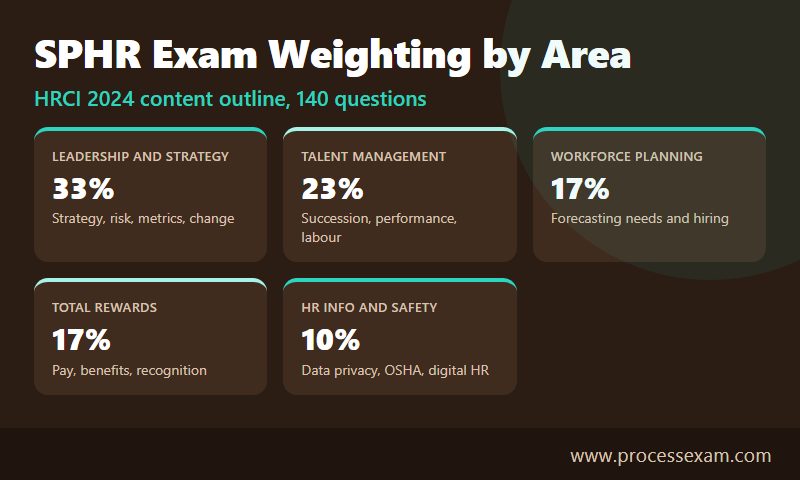
| Functional area | Weight | Responsibilities listed | The kind of decision it asks for |
|---|---|---|---|
| Leadership and Strategy | 33% | 12 | Set HR strategy, weigh risk, use business metrics, lead change |
| Talent Management | 23% | 11 | Design succession, performance, labour and offboarding strategy |
| Workforce Planning and Talent Acquisition | 17% | 3 | Forecast talent needs across business cycles |
| Total Rewards | 17% | 4 | Shape the rewards philosophy, pay and benefits |
| HR Information Management, Safety, and Security | 10% | 3 | Protect data, plan for safety and digitalise HR |
Two things stand out when the weights sit beside the responsibility counts. Leadership and Strategy carries a third of the exam, roughly 38 of the 115 scored questions, and it is the area where the outline reads most like a board agenda. Workforce Planning and Talent Acquisition lists only three responsibilities yet holds the same 17% as Total Rewards, so each of its three statements can fill many questions and has to be understood in depth rather than skimmed. Our SPHR syllabus outline lays out the same areas topic by topic if you want one page to tick off.
Leadership and Strategy, 33 per cent
HRCI describes this area as leading the HR function by developing HR strategy, contributing to organisational strategy, influencing people management practices and monitoring risk. The responsibilities range from contributing to vision, mission and values to analysing human capital risk, business continuity and geopolitical scanning, interpreting key performance indicators, financial statements and budgets, designing change strategies, promoting diversity, equity and inclusion, and evaluating how US federal laws apply to complex HR strategies. Expect questions where a financial or legal fact is buried in a people scenario.
Talent Management, 23 per cent
This is the widest list after strategy, and it goes well past training. It includes succession plans for key roles, performance management, leadership development, policies for employees returning after parental leave, sabbaticals or expatriate assignments, labour strategies such as collective bargaining and grievance programmes, and offboarding, including layoff strategy and alumni programmes. The wording is design and evaluate, never administer, so the question is usually which programme or policy to put in place.
Workforce Planning and Talent Acquisition, 17 per cent
Forecasting is the heart of it: evaluating organisational needs across business cycles, then recruiting, onboarding and integrating people when the business expands, shrinks, merges or enters a joint venture. Candidates from recruitment-heavy backgrounds find the sourcing material easy and the restructuring and cultural-integration material surprisingly detailed.
Total Rewards, 17 per cent
Four responsibilities cover the rewards philosophy and its communication, compensation strategy including incentives, equity and executive pay, benefit strategy covering health, retirement and wellness, and recognition programmes. The population is deliberately broad: hourly and salaried staff, expatriates, executives, board members and contractors can all appear in one question.
HR Information Management, Safety, and Security, 10 per cent
The smallest area is not the safest to ignore. It asks you to align HR data privacy with the organisation's data protection strategy, evaluate safety and security approaches, naming examples such as OSHA, HIPAA, emergency response and crisis management, and lead HR digitalisation work. Ten per cent still means about a dozen scored questions, too many to leave to chance.
How do you build judgement for questions where several answers look right?
Judgement is a habit, and habits form by repetition with feedback. The method below works on any SPHR-style scenario and is easy to practise because it needs nothing but the scenario and a few seconds of discipline. Run the options through five filters, in this order.
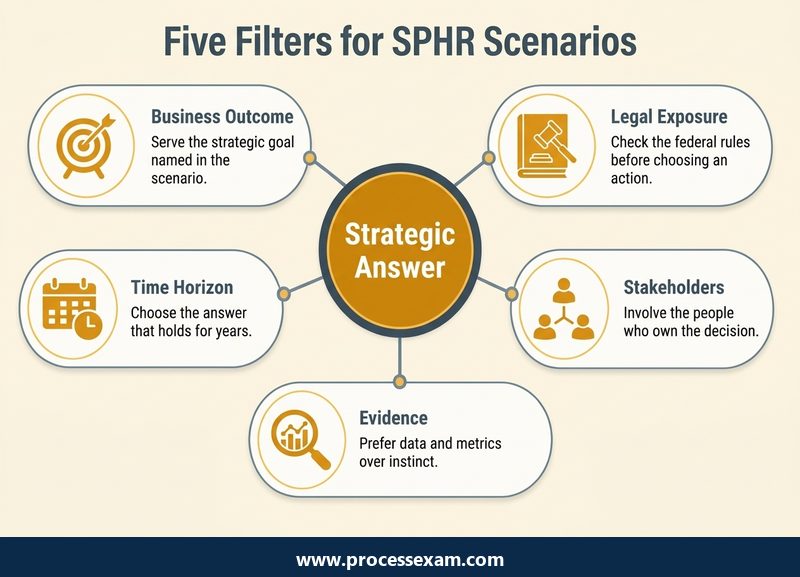
- Business outcome. Which option moves the organisation toward the strategic goal stated or implied in the scenario? An answer that is excellent HR but irrelevant to that goal is usually a distractor.
- Legal exposure. Does any option create or ignore a federal obligation? The outline asks you to evaluate how US federal laws apply to strategy, so a legal check often decides the sequence.
- Stakeholders. Who is affected, and who actually owns the decision? Senior answers bring the right leaders in; they neither bypass them nor pass the decision to someone junior.
- Evidence. Does the option rest on data, metrics or a credible survey, or on instinct? The outline repeatedly asks for decisions based on credible and relevant information.
- Time horizon. Will the answer still hold in two or three years, or does it fix this week's problem and create next year's?
Apply the filters to the plant closure scenario. Business outcome keeps all four options alive. Legal exposure promotes the notice-rules check to the front, because it governs the timetable. Stakeholders then point to who approves the plan, and evidence points to the cost model. The communication plan and the retention interviews follow from those facts. You reach the same ranking a seasoned HR director would reach, but by method rather than by feel, and a method is what holds up in the last hour of a long exam.
A review routine that trains the filters
Practice questions only change your judgement if you review them properly. After each set, take every item you missed or guessed and write down, in one line, which filter would have decided it. Then label the type of error. Four labels cover most misses:
- Level: you answered for one team or one employee when the question was about the organisation.
- Law: you missed a federal rule that changed which action was permitted.
- Sequence: the action was right but something else had to come first.
- Scope: you solved one site, unit or population when the question covered all of them.
After a week or two the labels stop being evenly spread, and you can see which filter you skip under pressure. That personal pattern is worth more than any score. A bank of scenario questions written to the outline gives you enough material to find it, and the SPHR practice exam is one place to get items that make you argue between two reasonable options before you spend a booking fee.
Does senior HR experience cover the gaps, or hide them?
Experience is the SPHR's entry ticket and its most common blind spot. Every senior candidate knows their own organisation well, and the exam is not about their organisation. It is about the outline. A head of reward who has never negotiated with a union can answer anything in Total Rewards and still meet labour strategy, collective bargaining and grievance programmes under Talent Management. A talent acquisition leader may have run the best sourcing operation in the region and never read a financial statement.
The cure is a gap audit built on HRCI's own text. Open the outline, go through the 33 responsibilities, and give yourself an honest score for each: have led it, have contributed to it, have only read about it. The pattern usually clusters in a few places:
- Business metrics and finance. Responsibility 1.4 names key performance indicators, financial statements and budgets, and 1.8 adds predictive analytics, return on investment and pay equity analysis. HR leaders who delegate the numbers are exposed here.
- Labour relations. Collective bargaining and grievance programmes sit in the Talent Management list. Candidates from non-union employers tend to skim them.
- Data privacy and security. The last area asks you to align HR data practices with the organisation's cyber security and data protection strategy, which many HR leaders leave to IT.
- Change and risk. Designing change strategies and scanning internal and external factors for human capital risk are strategy tasks, not project administration.
Then check the law. The outline warns that employment laws change constantly and puts the burden on you: you must know the rules in force on the day you sit the exam. A study book printed two years ago is a draft, not a source. Read current guidance on the federal rules the outline mentions and treat any resource that cannot tell you its publication date with caution.
Finally, make the gap audit the shape of your study time rather than your reading pile. Give the least familiar areas the first weeks, because your familiar areas will hold up under revision, while the unfamiliar ones need time to settle. Keep the weights in mind as you do it: a weak spot in Leadership and Strategy hurts three times as much as one in HR Information Management, Safety, and Security.
How should you read a practice score when the real result is scaled?
HRCI reports results on a scaled score, and a scaled score of 500 on a range of 100 to 700 is needed to pass. The handbook explains why: HRCI keeps several forms of each exam, some questions are replaced as new versions appear, and a process called equating adjusts for differences in difficulty so that the passing score is 500 whichever form you receive. The consequence for you is simple. There is no fixed share of questions that equals a pass, so a percentage from any practice set is a rough signal, not a forecast.
Use practice results in three ways instead. First, read them by functional area, not as a single number, and compare each area with its weight. A decent overall score that hides a poor result in a heavy area is the most dangerous kind. Second, watch how your result changes after you apply the five filters to your misses; the trend matters more than any single set. Third, look at the speed of your reasoning, because the exam gives you roughly a minute per question.
HRCI's exam page says the 140 questions are 115 scored items plus 25 pretest items, and the handbook adds that pretest questions are not distinguished from the rest and do not count toward your result. That is a reason to stay calm rather than to guess which ones to skip. If one question seems to come from nowhere, it may be unscored, so make your best choice, flag it if you wish and move on without letting it eat into the next five.
How long is the SPHR exam, and how should you pace it?
You have two and a half hours of testing, plus half an hour of administration time that does not come out of your answering clock. Scenario sets deserve more time than single items, because one careful reading of the story serves several questions. A sensible rule is to reach the halfway point of the questions around the one-hour mark, which leaves a buffer for the scenarios you flagged. If you drift well behind that, shorten your deliberation on single items rather than rushing the scenarios.
How hard is the SPHR exam in practice?
No first-time pass rate appears on HRCI's exam page, so treat any figure you see elsewhere with caution. The honest difficulty lies in three things: the length of the exam, the strategic framing of the questions, and the breadth of five functional areas that a specialist rarely covers in daily work. Candidates who prepare for all three, as above, find the exam demanding rather than unfair.
Who qualifies to sit the SPHR, and what signals say you should schedule it?
HRCI's page asks for professional-level HR experience on one of three routes. Pick the one that matches your education:
- a master's degree or higher plus four years in a professional-level HR job;
- a bachelor's degree plus five years in such a job;
- no degree requirement at all if you have seven years in a professional-level HR job.
Eligibility is the floor, not the signal that you are ready. A better test is whether your gap audit now shows no area where you could not defend a decision to a chief executive, whether your practice results by area sit close together, and whether you can explain your reasoning for a missed question in one line. Book when those three things are true, and book with the 180-day window in mind: the clock starts when HRCI approves your application, so apply when you can realistically study, not months ahead of time.
The reward for getting this right is a credential that HRCI places in its Strategic category, aimed at people who plan and lead rather than carry out. Passing with a clear understanding of how senior answers are built also pays off after the exam, because the same five filters are what boards and chief executives expect from an HR leader in a real meeting. Read the sources behind this guide, HRCI's SPHR page, the content outline and the handbook, once more in your final week to catch anything that changed since you started.
Frequently Asked Questions
How hard is the SPHR exam?
The SPHR is demanding because the questions test strategic judgement, not recall. HRCI classes questions as knowledge, application or synthesis and evaluation, and scenarios combine several functional areas. You face 140 questions, 115 scored and 25 pretest, and you need a scaled score of 500 on a scale of 100-700 to pass.
How long is the SPHR exam?
The SPHR gives you 150 minutes of testing time for 140 questions, plus 30 minutes of administration time that does not reduce your answering clock. That works out at a little over a minute per question, so pace scenario sets carefully and keep a buffer for flagged questions.
What are the SPHR certification requirements?
HRCI requires professional-level HR experience on one of three routes: a master's degree or higher with four years, a bachelor's degree with five years, or seven years with no degree requirement. You apply to HRCI, are approved, and then have 180 days to take the exam through Pearson VUE.
What is the passing score for the SPHR?
The SPHR passing score is 500 on a scaled range of 100 to 700. HRCI scales results and equates the different exam forms so that 500 is the pass mark whichever version you sit. Because of that, no fixed number of correct answers guarantees a pass, and a practice percentage is only a rough guide.
How much does the SPHR certification cost?
HRCI charges an exam fee of $495 plus a separate application fee of $100. After a failed attempt without Second Chance Insurance you wait 90 days, then apply and pay the related fees again. HRCI says fees can change at any time, so confirm the current amount on its website.
- HRCI HR Senior Professional Exam Questions |
- HRCI HR Senior Professional Question Bank |
- HRCI HR Senior Professional Questions |
- HRCI HR Senior Professional Study Guide |
- HRCI SPHR Quiz |
- SPHR Certification |
- SPHR Questions |
- SPHR Practice Test |
- SPHR Study Guide Material |
- SPHR Sample Exam |
- HR Senior Professional Certification |
- HRCI HR Senior Professional Book |
- HR Senior Professional Certification Cost |
- HR Senior Professional Certification Requirements |
- HRCI HR Senior Professional Sample Questions |
- SPHR Exam Questions Download |
- SPHR Test Questions |
- HR Senior Professional PDF |
- HRCI Senior Professional in Human Resources


