
Six Sigma Deployment: Six Elements That Make It Work
A company has certified a large group of Green Belts and Black Belts, printed the certificates and held a launch event, and twelve months later has closed almost no projects. Nobody was careless. The belts were trained; the programme around them was never built. A Six Sigma deployment succeeds or fails on six elements that have little to do with statistics: how projects are chosen, who owns them, how much time belts really get, who validates the savings, how projects are reviewed, and what keeps the gains in place.

This article walks through those six elements in the order a deployment meets them, then lists the early signs that a programme is drifting towards the stalled pattern above. It stays on the company-wide view. The project-level methods, DMAIC and DMADV, are covered in other guides on this blog, and the exam itself gets one short block near the end.
Which six elements decide whether a Six Sigma deployment works?
A deployment is a management system, and the technical tools are the smallest part of it. Wikipedia's overview of Six Sigma traces the method back to a manufacturing programme, but what carried it into banks, hospitals and software companies was the governance wrapped around the tools: sponsors, a defined belt structure, project reviews and a link to financial results. Those are the six elements, and each one fails in a recognisable way.
| Element | What it looks like when it works | What it looks like when it is missing |
|---|---|---|
| 1. Projects tied to strategy | Every charter names the business goal it serves | Belts pick topics they find interesting or easy |
| 2. Clear roles above the belts | A named sponsor, champion and process owner for each project | Nobody can say who may remove a blocker |
| 3. Real belt capacity | Belts have protected time and a defined career path | Projects are squeezed in after the day job |
| 4. Savings checked by finance | One agreed definition of a saving, signed by a finance partner | Each project team reports its own figure |
| 5. Tollgate reviews | Scheduled gate reviews that can stop a project | Reviews are updates; nothing is ever stopped |
| 6. Control that outlasts the team | A process owner holds the control plan after closure | The metric drifts back once the belt moves on |
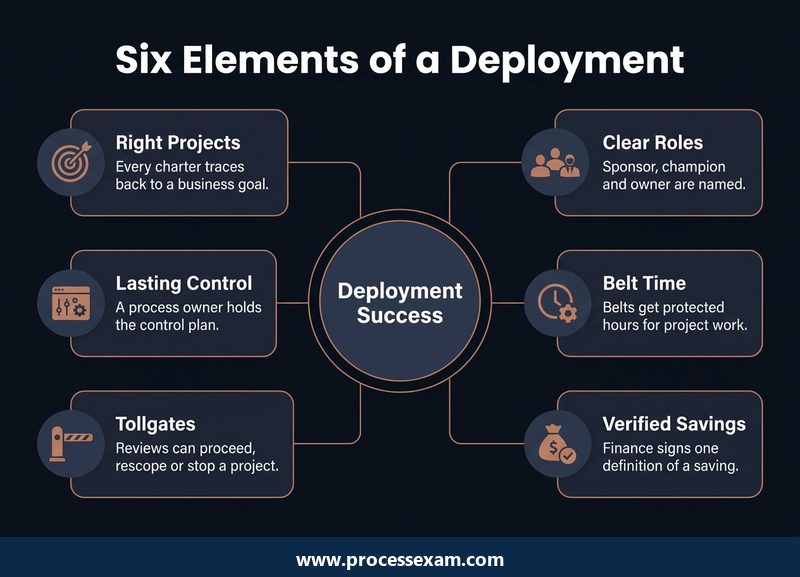
The order matters. Elements one and two decide whether the right work starts. Elements three to five decide whether it finishes. Element six decides whether finishing was worth the effort. A deployment that is strong on the first five and silent on the sixth produces impressive close-out slides and a process that looks the same a year later.
How should a company choose the projects that go into the pipeline?
The first element is project selection, and it is the one deployments most often get wrong while believing they got it right. A project list assembled by asking every department for ideas is a wish list. A project list built downwards from the company's goals is a portfolio. The difference shows when two projects compete for the same belt: the wish list has no way to choose, and the portfolio does.
Start from the goals, then look for the processes behind them
Take a goal such as shorter lead times to customers or fewer warranty claims. Ask which processes most influence that number, then ask where those processes lose time or create defects. The answer is a longlist of candidate problems, each already attached to something the leadership cares about. Candidates that cannot be attached to any goal are not rejected for being poor ideas; they are parked, because belt time is the scarcest resource in the programme.
Size the project for a single belt and a short life
A project with an enormous scope drags on and drains the team's interest. A well-scoped one produces an early result, and that result builds credibility for the whole programme. When a candidate is too large, split it by product line, site or defect type and charter the first slice. The test is simple: can a belt state the problem, the metric and the target in one paragraph, and can the team reach the end of the work in a few months rather than a few years?
Check that the process is going to stay put
Imagine a team asked to shorten recruitment cycle time while management has already decided to replace the recruitment process with an automated one in a few months. The project will be scrapped halfway, and the belt and the team will have learned that the programme does not coordinate with the rest of the business. Before a charter is signed, ask the sponsor whether the process is scheduled for a system change, a reorganisation, a merger or an outsourcing decision. If it is, the effort belongs elsewhere.
Keep a funnel, not a list
Mature programmes run a pipeline: ideas are logged, screened against the goals, scored on expected value and effort, and only then chartered. A visible funnel does two jobs. It gives sponsors a fair way to say no, and it guarantees that when a project ends, the next one is ready for the belt instead of a three-week search for a topic.
Who owns what: the sponsor, the champion, the process owner and the belt?
The second element is clarity of roles above the belt. Most failed deployments do have senior support in the abstract. What they lack is a named person for each project who can do the specific things a project needs. Vague sponsorship is the commonest reason a trained belt stalls with a finished analysis and no authority to change anything.
| Role | Owns | Typical decision |
|---|---|---|
| Executive sponsor | The programme and its link to the business plan | Which goals the deployment serves this year |
| Champion | A group of projects in one function or value stream | Which candidates are chartered and which belt takes them |
| Process owner | The process being changed, before and after the project | Whether the new way of working is adopted |
| Black Belt | The project method, the data and the team's progress | Which analysis is needed and when a gate is ready |
| Green Belt | A smaller project, usually inside their own area | How to scope the work and collect the data |
| Master Black Belt | The belt community, the curriculum and the portfolio's quality | Which projects need mentoring and which method fits |
Two roles are worth a closer look because deployments blur them. The first is the champion, who is a manager with budget and authority, not a cheerleader. A champion removes blockers that the belt cannot, such as access to data owned by another department or a manager who will not release a team member. The second is the process owner, who is frequently forgotten in the charter. The owner is the person who will live with the change, so the owner needs to be in the room when the solution is chosen, not briefed afterwards.
Where sponsors step in
Sponsors do not need to attend every team meeting, and a programme that expects it will lose their time within a month. They need to be present at three moments: when the project is chosen, at each gate review, and when a conflict between belts, process owners or departments needs someone with the standing to settle it. Everything else can be delegated to the champion. Write these three moments into the programme's rules and an absent sponsor becomes visible quickly.
Name a co-lead when the work crosses functions
A common choice that backfires is appointing a lead from a different function simply because that person has free time. A project to improve a finance process led by someone from human resources starts with a handicap, because the lead does not know the work or have a stake in it. The safer pattern is a lead from the process being improved, with a co-lead from the partnering function as a back-up. The pairing also helps when team roles shift with customer demand and one of the two is pulled away.
How many belts does a deployment need, and how much time must they get?
The third element is belt capacity, which is where good intentions meet the calendar. A belt who is expected to run a project in whatever time is left after a full job will not finish it. Deployments that work make the capacity explicit before the training budget is spent, and the sums are not complicated.
Work from the project pipeline, not from a headcount rule
Rules of thumb for the number of belts per hundred employees circulate widely, and none of them is a standard. A better starting point is the pipeline: how many projects does the portfolio need this year, how long does a project take for each belt level, and how much of each belt's week is protected for it? Dividing the first by the second gives the number of belts. A company that skips this arithmetic usually discovers it has trained twice as many Green Belts as it can supervise and too few Black Belts to coach them.
Define what each belt level is expected to deliver
Each level needs a deliverable that is written down: a minimum number of closed projects in a period, a minimum validated value or, at the least, a stated time commitment. ASQ's page for the Certified Six Sigma Black Belt shows how a credentialing body ties the title to demonstrated experience, and a company can use the same logic internally by linking each belt title to project work rather than to attendance at a course.
Put project results into performance objectives
One of the strongest levers is also the plainest. When project work appears in the objectives of everyone on the team, with measurable targets, it stops being a favour to the belt. Appraisal items bring accountability and put a healthy pressure on the team to deliver as planned. Without them, the project competes with every other task and loses to whichever has a manager asking about it each week.
Adapt the training to the organisation's own work
Whether the programme is delivered by an outside consultant or by an internal champion, the person teaching needs to understand the context and culture of the company. Training works best when the schedule bends around participants' work, when examples come from the business and when the aim goes beyond statistics modules. The target is people who can run root-cause analysis, solve problems creatively and improve processes, so that the company gains capability rather than certificates. Dumping everything on a team in the first week produces recall of very little.
What should a tollgate review decide, and who validates the savings?
Elements four and five belong together, because a gate review is where a savings claim is first tested. A tollgate is a scheduled point at the end of a project phase where the sponsor, champion and process owner decide whether the work has earned the right to continue. The review can end in several ways, and a deployment that never uses the stop outcome is not really reviewing.
| Gate | Question the review asks | Allowed outcomes |
|---|---|---|
| After define | Is the problem tied to a goal, with an owner and a scope that fits? | Proceed, rescope, park |
| After measure | Can we trust the data, and is the baseline stated plainly? | Proceed, repeat measurement, stop |
| After analyze | Are the causes verified with evidence, not opinions? | Proceed, return to analysis, stop |
| After improve | Did the pilot move the measure, and will the owner adopt the change? | Roll out, adjust the pilot, stop |
| Before closure | Is control in place, and has finance confirmed the value? | Close, extend for control, hand over |
Give the gate the power to stop a project
The test of a tollgate culture is whether any project has been stopped. A project whose target turns out to be unreachable, or whose process has changed under it, should be closed without blame and its belt reassigned. Programmes that keep every project alive to protect the numbers fill the pipeline with dead weight and hide the real completion rate.
Agree one definition of a saving, and let finance own it
The fourth element is financial validation. Without it, each team reports a number in its own way, the totals are impossible to reconcile and the first sceptical executive stops believing any of them. The fix is organisational, not mathematical. Agree what counts as a hard saving, such as a cost that leaves the budget, and what counts as a soft one, such as time freed or risk reduced. Name a finance partner to sign each project's figure at the closure gate and again after the results have had time to show up in the ledger.
Keep two further habits. Record the baseline at the start, with the same finance partner, so the claim cannot move later. And separate the project's result from changes in volume, price or mix that happened to coincide with it, so the programme does not take credit for a good quarter it did not create.
How do you stop the gains from slipping after the project closes?
The sixth element is control, and it is the one most visibly missing from failed programmes. A project team improves a process, the team disbands, and within a year the measure has wandered back to where it began. The cause is rarely sabotage. It is that nobody owns the new way of working after the belt leaves.
Hand the control plan to the process owner, in writing
A control plan names the measure, how often it is read, who reads it, the limit at which someone must act, and what the action is. At closure the plan is handed to the process owner, who signs it. The belt's role ends at a defined handover rather than at a vague sense that the work is done. Where the measure is a chart, the owner should be able to read it without the belt present.
Plan the follow-up before closure
A closed project still needs a check. Schedule a review some months after closure, with finance in the room, to confirm that the measure has held and the saving is real. If it has slipped, the deployment has learned something about its own control plans, which is worth more than the project's original result.
Recognise results on time and in public
Management should recognise project teams promptly and in line with the company's own reward policies. Celebrating a win in the open creates interest in the next wave and tells the rest of the organisation that the programme produces results. It earns its place in the list because the belts who see their work recognised are the ones who take the next project.
How can you tell early that a deployment is failing?
The six elements fail quietly, usually months before anyone reports a problem. The signs below are things a programme office can check from its own records. None needs an outside audit, and each points back to one of the elements above.
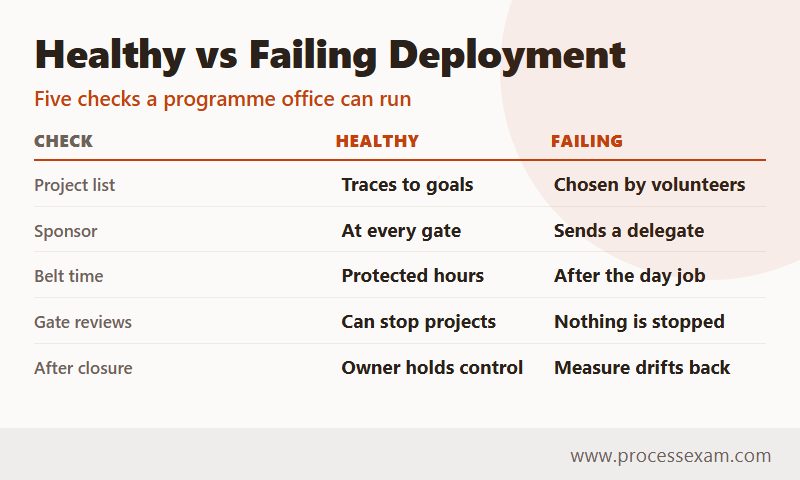
| Early sign | What it points to | First thing to check |
|---|---|---|
| Many belts trained, few projects chartered | Selection and capacity | Is there a funnel, and is belt time protected? |
| Charters cannot name a goal | Strategy link | Ask each champion which goal the project serves |
| Gate reviews are rescheduled or attended by delegates | Sponsor engagement | Are the three sponsor moments written into the rules? |
| No project has ever been stopped | Tollgate discipline | Read the minutes for the last two gates |
| Savings totals differ between reports | Financial validation | Is there one definition and one finance signatory? |
| Projects close, then the measure drifts | Control | Who owns each control plan, and who reads it? |
| Belts finish training and drift back to old roles | Capacity and career path | Do their objectives mention project work? |
Two of these deserve extra attention. The first is a rising count of projects stuck in the same phase, which usually means the gate is missing or toothless. The second is the gap between the number of projects started and the number closed. A programme can be healthy with a modest closure rate if the cause is visible and being fixed. It cannot be healthy if the gap is growing and nobody is asked about it.
Run a short health review every quarter
Once a quarter, let the programme office run the seven checks above and report the answers to the executive sponsor in a single page. The aim is to catch drift while it is cheap to correct. A deployment that does this seldom needs a dramatic relaunch, because the problems are corrected while they are still small.
Where does ASQ test deployment knowledge, and what does the CMBB involve?
Deployment is the core of ASQ's Certified Master Black Belt, the credential for practitioners who run programmes rather than projects. Its Body of Knowledge covers enterprise-wide planning, organisational competencies for deployment, project portfolio management and coaching and mentoring, which line up with elements one to five above, and it adds training design and advanced data methods. Candidates also pass a portfolio review before they can register, which is covered in a separate guide on the credential. The figures below are as ASQ publishes them.
| Exam detail | CMBB |
|---|---|
| Full name | ASQ Certified Master Black Belt |
| Exam code | CMBB |
| Vendor | ASQ |
| Number of questions | 110 |
| Duration | Total appointment time - 330 minutes Exam Time - 320 minutes |
| Exam fee | ASQ MEMBERS - $1,499 NON-MEMBERS - $1,599 RETAKES - $1,399 |
| Passing score | 550/750 |
The CMBB syllabus lists the topic areas the questions are drawn from.
Once the deployment vocabulary feels familiar, a pass through the CMBB practice exam shows whether you can apply it to a case, not just recite it.
Frequently Asked Questions
What are the key success factors for a Six Sigma deployment?
Six elements carry most of the weight: projects chosen from business goals, named sponsor and champion roles, protected belt time, savings validated by finance, tollgate reviews that can stop projects, and control plans owned by the process owner. A programme missing any one of them tends to stall or lose its results.
Why do Six Sigma deployments fail?
Most fail on management rather than method. Projects are picked without a link to strategy, belts have no protected time, reviews never stop anything, and nobody owns the control plan after closure. The result is trained people, a thin project record and savings figures nobody trusts.
What is the difference between a sponsor and a champion in Six Sigma?
The executive sponsor owns the programme and its tie to the business plan. A champion is a manager who owns a group of projects in one function or value stream, charters them, assigns belts and removes blockers the belt cannot. A process owner then holds the changed process after closure.
Who should validate the savings from a Six Sigma project?
A finance partner, not the project team. The company agrees one definition of hard and soft savings, records the baseline at the start, and has finance sign the figure at the closure gate and again after the results appear in the ledger. That keeps totals consistent and credible across projects.
Which ASQ exam covers Six Sigma deployment?
The ASQ Certified Master Black Belt (CMBB). It has 110 questions, a total appointment time of 330 minutes with 320 minutes of exam time, and a passing score of 550/750. Its Body of Knowledge covers enterprise planning, deployment competencies, portfolio management, training and coaching.
- Six Sigma |
- ASQ Master Black Belt Test Questions |
- ASQ Master Black Belt Book |
- Master Black Belt Certification Cost |
- Master Black Belt Certification Requirements |
- ASQ Master Black Belt Sample Questions |
- Master Black Belt PDF |
- CMBB Question Bank |
- CMBB Body of Knowledge (BOK) |
- Master Black Belt Simulator |
- Master Black Belt Mock Exam |
- ASQ CMBB BOK PDF |
- CMBB Exam Questions Download |
- CMBB Test Questions |
- CMBB Handbook


