
ServiceNow CIS-SAM Certification: Earnings Guide
A popular belief says a certification lifts your pay all by itself. For CIS-SAM that is only half true. The ServiceNow Certified Implementation Specialist - Software Asset Management credential raises your earning power when it sits on top of real work: turning untidy install data into a license position an auditor will accept. This guide covers the roles that pay for that skill, what moves their value, and the 60-question exam you pass to prove it.

Does the CIS-SAM certification actually raise what you earn?
It can, but not in the way the question usually assumes. Employers do not pay for a line on a CV. They pay for the problem that line promises to solve. In software asset management that problem is expensive and easy to explain to a finance director: an organisation is either paying for software nobody uses, or using software nobody paid for. The first wastes budget at every renewal. The second turns into a bill, sometimes a large one, when a publisher audits the estate.
CIS-SAM tells a hiring manager that you know how ServiceNow's Software Asset Management application tackles both sides of that problem. It shows you can bring installation data into the platform, normalise it into recognisable products, record what the company is entitled to use, and reconcile the two into a position that shows where the gaps are. A candidate who can do that on the platform the company already owns is worth more than one who would need months to learn it.
What the certificate cannot do is replace evidence. Two people with the same credential can be valued very differently. One ran reconciliation for a publisher with a complicated metric and found savings the business could bank. The other passed the exam after a course and has never touched a live instance. The credential opens the interview; the stories you can tell inside it decide the offer.
Why this page does not quote salary figures
Pay for SAM work varies by country, city, industry and seniority, and published numbers go out of date within a year. Rather than print a range that may be wrong where you live, this guide explains what drives the number up or down. When you want a current figure, look up the job title rather than the certification in a salary survey for your own country. Surveys rarely list CIS-SAM on its own, but they do list software asset manager, IT asset manager and ServiceNow consultant, and those are the jobs this credential feeds.
Which jobs use ServiceNow SAM skills, and what does each one own?
The credential is aimed at implementers, but its knowledge travels well beyond project teams. Most people who hold it work in one of five roles, and each role leans on a different part of the exam.
Software asset manager
The software asset manager owns the organisation's license positions. That means knowing, publisher by publisher, how many rights were bought, how many are in use, and what the contracts allow. In a ServiceNow shop this person lives in the Software Asset Workspace, reviews reconciliation results, and decides whether a shortfall is fixed by buying, reclaiming or reallocating. The compliance domain of the exam, the heaviest one, is essentially this job described as questions.
IT asset manager
An IT asset manager looks after hardware and software together, from purchase to disposal. For this role CIS-SAM adds depth on the software half, while the hardware half has its own ServiceNow credential. The overlap sits in the CMDB: a laptop record, the software discovered on it and the user it is assigned to all have to agree before either hardware or software reporting can be trusted.
ServiceNow SAM implementation consultant
This is the role the exam was written for. A consultant activates and configures the application for a customer, connects discovery sources, loads entitlements from contracts and purchase records, sets up publisher-specific handling, and hands over a working process. Consultants are measured on projects delivered, so the certification matters twice for them: it is often a condition for being staffed on partner projects, and it is proof to the customer that the person configuring their compliance data has been tested on it.
SAM or license analyst
Analysts do the detailed work that keeps positions accurate between audits: chasing unnormalised installs, matching purchase lines to entitlements, checking that allocations follow real users, and preparing evidence packs when a publisher asks for one. Many software asset managers started here. It is also the most common landing role for someone moving into SAM from service desk or procurement work.
SAM program lead or ITAM platform owner
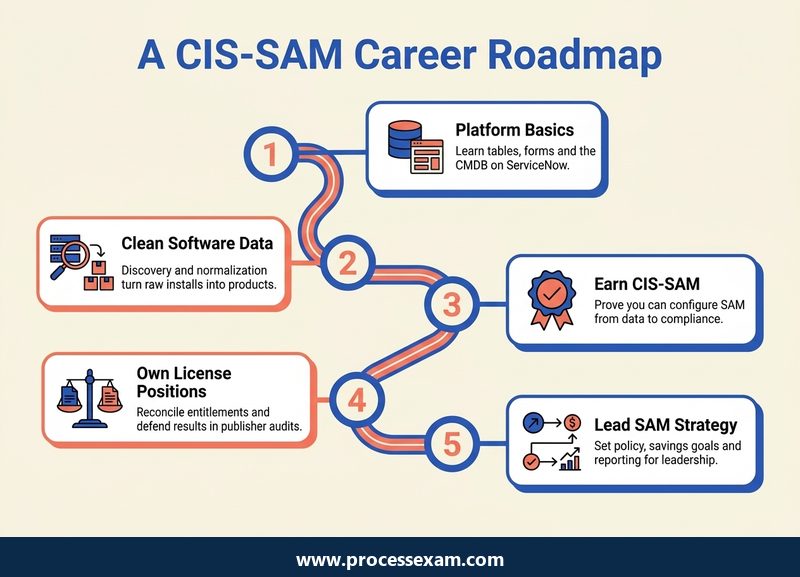
At the senior end, someone sets policy: which publishers get the most attention, what savings target the program owns, how reclamation is approved, and what leadership sees each quarter. This role rarely configures anything by hand, but it has to know what the application can and cannot do to set realistic goals. The roadmap above shows the usual order in which people move through these stages.
| Role | Exam domain it uses most | What it is judged on |
|---|---|---|
| Software asset manager | Practical Management of Software Compliance | Accurate license positions and audit outcomes |
| IT asset manager | Software Asset Core Overview and Fundamentals | One trustworthy record per asset across its life |
| SAM implementation consultant | Data Integrity and Operational Integration | Projects delivered on time with clean data |
| SAM or license analyst | Data Integrity: discovery and normalization | Fewer unmatched installs and entitlements |
| SAM program lead | Extending SAM: optimization and reporting | Savings banked and risk reported upward |
What does the CIS-SAM exam involve, from prerequisites to your result?
The exam checks whether you can configure, implement and maintain ServiceNow's Software Asset Management application. The logistics below are the figures we hold for the exam; anything ServiceNow may change between releases, such as the voucher process, should be confirmed on ServiceNow University before you pay.
| Exam detail | CIS-SAM |
|---|---|
| Exam name | ServiceNow Certified Implementation Specialist - Software Asset Management |
| Exam code | CIS-SAM |
| Vendor | ServiceNow |
| Exam fee | USD $450 |
| Duration | 90 minutes |
| Number of questions | 60 |
| Passing score | Pass / Fail |
| Scheduling | Pearson VUE |
What sits behind a sign-in
ServiceNow publishes the detailed specification in ServiceNow's CIS-SAM mainline exam blueprint on ServiceNow University. When we checked in September 2026 the document needed a free ServiceNow University account to open, so we could not read ServiceNow's own wording in public. The same applies to the credential path, which lists the learning ServiceNow expects before you buy a voucher. Create the account first and read both; the prerequisites and any recommended courses are stated there, and they are the ones that count.
How the questions behave
Expect multiple-choice questions with one answer and multiple-select questions where you pick several. Sixty questions in ninety minutes gives you a minute and a half for each, which sounds generous until a question describes a publisher, a license metric and two conflicting data sources in one paragraph. Results are reported as Pass or Fail, with no published passing percentage, so judge your readiness by timed practice rather than by chasing a number.
Keeping the credential current
ServiceNow ties its certifications to platform releases, and its University site shows what a certified person must do to stay current. Check your status there after each release rather than relying on a training partner's summary, because the rules have changed over the years and old pages are still indexed.
How are the five CIS-SAM domains weighted, and what does each one test?
ProcessExam's breakdown of the exam, published on our domain-by-domain CIS-SAM syllabus, groups the content into five domains. The shares tell you where to spend time: the two middle domains, data integrity and compliance, carry well over half the marks between them.
| Domain | Weight | Topics |
|---|---|---|
| Software Asset Core Overview and Fundamentals | 14% | SAM basics, process architecture, application introduction and recommended practices |
| Data Integrity - Attributes and Sources for the Data | 28% | Importing data, software discovery and normalization, content services |
| Practical Management of Software Compliance | 30% | Products and models, license metrics, entitlements and allocations, software reconciliation |
| Operational Integration of Software Processes | 13% | Contract and change management, service catalog and procurement, software remediation |
| Extending SAM | 15% | Software model lifecycle and retirement, installation optimization, reporting, implementation and maintenance |
Core overview and fundamentals
This domain checks that you understand what software asset management is for before you touch the application. Know the lifecycle of a software asset from request to retirement, the roles involved, and how ServiceNow's application is structured: which parts handle discovery data, which hold entitlements, and where reconciliation happens. Recommended practices matter here, such as starting with the publishers that carry the most spend or risk instead of trying to reconcile everything at once. For neutral background on the discipline itself, the Wikipedia overview of software asset management is a sensible primer before you move on to ServiceNow specifics.
Data integrity
Nothing in SAM works if the install data is wrong, so this domain carries more than a quarter of the exam. You need to know where installation records come from: ServiceNow Discovery, agents, and integrations with endpoint tools such as Microsoft Configuration Manager. Then comes normalization, where a raw string like a publisher name spelled three ways is matched to one recognised publisher, product, version and edition. ServiceNow's content service supplies that library of known software, and the exam tests how its results are applied, what a partially normalised record means, and how you deal with software the library does not recognise.
Practical management of software compliance
The heaviest domain is the heart of the job. Software models define exactly which installations count as a given licensable product. Entitlements record what was bought, each with a license metric such as per device, per user or per processor core, and some metrics need allocations that tie a right to a named user or device. Reconciliation then compares consumption against rights and produces the license position. Expect scenario questions that ask why a position looks wrong, and answer them by tracing back through the model, the metric and the allocation.
Operational integration
SAM cannot sit apart from the rest of IT. This domain covers how software contracts are recorded, how change management and the service catalog route new software requests so that rights are checked before installation, how procurement feeds entitlements, and how remediation options are raised when a position shows a shortfall or a surplus.
Extending SAM
The last domain looks past the first go-live. It covers the lifecycle of software models, including end-of-life and end-of-support data, installation optimization and reclamation of unused software, reporting for different audiences, and how an implementation is maintained as publishers, contracts and the platform itself change.
How does a license position come together inside ServiceNow?
Reading the domains as a list hides how tightly they connect. Following one product from discovery to a finished position shows the chain the exam keeps returning to, and it is the chain employers expect you to repair when it breaks.
Step 1: installations arrive
A discovery source reports that a design application is installed on a group of laptops. Each report lands as a software installation record linked to the configuration item for that laptop. At this point the data is only as good as the source: the publisher name may be abbreviated, the version may include a build number, and two sources may report the same install slightly differently.
Step 2: normalization makes the data comparable
The content service matches each raw record to a recognised publisher, product, version and edition. Installs it cannot match stay unnormalised and need attention, either by waiting for the library to catch up or by normalising them manually with care. An estate full of unnormalised installs produces positions that look healthy only because much of the consumption is invisible.
Step 3: the software model decides what counts
A software model says which normalised installations belong to the product the company actually licenses. If the contract covers one edition and some users installed another, the model is where that difference either shows up or gets hidden. Many wrong positions trace back to a model that is too broad or too narrow.
Step 4: entitlements and allocations record the rights
Purchase records and contracts become entitlements. Each carries a license metric, and the metric decides what reconciliation counts: devices, users, processor cores or something publisher-specific. Where the metric requires it, allocations assign rights to the named users or devices that hold them. An entitlement loaded with the wrong metric is one of the quickest ways to turn a compliant estate into an apparent shortfall.
Step 5: reconciliation produces the position
Reconciliation compares what is consumed against what is owned and shows the result per product: compliant, short, or carrying spare rights. The number itself is the easy part. The skill the exam tests, and the one employers pay for, is explaining it. Why is this product short? Is it genuine over-use, a model catching the wrong edition, or entitlements that were never loaded? The ServiceNow product documentation describes each of these screens and settings in full, and it is worth keeping open while you practise.
Step 6: remediation and reclamation close the loop
A shortfall can be fixed by buying, by removing unused installations, or by reallocating rights from people who no longer need them. A surplus can be cut at the next renewal. The application's remediation options and reclamation rules turn those decisions into tasks, so the position improves in a way that can be shown to an auditor rather than argued about.
What pushes the market value of a CIS-SAM holder up or down?
Since this guide gives no numbers, here is the part that decides them. Recruiters and hiring managers weigh the same handful of factors, and most of them are in your control.
Factors that raise your value
- Audit experience. Having prepared evidence for, or defended a position during, a publisher audit is the single strongest signal in this field. It shows you can carry the stakes, not only run the tool.
- Complex publishers. Positions for publishers that mix processor, user and subscription metrics are harder to get right. Experience with them is scarce and noticed.
- Savings you can name. A concrete account of rights reclaimed, a renewal reduced or a true-up avoided is worth more than any list of duties. Keep a private record of outcomes as they happen.
- Platform breadth. SAM work touches the CMDB, discovery, procurement and the service catalog. Holders who also understand those areas, or hold related ServiceNow credentials, can take on implementation work end to end.
- Industry. Organisations with large, regulated or audit-heavy estates, such as banking, insurance, healthcare and the public sector, tend to invest more in SAM because the cost of getting it wrong is higher.
Factors that hold value down
- Certification without a live instance. Employers quickly spot a candidate who can recite the domains but has never explained a real shortfall.
- Tool knowledge without contract knowledge. A position is only as good as the reading of the agreement behind it. People who cannot read license terms stay in analyst roles longer.
- A lapsed credential. If your status on ServiceNow University has lapsed, the certificate stops helping at exactly the moment a recruiter checks it.
The market also shifts with how organisations buy software. More spend has moved to subscriptions and cloud services, and SAM teams increasingly track who is actually using a paid subscription as well as what is installed. People who can speak to both sides, installed software and subscriptions, are in a stronger position than those who know only one.
How should you prepare if you have never run a SAM project?
Most candidates come to CIS-SAM from administration, ITSM or procurement rather than from a finished SAM rollout. That is fine, but it changes where your study time should go. Spend it on the parts you cannot pick up at work: reconciliation logic, license metrics and normalization.
Build a practice estate
A free Personal Developer Instance from the ServiceNow Developer Program gives you a place to practise. Check which asset management plugins your instance lets you activate, then build a small estate by hand: a few laptops, a handful of software installations with deliberately messy publisher names, and entitlements with different metrics. Run reconciliation, read the results, then break something on purpose, such as a model that covers the wrong edition, and watch the position change. This teaches the cause and effect the exam asks about far faster than reading.
Follow the blueprint order
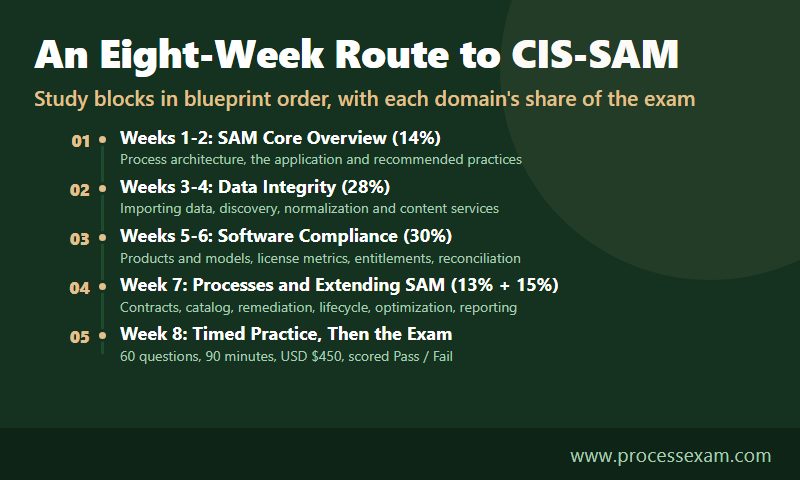
Study in the order the timeline above shows. Start with the core overview so the vocabulary is settled, then spend the most time on data integrity and compliance, which together make up more than half the exam. Leave operational integration and extending SAM until later, but do not skip them: between them they still account for over a quarter of the marks.
Test yourself under exam timing
From the halfway point, add timed question sets so you get used to reading a scenario, tracing it to a cause and choosing among close options within about a minute and a half. When you are ready for a full run, our CIS-SAM practice test uses the same 60-question, 90-minute shape, so your result tells you about pace as well as knowledge. Review every question you get wrong and write down which link in the chain from install to position you misread; the pattern in that list shows what to revise.
Plan the last week
In the final week, stop adding new material. Re-read your own notes on license metrics and reconciliation, repeat the practice estate exercise from memory, and take one last timed run two or three days before the exam, not the night before. Book your seat through Pearson VUE once your practice results are steady, rather than on a date picked before you started.
Which mistakes cost CIS-SAM candidates marks, and which cost SAM careers?
Some mistakes lose points on the day. Others quietly hold back a career after the certificate arrives. Both lists are short, and both are avoidable.
On the exam
- Treating normalization as a detail. Data integrity carries more than a quarter of the marks, and many compliance questions depend on it too.
- Memorising metric names without their effect. Know what each metric makes reconciliation count, not only what it is called.
- Reading the answers before the scenario. Several options are usually possible in the application. The right one follows the recommended practice for the situation described.
- Ignoring the smaller domains. Contracts, catalog, lifecycle and reporting make up 28% of the exam between them, and they are easy marks for anyone who has studied them.
After the exam
- Stopping at the tool. Learn to read license agreements. The best SAM professionals explain what a contract allows and then show the platform proving it.
- Reporting positions without a story. Leadership responds to risk and savings in plain terms. A position shared without an explanation invites the wrong decision.
- Letting the credential lapse. Keep your status current on ServiceNow University so the certificate still counts when an opportunity appears.
Put simply, CIS-SAM is worth the most to people who treat it as the start of a track record rather than the end of a course. Pass the exam, then collect the positions you fixed, the audits you supported and the savings you found. Those are what turn the credential into a better job.
Frequently Asked Questions
What is the CIS-SAM certification?
CIS-SAM is ServiceNow's Certified Implementation Specialist credential for its Software Asset Management application. It confirms that you can configure, implement and maintain the application, from bringing in installation data and normalising it to recording entitlements and reconciling them into license positions that show where an organisation is compliant, short or over-licensed.
How much does the CIS-SAM exam cost?
The CIS-SAM exam fee is USD $450. ServiceNow can change fees or offer vouchers through its learning programs, so confirm the current price on ServiceNow University before you buy. The fee covers one attempt at a 60-question exam lasting 90 minutes, scheduled through Pearson VUE.
How many questions are on the CIS-SAM exam, and what is the passing score?
The exam has 60 questions to answer in 90 minutes, mixing single-answer and multiple-select items. ServiceNow reports results as Pass or Fail and does not publish a passing percentage, so the most reliable way to judge readiness is steady results on timed practice under the same conditions.
Does the CIS-SAM certification increase salary?
It can, when it is backed by real work. Employers value what the credential proves: that you can produce license positions they can defend in an audit and find savings at renewal. Audit experience, complex publishers and savings you can name raise your value more than the certificate alone.
Which CIS-SAM domain carries the most weight?
Practical Management of Software Compliance carries the most weight at 30%, followed by Data Integrity at 28%. Together they make up more than half the exam, covering products and models, license metrics, entitlements, allocations, reconciliation, software discovery, normalization and content services.
- ServiceNow Software Asset Management Implementation Specialist Sample Questions |
- CIS-SAM Exam Questions Download |
- CIS-SAM Test Questions |
- Software Asset Management Implementation Specialist PDF |
- ServiceNow Software Asset Management Implementation Specialist Book |
- Software Asset Management Implementation Specialist Certification Cost |
- ServiceNow Software Asset Management Implementation Specialist Test Questions |
- CIS-SAM Question Bank |
- CIS-Software Asset Management Simulator |
- CIS-Software Asset Management Mock Exam |
- ServiceNow CIS-Software Asset Management Question Bank |
- ServiceNow CIS-Software Asset Management Book |
- ServiceNow CIS-Software Asset Management Study Guide |
- CIS-Software Asset Management Certification |
- CIS-Software Asset Management Certification Cost |
- ServiceNow CIS-Software Asset Management Exam Questions |
- ServiceNow CIS-Software Asset Management Sample Questions |
- CIS-Software Asset Management |
- CIS-Software Asset Management PDF |
- Technology


