
ServiceNow CIS-CSM Certification: Syllabus, Fee and How to Pass
Updated on 9 October 2026. What’s new: corrected the exam time limit to 90 minutes and added the five-area blueprint weightings
Plenty of ServiceNow admins assume CIS-CSM is the ITSM exam with the word "customer" swapped in. It is not. The ServiceNow Certified Implementation Specialist - Customer Service Management exam has 60 questions, gives you 90 minutes, costs USD $450, and puts its heaviest block, 38 percent, on configuring CSM itself rather than on running incidents.

Who should sit the CIS-CSM exam, and who should wait?
CIS-CSM is an implementation credential. It suits people who set up, extend or support the ServiceNow Customer Service Management application for a company that handles customer cases: consultants at ServiceNow partners, platform owners inside a support organisation, and administrators who have been handed a CSM rollout. The title says implementation specialist for a reason. The questions are written from the point of view of someone who decides how the application should be configured, not someone who only closes cases.
It is a poor first ServiceNow exam for a person who has never touched the platform. Many questions assume that you already know how a table, a role, a form, a notification or a flow behaves, so that you can spend your effort on what is specific to customer service. If you have not yet worked in the platform at all, a platform fundamentals course and some time in a personal developer instance come first. If you have run ITSM for a year and your next project is a customer-facing service desk, you are in the right place.
A quick self-check
- Can you explain, without notes, why a customer record is not the same thing as a user record?
- Have you ever built or edited an assignment rule, a notification or a catalog item?
- Can you describe the difference between a case and an incident to a colleague in two sentences?
If two of those answers are "no", spend a week in the platform first. The exam rewards hands-on familiarity far more than memorised definitions, and ServiceNow's own certification page for this credential is the place to confirm any entry requirements before you book, because the vendor decides them and can change them.
What does the exam look like on the day?
The figures below match the exam summary on our syllabus page. ServiceNow publishes the exam blueprint on its learning site, which loads through a script-driven page, so read the current blueprint there before you commit to a date.
| Item | CIS-CSM |
|---|---|
| Exam name | ServiceNow Certified Implementation Specialist - Customer Service Management |
| Exam code | CIS-CSM |
| Questions | 60 |
| Duration | 90 minutes |
| Fee | USD $450 |
| Passing score | Pass / Fail |
| Category | CRM and industry |
Sixty questions in ninety minutes is ninety seconds each. That is more generous than it sounds on a recall exam and tighter than it sounds on a scenario exam, and CIS-CSM sits in the second group. A typical question describes a company, a customer type, a channel or a service promise and then asks which configuration produces the behaviour the business wants. Reading the scenario carefully takes most of the time. Picking the answer takes very little once you have built the thing before.
Pass or fail, with no number to chase
ServiceNow reports a pass or a fail and does not publish a percentage for this exam. That changes how you should judge readiness. You cannot aim at a number, so aim at a pattern: you should be able to explain why each wrong option in a practice question is wrong, because the real exam uses the same trick of offering several answers that are plausible on other ServiceNow products and wrong for CSM.
Booking and delivery
Exams in this programme are scheduled through ServiceNow's testing partner, and our syllabus page lists Pearson VUE for CIS-CSM. Create the account early, check the identification you will need, and book a slot far enough ahead to leave a few buffer days if a work crisis lands in your plan. Retake and voucher terms change from time to time and could not be read for this exam, so check them on ServiceNow's page rather than relying on a forum post.
How is the blueprint split, and where do the marks sit?
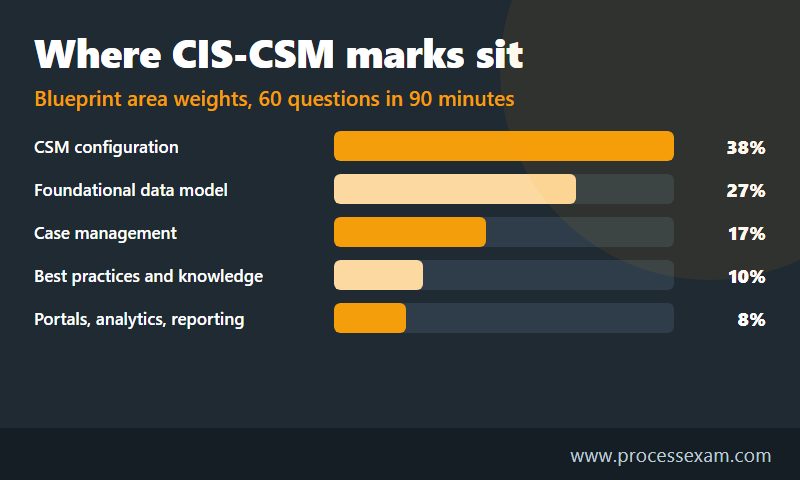
The syllabus page for this exam lists five areas with weights that add up to 100 percent. Treat the weights as a guide to where to spend your hours, not as a promise about how many questions each area will contribute to your particular paper.
| Blueprint area | Weight | What it is mostly about |
|---|---|---|
| CSM configuration | 38% | Routing and assignment, case types, channels |
| CSM foundational data model | 27% | Business and product models, install base, contracts and entitlements |
| Case management | 17% | State flows, major issues, digests, workspace, escalations |
| CSM best practices and knowledge management | 10% | Architecture, end-to-end processes, project scope, knowledge quality |
| Workspace, portals, service catalog, analytics and reporting | 8% | Portals, catalog, special handling notes, SLAs, targeted communications, reporting |
Two areas, configuration and the data model, add up to 65 percent. Anybody who splits study time evenly across the five rows is under-investing in the two that matter most. Equally, the 8 percent row is small but not empty: a handful of questions on portals or SLAs are the difference between a comfortable pass and a nervous one. You can compare this table with the full topic list on our CIS-CSM syllabus page while you plan.
What do you actually need to know in each area?
CSM configuration (38%)
This is the heart of the exam, and the topics named in the blueprint are CSM in ServiceNow, routing and assignment, case types and channels. Expect to reason about how a customer contact becomes a case and where that case ends up.
- Channels. Know the ways a customer can reach the business, how a request from each channel turns into a case, and why a company would treat a phone call differently from a portal submission.
- Case types. Understand that one application can support several kinds of case with different fields, flows and rules, and know when a new type is justified and when a category or a field would do.
- Routing and assignment. Be able to say who receives a case, why, and what to change when the wrong team receives it. Practise reading a rule or queue setup and predicting the outcome.
The good way to prepare is to configure a small scenario yourself: two products, two customer types and three channels, and then try to make each combination land with the right group. The questions are far easier after you have been confused by your own setup.
CSM foundational data model (27%)
The data model is where ITSM experience misleads people most. A customer service organisation tracks organisations, the people at them, individual consumers who belong to no organisation, the products those customers own, and what they are entitled to. The blueprint names business models, product models, install base management and contracts and entitlements.
- Business models. Learn how accounts, contacts and consumers relate, and which situations call for each. A business-to-business support desk and a business-to-consumer one are modelled differently.
- Product models. Know how the things a company sells are described, so that a case can be tied to a product rather than just to free text.
- Install base. Understand what it means to record the specific items a customer actually owns or has deployed, and why that beats guessing from a sales history.
- Contracts and entitlements. Be clear on how an entitlement decides whether a customer is covered, for which product and through which channel, and what the agent sees when coverage is missing.
Case management (17%)
Here the exam moves from set-up to day-to-day operation: case state flows, major issue management, case digests and service definitions, the CSM workspace, and case actions, tasks and escalations. Know what each state means, what moves a case between states, and how a major issue lets one problem affecting many customers be handled once rather than case by case. Understand how service definitions describe what a customer can be given and how escalations draw attention to a case that is going badly.
Workspace, portals, catalog, analytics and reporting (8%)
The smallest row still has several distinct ideas: portals and the service catalog for customer self-service, special handling notes that warn an agent about a sensitive customer, SLAs, targeted communications, and Platform Analytics and reporting. A good rule is to know one practical example of each. For instance, when would a special handling note appear and to whom, and what does an SLA do to the way an agent works the queue?
Best practices and knowledge management (10%)
This area covers ServiceNow architecture for customer service, end-to-end customer service processes and defining project scope, and then knowledge management: functionality overview, the Article Quality Index, knowledge blocks and search, and bulk translations. Questions here tend to ask what you would do first, or what the sensible scope of a first release is. Think like a consultant who has to say no to some requests.
Which habits from ITSM will cost you on a CSM question?
Most people who attempt this exam have an ITSM background, so the useful preparation is to list the habits that will mislead you. The table sets out the ones that surface most often.
| ITSM reflex | What CSM expects instead |
|---|---|
| The requester is an employee user record | The customer is an account, contact or consumer, and may never log in |
| The ticket is an incident | The work item is a case, with its own types and state flow |
| Priority comes from impact and urgency | Service level can also depend on what the customer is entitled to |
| Fix the root cause in a problem record | Handle a widespread issue as a major issue and keep affected customers informed |
| Assign by technical support group | Route by channel, product, customer segment or entitlement |
| Knowledge serves staff | Knowledge serves customers too, so quality, search and translation matter |
None of these is a trick. They are the places where a confident ITSM answer is simply written for the wrong product. When a practice question feels easy, check whether you answered it for CSM or for the application you know best.
Reading scenario questions
Start with the customer: who are they, and how are they modelled? Then the channel, then the entitlement, then what the business wants to happen. A good half of the options will fail on the first of those four checks. If two options remain, ask which one you would prefer to maintain a year from now. ServiceNow tends to favour the configuration that uses the application as designed over a clever customisation.
What sort of preparation routine works for a person with a day job?
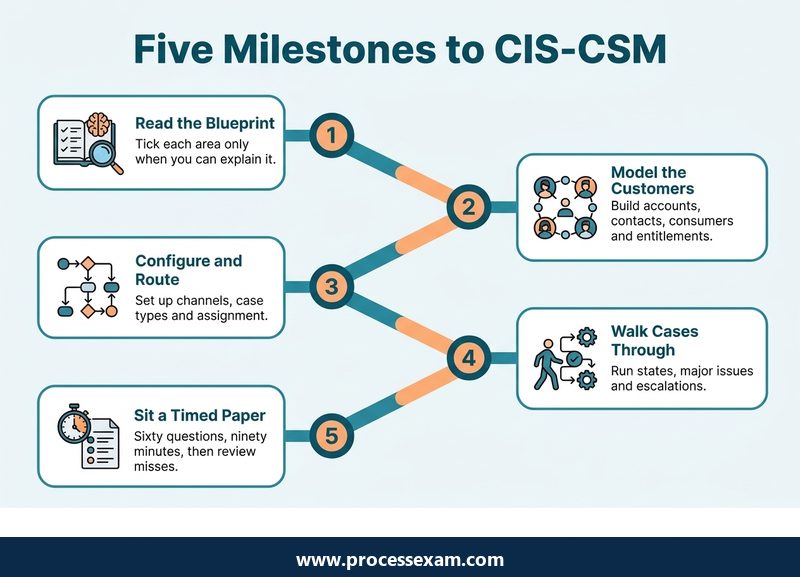
You do not need a calendar of long evenings, but you do need a routine with three ingredients: a place to build, the blueprint as a checklist, and timed practice. The sequence below is a flexible outline, not a promise about duration. People who already run CSM can compress it; people who have not may stretch it.
Start with the blueprint and a working instance
Print or copy the blueprint and tick each bullet only when you could explain it to a colleague and have seen it in the platform. ServiceNow lets learners request a personal developer instance, and ServiceNow's own documentation site describes the application's tables, roles and settings, so every doubt can be settled by looking.
Build the data model first
Because the data model carries 27 percent and sits underneath everything else, create sample accounts, contacts and consumers, a small product catalogue, a few install base records, and a contract with an entitlement. Then open a case against each and note what changes. This single exercise teaches the vocabulary that the other four areas assume.
Then configuration, then case handling
Add channels, a second case type and a routing rule, and watch where cases land. After that, walk a case through its states, raise a major issue, escalate a case and read the digest. Spend the last days of this phase on portals, knowledge and reporting so that the smaller areas do not stay unfamiliar.
Finish with timed practice
Take a full paper of sixty questions in ninety minutes at least twice. Mark every question you guessed, even the ones you got right, and revisit those with the platform open. When you can predict the explanation before reading it, you are close. If you want a mock paper that follows the exam pattern, the CIS-CSM practice exam gives you timed attempts and a record of what you got wrong, so your last revision days go to real weak spots.
The last two days
Do not learn anything new. Reread your own notes on entitlements, routing and major issues, sleep, confirm your identification and your testing slot, and log in early. Fatigue loses more marks on a scenario exam than a missing fact does.
Does the training path or the experience matter more?
ServiceNow publishes recommended training for each credential and may attach prerequisites to a voucher, so open the blueprint page before you spend anything. Its prerequisite section could not be read from outside a sign-in, so this guide does not state any entry requirement for you. What can be said is general: ServiceNow's training teaches the application's vocabulary, and time in the platform teaches you to recognise it in a scenario. You want both.
If you must choose where to put limited hours, choose the hands-on work. A candidate who has built a routing rule and a contract entitlement will find the matching questions straightforward. A candidate who has only read about them will recognise the words and still hesitate between two options, and hesitation is what consumes the ninety minutes.
Where practice material helps and where it does not
Practice questions are a measuring instrument, not a source of knowledge. Use them to find gaps, then close the gaps in the platform. Be wary of any material that promises specific live questions or a guaranteed pass: the exam is meant to be earned through experience, and a collection of remembered questions gives out the moment ServiceNow revises the blueprint. Wikipedia's ServiceNow entry is a handy background read if you are new to the vendor, but the blueprint is the only document that defines the exam.
What does the credential change at work, and what comes after it?
For an employer, a CIS-CSM badge is a signal that you have been tested on the customer service product rather than on the platform in general. That matters most in two settings. Inside a company that has bought CSM, it marks you as a person who can own configuration decisions. At a partner, it is the kind of credential that clients and project managers look for when staffing an implementation.
It will not replace project experience. Hiring managers for CSM work usually ask what you have delivered: how many channels, which customer types, whether you handled entitlements and knowledge. Use the exam to structure what you already know and to fill the gaps in it, then talk about the projects. No salary figure is quoted here, because pay for this skill varies by country, seniority and employer, and a number without a source would mislead.
Where to go next
Because CSM draws on platform basics, workflow design and knowledge management, a CIS-CSM holder is well placed to take a second implementation specialist exam in the area that their projects actually touch. Choose by the work in front of you, not by the credential that sounds largest. Keep an eye on ServiceNow's release cycle too: the application changes with each family release, and an implementation specialist who stops reading release notes slowly stops being one.
Is CIS-CSM still on offer?
ServiceNow's credential page for this exam is still published as of October 2026, and a search of the web the same month shows the exam still listed. ServiceNow has retired exams before, so confirm availability on ServiceNow's CIS-CSM credential page on the day you plan to book.
Frequently Asked Questions
How many questions are on the CIS-CSM exam?
The ServiceNow CIS-CSM exam has 60 questions and a 90-minute time limit, about ninety seconds a question. Most are scenario based, so read the customer type, channel and entitlement first, flag anything slow, and return to it once the quicker questions are done.
How much does the CIS-CSM exam cost?
The listed fee for the ServiceNow CIS-CSM exam is USD $450. ServiceNow can change fees, add vouchers or attach training requirements, so check the current price and any retake terms on ServiceNow's credential page before you book a testing slot.
What is the passing score for CIS-CSM?
CIS-CSM is reported as Pass or Fail, and ServiceNow does not give a numeric pass mark for it. Measure readiness by timed practice instead: you should finish sixty questions inside ninety minutes and be able to explain why each wrong option fails.
Which CIS-CSM topics carry the most weight?
On the syllabus listing, CSM configuration carries 38 percent and the foundational data model 27 percent, so together they make up 65 percent. Case management follows at 17 percent, best practices and knowledge at 10 percent, and portals, catalog, analytics and reporting at 8 percent.
Is CIS-CSM harder than CIS-ITSM?
Neither is simply harder; they test different products. People with ITSM experience often stumble on CSM's customer data model, entitlements and case types, because habits from incidents and employee users do not carry over. Hands-on time in a CSM instance closes most of that gap.
- ServiceNow Customer Service Management Implementation Specialist Test Questions |
- CIS-CSM Question Bank |
- CIS-Customer Service Management Simulator |
- CIS-Customer Service Management Mock Exam |
- ServiceNow Customer Service Management Implementation Specialist Book |
- Customer Service Management Implementation Specialist Certification Cost |
- Customer Service Management Implementation Specialist Certification Requirements |
- ServiceNow CIS-Customer Service Management Question Bank |
- ServiceNow CIS-Customer Service Management Book |
- ServiceNow CIS-Customer Service Management Study Guide |
- CIS-Customer Service Management Certification |
- ServiceNow Customer Service Management Implementation Specialist Sample Questions |
- CIS-CSM Exam Questions Download |
- CIS-CSM Test Questions |
- Customer Service Management Implementation Specialist PDF |
- ServiceNow CIS-Customer Service Management Exam Questions |
- ServiceNow CIS-Customer Service Management Sample Questions |
- CIS-Customer Service Management |
- CIS-Customer Service Management PDF


