
ServiceNow Certified Application Developer Roadmap: CAD Exam to Career
Updated on 22 September 2026. What’s new: exam booking corrected to Pearson VUE, and the Managing Applications domain now covers Git source control and delegated development
If your CAD notes still say the exam is booked through Kryterion, they are out of date: ServiceNow exams are now scheduled through Pearson VUE. What has not moved is the shape of the test. The ServiceNow Certified Application Developer exam still asks 60 questions in 90 minutes, costs USD $300 and returns a Pass / Fail result. This roadmap covers the current facts, the six domains, one practice app that touches all of them, and an eight-week plan.

CAD sits one level above the administrator credential in ServiceNow's platform track. An administrator configures what the platform already offers; an application developer builds something new on it, inside its own application scope, with its own tables, scripts, security rules and automation. The exam is written to find out whether you can make those build decisions correctly, not whether you can recite menu paths.
The guide is written for three kinds of reader: administrators who have started writing scripts and want the credential that proves it, developers from other platforms who are new to ServiceNow's way of doing things, and people who already failed CAD once and want to know what to change. Each section answers one question a candidate asks on the way from first look to booked exam.
What does the ServiceNow CAD exam involve when you book it today?
Start with the numbers, because they shape every later decision about pace and practice. These are the figures ProcessExam holds for the exam, checked in September 2026:
| Exam detail | ServiceNow CAD |
|---|---|
| Exam name | ServiceNow Certified Application Developer |
| Exam code | CAD |
| Exam fee | USD $300 |
| Duration | 90 minutes |
| Number of questions | 60 |
| Passing score | Pass / Fail |
| Question style | Multiple choice and multiple select |
| Where it is scheduled | Pearson VUE |
Ninety minutes for sixty questions gives you an average of a minute and a half per item. That sounds generous until you meet a multiple-select question with a short script in it, where you have to work out whether a line runs on the client or the server before you can judge any option. Candidates who run out of time usually lose it on exactly those questions, which is why the timing drills later in this guide matter.
The result comes back as a pass or a fail. ServiceNow does not publish a numeric cut score for CAD, so any percentage you see quoted in a forum is somebody's guess. Treat your own scores on timed practice sets as the measure that counts.
Booking, blueprint and learning path
Registration starts in your ServiceNow University account, and the appointment itself is handled through Pearson VUE's ServiceNow exam page, where you choose a test centre or an online-proctored session. If you sit the exam at home, test the webcam, microphone and network on the computer you will actually use, not a spare one, and clear the desk the day before.
ServiceNow publishes the CAD exam blueprint on ServiceNow University. The full document opens only after you sign in, so this guide works from what is public: the page summary, checked in September 2026, says the mainline blueprint was updated in January 2026. Sign in and compare its domain list with your study plan before you pay. ServiceNow also keeps a CAD exam and learning path page that lists the courses it expects candidates to take first; the scripting and application development fundamentals courses are the usual starting point.
How is an application developer's job different from an administrator's?
The quickest way to understand what CAD tests is to look at where the administrator's work stops. An administrator adds a field to the incident form, builds a report, adjusts an assignment rule or imports a list of users. All of that uses tables and features that already exist. A developer starts with an empty application record and decides what the tables, relationships, forms, rules and permissions should be.
That shift brings three responsibilities the administrator exam barely touches.
- Scope. Everything a developer builds lives inside an application scope with its own namespace. The scope decides which other applications can read your tables, call your scripts or change your records, and it protects your work from accidental edits.
- Logic placement. The same outcome can often be built on the client, on the server, in a flow or in an access rule. A developer is expected to pick the place that is fastest, safest and easiest to maintain.
- Lifecycle. A custom application has to move from a development instance to test and production, be reviewed, and be maintained by other people. Source control and delegated development are part of the job, not an afterthought.
Who does well on CAD? People who have already built something small on the platform and hit a real problem, such as a script that worked for an admin and failed for a normal user. The exam is full of situations like that. Candidates with strong JavaScript but no platform time often struggle, because the question is rarely whether code is valid and usually whether it belongs where it has been put.
Which CAD domains carry the most marks, and why do four of them tie?
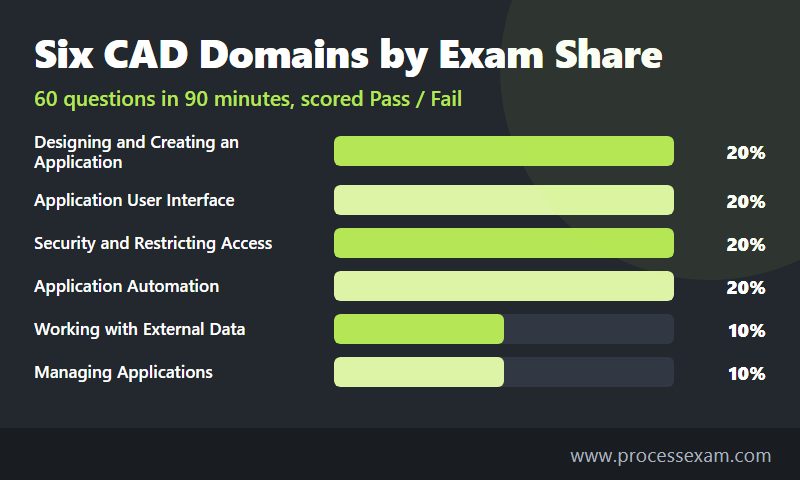
The CAD syllabus is split into six domains. Four of them carry a fifth of the exam each, and the last two share the remaining fifth:
| Domain | Weight | What the syllabus names |
|---|---|---|
| Designing and Creating an Application | 20% | Deciding if an app suits ServiceNow, designing the data model, creating modules, using application scope |
| Application User Interface | 20% | Forms, adding and removing fields, client-side and server-side scripts, Record Producers as a UI |
| Security and Restricting Access | 20% | Restricting apps and modules, Access Controls, GlideSystem security methods, scope protection |
| Application Automation | 20% | Workflow and Flow Designer, application properties, events, scheduled jobs, utility Script Includes, email |
| Working with External Data | 10% | Importing CSV or Excel data, integrating with an external source over REST |
| Managing Applications | 10% | Installing applications, delegated development, the ServiceNow Git integration |
The four-way tie is the useful part. It means there is no single domain you can master and coast on: security is worth exactly as much as the user interface, and automation exactly as much as design. Candidates who come from a scripting background tend to over-invest in the interface and automation domains, where code lives, and under-invest in design and security, where the questions are about judgement. Those two domains together are forty percent of the exam.
The two smaller domains are still worth a steady effort. Import and REST questions are among the most predictable on the paper, and the source control topics in Managing Applications are short to learn if you have used Git anywhere else. Because the full blueprint sits behind a sign-in, confirm the current split on ServiceNow University before you set your weekly hours; if the weights there differ, follow ServiceNow's figures.
How does one small practice app take you through all six domains?
Reading about domains one at a time hides how they connect, and the exam's scenarios connect them constantly. A better method is to build one small application from start to finish and notice which domain each step belongs to. Here is a practice project that fits in a free developer instance: an Equipment Loans app that lets staff borrow laptops, headsets and projectors from the IT team.
Step 1: design the app and its data (Designing and Creating an Application)
Create a new scoped application in App Engine Studio or Studio. Give it two tables: Equipment, holding each item's asset tag, type and condition, and Loan, holding the borrower, the item, the start date, the due date and a state. Make Loan reference Equipment rather than copying its fields. Add an application menu with modules for My Loans, All Loans and Overdue Loans. Before you build, ask the question the syllabus starts with: is this a good fit for ServiceNow at all? A loan process with approvals, notifications and a record of who holds what is a clear yes. A graphics-heavy public website would not be.
Step 2: shape the forms and how people ask (Application User Interface)
Arrange the Loan form so the borrower sees only what they need. Add a client script that warns when the due date is more than thirty days after the start date, and a UI policy that makes the return condition field mandatory once the state is Returned. Then build a Record Producer on the Service Catalog so staff request a loan without ever opening the Loan table. This is the pattern the syllabus names: a Record Producer as an application's user interface.
Step 3: lock it down (Security and Restricting Access)
Create two roles inside your scope: a loan user and a loan manager. Restrict the All Loans module to managers. Write table-level and field-level Access Controls so that borrowers can read only their own loans and cannot edit the due date. Add one scripted condition that uses a GlideSystem method, such as checking the current user's role, and test it by impersonating a borrower. Finally, look at the application's cross-scope settings and decide which other scopes, if any, should be allowed to read your tables.
Step 4: make it run by itself (Application Automation)
Build a flow in Flow Designer that sends a loan request for manager approval and marks the item as out when it is approved. Store the maximum loan length in an application property instead of hard-coding thirty days. Register an event called loan overdue, fire it from a scheduled job that runs each morning, and send the borrower an email notification when it fires. Put the date calculation in a utility Script Include so the scheduled job and the client-side check can share it.
Step 5: bring in outside data (Working with External Data)
Import the existing equipment list from a spreadsheet through an import set and a transform map, choosing the asset tag as the field that matches incoming rows to existing records so a second import updates rather than duplicates. Then call a public test REST endpoint from a REST Message, look at the response in the REST API Explorer, and write the returned value into a field. The skill being tested is not the endpoint; it is knowing how to test and debug the call when it fails.
Step 6: ship and maintain it (Managing Applications)
Link the application to a Git repository through the ServiceNow Git integration, commit your work, make a change on a branch and merge it back. Set up delegated development so a colleague can edit scripts in your app but not its security rules. Finally, publish the app and install it on a second instance, or practise the install steps if you only have one. By the end you will have touched every line of the syllabus at least once, and the scenario questions will describe situations you have already seen.
Which scripting choices does the CAD exam keep testing?
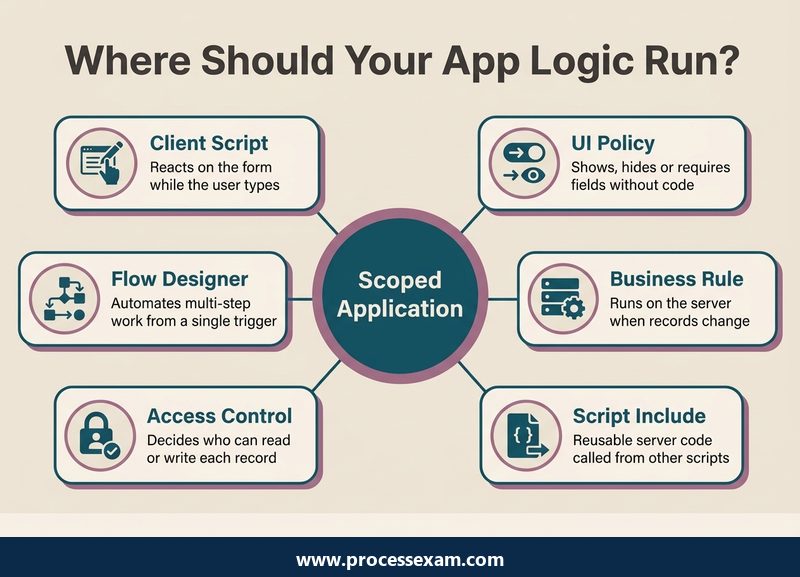
A large share of CAD questions come down to one decision: where should this piece of logic run? The options overlap, and the exam rewards the one that follows ServiceNow's own guidance. This table sums up the choices you will meet most often:
| Tool | Where it runs | Choose it when |
|---|---|---|
| Client script | In the browser, on the form | You need to react while a user is typing or before a form is submitted |
| UI policy | In the browser, on the form | You only need to show, hide, require or lock fields, which needs no code |
| Business rule | On the server | Something must happen whenever a record is inserted, updated, deleted or queried |
| Script Include | On the server | Several scripts need the same logic, or the browser must ask the server for data |
| Access Control | On the server | You are deciding who may read, write, create or delete a record or a field |
| Flow | On the server, in the background | A process has several steps, approvals or waits that a person should be able to read |
Client and server, and the bridge between them
Client scripts work with the form through the g_form object and with the user through g_user. Server scripts work with the database through GlideRecord and with the session through gs, the GlideSystem object. When a form needs data that is not on it, the right pattern is an asynchronous GlideAjax call to a client-callable Script Include, so the browser does not freeze while it waits. Expect at least one question that offers a synchronous call or a GlideRecord query in a client script as a distractor; both work, and both are the wrong answer.
Before and after business rules
A before rule runs ahead of the database write, so it can change the current record without another update. An after rule runs once the record is saved, which makes it the place to update related records. An async rule runs later in the background, which keeps slow work away from the user's save. Questions often describe a rule that calls current.update() inside a before rule; recognise it as a mistake that causes a second write.
Scripted security
When an Access Control needs more than a role check, its script must return true or false. Methods such as gs.hasRole() and gs.getUserID() are what you use to compare the record with the person asking for it. The exam also checks the evaluation order: a table rule and a field rule both have to allow access, and a missing rule is not the same as a permissive one.
What does an eight-week CAD study roadmap look like?
This plan assumes you already use ServiceNow and can give it about an hour on weekdays and a longer block at the weekend. If the platform is new to you, spend two extra weeks on stage one before starting the clock. Each stage ends with something you can check, so you know it is finished.
| Weeks | Stage | Finished when |
|---|---|---|
| 1 to 2 | Foundations: ServiceNow's scripting and application development fundamentals courses, plus a fresh developer instance | You can explain scope, GlideRecord and the difference between client and server code without notes |
| 3 to 4 | Build the practice app: design, forms, Record Producer and security | A borrower you impersonate sees only their own loans and cannot change a due date |
| 5 | Automation: flow, event, scheduled job, application property, email | An overdue loan sends a notification without you touching it |
| 6 | External data and lifecycle: import, REST, Git, delegated development | A second import changes no row count and a branch merges cleanly |
| 7 | Timed practice and error log | Two full timed sets reviewed, every miss tagged with its domain |
| 8 | Targeted repair and booking | Your weakest domain scores as well as the others on fresh questions |
Sign up with the ServiceNow Developer Program to get a Personal Developer Instance at no cost. Build the Equipment Loans app there rather than on a shared company instance: you need admin rights, freedom to break things, and a clean scope with nothing else in it.
How to use practice questions without fooling yourself
Begin with a short set early, in week two, purely to see how the questions are phrased; the free ServiceNow CAD sample questions are enough for that. Save full-length timed sets for week seven, when you have built the app and the questions can tell you something. For each miss, write down the domain and the reason: did you not know the tool, did you know it but put the logic in the wrong place, or did you misread the scenario? The third kind is fixed by slowing down, not by studying more.
When your error log is short and spread evenly across the six domains, sit a final full-length run in exam conditions. The CAD mock exam on ProcessExam follows the same 60-question, 90-minute pattern, which makes it a fair rehearsal for pace as well as knowledge.
Which CAD traps catch even experienced developers?
The candidates who find CAD hardest are often not beginners. They are people with years of JavaScript, or years of administration, who carry habits that the exam is written to catch.
- Building in the global scope. Old instances are full of global customisations, and some developers still start there. The exam expects a scoped application with deliberate cross-scope permissions.
- Querying the database from the browser. GlideRecord in a client script, or a synchronous server call, will appear as an option. Choose the asynchronous GlideAjax route.
- Using a script where configuration would do. If a UI policy can make a field mandatory, a client script that does the same thing is the weaker answer.
- Treating security as a role check only. Roles open modules; Access Controls protect data. A borrower who cannot see a module may still reach the records through a list URL if the table rules are missing.
- Hard-coding values. A loan limit written into three scripts is a maintenance problem; an application property is the answer the exam prefers.
- Relying on update sets as source control. Update sets still move configuration between instances, but the syllabus names the Git integration and delegated development for managing an application's code. Know what each one is for.
- Skipping the import details. Leaving out the field that matches incoming rows to existing ones creates duplicates on the second run, and the exam likes that scenario.
There is one exam-day trap as well. Multiple-select questions tell you how many answers to pick. Read that instruction before the options, not after, and never leave a question blank: an unanswered item cannot score.
Where does the CAD credential take you after you pass?
Passing CAD shows employers something specific: you can build on ServiceNow, not just run it. That matters in three kinds of role. Platform developers inside companies that run ServiceNow build and maintain the custom apps their teams ask for. Consultants at implementation partners build the same things for many customers and are often expected to hold CAD before they are staffed on development work. And administrators who want to move into development use CAD as the step that makes the move official in their own organisation.
The credential also changes what you are trusted with. A developer who understands scope, Access Controls and source control can be handed an application to own, including its reviews and releases, rather than being given single tickets. Over time that ownership leads towards technical lead and platform architect work, where the same judgement about where logic belongs is applied across many applications at once.
Keeping the credential current
ServiceNow releases new platform versions twice a year, and certified professionals are expected to keep up with them. Your ServiceNow University account shows any maintenance exams due on your credentials and their deadlines, so look there after each release instead of relying on email reminders. Keep your developer instance, upgrade it when a new release is offered, and rebuild the parts of the Equipment Loans app that a release changes; it is the quickest way to see what is actually different.
What to take on next
Once CAD is done, many developers pick the next credential by the products they work on: an implementation specialist exam for the module they build around most, or one of the shorter micro-certifications that go deeper into a single tool such as Flow Designer, Integration Hub or Service Portal. Choose by the work in front of you. A credential that matches the applications you are about to build will pay back sooner than one chosen from a list.
Frequently Asked Questions
What does CAD stand for in ServiceNow?
CAD stands for Certified Application Developer. It is ServiceNow's credential for people who build custom applications on the platform: designing tables inside an application scope, writing client and server scripts, securing data with Access Controls, automating work with flows and managing the app's source code.
How much does the ServiceNow CAD exam cost?
The ServiceNow Certified Application Developer exam costs USD $300 per attempt. You register through your ServiceNow University account and schedule the appointment through Pearson VUE. Confirm the fee shown in your account at checkout, because ServiceNow sets the current price there.
How many questions are on the CAD exam, and how long do you get?
The CAD exam has 60 questions and a 90-minute time limit, which averages a minute and a half per question. Questions are multiple choice or multiple select, and many describe a short scenario or script, so practise reading them against the clock before exam day.
What is the passing score for the ServiceNow CAD exam?
ServiceNow reports the CAD result as Pass / Fail and does not publish a numeric passing score. Any percentage quoted online is an estimate. The better readiness check is consistent results on timed practice sets across all six domains, with no single domain lagging behind.
Which CAD exam domains carry the most weight?
Four CAD domains carry 20% each: Designing and Creating an Application, Application User Interface, Security and Restricting Access, and Application Automation. Working with External Data and Managing Applications carry 10% each. Confirm the current split in the blueprint on ServiceNow University before planning study time.
- ServiceNow Application Developer Test Questions |
- CAD Question Bank |
- ServiceNow Application Developer Book |
- Application Developer Certification Cost |
- Application Developer Certification Requirements |
- ServiceNow Application Developer Sample Questions |
- CAD Exam Questions Download |
- CAD Test Questions |
- Application Developer PDF |
- Platform and AI


