
SDP Certification: The SAFe DevOps Exam Is Not About Tools
Updated on 23 September 2026. What’s new: exam access corrected to the first two attempts within 60 days of the course at $50 a retake, written for the current SDP 6.0 release.
The SAFe DevOps Practitioner exam is 45 multiple-choice questions in 90 minutes, and 73% is the pass mark. You reach it through the two-day SAFe DevOps course, and the first two attempts are covered by your course fee if you sit them within 60 days. What surprises most candidates is where the marks sit. The single heaviest lesson is Continuous Exploration, at 25-27% of the paper, and not one of its topics is about a build server.

That is the whole character of the SDP exam in one sentence. It is written for people who can already automate things, and it spends its questions on the decisions that surround the automation: which value stream to fix first, how a hypothesis becomes a Feature, when to decouple a deployment from a release. Engineers who revise pipelines and containers walk out of the exam puzzled. Engineers who revise the flow of value walk out certified.
This guide sets out what Scaled Agile currently publishes for the SDP exam, how each lesson is weighted, what the attempts and retakes cost, and a six-week plan that fits around a full-time job.
Why does a DevOps exam put its heaviest lesson before anyone writes code?
Look at the blueprint and the intent is obvious. Continuous Exploration carries 25-27%, more than any other lesson, and Value Stream Mapping carries 15-17% on top of it. Between them they cover hypotheses, customer research, architecting for continuous delivery, turning ideas into Agile Release Train backlog Features, prioritising a DevOps backlog with WSJF, and measuring the health of a development value stream. None of that happens in a repository.
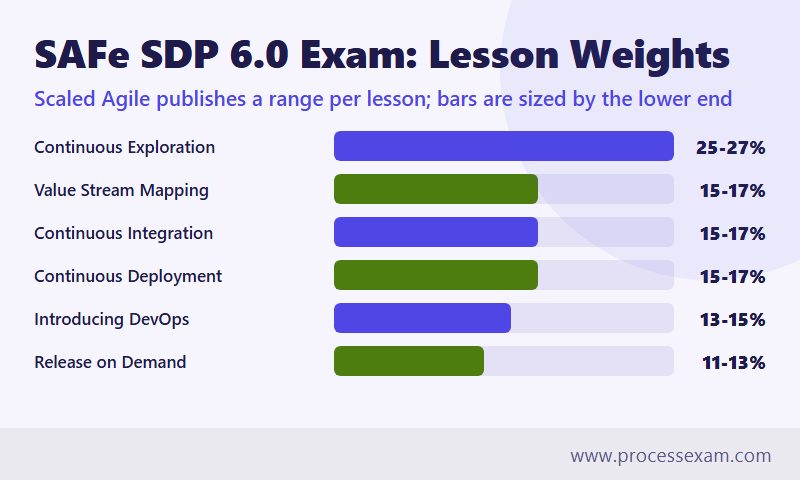
Continuous Deployment, the lesson closest to what many people picture when they hear DevOps, is 15-17%. Release on Demand, the part that actually puts value in front of customers, is the lightest lesson at 11-13%. If you rank your revision by how much of your working week each topic occupies, you will get the order almost exactly backwards.
The reason is the framework's own argument. A delivery pipeline that ships the wrong thing faster has made the organisation worse, not better, so SAFe treats exploration and value stream health as part of DevOps rather than as something the product people do beforehand. Scaled Agile describes the continuous delivery pipeline as four connected aspects, and the exam walks that pipeline end to end, giving the front of it the most room.
CALMR is the lens every scenario question uses
The course opens with CALMR, which Scaled Agile expands as culture, automation, lean flow, measurement and recovery. Treat it as five separate lenses rather than an acronym to recite. A scenario that describes finger-pointing between two teams is a culture question. A scenario about batch sizes and queues is a lean flow question. A scenario about a bad release reaching production and nobody noticing for a day is split between measurement and recovery.
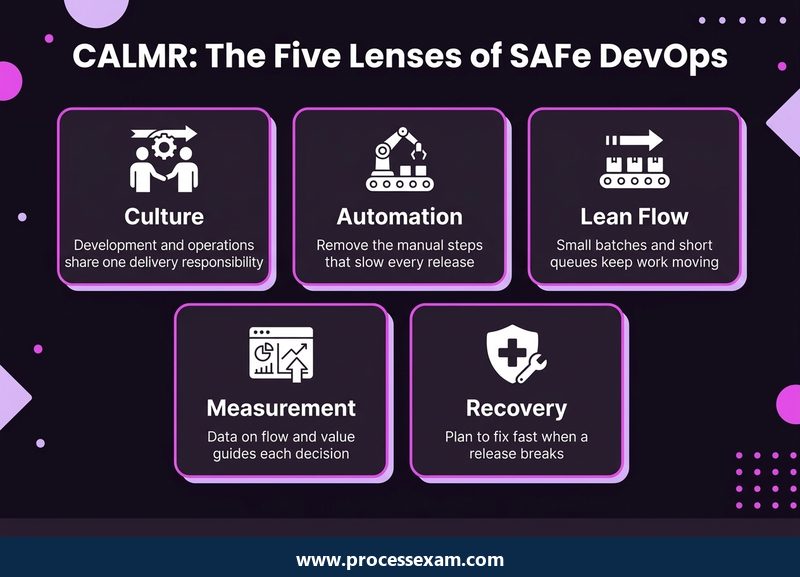
Candidates who can name the five letters but cannot sort a scenario into the right one lose marks steadily across the whole paper, because CALMR is not confined to the first lesson. It reappears wherever the exam asks you to diagnose a problem rather than describe a practice.
Which version of the SAFe DevOps exam will you sit in 2026?
SDP 6.0. Scaled Agile spent 2026 moving course after course onto dated AI-Empowered releases, and the DevOps course has not been part of that programme. When we checked in September 2026, the exam study guide Scaled Agile serves for this credential was still headed SDP (6.0) and was last revised on 25 March 2026. There is no AI-Empowered DevOps study guide beside the ones now published for the Agilist, Practitioner, Practice Consultant, Advanced Scrum Master, Scrum Master, Product Owner/Product Manager and Release Train Engineer exams.
Two practical consequences follow. First, the figures on Scaled Agile's SDP exam study guide are the ones your exam will be built from, and the domain list on our SAFe SDP exam syllabus page matches them lesson for lesson, including the weightings. Second, the AI material circulating around other SAFe courses is not on this paper. There is no AI lesson and no AI domain in SDP 6.0, so time spent revising how SAFe applies large language models to portfolio work is time you have taken away from WSJF and value stream mapping.
One caution about third-party course listings. Some training providers advertise an "AI-Empowered SAFe 6.0 DevOps" class. That wording describes the instructor's material, not a renamed exam. Before you book anything, open Scaled Agile's own SAFe DevOps certification page and confirm the course title there, because the exam you are given access to is the one attached to the course your provider is licensed to teach.
The figures Scaled Agile publishes today
These are the details Scaled Agile gives for the exam itself, separate from whatever a training partner charges for the class.
| Exam detail | SDP |
|---|---|
| Exam name | SAFe DevOps Practitioner |
| Exam code | SDP |
| Certification | Certified SAFe DevOps Practitioner (SDP) |
| Version | SDP 6.0 (study guide revised 25 March 2026, checked September 2026) |
| Number of questions | 45 |
| Duration | 90 minutes |
| Passing score | 73% |
| Question format | Multiple choice with one correct answer |
| Delivery | Online, closed book, with no outside help allowed |
| Access | Through the learning plan, after the course is completed |
| Attempts included | First two, within 60 days of finishing the course |
| Retake fee | $50 |
| Course | SAFe DevOps, two days, instructor-led, remote or in person |
Two of those lines are worth reading twice. The timer runs to the end whether or not you have answered everything, and any question left blank is counted wrong, so a deliberate guess on a question you cannot crack is always better than a blank. And the exam is closed book: the workbook you keep from the course is a study aid, not something you can open during the 90 minutes.
What does the SDP exam ask you, lesson by lesson?
The blueprint has six lessons, each weighted as a range rather than a fixed figure. Work through them in order the first time, because each one assumes the previous one.
Introducing DevOps, 13-15%
Explains the problem DevOps exists to solve, defines DevOps and its benefits, covers continuous security and testing, and summarises the SAFe CALMR approach. Light on figures, heavy on judgement. Expect to be asked which of four described behaviours is the DevOps answer to a delivery bottleneck, and to recognise continuous security as something built into the pipeline rather than bolted on at the end.
Value Stream Mapping, 15-17%
Two objectives only: explain why you map a value stream, and analyse the health of your development value stream. The questions turn on vocabulary you must be able to use precisely. Process time is the time work is actively being done; lead time is the whole elapsed time including waiting; activity ratio is the relationship between them; percent complete and accurate tells you how often work has to be sent back. If you can look at a described map and say which of those numbers would improve most from a given change, this lesson is straightforward marks.
Continuous Exploration, 25-27%
The biggest lesson, and the one to over-prepare. It covers creating solution hypotheses, collaborating with and researching customers, architecting the solution for continuous delivery, synthesising ideas into Agile Release Train backlog Features, and using Weighted Shortest Job First to prioritise a DevOps backlog.
WSJF is the one topic here with real mechanics behind it, and it earns its own evening. You need to know that cost of delay is built from user and business value, time criticality and risk reduction or opportunity enablement, that job size divides it, and above all what the ranking does to the order of work. A worked example helps: two items with the same cost of delay but different sizes, and you should be able to say instantly which one the train takes first and why that is not the same as saying it matters more.
Continuous Integration, 15-17%
Developing the solution, building continuously, testing end to end and staging the solution for deployment. This is the lesson where hands-on experience genuinely pays, but stay alert to the framing. The exam asks about the effect of a practice on flow, not about the syntax of a pipeline definition. Trunk-based development, small batches, a fast build that everyone trusts, test automation that runs against a production-like stage: know why each one shortens feedback, not merely that it is recommended.
Continuous Deployment, 15-17%
Deploying to production, verifying the solution, monitoring its health, and responding and recovering. The central idea, and the one the exam returns to, is that deployment and release are separate events. Dark launches, feature toggles and canary releases all exist so that code can sit in production without being switched on. If a question describes a team that cannot ship until a marketing date, the answer is almost always to decouple the two.
Release on Demand, 11-13%
Releasing value to customers, stabilising the solution, measuring business value, and learning from feedback to improve. The lightest lesson, but do not leave it out on the grounds that it is worth the least. The questions here are the easiest to get right once you accept the framework's position that a release is a business decision and the pipeline's job is to make that decision cheap to take at any moment.
What does it cost to become a Certified SAFe DevOps Practitioner?
The exam is not sold on its own. Access arrives through the learning plan once you have completed the SAFe DevOps course, and the first two attempts are already paid for inside your course registration fee provided you take them within 60 days of finishing the class. After that, each attempt costs $50.
The retake ladder matters if things go badly. Your third attempt overall, counted as the first retake, can be taken straight away once a second one has failed. Ten days must then pass before a fourth, thirty more before a fifth, and thirty between every attempt after that. So two careless failures do not cost you much beyond $50 and your pride, but a run of them turns into months. That is an argument for not booking the exam the morning after the course finishes simply because the window feels generous.
Course prices themselves are set by the training partner, not by Scaled Agile, and vary by country and delivery method, so compare the quotes in your own region rather than trusting a figure copied from a blog. What every course includes is worth checking against Scaled Agile's own list: perpetual access to the workbook and learning platform, an unlimited-attempt practice test with question-level feedback, and customer support for certification questions.
How should a working engineer split six weeks of SDP study?
Six weeks at three or four hours a week is enough for someone who has finished the course and works in or near a delivery pipeline. The plan below deliberately front-loads the two lessons that carry the most weight, and leaves the last fortnight for timed practice rather than new material.
| Week | Focus | What you should be able to do by Friday |
|---|---|---|
| 1 | CALMR and Introducing DevOps | Sort any described problem into culture, automation, lean flow, measurement or recovery |
| 2 | Value Stream Mapping | Read a map and name which measure a proposed change would move |
| 3 | Continuous Exploration, part one | Turn a customer problem into a hypothesis and then into an ART backlog Feature |
| 4 | Continuous Exploration, part two, and WSJF | Rank a small backlog with WSJF and defend the order out loud |
| 5 | Continuous Integration and Continuous Deployment | Explain why each practice shortens feedback, and separate deploy from release |
| 6 | Release on Demand, then timed practice | Finish 45 questions inside 90 minutes with time left to revisit flagged ones |
Week six is where most of the gain is, because pacing is a skill of its own. Two minutes per question sounds comfortable until a three-line scenario arrives with four plausible options. Sit at least two full-length timed sets before the real thing, and treat every question you flagged as a study item rather than a statistic. Our SDP practice test runs to the same 45-question, 90-minute shape, so the clock feels familiar on the day rather than novel.
One habit is worth building from week one. Keep a single page of errors, written as "I chose X, the answer was Y, because Z". Reviewing that page on the last evening is worth more than re-reading the workbook, because it targets your own misunderstandings instead of the whole syllabus.
Which habits from a tools-first DevOps background work against you?
The candidates who struggle are rarely the ones who know least about DevOps. They are usually the ones whose experience is deep in one part of the pipeline and who answer from that experience rather than from the framework.
- Answering with your own toolchain. The exam never names a product. A question about staging is about what staging achieves, and the option that mentions a specific technique you happen to use is not automatically right.
- Underestimating Continuous Exploration. It is the largest lesson and the one furthest from a typical engineer's day. Give it two weeks, not one evening.
- Skipping WSJF mechanics. Knowing that cost of delay is divided by job size is not enough; you need to predict what changes when one input moves.
- Treating deploy and release as one word. Several questions exist purely to see whether you separate them.
- Revising for the wrong version. Material written around AI-Empowered SAFe courses covers topics this paper does not contain.
- Leaving questions blank. Unanswered questions are scored as incorrect, and the exam submits itself when the timer ends.
- Booking straight out of the classroom. The 60-day window exists so you can prepare. Using one day of it wastes the other 59.
How do you keep the SDP certification active after you pass?
The certification is renewed yearly. Keeping it active is what keeps the benefits attached to it, and those benefits are a real part of the value rather than a footnote: full access to the framework, the SAFe Skills library, SAFe Studio and its value stream mapping and other workshops, recorded Summit sessions, the community forums, and toolkits for preparing and running PI Planning.
Passing also earns a digital badge you can attach to a professional profile, a course certificate of completion, and PMI PDUs plus Scrum Alliance SEUs earned from the class itself. Those hours count towards any project management or Scrum credential you already hold that asks for continuing education. Renewal terms and any associated fee are set by Scaled Agile and are visible in your own SAFe Studio account, so check them there rather than relying on a figure from elsewhere.
A practical note for anyone whose employer is paying. Ask before the course whether the renewal will be covered too. It is a small annual item that is easy to agree in advance and awkward to raise a year later.
Does the SDP change what an employer will hire you to do?
It changes the conversation more than the job title. SDP is aimed at everyone along the value stream rather than at one role, and Scaled Agile lists software engineers, development managers, release managers, QA leads, infrastructure architects, Scrum Masters and Product Owners among the people it is built for. That breadth is the point: the credential says you can hold a discussion about flow with people whose jobs are not yours.
In practice it tends to help in three situations. When an organisation is starting or repairing a delivery pipeline and wants someone who can run a value stream mapping workshop rather than only configure the tooling. When a release manager or QA lead wants to move into a role that shapes how work arrives rather than how it ships. And when an existing SAFe programme needs someone inside the train who can connect the engineering practice to the framework the rest of the organisation already speaks.
It is a weaker fit if you want a deep technical certification on a specific platform, or if your organisation does not run SAFe at all and has no plans to. The vocabulary of Agile Release Trains, Features and PI Planning is assumed throughout, and outside that context a good deal of the exam's value does not transfer. If you are in that position, the honest answer is to pick a platform or practice certification instead and come back to SDP when a train is actually running.
For everyone else, the exam is a fair one. It is short, it is clearly published, the weightings tell you where to spend your evenings, and two attempts are already paid for. Spend them on the front of the pipeline.
Frequently Asked Questions
How many questions are on the SAFe SDP exam and what is the passing score?
The SAFe DevOps Practitioner exam has 45 multiple-choice, single-select questions with a 90-minute limit, and the passing score is 73%. It is delivered web-based and closed book, the timer submits the paper automatically, and any unanswered question is marked incorrect.
What does the SDP certification cost?
Scaled Agile includes your first two exam attempts in the SAFe DevOps course registration fee when you take them within 60 days of finishing the course. Each attempt after that costs $50. The course price itself is set by the training partner and varies by region.
Is the SAFe DevOps exam still version 6.0 in 2026?
Yes. Checked in September 2026, Scaled Agile's study guide for this credential is still SDP (6.0), last revised on 25 March 2026. Several other SAFe exams moved to dated AI-Empowered releases during 2026, but SAFe DevOps was not part of that wave.
Which SDP exam domain carries the most weight?
Continuous Exploration, at 25-27% of the paper. Value Stream Mapping, Continuous Integration and Continuous Deployment each carry 15-17%, Introducing DevOps 13-15%, and Release on Demand 11-13%. The front of the delivery pipeline is worth far more than the deployment end.
Can I take the SDP exam without attending the course?
No. Access to the exam is granted through the learning plan only after you complete the SAFe DevOps course, which runs for two days and is delivered by a certified instructor either remotely or in person. There is no standalone registration route for this exam.
- SAFe DevOps Practitioner Exam Questions |
- SAFe DevOps Practitioner Question Bank |
- SAFe DevOps Practitioner Questions |
- SAFe DevOps Practitioner Study Guide |
- SAFe SDP Quiz |
- SDP Certification |
- SDP Questions |
- SDP Practice Test |
- SDP Study Guide Material |
- SDP Sample Exam |
- DevOps Practitioner Certification |
- SAFe DevOps Practitioner |
- SAFe DevOps Practitioner Book |
- DevOps Practitioner Certification Cost |
- DevOps Practitioner Certification Requirements |
- SAFe DevOps Practitioner Sample Questions |
- SDP Exam Questions Download |
- SDP Test Questions |
- DevOps Practitioner PDF


