
SAFe Product Owner Certification: POPM vs PSPO I vs CPOA
Choose by the operating model you work inside, not by the brand you recognise. Scaled Agile's POPM fits product owners and product managers in a SAFe organisation, Scrum.org's PSPO I fits people on Scrum teams, and IIBA's CPOA fits analysts who steer product decisions. The three exams differ in length, pass mark, price, course requirement and renewal, and this guide lines them up so you can see which one your role and your employer actually reward.
What does each of the three certifications actually test?
All three carry the words product owner in their story, yet they examine different bodies of knowledge. The quickest way to avoid buying the wrong one is to read what each vendor says the exam covers, because the overlap is smaller than the shared job title suggests.
SAFe POPM: product roles inside a planning train
The current release is the AI-Empowered SAFe Product Owner/Product Manager, and Scaled Agile's certification page describes it as a foundational-level credential for people who are new to SAFe. Checked October 2026. Its exam guidelines list six domains: roles and responsibilities, PI Planning preparation, leadership for PI Planning, iteration execution, PI execution, and applying AI to product roles. The heaviest is iteration execution at 28 to 30 percent, which covers creating stories, planning an iteration, managing flow on the team Kanban, refining the team backlog and supporting DevOps and release on demand.
What makes POPM distinctive is that it examines a job split in two. The Product Manager looks after the ART backlog and roadmap, while the Product Owner looks after the team backlog, and the questions expect you to know which of them acts, which one is consulted, and what the Planning Interval cadence demands of each. A person who has never worked on an Agile Release Train will meet vocabulary here that no other exam in this comparison uses: solution vision, roadmaps, PI Objectives, the PO Sync and the System Demo.
Scrum.org PSPO I: the Product Owner accountabilities in the Scrum Guide
Scrum.org's PSPO I page says many questions focus on Product Owner accountabilities based on the Scrum Guide, together with how you apply Scrum from your own experience. The assessment draws on three focus areas from the Professional Scrum Competencies: understanding and applying the Scrum framework (empiricism, the Scrum Team, events, artifacts and Done), developing people and teams through self-management, and managing products with agility, which spans forecasting and release planning, product vision, product value, backlog management, business strategy, and stakeholders and customers.
The format is multiple choice, multiple answer and true or false, and that mix matters. A multiple-answer question can punish a half-right instinct, so the assessment rewards candidates who know exactly where the Scrum Guide draws a line, for example who decides what, rather than those who hold a general feel for agile.
IIBA CPOA: product ownership through a business analysis lens
IIBA's CPOA page states that the exam asks 60 multiple-choice, knowledge-based questions drawn from the Guide to Product Ownership Analysis. The blueprint has seven knowledge areas. Foundational concepts take 10 percent, and the other 90 percent is split evenly, 15 percent apiece, across customer intimacy, the whole team, making an impact, delivering often, learning fast and obsessing about value. No framework is named in the blueprint at all. The subject is the analysis behind product decisions: understanding customers, aligning strategy, and learning from what you ship.
That makes CPOA the most framework-neutral of the three. It travels well between a SAFe programme, a Scrum team and a Kanban shop, because it examines thinking techniques instead of event names. The trade-off is that a recruiter who screens for a specific framework will recognise POPM or PSPO I faster than a certificate whose name starts with an analysis body.
How do the exam facts compare side by side?
The table sets the three exams against each other on the points candidates ask about first. Questions, time, pass mark and price are the published figures for each exam, and the course and renewal rows follow each vendor's own pages, linked in the sections after the table.
| Detail | SAFe POPM | Scrum.org PSPO I | IIBA CPOA |
|---|---|---|---|
| Certification | Certified SAFe Product Owner/Product Manager (POPM) | Scrum.org Certified Professional Scrum Product Owner I (PSPO I) | IIBA Certificate in Product Ownership Analysis (CPOA) |
| Number of questions | 45 | 80 | 60 |
| Duration | 90 minutes | 60 minutes | 90 minutes |
| Passing score | 82% | 85% | Pass or Fail |
| Exam fee | Included with the course when taken in time; $50 per retake | $200 per attempt | Member - $250, Non-Member - $405 |
| Retake fee | $50 | $200 per attempt | Member - $195, Non-Member - $350 |
| Course | Not required, per Scaled Agile; attempts bundled with the course | Strongly recommended, not a prerequisite | None; no work experience requirement |
| Keeping it current | At least 12 CEUs each year | Lifetime, no annual renewal fee | No recertification, no expiration |
What the pace per question tells you
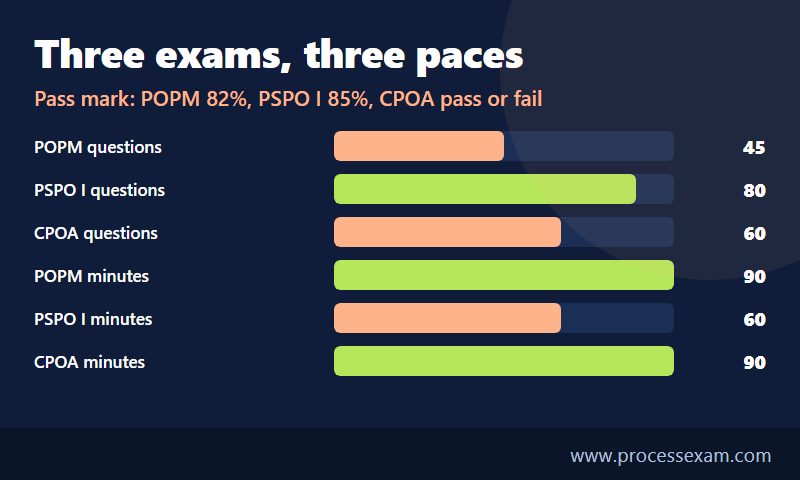
Divide the clock by the questions and three different exams appear. POPM allows two minutes for each of its 45 questions, which suits scenario questions you have to read, picture on a team, and judge. CPOA allows 90 seconds for each of 60, a middle pace for knowledge questions that need a moment of recall. PSPO I allows 45 seconds for each of 80, so hesitation is the enemy: you either know where the Scrum Guide stands or you spend time you do not have.
What the pass mark means in answers
At 82 percent, POPM needs 37 of its 45 answers right, leaving room for eight misses. At 85 percent, PSPO I needs 68 of 80, leaving twelve. Both counts are simple arithmetic on the published percentages, rounded up to whole questions. CPOA publishes no percentage, only a pass or fail on the screen, so you cannot plan a margin and should treat every question as if it counts.
A smaller margin of error is not automatically a harder exam. POPM's eight misses sit on only 45 questions, so a few careless reads cost more than they would on PSPO I, where twelve misses are spread across a longer paper. Candidates who find one of these easy and another hard are usually reacting to the pace and the style, not to the difficulty of the ideas.
Do you need a course, and what does that do to the real cost?
The sticker prices mislead, because they cover different things. Only one of the three exams is priced mainly as a component of a course, and that changes how you should compare them.
POPM: the course fee carries the exam
Scaled Agile's exam details page says two attempts come bundled with your course registration fee, provided you sit them inside 60 days of completing the course, and that extra attempts cost $50 each. Access runs through the learning plan you receive after the course. The certification page itself marks the training course as not required for the proctored exam, so a route without the course exists, though the page quotes no separate fee for it. Check the current price with Scaled Agile before you assume anything. For most candidates the working budget is the course price, and the exam is a bundled extra.
Retakes after the second attempt follow a waiting ladder: the first retake is available immediately, the next after 10 days, and later ones after 30 days each. The ladder is generous in cost and strict in time, so a candidate who fails twice has no reason to rush the third try.
PSPO I: a flat fee, a password and no expiry on the attempt
Scrum.org charges $200 USD per attempt as a one-time payment, with taxes added at checkout where they apply. A test password has no expiration date but works for one attempt only. Attending a class is strongly recommended and not a prerequisite, and Scrum.org says each of its training classes includes a free attempt at the matching certification. So the exam alone is the cheapest of the three to attempt, and the cost of a miss is a clean $200 each time.
CPOA: a member price, a non-member price and a six-month window
IIBA lists the exam at $250 for members and $405 for non-members, with rewrites at $195 and $350, and says exam and learning bundles are also on sale. Its candidate handbook, dated May 2026, adds three rules that affect planning: payment starts a six-month clock for scheduling and sitting the exam, a refund request has a 30-day limit counted from payment, and rewrite fees sit outside the first purchase. The exam is offered online with remote proctoring only. There is no work experience requirement, though IIBA recommends the certificate for business analysis professionals with about two years of experience.
The cost of passing after one failure
Put the figures together for a candidate who fails once and then passes. With PSPO I that is $200 plus $200, so $400. With CPOA it is $250 plus $195 for a member, so $445, or $405 plus $350 for a non-member, so $755. With POPM taken inside the 60-day window it is nothing extra, because two attempts come with the course fee, and a third attempt would add $50. The sums use only vendor-published figures, and they show why POPM looks expensive on the course invoice and cheap on the exam, while CPOA is the opposite for a non-member.
Which one fits your organisation and your role?
Start from facts about your workplace that you can check this week, not from your ambitions. Four questions settle most cases.
- Which framework is written on your team's wall: SAFe, Scrum, or neither?
- Who is paying, and is a course already in the budget?
- Do you need the credential to last without upkeep?
- Does your job lean toward deciding what to build or toward specifying and validating it?
Your company runs SAFe
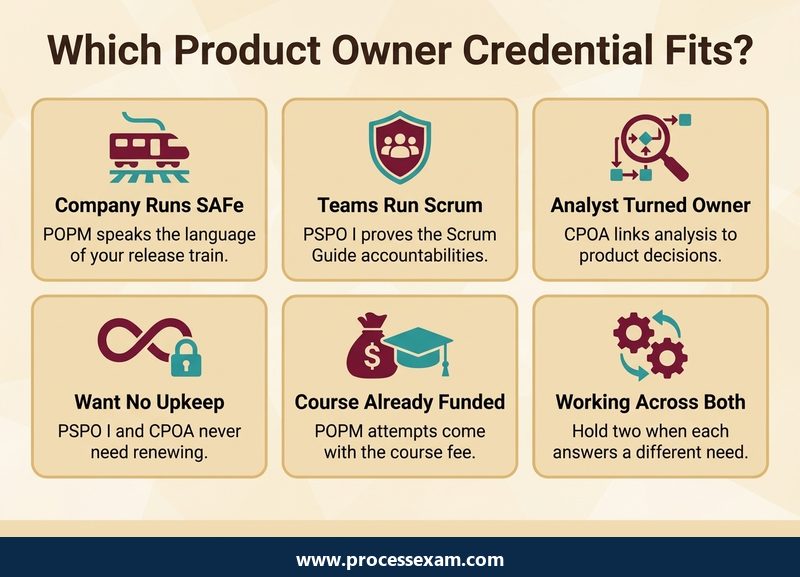
Take POPM. Scaled Agile describes the audience as product owners, product managers, business owners and portfolio managers, so the exam suits anyone who has to read or feed a backlog that crosses teams. It is also the only one of the three that tests Planning Interval events, so if your calendar contains PI Planning, a certificate built around it speaks to your colleagues directly.
Your teams run Scrum
Take PSPO I. It examines the accountabilities in the Scrum Guide, so a Product Owner in a Scrum team can show a standard colleagues already use. The lifetime validity matters here too: a contractor who moves between clients does not carry an annual upkeep task with the certificate.
You are an analyst becoming a product owner
Take CPOA. Its seven knowledge areas are written for people who learned their craft through business analysis and now carry a product, and its framework-neutral wording follows you across employers. It also suits a hybrid role, such as an analyst who supports a product owner on a SAFe train, where the owner's certificate would be POPM but your own work leans toward customer discovery and value.
You are on none of those
Read five job adverts in your region and in your sector, and write down which of the three names appears. A certification that shows up in the advert is worth more than one that is merely respected. If none appears, take the one whose body of knowledge you will use in your next meeting.
Which of them expire, and what does keeping each one cost?
Renewal is where the three credentials part company. Scaled Agile's certification page says you must earn a minimum of 12 Continuing Education Units each year to maintain POPM, and it lists PMI PDUs and Scrum CEUs among the benefits of being certified. The exact terms and any renewal fee are on Scaled Agile's pages, and no fee figure appears there, so none is quoted here. What matters for planning is that POPM is a yearly habit: log learning as you go instead of finding twelve units' worth of evidence in the last month.
Scrum.org states plainly that PSPO I is a lifetime certification with no annual renewal fee. IIBA's recertification table lists CPOA with recertification required marked No and a term of no expiration. The same table shows the larger IIBA designations CCBA and CBAP asking for 60 Continuing Development Units every three years, so CPOA is lighter than they are.
A lifetime certificate is convenient, and it also freezes in time. PSPO I records that you passed the assessment, not that you kept up with later changes, and a CPOA holder from several years ago was examined against the guide of that time. POPM's annual cycle is more work, though it is also the only one of the three that nudges you to keep learning. Employers who care about currency will ask about your recent work whichever one you hold, so treat a lifetime credential as a starting point and keep a short record of what you have applied since.
When does it make sense to hold two of them?
A second certification earns its place when it answers a different question from the first. It is wasted when it repeats the same answer with a different logo. Three pairings are common, and each has a clear reason behind it.
POPM and PSPO I
This pair suits anyone who works across both worlds: a consultant who joins SAFe programmes and Scrum teams, or a product owner in a SAFe organisation whose teams run Scrum events at the team level. POPM shows you can work with the train and its planning rhythm, while PSPO I shows you can defend the Product Owner accountability as the Scrum Guide writes it. The pairing is cheap on the PSPO I side, at $200 per attempt, once POPM is in place through a course.
POPM and CPOA
This pair is for people whose job is half analysis and half product management inside SAFe, such as a Product Manager who also writes the business case. POPM places you on the train, and CPOA proves you can do the discovery and alignment work behind the backlog without leaning on any framework's vocabulary. Because CPOA never expires, it also survives a change of operating model.
PSPO I and CPOA
This pair fits an analyst in a Scrum organisation. PSPO I covers the accountabilities your team expects from the role, and CPOA gives you the techniques for customer discovery and value that the Scrum Guide deliberately leaves open. Two lifetime credentials also mean no yearly upkeep.
When a second one is not worth it
Skip it when both exams would be taken for the same audience and neither answers a gap in your daily work. A hiring manager reads the certificate that matches the framework on the vacancy; the second one rarely tips a decision unless it covers something the first does not. A better second investment is often a year of applying the first, with a documented result you can describe in an interview. If you do hold two, take the one your employer funds first, then the one with no renewal, and avoid sitting both inside the same month, because the study habits differ more than people expect.
How should you prepare when the exams ask different kinds of question?
Each exam rewards a different habit, so prepare for the one you have chosen rather than for product ownership in general. For POPM, practise reading a short scenario and naming who acts: the Product Owner, the Product Manager, or the team. Anchor your revision on the domain list and its weights, especially iteration execution. For PSPO I, read the Scrum Guide until you can say where each accountability begins and ends, then work through Scrum.org's free open assessments for the pace. For CPOA, build a one-line summary for each of the seven knowledge areas from IIBA's guide, because the questions test technique recall and application.
If you are sitting POPM, a timed attempt on the POPM practice exam shows how two minutes per question feels, and the POPM syllabus lets you check your weakest domain against the weights before you book.
If you plan to hold two, order them by overlap. Sit the exam whose course or guide you are already working through, then take the second while its vocabulary is fresh. Keep a short list of terms that mean different things in each system, such as how each describes the person who orders the backlog, because mixing the two vocabularies is the most common slip when someone studies for two exams at once.
Whichever exam you choose, confirm the current fee, course terms and exam details on the vendor's own page on the day you book. Scaled Agile, Scrum.org and IIBA all say their terms can change, and the AI-Empowered release of POPM shows how quickly a syllabus can move.
Frequently Asked Questions
What is the difference between SAFe POPM and PSPO I?
POPM tests product roles inside SAFe, including the Product Manager's ART backlog and PI Planning, in 45 questions and 90 minutes. PSPO I tests the Product Owner accountabilities in the Scrum Guide, in 80 questions and 60 minutes. Choose POPM for a SAFe employer and PSPO I for Scrum teams.
How much do the POPM, PSPO I and CPOA exams cost?
PSPO I costs $200 per attempt. CPOA costs $250 for IIBA members and $405 for non-members, with retakes at $195 and $350. POPM attempts are included in the course registration fee when taken within 60 days, and each retake after the second attempt costs $50.
Do POPM, PSPO I and CPOA expire?
POPM needs at least 12 Continuing Education Units each year to stay active. PSPO I is a lifetime certification with no annual renewal fee. CPOA is listed by IIBA as requiring no recertification and having no expiration, unlike the larger CCBA and CBAP designations.
Do you need a course before taking the POPM exam?
Scaled Agile's certification page marks the training course as not required for the proctored exam. The first two attempts are bundled with the course fee when taken within 60 days of finishing it, and access comes through the learning plan, so most candidates take the course first.
What are the pass marks for POPM, PSPO I and CPOA?
POPM requires 82 percent, which is 37 correct answers out of 45. PSPO I requires 85 percent, which is 68 correct out of 80. IIBA reports CPOA only as pass or fail and publishes no percentage, so you cannot plan a margin for it.
- SAFe Product Owner/Product Manager Test Questions |
- POPM Question Bank |
- Scaled Agile |
- SAFe Product Owner/Product Manager Book |
- Product Owner/Product Manager Certification Cost |
- Product Owner/Product Manager Certification Requirements |
- SAFe Product Owner/Product Manager Sample Questions |
- POPM Exam Questions Download |
- POPM Test Questions |
- Product Owner/Product Manager PDF


