
SAFe Practitioner SP Exam: What the Certificate Changes for You on the Team
Updated on 12 October 2026. What’s new: rewritten for the AI-Empowered SAFe for Teams exam Scaled Agile sells now, with 76% to pass and two attempts within 60 days of the course.
A SAFe Practitioner certificate tells a hiring manager that you can already work inside an Agile Release Train, the place where many developers, testers and analysts at SAFe companies spend their week. You earn it by passing a proctored exam of 45 questions in 90 minutes, with 76% needed to pass. In October 2026, Scaled Agile sells it as the AI-Empowered SAFe for Teams certification.

Those few facts hide a lot of detail, and most of it matters to someone who is not a manager, not a coach and not planning to become either. This guide is written for the ordinary team member: the person who sits in iteration planning, picks up stories, joins the demo and is asked, on the first morning of Planning Interval work, how confident the team feels. It sets out what the credential changes at work, which edition you will face, how the seven exam domains are weighted, what the attempts cost, and how to spend the weeks between the course and the exam date.
What does a team member actually gain from holding the SAFe Practitioner certificate?
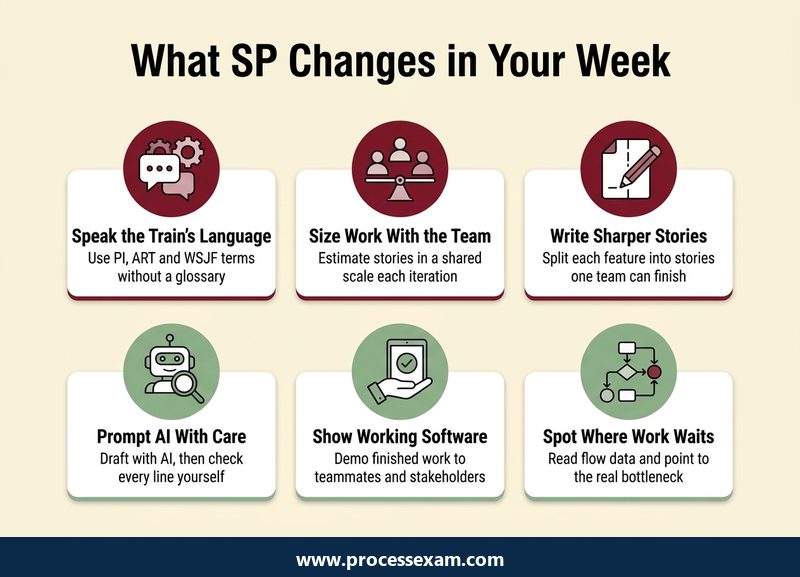
Picture a tester who joins a company that runs SAFe. In the first week she hears about the ART, a Planning Interval, WSJF, a system demo and an Inspect and Adapt workshop, and nobody stops to explain any of them. She nods, learns by osmosis and, for a few months, works a little slower than she could. The certificate exists to remove those months. Scaled Agile describes the course as the one for people who work on an Agile Team at an organisation practising SAFe, and says it gives you a shared language and a clear view of how your role contributes to the train.
The practical gain is therefore less about a line on a CV and more about reducing friction. Once you know why the team backlog is split into stories while the train's backlog holds features, you stop treating planning as someone else's meeting. Once you know what the system demo is for, you stop treating a half-finished integration as a problem for the next iteration. Employers notice that kind of person, because a team whose members all speak the same planning language needs fewer clarifying meetings.
Who is the course aimed at?
Scaled Agile's own certification page names four groups: agile team members, team managers, software developers and project managers. For managers the pitch is flow metrics and removing silos. For developers it is collaboration and taking part in SAFe events. For project managers it is a move from traditional oversight to Lean-Agile facilitation. For everyone it now adds practical AI skills, such as prompting, which the exam tests directly.
What do you get besides the exam result?
Scaled Agile lists several things that come with the certification: access to the SAFe community forums and job boards, role-based networking circles, the SAFe Skills Library, toolkits for preparing and running PI Planning, the SAFe CoPilot AI assistant, a digital badge you can share, and credit towards PMI PDUs and Scrum CEUs. None of that guarantees a promotion or a pay rise, and no salary figure belongs in a guide like this one. What it does give you is a recognised proof of knowledge that a recruiter can verify and a community to ask questions in once you are inside a SAFe organisation.
The course itself is optional for the exam, since the vendor's page states that the training course is not required, but it is the route most people take and the one this guide assumes. Scaled Agile describes the certification as foundational level and suited to people who are new to SAFe, so you do not need earlier credentials or years of agile experience before you start.
Which edition of the Practitioner exam will you sit in October 2026?
The edition that matters is the one Scaled Agile sells today, and on the vendor's SAFe Practitioner certification page, checked in October 2026, that is the AI-Empowered SAFe for Teams course and exam. The page says the course teaches you to execute iterations, collaborate across teams, and use AI to optimise personal and team productivity. The exam guidelines on the same page list AI-related topics inside the domains, including crafting AI prompts and responsible AI. Study material written before this release will teach you the framework well enough, but it will not prepare you for those items.
This matters because older guides, forum posts and some practice material still describe earlier SAFe releases. Scaled Agile's retake page also states that candidates cannot retake or buy retakes for SAFe 4 or SAFe 5 exams, and that anyone who wants those certifications has to take a new course. If a resource you find talks about a version number and never mentions AI, treat it as background reading and check every fact against the vendor's current exam guidelines before you rely on it.
The course is offered in English, French, German, Japanese, Korean, Simplified Chinese, Spanish and Brazilian Portuguese, according to the vendor page. Look at that page again a week before you book, because Scaled Agile has changed its exam policy more than once this year.
How hard is it to reach 76% in 90 minutes?
Forty-five questions in 90 minutes gives you two minutes a question, which is generous for multiple choice. The tighter number is 76%. On 45 questions that works out to about 35 correct answers, so you can miss ten and still pass, but you cannot afford to guess your way through an entire domain. The exam is a timed, multiple-choice paper that finishes with a coaching report, and the vendor also supplies an unlimited practice test with question-level feedback as part of the certification process.
| Item | Detail |
|---|---|
| Exam code | SP |
| Certification | Certified SAFe Practitioner (SP) |
| Course | SAFe for Teams |
| Edition checked in October 2026 | AI-Empowered SAFe for Teams |
| Questions | 45 |
| Duration | 90 minutes |
| Passing score | 76% |
| Attempts | Two sittings covered by the course if used inside 60 days of finishing it; each retake $50 |
| Level | Foundational |
| Renewal | 12 continuing education units each year |
What is a proctored exam like?
The exam is proctored, which means a live person watches you through your webcam. Scaled Agile's guidance asks you to download the Guardian Browser, test your equipment, and book an appointment with a proctor; buying the exam does not give you same-day access, so book ahead. On the day you need a valid photo ID, a working webcam and microphone, a stable connection, a private room and a hard surface to work on. You will be asked to show the room and your ID, and no outside resources are allowed. Only one monitor may be connected, and virtual machines are not permitted.
Cancel or reschedule at least 24 hours ahead. Scaled Agile states that a session cancelled inside 24 hours is billed whatever the reason. If you need extra time, a screen magnifier or other accommodations, the vendor says to email its support team before you schedule, because a proctor may end a session if the accommodation was not agreed in advance. The vendor's exam preparation FAQ lists every requirement.
What do the seven SP domains ask, and how much is each worth?
Scaled Agile publishes the exam guidelines as seven domains with a percentage range for each. Because the ranges overlap and are not exact shares, treat them as a map of where to spend your time, not a precise points budget. The three biggest, Connecting to the Customer, Delivering Value and Forming Agile Teams as an Agile Release Train, together take roughly half of the paper.
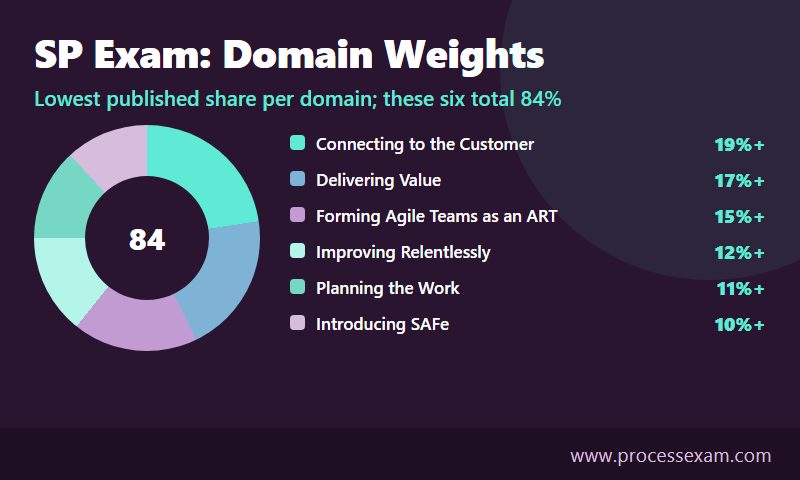
Introducing SAFe (10-12%)
The opening domain covers the SAFe disciplines, the foundations and what the AI-Empowered release adds. It is quick to revise: know why SAFe exists, what its core ideas are, and how AI fits into the way a team works. Expect straightforward questions that reward reading the framework's own wording.
Forming Agile Teams as an Agile Release Train (15-17%)
This domain covers what makes an Agile team, how an Agile team operates, how Scrum and Kanban fit into SAFe, and what it means to operate inside an ART. It is where your personal experience helps most, and also where it misleads most. A team that has run Scrum for years has habits that are fine for one team and wrong for a train of many.
Connecting to the Customer (19-21%)
The heaviest domain. It covers the customer-centric mindset, product vision and roadmap, the components of stories and features, creating team backlogs, and crafting AI prompts. Work through how a vision turns into a roadmap, how a feature breaks into stories a team can finish, and what a well-formed story looks like. The prompt-crafting topic is new to this edition, so practise writing and judging prompts, not just reading about them.
Planning the Work (11-14%)
Here sit PI Planning participation, team planning and backlog refinement. Know what the team brings to PI Planning, how it commits to objectives, and how refinement keeps the next iteration's work ready. The questions are scenario-based: a team has too much work for its capacity, or a dependency appears halfway through planning, and you choose the sensible response.
Delivering Value (17-19%)
The second-heaviest domain covers the continuous delivery pipeline, sync events, built-in quality and responsible AI. Built-in quality is a recurring theme in SAFe, so learn what it means in practice for a team, not only the definition. Responsible AI appears here as human oversight: AI may suggest, draft or analyse, but a person remains accountable for the result.
Getting Feedback (7-9%)
The smallest domain covers feedback techniques and the team and system demos. It is small, but it is also where candidates forget that a team demo and a system demo serve different audiences. A few hours of focused revision here is enough to collect most of its marks.
Improving Relentlessly (12-14%)
The final domain covers reviewing iterations, accelerating flow, and the Measure and Grow approach. Be ready to read a simple flow scenario, such as work waiting too long between steps, and identify what to change. The free SP sample questions are a quick way to see how this style of scenario is worded.
What does the exam cost, with or without the course?
Scaled Agile's retake page states that SAFe Practitioner counts as a foundational exam, so two sittings come with your course fee as long as you use them inside 60 days of the last class day. The rule covers courses taken after 14 April 2026, when the vendor changed its policy. If both attempts fail, a retake fee applies, and the vendor puts it at $50 for most exams.
The same page sets waiting periods: the first retake is available straight after the second failed attempt, the next is available 10 days after that, and later ones need 30 days between attempts. Plan around the 60-day window, not the retakes. A candidate who books the first attempt early leaves room for a second without paying anything extra.
What if you skip the course?
Because the vendor's certification page says the training course is not required, there is also a standalone route. Scaled Agile's proctored exam FAQ gives the fee as $495 plus tax, non-refundable, and says that the purchase includes two exam attempts within a 60-day window. If both fail, a new purchase is required. That is a far higher price than the retake fee, so for most people the course, which already carries the two attempts, is the sensible route. Check both vendor pages on the day you buy, as fees and policies change.
What should the weeks between the course and the exam look like?
The 60-day window is long enough to forget the course, and short enough that you cannot coast. Three focused weeks is a sensible plan for someone who already works on an agile team. Start counting from the last day of class, book the proctor appointment in week one so the date exists, and use the vendor's unlimited practice test as a measuring tool, not a one-off.
| Week | Domains | What to do |
|---|---|---|
| 1 | Introducing SAFe, Forming Agile Teams as an ART, Connecting to the Customer | Reread course notes; write three stories from a real feature at your own company; draft and critique two AI prompts for backlog work. |
| 2 | Planning the Work, Delivering Value | Walk through your last PI Planning from a team member's seat; list the built-in quality practices your team actually uses and those it skips. |
| 3 | Getting Feedback, Improving Relentlessly, then mixed review | Sit two timed practice runs, review every wrong or guessed answer, and rewrite the explanation in your own words. |
Once the course is behind you, score yourself domain by domain on the SP practice exam; the two weakest of the seven domains are where the last week belongs, not the topics you already know.
How do you know you are ready?
Readiness is not a feeling. Two timed practice runs above the pass mark, with the second one no worse than the first, is a better signal than finishing the notes. Look at the pattern of misses as well as the score: if every wrong answer comes from one domain, a second full run will not help, and a focused hour on that domain will.
Which answers look right on your team but wrong in SAFe?
The exam is built from scenarios, and its most reliable trap is the answer that is correct for a single team and incorrect for a train. Five patterns are worth rehearsing before exam day.
- Fixing it inside the team. When a scenario shows a dependency on another team, the neat in-team answer is rarely the SAFe one. The framework expects teams to coordinate through the train's events.
- Mixing up the size of work. Stories fit inside an iteration, features are sized to fit the Planning Interval. An answer that treats a feature as something a team finishes in one iteration is a signal that it is wrong.
- Treating AI output as finished work. The exam's responsible AI material is about human-in-the-loop oversight. An answer that publishes an AI-written story without review is the weak option.
- Using the retrospective as the only improvement tool. Improvement in SAFe also happens at the train level, so a problem that crosses teams is not solved by one team's retrospective.
- Picking the loudest metric. Questions on flow ask what the measure tells you about where work waits. Utilisation is often the distractor.
The remedy is simple and slow: for every practice question you miss, name the level at which the scenario happens, whether team, train or customer, before you look at the answer. After twenty or thirty questions that habit becomes automatic.
What does staying certified ask of you, and where does the path lead next?
To keep the credential live, the vendor's certification page asks you to collect 12 continuing education units in every year. Passing gives you the accreditation and a digital badge, and Scaled Agile lists a certification-upgrade learning series among the benefits for certified people. Put the renewal date in your calendar the week you pass, because a lapse costs more effort than an annual habit does.
Where you go next depends on the role your team gives you. The vendor's course list shows the neighbouring paths: SAFe Scrum Master, SAFe Product Owner/Product Manager, SAFe DevOps, Agile Software Engineering, and the Leading SAFe course for people who guide others. Pick the one that matches the work you already do, ask your employer to fund it, and treat the Practitioner certificate as the shared base that makes the next course easier to follow. The framework's own site, Scaled Agile Framework, explains every role and event in plain language and is free to read.
Frequently Asked Questions
How many questions are on the SAFe Practitioner exam?
The SAFe Practitioner (SP) exam has 45 multiple-choice questions and a 90-minute time limit, which gives about two minutes per question. It is proctored, so you book an appointment with a live proctor and take it on your own computer in a private room.
What score do you need to pass the SP exam?
Scaled Agile sets the passing score at 76%. On 45 questions that is about 35 correct answers, so you can miss roughly ten. The exam ends with a coaching report, and the vendor's unlimited practice test is the best way to measure yourself beforehand.
How much does it cost to retake the SAFe Practitioner exam?
Two attempts come with the course fee if you use them within 60 days of finishing it. After that, Scaled Agile charges $50 per retake for most exams, with a 10-day wait before the second retake and 30 days after that.
Do you have to attend the SAFe for Teams course before the exam?
No. Scaled Agile's certification page says the training course is not required, and it sells the proctored exam on its own. The standalone fee is $495 plus tax with two attempts in a 60-day window, so the course route is usually cheaper.
How do you renew the SAFe Practitioner certification?
You maintain the credential by earning at least 12 continuing education units each year. Scaled Agile lists a certification-upgrade learning series, community events and its skills library among the benefits of staying certified, and the digital badge shows your status.
- SAFe Practitioner Exam Questions |
- SAFe Practitioner Question Bank |
- SAFe Practitioner Questions |
- SAFe Practitioner Study Guide |
- Practitioner Certification |
- SAFe Practitioner |
- SAFe for Teams Questions |
- SAFe Practitioner Book |
- Practitioner Certification Cost |
- Practitioner Certification Requirements |
- SAFe for Teams Question Bank |
- SAFe for Teams Book |
- SAFe for Teams Study Guide |
- for Teams Certification |
- for Teams Certification Cost |
- for Teams Certification Requirements |
- SAFe Practitioner Sample Questions |
- Practitioner PDF |
- SAFe for Teams Exam Questions |
- SAFe for Teams Sample Questions |
- for Teams |
- for Teams PDF


