
SAFe POPM Certification: A Career Game-Changer
Updated on 22 September 2026. What’s new: rewritten for the AI-Empowered POPM exam released in May 2026, with the pass mark corrected to 82% and two attempts within 60 days.
POPM stands for Product Owner/Product Manager, and the most common misreading is that it names one job. In the Scaled Agile Framework it names two connected roles: the Product Manager owns the vision, roadmap and ART backlog for a whole Agile Release Train, while each Product Owner owns one team's backlog and the stories in it. The certification prepares you for either seat.

That distinction decides most of what the credential is worth to you. A business analyst stepping into a team-level Product Owner seat, a product manager whose company has just launched its first train, and a project manager asked to "own the backlog" all end up in the same two-day class, yet each leaves with a different job to do on Monday. This article looks at the certification from the job side rather than the exam side: what each role actually does, where the hand-offs sit, who benefits from certifying, and what tends to change in a career afterwards.
What does POPM stand for, and why does one certification cover two jobs?
The full title Scaled Agile uses today is the AI-Empowered SAFe Product Owner/Product Manager, and the credential it leads to is the Certified SAFe Product Owner/Product Manager, shortened to POPM. The slash in the middle is deliberate. SAFe treats product ownership as a layered responsibility: one layer steers what a train of five to twelve teams builds over a Planning Interval, and a second layer turns that direction into work a single team can finish within an iteration.
Scaled Agile could have split those layers into two courses. It chose not to, and the reasoning shows up the first time a train plans together. A Product Manager who does not understand how stories are sliced will write features no team can deliver in one increment. A Product Owner who does not understand how features are ranked will argue for team priorities that quietly contradict the train's economic order. Teaching both roles side by side means each person knows what the other needs from them before they meet in the planning room.
So the name answers a search question and a career question at once. POPM is not a synonym for "Product Owner in Scrum", and it is not a general product management qualification either. It certifies that you can work at the point where a train's business intent meets a team's delivery, from either side of that boundary.
How the role relates to Scrum's Product Owner
People arriving from Scrum often ask whether the SAFe Product Owner is the same role. At team level it is close: the Product Owner still orders a backlog, still clarifies stories and still decides whether the work meets its acceptance criteria. What changes is the context. A Scrum Product Owner is usually the final word on product direction. A SAFe Product Owner works inside a direction set by Product Management for the whole train, so part of the job is translation rather than invention. Candidates who miss that shift tend to struggle both in class and on the train.
What does a SAFe Product Manager own on an Agile Release Train?
Product Management in SAFe is the content authority for the ART backlog. Scaled Agile's own Product Management article places it among the train's leaders, alongside the Release Train Engineer, the System Architect and the Business Owners, with responsibility for product strategy, vision and roadmapping. In practice the job breaks into five recurring pieces of work.
- Understanding customers and the market. Product Management spends real time with customers, sales, support and analytics, because the vision is only as good as the evidence behind it. SAFe leans on design thinking here: personas, journey maps and early experiments come before commitments.
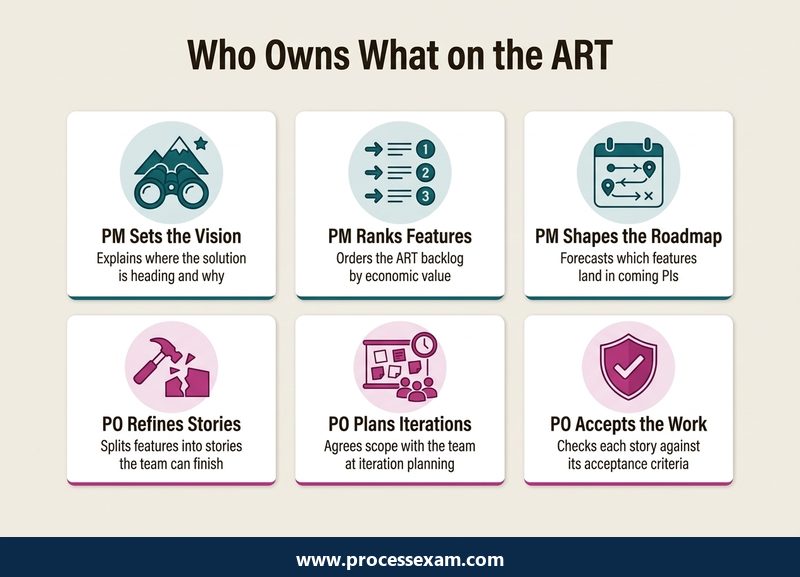
- Setting and communicating the vision. The vision describes where the solution is heading and why that matters to customers. At PI Planning it is presented to everyone on the train, so a Product Manager must be able to explain it to engineers, testers and architects in plain terms.
- Keeping a roadmap. The roadmap forecasts which features are likely to land over the next few increments. It is a forecast, not a promise, and a good Product Manager revisits it after every Inspect and Adapt.
- Defining and ranking features. Features are written with a benefit hypothesis and acceptance criteria, then ordered with Weighted Shortest Job First, which divides cost of delay by job size. That ranking is what keeps the train building the most valuable work first.
- Accepting what the train delivers. At the system demo, Product Management judges whether features actually meet their acceptance criteria and whether the benefit hypothesis still holds.
Scaled Agile notes that a single train can need more than one Product Manager, which is common when an ART carries several products or a complex system. Where that happens, the Product Managers still present one ranked backlog to the teams. A train with two competing priority lists is a train that will plan badly.
The people a Product Manager works with most are worth naming, because the relationships are the job. Business Owners hold the money and the final say on business value, and they score PI objectives with the teams during planning. The System Architect makes sure enablers for the architecture compete fairly with customer features for capacity. The Release Train Engineer runs the events and keeps flow visible, so when a dependency or a risk threatens the plan, the Release Train Engineer and Product Management usually resolve it together.
What does a SAFe Product Owner do from one iteration to the next?
If the Product Manager decides what the train builds, the Product Owner decides how that intent becomes finished work for one team. Scaled Agile's Product Owner article describes the role as the voice of the customer on the Agile Team, responsible for keeping the team backlog aligned with customer and stakeholder needs. A typical iteration shows what that means in hours rather than in job-description language.
Before and during iteration planning
The Product Owner arrives with a backlog already refined for at least the next iteration. Stories are small enough to finish, carry acceptance criteria the whole team reads the same way, and trace back to a feature the train committed to. During planning the Product Owner explains intent and trade-offs, then lets the team decide how much it can take on. A Product Owner who dictates scope rather than negotiating it loses the team's trust quickly.
Through the iteration
Questions come up daily, and the Product Owner answers them fast enough that nobody waits. Stories are reviewed and accepted as soon as they are done rather than saved for the last day, which keeps flow on the team Kanban honest. When a story turns out larger than it looked, the Product Owner splits it with the team instead of stretching the iteration. Enabler stories for technical work get the same attention as customer stories, because a team that never pays down technical debt slows the whole train.
Across the train
Usually once a week, the Product Owner joins the PO sync with Product Management and the other Product Owners. This is where scope moves between teams, where a slipping feature is flagged early, and where the train's backlog is adjusted in response to what the teams have learned. At the end of each iteration the Product Owner leads the team's iteration review, and at the end of the increment the team's work appears in the system demo that Product Management judges.
Most organisations ask one Product Owner to support one or two teams. Beyond that, backlog refinement starts to slip and stories arrive half-written, so a Product Owner covering three teams is usually a sign the train needs another person in the role rather than a stronger individual.
Where does the Product Owner's job end and the Product Manager's begin?
The boundary sits at the feature. Product Management owns features in the ART backlog, and Product Owners own stories in their team backlogs. Everything else follows from that line, but it helps to see decisions side by side, because real work rarely arrives labelled.
| Decision or artefact | Product Manager | Product Owner |
|---|---|---|
| Solution vision and roadmap | Owns and presents it | Contributes team insight and customer feedback |
| Features and their benefit hypothesis | Writes and ranks them in the ART backlog | Helps refine and size them before planning |
| Stories and acceptance criteria | Reviews when a feature is at risk | Writes, splits and orders them in the team backlog |
| PI objectives | Guides business value with Business Owners | Helps the team draft objectives it can commit to |
| Accepting work | Accepts features at the system demo | Accepts stories during the iteration |
| Customer contact | Markets, segments and strategic customers | Day-to-day users and detailed feedback |
Two scenarios show how the table works under pressure. In the first, a large customer asks for an urgent change halfway through the increment. The Product Owner who hears about it does not add it to the team backlog alone; the request goes to Product Management, which decides whether it displaces a committed feature and, if so, which one. The Product Owner then reshapes the team's stories once the decision is made. In the second, a team discovers mid-iteration that a feature is twice the size everyone assumed. The Product Owner splits what the team can finish, reports the rest at the PO sync, and Product Management decides whether the remainder waits for the next increment or pushes something else out.
In both cases, the failure mode is the same: one role making the other's decision because it was closer to the problem. Trains where that happens repeatedly end up with priorities that nobody can explain. That is why the course spends so much time on who decides what, and why the exam returns to it in scenario after scenario.
One practical note for people who hold both roles at once. Small organisations sometimes ask one person to be the Product Manager for a small train and the Product Owner for one of its teams. It can work for a while, but keep the two backlogs genuinely separate and make the feature-level decisions in the open with the other Product Owners. Otherwise your own team quietly becomes the train's favourite.
Who should take the POPM course and exam, and who should wait?
The course suits anyone who already makes, or is about to make, decisions about what a team or a train builds. Scaled Agile describes the audience as professionals who bridge customer needs and execution, and in practice five groups make up most classes.
- Product Owners and Product Managers joining a SAFe organisation. They know product work but need the train's vocabulary and events before their first PI Planning.
- Business analysts and subject matter experts. They already write requirements and know the customer; POPM gives them a recognised route into ownership.
- Scrum Product Owners whose company has scaled. The team-level skills carry over; the new part is working inside the train's economic order.
- Project and programme managers. Organisations adopting SAFe often move them into product roles, and the course reframes delivery management as value management.
- UX designers and technical leads moving towards product decisions. Design thinking and feature definition sit naturally with their existing strengths.
Who should wait? Someone whose next role is coaching teams will get more from the SAFe Scrum Master path, and someone who will run the train's events rather than its backlog is better served by the Release Train Engineer route. People with no Agile exposure at all can take the course, but they usually benefit from a foundation class first, because POPM assumes you can picture an iteration and a backlog without being taught what they are.
Before booking, it is worth checking how the six domains on our POPM syllabus breakdown map onto your current job. If most of them describe work you already do, the course will sharpen and name it. If most describe work you have never seen, plan extra reading around the class and consider asking to observe a PI Planning event before you sit the exam.
What the exam checks
The course ends with an exam that tests role judgement more than recall. These are the facts to plan around, taken from Master data and checked against Scaled Agile's exam details for the AI-Empowered POPM in September 2026.
| What to know | AI-Empowered POPM |
|---|---|
| Credential awarded | Certified SAFe Product Owner/Product Manager (POPM) |
| Exam code | POPM |
| Release in use | AI-Empowered SAFe Product Owner/Product Manager, released 5 May 2026 |
| Questions | 45 |
| Pass mark | 82% |
| Time allowed | 90 minutes |
| Attempts and fee | Two attempts come with the course when taken within 60 days of finishing it; any later attempt costs $50 |
Because the questions describe situations a Product Owner or Product Manager meets on a train, the most useful rehearsal is answering them under the same clock. A timed POPM practice test shows quickly whether you are choosing the answer your old job would give or the one SAFe prescribes for the role.
How does the AI-Empowered release change the product roles?
The May 2026 release added a sixth exam domain, Apply AI to Product Roles, and folded AI practice into the rest of the course. On its POPM certification page, Scaled Agile lists backlog refinement, prioritisation, feature discovery and customer persona development among the product tasks where AI techniques are taught. For people in the role, that list is more interesting than the exam weighting, because it describes where the job itself is shifting.
For a Product Manager, the change is mostly in discovery. Drafting personas from interview notes, summarising large volumes of support tickets, comparing competitor positioning or generating first-pass benefit hypotheses were slow tasks that AI now accelerates. The judgement does not move: someone still has to decide which insight is real, which hypothesis is worth testing and which feature earns a place in the next increment.
For a Product Owner, the change is mostly in refinement. A model can propose story splits, draft acceptance criteria or flag stories that look too large, which frees time for the conversations with the team and users that no tool replaces. The course pairs this with responsible use: checking AI output before it reaches a customer, keeping sensitive data out of tools that are not approved for it, and treating generated content as a draft that a named person owns.
The career consequence is straightforward. Hiring managers for product roles on SAFe trains increasingly expect candidates to say how they use AI in backlog work and where they refuse to. The AI-Empowered badge gives you a vocabulary for that conversation, provided you can back it with examples from your own backlog.
What changes in your work and career after you earn POPM?
The certificate itself changes little on the first morning. What changes is how you take part in the train's events and how you describe your work, and both show up within the first increment.
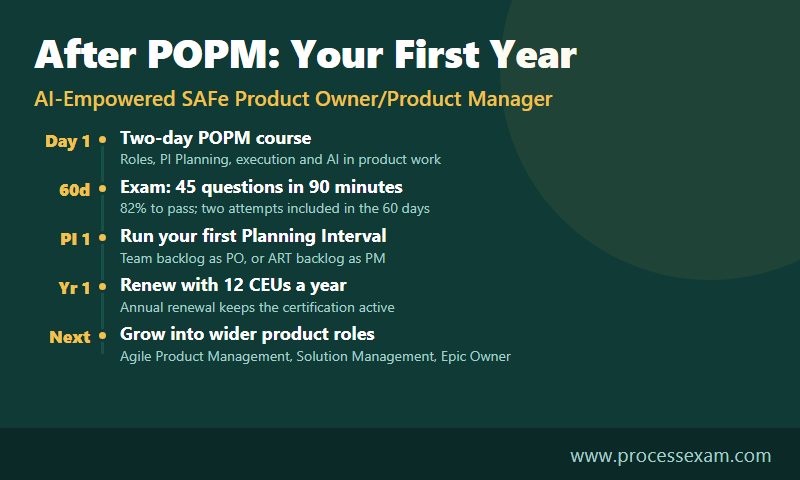
Your first Planning Interval as a certified PO or PM
Newly certified Product Owners usually notice the difference in refinement first. Stories arrive at iteration planning already split and traced to features, and questions at the PO sync become about trade-offs rather than status. Newly certified Product Managers tend to notice it at PI Planning: the vision briefing is shorter and clearer, features carry benefit hypotheses, and the draft plan review produces fewer surprises. None of this comes from the certificate; it comes from applying what the course taught at the first opportunity, while it is fresh.
A useful habit in the first increment is to write down three decisions you made because of the course, and three you would make differently next time. That list becomes the story you tell in performance reviews and interviews, which is far more persuasive than a badge on its own.
Where the path usually leads
Product careers in SAFe organisations tend to follow the scope of the backlog. A Product Owner who handles one or two teams well is often asked to take on Product Management for a train. A Product Manager who handles one train well may move into Solution Management for a large solution with several trains, or become an Epic Owner who carries a large initiative through the portfolio. Scaled Agile's Agile Product Management certification is the usual next credential at that point, because it moves the focus from execution to strategy, market sensing and product economics.
Some people move sideways rather than upwards. Product Owners with strong facilitation skills become Scrum Masters or Release Train Engineers; Product Managers with strong financial instincts move into Lean Portfolio Management. The POPM course does not decide the direction, but it gives you enough of the whole train to see which direction suits you.
Keeping the credential active
SAFe certifications are renewed each year, and Scaled Agile asks certified professionals to earn a minimum of 12 continuing education units annually. For most people in an active product role, attending community events, completing short learning modules and taking part in the platform's resources covers that requirement without much effort. Holders who certified on the earlier SAFe 6 version should check the renewal page for the route to the AI-Empowered designation rather than assuming a full re-sit.
When does POPM pay off, and when is another credential a better fit?
POPM pays off most clearly in three situations. The first is when your employer runs SAFe, or is about to, and your role involves deciding what a team or a train builds. The shared vocabulary alone saves hours in every planning event, and many organisations expect the credential for anyone in a backlog-owning role. The second is when you are changing role into product work, because it gives you a recognised starting point and a structured account of responsibilities that interviews tend to probe. The third is when you are a consultant or contractor who moves between SAFe clients, since the credential tells a new client that you already know how their trains work.
It pays off less in organisations that run product teams without SAFe. There, the train-level structures the course teaches may never appear, and a general product management qualification or a Scrum-based Product Owner credential may describe your work more accurately. It also pays off less if you certify and then never touch a backlog: employers ask what you did with a credential far more often than whether you hold it.
A simple test helps. Look at your calendar for the next three months. If it contains PI Planning, PO syncs, system demos or backlog refinement, the course will pay for itself inside the first increment. If it contains none of them, take the course when your role changes rather than before.
Whichever side of the slash you end up on, the lasting value is the same: a clear line between deciding what a train builds and shaping how a team delivers it, and the habit of respecting that line when the pressure is on. That habit is what hiring managers who run trains are really listening for.
Frequently Asked Questions
What is the full form of POPM in SAFe?
POPM stands for Product Owner/Product Manager. The credential is the Certified SAFe Product Owner/Product Manager, awarded by Scaled Agile after its course and exam. It covers two connected roles: Product Management, which owns the ART backlog and vision, and the Product Owner, who owns a team backlog.
Is the SAFe POPM certification worth it?
It is worth it when your organisation runs SAFe, or is adopting it, and your job involves deciding what a team or train builds. It gives you the shared vocabulary for PI Planning and backlog work. In companies that do not use SAFe, a general product credential may fit better.
Is the SAFe POPM exam proctored?
Scaled Agile describes the POPM exam as web-based and closed book, with no outside assistance allowed and a visible timer. Access comes through the learning plan issued after the course. Check the exam details page for current delivery rules before you start, as they can change.
What is the pass mark for the AI-Empowered POPM exam?
The AI-Empowered POPM exam has 45 questions in 90 minutes and a passing score of 82 percent. Two attempts are included with the course when taken within 60 days of finishing it, and any later attempt costs $50 under Scaled Agile's current terms.
What is the difference between a SAFe Product Owner and Product Manager?
The Product Manager owns the vision, roadmap and ART backlog for a whole Agile Release Train and ranks features by economic value. The Product Owner owns one or two team backlogs, writes and splits stories, and accepts finished work during each iteration.
- SAFe Product Owner/Product Manager Test Questions |
- POPM Question Bank |
- Scaled Agile |
- SAFe Product Owner/Product Manager Book |
- Product Owner/Product Manager Certification Cost |
- Product Owner/Product Manager Certification Requirements |
- SAFe Product Owner/Product Manager Sample Questions |
- POPM Exam Questions Download |
- POPM Test Questions |
- Product Owner/Product Manager PDF


