
SAFe ASE Certification: Exam Format, Lessons and Study Plan
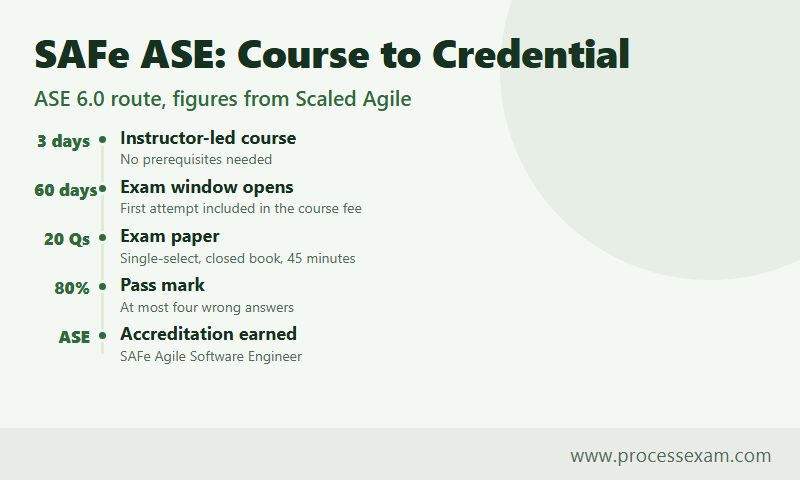
The SAFe Agile Software Engineering (ASE) exam is 20 multiple-choice questions in 45 minutes, and you need 80% to pass, which means at most four wrong answers. It follows a three-day course with no prerequisites, and Scaled Agile includes your first attempt in the course fee when you sit it within 60 days. The questions test engineering judgement more than recall, so this guide shows what each of the twelve lessons expects.

Developers often treat a framework exam as a vocabulary test and are surprised by ASE. Almost every question puts you inside a team that is writing, testing or changing software, and asks which practice keeps quality high while work keeps flowing. If you have never written a behavior-driven scenario or refactored under a test, the wording will feel unfamiliar even when you have years of coding behind you.
Below you will find the exam facts, a straight answer on which release is current, the lessons in the order the study guide lists them, what the attempts cost, a three-week plan and the places where experienced engineers lose marks. The figures come from Scaled Agile's own pages, which we checked in October 2026.
What does the SAFe ASE certification cover, and who should take it?
ASE is the Scaled Agile course for the people who build the product: software engineers, technical leads, DevOps engineers, QA and test automation specialists, and engineering managers. Scaled Agile's course page describes it as a foundational course with no prerequisites, delivered over three days in a classroom or remotely, and it awards the SAFe Agile Software Engineer accreditation when you pass the exam.
The course is about engineering practice, not about running a release train. It takes the extreme programming heritage, test-first thinking, behavior-driven development, modelling, code and design quality, and fits them into a flow of work where many teams deliver one system together. Scaled Agile's own definition of Agile Software Engineering calls it the set of modern practices that reliably and predictably create quality software-centric systems, and the exam is built around that sentence.
It suits you best if you write or review code, or test it, every week. It suits you less if your job is people management or portfolio planning; the Leading SAFe or Product Owner courses fit those roles better. And you do not need a particular programming language: the examples are described in plain terms, so a Java developer, a Python tester and a .NET engineer sit the same paper.
Which release of the ASE exam are you preparing for in 2026?
This matters because Scaled Agile has been changing its courses. Several of them, among them Leading SAFe, the Practitioner course and the Release Train Engineer course, have moved to AI-Empowered releases that are identified by a date instead of a version number. ASE has not. Scaled Agile's study guide is still titled Exam Study Guide: ASE (6.0) - SAFe Agile Software Engineer, and the version of that page we read carries a date of 24 July 2026.
That is why this article is written for ASE 6.0. We checked the study guide and the course page in October 2026 and found no AI-Empowered or date-numbered ASE release. If you buy a course, the Learning Plan you receive is the final word, so open it on day one and compare it with the lesson list below. If Scaled Agile publishes a new release later, the lesson names are the first thing that would change.
One practical consequence follows. Older study material that says SAFe 4.6 or SAFe 5.0 describes an earlier course, and some of its topics are arranged differently. Prefer material that follows the twelve lesson titles used in the 6.0 guide.
How many questions, minutes and marks does the ASE exam give you?
The exam is short. You have 20 single-select multiple-choice questions and 45 minutes, which is roughly two minutes a question, and the pass mark is 80%. Sixteen correct answers pass; fifteen do not. It is web-based and closed book, so no outside help is allowed. The timer is visible once questions appear, and the exam submits itself when it runs out, with unanswered questions scored as wrong.
| Exam detail | SAFe ASE |
|---|---|
| Full name | SAFe Agile Software Engineering, accreditation Certified SAFe Agile Software Engineer (ASE) |
| Exam code | ASE |
| Vendor | Scaled Agile (SAFe) |
| Course release | ASE 6.0 (study guide dated 24 July 2026) |
| Course | 3 days, no prerequisites |
| Number of questions | 20, multiple-choice, single-select |
| Duration | 45 minutes |
| Passing score | 80% |
| Delivery | Web-based, closed book, opened from your Learning Plan after the course |
| First attempt | Covered by your course fee, provided you sit it inside 60 days of finishing the class |
| Retake fee | $50 per attempt, according to the study guide |
The format has a few details worth knowing before you sit. You must accept the Candidate Agreement before the exam starts. The Submit button ends the exam and calculates the score at once, so check your flags first. There is also a practice test with the same number of questions, difficulty, time limit and domains as the real thing, with unlimited attempts. Passing it does not guarantee you pass the exam, but it is the closest rehearsal you will get.
A word on the passing score. Some listings, including older pages, show a higher pass mark for ASE. Scaled Agile's current ASE exam study guide says 80%, so plan for 80%, and treat any figure above that as out of date until the Learning Plan in your own course says otherwise.
What do the twelve ASE lessons ask you to know?
Scaled Agile publishes the exam blueprint as the lesson list of the course, and it does not publish percentage weightings for ASE. That is unusual among SAFe exams and means you should prepare evenly rather than guess which lesson is heaviest. Because the paper is only 20 questions, each lesson shows up about once or twice, and the practical lessons, BDD, design and TDD, are where the scenarios get longest.
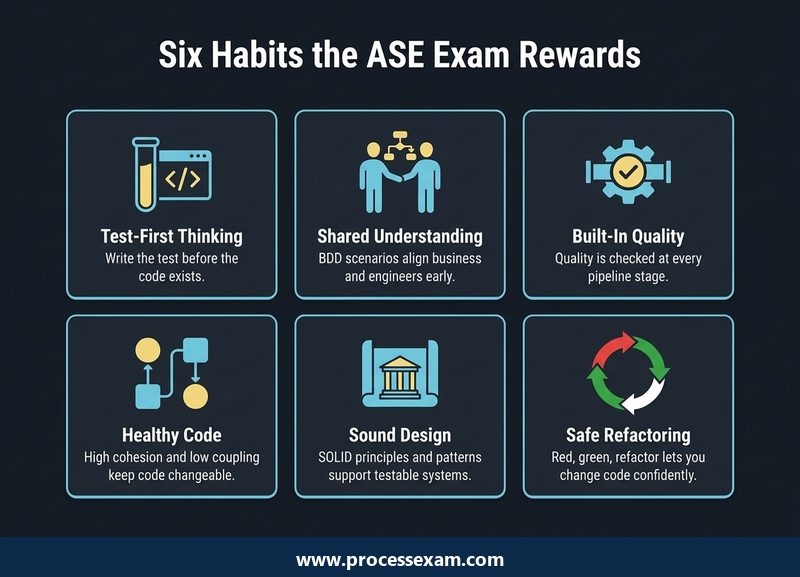
Lessons 1 and 2: engineering foundations and built-in quality
The course opens by defining Agile Software Engineering and connecting principles to practices. Expect to be asked what extreme programming practices contribute (pair work, continuous integration, collective ownership, test-first) and what Built-In Quality means in SAFe: quality is a property of how you work at every step, not an inspection stage at the end. You will also need to describe the trade-offs, for example speed now against rework later.
Lesson 3: accelerating flow
This lesson is about outlining how value flows from idea to customer and about validating the benefit hypothesis. A question might describe a feature that was built on time and still delivered no measurable benefit, and ask what the team skipped. The answer usually involves stating the hypothesis before building and measuring it after release.
Lesson 4: intentional architecture
Here you apply systems thinking, explain how Agile architecture supports Lean-Agile development, and architect and design for testability. A system that cannot be tested in small pieces cannot be changed safely, so questions favour seams, interfaces and small components over a big design decided in advance.
Lesson 5: thinking test-first
You are asked to shift testing left, explain the Agile testing matrix, describe the role of nonfunctional requirements and build quality throughout the pipeline. Know what the four quadrants of the matrix are for, which ones support the team and which critique the product, and why nonfunctional requirements such as performance or security must be tested continuously rather than at release.
Lesson 6: discovering story details
This lesson covers story criteria, splitting stories to reduce the Minimum Marketable Feature, creating workflows and story maps, and identifying assumptions and risks. Splitting questions are common. The usual right answer slices thin across the whole workflow so each slice can be demonstrated, and the usual wrong answer slices by technical layer.
Lesson 7: shared understanding through behavior-driven development
BDD gets a full lesson because it is where engineering and business meet. You apply it to create shared understanding, specify desired behavior for domain terms, describe behavior for business rules and algorithms with tests, test the user interface, apply test doubles and find the existing tests that a new requirement affects. Know the Given-When-Then structure, and know why a scenario should describe behavior a business person can read, not clicks on a screen.
Lesson 8: communicating with models
Models are a communication tool in ASE, not paperwork. You explain why models are used, outline static models, use the Class-Responsibility-Collaboration technique and outline dynamic models. A question may show a team arguing about who owns a rule and ask which kind of model would settle it fastest.
Lessons 9 and 10: code quality and design quality
Code quality asks you to identify code qualities, describe cohesion and coupling and explain the benefits of collective ownership. Design quality asks you to explore design options, explain interface-oriented design, apply the SOLID principles and apply software design patterns. Cohesion and coupling are the pair to be sure of: good code keeps related things together and unrelated things apart. For SOLID, practise recognising each principle from a short description of a problem, because the exam describes the symptom, not the name.
Lessons 11 and 12: implementing with quality, then the review
Implementing with quality is test-driven development: you apply its practices for writing software and refactor to support new behavior. The red, green, refactor cycle is the core of it, and a typical question asks what to do at a given step of the cycle. The final lesson summarises the course and has you review your action plan for adopting the practices, so it adds little new content. For background reading on the cycle, the general overview of test-driven development is a neutral refresher.
What do ASE attempts and retakes cost, and why do Scaled Agile's pages differ?
Scaled Agile's study guide says the first attempt is included in your course registration fee when taken within 60 days of finishing the course. Further attempts carry a $50 retake fee. The first retake is available immediately after a failed attempt, the second 10 days after the first retake, the third 30 days after the second, and every later retake needs a 30-day wait.
Here is where it gets confusing. Scaled Agile's general exam retake FAQ lists ASE as an exception to its standard policy. It says ASE and SAFe for Hardware courses include 20-question completion quizzes with unlimited attempts, no retake fees and a 45-minute limit per attempt. The two pages therefore describe the same exam with two different retake rules.
We cannot tell you which one your account follows, because the vendor's own pages disagree and the Learning Plan is where the rule is applied. What you should do is simple. Read the retake wording shown inside your Learning Plan before you start attempt one, and take a screenshot of it. Then treat the first attempt as the one that counts: plan as if a retake might cost you $50 and a waiting period, and you will prepare properly whichever page turns out to be right.
The 60 days are a clock too. They start when you complete the course, not when you feel ready, and a missed window can cost you a new purchase. Put the date in your calendar on the last day of class.
How should you use three weeks between the course and the exam?
The course itself teaches the material, so the weeks after it are for turning understanding into fast, correct answers. This plan assumes the three-day class is behind you and that you can give about an hour on weekdays and a little longer at weekends. Developers who code daily can shorten it; testers and managers who do not write code may want to stretch it to four weeks.
| Days | Focus | What to finish |
|---|---|---|
| 1-3 | Course notes and the study guide | Read the twelve lesson topics against your notes; mark every one you cannot explain aloud |
| 4-7 | Test-first, stories and BDD | Write three Given-When-Then scenarios for a feature you know; split one large story three ways |
| 8-11 | Models, code quality, design quality | Describe cohesion and coupling in a module of your own; name which SOLID principle each of five small problems breaks |
| 12-14 | TDD and refactoring | Do a small kata with red, green, refactor; take the Scaled Agile practice test and note every miss |
| 15-19 | Weak areas | Revisit only the lessons that cost you marks; write one sentence for each rule you keep forgetting |
| 20-21 | Rehearsal | Two timed 20-question runs at 45 minutes; sit the exam inside the 60-day window |
Two habits make this plan work. First, learn by doing: the lessons that carry the longest scenarios are the ones you can practise at a keyboard in twenty minutes, so a small test-driven exercise teaches more than rereading slides. Second, explain things aloud. If you cannot say why splitting by workflow beats splitting by layer in two sentences, you will not choose the right option under time pressure.
When you want more practice than the vendor's single test, our free ASE sample questions give you scenario-style questions to measure yourself against. They are practice material from ProcessExam, not Scaled Agile's questions, and a good score on them predicts readiness better when you also review every wrong option.
Where do experienced developers lose marks on the ASE quiz?
Strong engineers fail this exam for reasons that have little to do with ability. These are the patterns we see most often.
- Answering from habit instead of from the course. If your team writes tests after the code, you will want to pick the option that does the same. ASE expects test-first, and it marks the course answer as right.
- Choosing the clever solution. Options that add a pattern, a framework or an abstraction are often distractors. The answer that makes the code simpler, easier to test or easier to share usually wins.
- Mixing up BDD and TDD. BDD works at the level of business behavior and shared understanding; TDD works at the level of code and design. A scenario about a conversation with a product owner is BDD, and one about a failing unit test is TDD.
- Slicing stories by layer. A story that covers only the database or only the interface cannot be demonstrated. Choose vertical slices.
- Treating testing as a phase. Built-In Quality means testing happens through the pipeline, so options that defer checks to the end are almost always wrong.
- Skipping the time check. At two minutes a question, a long scenario can eat five. Flag and move on, and use any spare time to return to flagged questions before pressing Submit.
Before you book, you can also check yourself against our ASE practice exam, which follows the same 20-question, 45-minute format. Take it once early for a baseline and once near the end to see whether the weak lessons have improved.
Is the ASE certification worth it for a developer's career?
ASE is a foundational accreditation, so its value is practical and specific, not dramatic. It tells an employer that you know the engineering practices that SAFe-based organisations expect their teams to follow: test-first, BDD, quality built into the pipeline, sound design and refactoring under tests. In companies that run SAFe at scale, that shared vocabulary saves real time in team onboarding and design reviews.
It helps most in three situations. When your organisation is adopting SAFe and technical staff are asked to lead by example. When you want to move from developer to technical lead, architect or engineering manager and need a recognised credential that proves you understand engineering practice beyond your own code. And when you work in a regulated or hardware-adjacent environment, where the course's focus on compliance and integrated systems matches your daily problems.
It helps less if you are not in a SAFe organisation and your goal is a pure programming role; there, a language or cloud credential will say more. We do not quote salary figures for ASE, because we found no reliable salary survey that separates it from the rest of a developer's skills. Judge it the way you would any course: by whether the practices change how your team works. If they do, the exam is the easy part, and a short, structured three-week plan is all you need to pass it.
Frequently Asked Questions
How many questions are on the SAFe ASE exam, and what is the passing score?
The SAFe ASE exam has 20 multiple-choice, single-select questions to answer in 45 minutes, and the passing score is 80%. That means 16 correct answers pass. It is web-based and closed book, and unanswered questions are marked wrong when the timer ends.
Is the SAFe ASE exam still SAFe 6.0?
Yes. Scaled Agile's current study guide is titled ASE (6.0) and carries a July 2026 date, while several other SAFe courses moved to AI-Empowered, date-numbered releases. We found no newer ASE release when we checked in October 2026, so prepare for 6.0.
How much does the SAFe ASE exam cost?
The first attempt is included in the course registration fee when you take it within 60 days of finishing the course. Scaled Agile's study guide lists a $50 retake fee, although its general retake FAQ says ASE quizzes have unlimited attempts and no fees. Confirm in your Learning Plan.
How hard is the SAFe ASE certification exam?
It is short but practical. With 20 questions and an 80% bar you can miss only four, and most questions describe an engineering situation instead of asking for a definition. Developers who know test-first, BDD and SOLID from real work usually pass after about three weeks of review.
Are there prerequisites for the SAFe ASE course?
No. Scaled Agile lists the Agile Software Engineering course as foundational with no prerequisites. It runs for three days, in a classroom or remotely, and the exam is opened from your Learning Plan after you complete the course. Some hands-on coding or testing experience helps you absorb it faster.
- Scaled Agile |
- ASE Question Bank |
- ASE Exam Questions Download |
- ASE Test Questions |
- SAFe Agile Software Engineering Test Questions |
- Agile Software Engineering Simulator |
- Agile Software Engineering Mock Exam |
- SAFe Agile Software Engineering Book |
- Agile Software Engineering Certification Cost |
- Agile Software Engineering Certification Requirements |
- SAFe Agile Software Engineering Sample Questions |
- Agile Software Engineering PDF


