
SAFe Agile Product Management Exam: Cost, Domains and How to Pass
Updated on 9 October 2026. What’s new: the first exam attempt is included in the course fee when taken within 60 days of finishing the course.
Picture a product owner who has just finished the three-day APM course and wants to know what the exam will ask. Its eight lessons run from design thinking and market segmentation to ART Kanban and rapid experimentation, and you need 75% of 60 questions, answered in 120 minutes. Scaled Agile includes one attempt in the course fee. This guide covers the version, fees, syllabus weights and a study plan, checked October 2026.
People type "agile product management exam" because they want two answers before paying for a three-day course: how hard it is, and what happens if the first sitting goes badly. The short versions are that it is a scenario exam for people who already do some product work, and that a failed first attempt is cheap to repeat. The rest of this guide gives you the detail to plan around.
The credential is the SAFe Agile Product Manager (APM) certification from Scaled Agile. Scaled Agile describes it as a course for experienced product and solution management professionals who want to lead agile product development at scale. The audience it names is product managers, product owners, product marketers, business owners, solution managers and project managers.
Which version of the APM exam are you preparing for in October 2026?
Scaled Agile's current study guide for this exam is titled "APM (6.0) - SAFe Agile Product Management" and carries an update date of 7 April 2026. So when this article was checked in October 2026, the vendor was still running the exam under the 6.0 label. That matters because several other SAFe courses moved to date-based, AI-Empowered releases during 2026, and a search for "SAFe 6.0" on those exams now turns up old material. For APM, the 6.0 study guide is the live one.
Two things on Scaled Agile's pages are newer than most blog posts you will find, including the earlier version of this one. First, the retake policy was rewritten with effect from 14 April 2026. Second, the window for the included first attempt is now 60 days from finishing the course, where older posts quote 30 days. Read the study guide on Scaled Agile's support site before you book, because the page itself says details are subject to change at any time.
Scaled Agile's certification page also suggests POPM (SAFe Product Owner/Product Manager) as a prerequisite for the course and recommends agile experience. It lists the course as three days of instructor-led training, delivered remotely or in person by a certified SAFe Practice Consultant.
How many questions, minutes and marks does the exam give you?
The exam is web-based and closed book, with multiple-choice questions that each have a single correct answer. Once the timer appears it keeps running, and the exam submits itself when time ends. Unanswered questions are marked wrong, so there is never a reason to leave a blank. Here are the figures in one place.
| Exam detail | SAFe Agile Product Management (APM) |
|---|---|
| Exam code | APM |
| Vendor | SAFe (Scaled Agile) |
| Study guide version | APM (6.0), updated 7 April 2026 |
| Questions | 60 |
| Duration | 120 minutes |
| Passing score | 75%, which is 45 of 60 questions |
| Format | Multiple-choice, single-select, web-based, closed book |
| First attempt | Covered by the course fee if you sit it inside 60 days after the course ends |
| Retake fee | $50 per retake |
Two minutes per question is generous. Candidates who run short of time usually do so because they reread long scenarios, not because the questions are slow to answer. Plan on roughly 90 seconds per question and keep the remainder as a buffer for the questions you flag.
Scaled Agile also gives every candidate an unlimited-attempt practice test inside the Learning Plan. According to the study guide, it mirrors the real exam in question count, difficulty, timebox and domain areas, and the vendor is careful to say that passing it does not guarantee passing the real exam. Treat it as a diagnostic, not a promise.
What do APM attempts and retakes cost, and how does the 60-day window work?
The first attempt is paid for through the course registration fee, provided you sit it within 60 days of completing the course. A retake costs $50, and the waiting periods lengthen as attempts pile up. Scaled Agile's retake FAQ and the APM study guide agree on the sequence below.
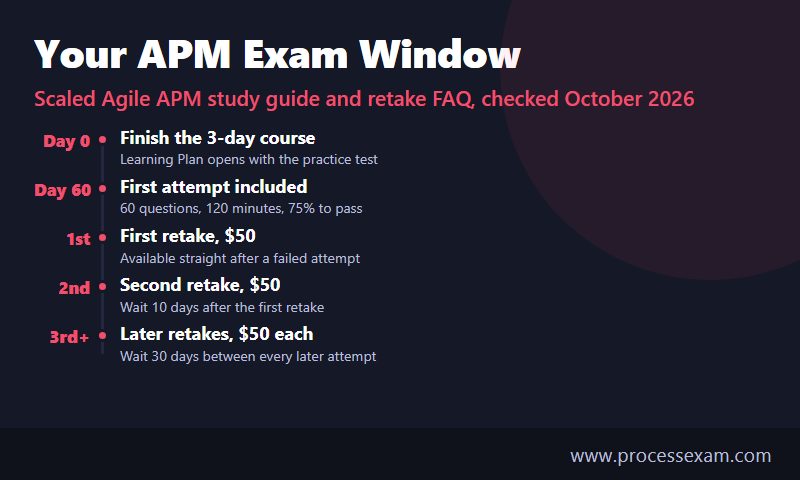
- First retake: available immediately after a failed first attempt.
- Second retake: available 10 days after the first retake.
- Third retake: available 30 days after the second retake.
- Further retakes: each needs a 30-day gap between attempts.
The cheapest route is to be ready on the included attempt. A $50 fee is small, but getting past the second retake also costs you a month of waiting. Retakes are bought inside your Learning Plan, where a retake button sits next to the exam.
Scaled Agile's policy page groups APM with its advanced and expert courses, whose included allowance is one attempt within the 60-day exam window. Foundational courses such as POPM include two attempts for courses taken after 14 April 2026, so the first APM attempt carries more weight than a first POPM attempt does. If you are comparing against posts written before April 2026, the 30-day window you will see there is the one gap between other sites and Scaled Agile's pages today. The fee and the waiting periods did not change.
Which eight lessons carry the marks, and how should you weigh them?
Scaled Agile publishes the exam as eight domains, each tied to one lesson of the course, and gives each a percentage range. The ranges make it possible to plan study time. Value delivery is the heaviest area, but the spread is flat: no domain is below 7%, so you cannot skip any lesson.
| Lesson | Domain | Weight |
|---|---|---|
| 1 | Product Manager Role in the Lean Enterprise | 11-13% |
| 2 | Continuous Exploration of Markets and Users | 12-14% |
| 3 | Market Segmentation Strategies | 11-13% |
| 4 | Empathy-driven Design | 7-9% |
| 5 | Product Strategy and Vision | 12-14% |
| 6 | Roadmap Creation to Build Solutions | 11-13% |
| 7 | Value Delivery | 14-16% |
| 8 | Innovation Creation in the Value Stream | 12-14% |
Our APM syllabus page lists the same areas if you want a checklist to tick off while you read the course workbook. Below is what each group of lessons asks of you, grouped by the way the questions behave.
Lessons 1 and 2: the role and the research (23-27% together)
Lesson 1 covers the product manager's role and responsibilities, the stakeholders and collaborators around the role, and design thinking. The exam wants you to separate what a product manager owns (the what and why, the market-facing view) from what the teams and the Release Train Engineer own (the how and the flow). Questions in this area often put a stakeholder's request in front of you and ask who should decide, or what evidence you need before deciding.
Lesson 2 is market research and continuous exploration. The topics are hypotheses and questioning, data-driven practices, research planning and research games for customer understanding. The recurring theme is that opinions are not evidence. When a scenario describes a feature one loud customer asked for, the better answer is usually the one that frames the request as a hypothesis and chooses a cheap way to test it with more customers.
A useful habit for both lessons is to rewrite every scenario as a question about evidence. What do we know, from whom, and how recent is it? What would change our mind? The options that answer those questions beat the options that simply act on the request.
Lessons 3 and 4: segments and personas (18-22% together)
Segmentation asks you to split a market into groups that behave differently and to judge each segment's value and fit. Expect scenarios where a product serves one group well and misses another, and you have to pick the segment that deserves attention first. Think of three tests: is the segment reachable, is it big enough to matter, and does the solution fit what that segment values?
Empathy-driven design is the lightest domain at 7-9%, covering persona purpose, creation and use, plus empathy-driven customer experience. Personas are tools for decisions, not decorations. A question may ask what makes a persona useful, and the answer is that it rests on research and settles trade-offs, not that it is detailed or attractive.
Lessons 5 and 6: strategy, vision and roadmap (23-27% together)
Product strategy and vision covers product and solution purpose, value propositions and business models, customer journey mapping, context, and platform, API and data strategy. Roadmap creation covers solution intent, market-driven roadmaps, balanced solution-based features, and the chain from features to stories and story maps. Read the two lessons together: the vision says where you are heading, and the roadmap says in what order you go.
The trap is to treat a roadmap as a promise of dates. SAFe frames it as a plan that responds to evidence, so options that lock in a long list of features before testing assumptions tend to be wrong. Know the difference between solution intent, which records what is known about the solution as it evolves, and the roadmap, which orders the work. Know too why a customer journey map belongs in strategy: it shows where a product helps or hurts the customer, and that shapes which features deserve a place in the plan.
Lesson 7: value delivery (14-16%)
This is the most heavily weighted lesson, and it is where product management meets the Agile Release Train. Scaled Agile lists the ART Kanban, the ART backlog, PI Planning and PI Execution. Expect scenario questions about how a product manager prepares the backlog for planning, what they do during PI Planning, and how they respond when circumstances change mid-increment. If you have never attended a PI Planning event, sketch one from the course material: who is in the room, what comes in, and what leaves.
Anchor your answers in flow. The ART Kanban is where larger ideas are analysed and approved before they reach the backlog, and the ART backlog holds the work the train will plan. A product manager who pushes unready items straight into a planning event creates the exact problems the lesson teaches you to prevent.
Lesson 8: innovation in the value stream (12-14%)
The last lesson covers value streams and product innovation, innovation metrics, epics, funding innovation, rapid experimentation, and application and hypothesis outcomes. Most candidates under-study it because it comes last in the course. Questions ask what to measure early (leading indicators rather than lagging revenue), how to decide whether to continue, adjust or stop an experiment, and how an epic is funded in small steps rather than in one large commitment.
Do you need POPM first, and how does APM differ from it?
Scaled Agile's certification page names POPM as a suggested prerequisite, not a requirement, so check your training partner's booking page for any hard rule. The difference in practice is one of altitude. POPM is the foundational role course: it works at team and train level, on backlog items, iterations and the planning cycle. APM works one level up and one step earlier, on markets, customers, strategy and the experiments that decide what ever reaches a backlog.
That changes how you answer. A POPM question usually asks how to refine and sequence work you already have. An APM question usually asks whether you should be building it at all, for whom, and how you would know. If you hold POPM, read the APM material as the front half of a story whose back half you already know. Lesson 7 is where the two overlap most.
How do you use the weeks after the three-day course?
You have up to 60 days from finishing the course to use the included attempt, and most candidates do well with three to four weeks of structured review inside that window. The aim is not to reread the workbook but to turn each lesson into decisions you can make quickly. Here is a four-week outline.
| Week | Focus | What to finish |
|---|---|---|
| 1 | Lessons 1 to 4 | Role, research, segments and personas; write one persona and one hypothesis from your own product |
| 2 | Lessons 5 and 6 | Draft a vision statement and a three-step market-driven roadmap; explain solution intent in two sentences |
| 3 | Lessons 7 and 8 | Walk through PI Planning from the product manager's chair; list leading indicators for one experiment |
| 4 | Practice and gaps | Take the Learning Plan practice test, then timed mixed questions; revisit every weak lesson |
Write short answers in your own words for every domain. If you cannot explain a topic in two sentences without looking, you do not yet know it well enough for scenario questions. Keep an error log: for each wrong practice answer, record the lesson, why the right option was better, and which words in the question pointed to it. After the first full practice test, spend your time on the two weakest lessons rather than spreading it evenly.
When your Learning Plan scores are steady, run a few full-length mixed sets under the real clock. Our APM practice exam gives you fresh scenarios beyond the single vendor test, which is worth having because you can only memorise that one test, not learn from it twice.
On the day
You review and accept a candidate agreement before the exam starts, and instructions on exam functions follow. Take the exam in a quiet place with a stable connection, because the clock does not pause. Answer the sure questions first, flag the doubtful ones, and use the final twenty minutes for a second pass over the flags. Do not change an answer unless you can name the specific reason the new option is better.
What separates a product manager's answer from a delivery manager's?
Many missed marks on this exam come from answering as a project manager or a scrum master. The vocabulary is similar, but the instinct is different. Product questions reward the answer that moves closer to evidence about customers; delivery instincts push toward finishing what was already planned. The six decision types below are the ones scenario questions keep returning to.
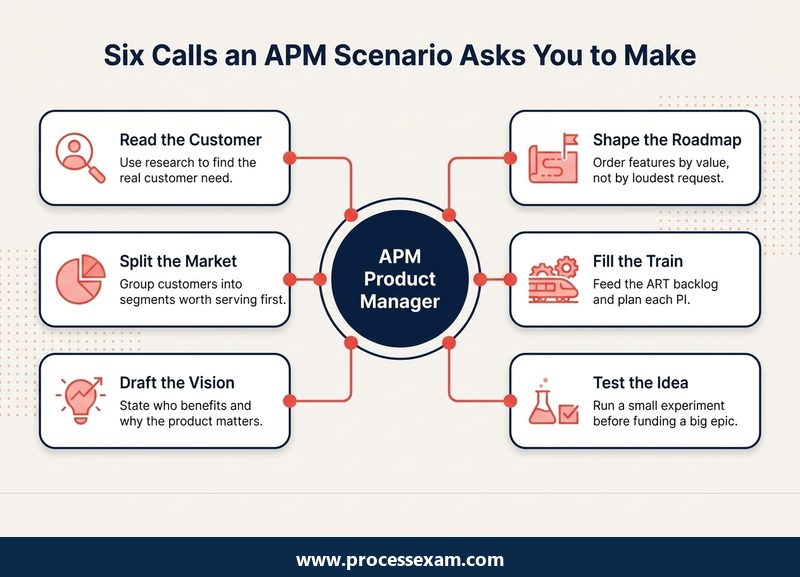
- Read the customer. Prefer research and observation over assumptions and internal opinion.
- Split the market. Choose the segment with the clearest need and a fit with what you can deliver.
- Draft the vision. A good vision names who benefits and why, rather than listing features.
- Shape the roadmap. Order work by expected value and learning, not by who asked loudest.
- Fill the train. Keep the ART backlog ready for PI Planning and respond to change during the increment.
- Test the idea. Run a small experiment before you fund a large epic.
When two options look right, ask which one a product manager could defend with customer data. Eliminate options that skip research, treat a roadmap as a fixed contract, or let one stakeholder set priorities alone. Be wary of absolute words such as "always" or "never", because SAFe's guidance tends to be conditional. If a scenario describes an organisation with many teams, check whether the answer needs the train to act, not only one team.
Who gains from APM, and how do you keep it active?
The credential helps most if your job already includes product strategy, roadmap or portfolio decisions inside a SAFe organisation, such as a product manager, solution manager or business owner who works with Agile Release Trains. Scaled Agile lists Product Managers, Product Owners, Product Marketers, Business Owners, Solution Managers and Project Managers as the intended audience. People moving from delivery roles toward product work also use it to show they understand the discovery side of the job. We do not quote salary figures here: the credential does not set pay by itself, and the vendor publishes no such figure.
On passing, Scaled Agile says you earn the certification, a shareable digital badge, a certificate of completion, and one year of SAFe Studio access with study materials and toolkits. It also lists PMI PDUs and Scrum Alliance SEUs for the course. The certification is renewed yearly. Scaled Agile's renewal article, dated August 2026, lists 24 continuing education units for advanced-level certifications such as APM, against 12 for foundational ones. CEUs are one-hour blocks across learning, community and professional application, and extras carry forward to your next renewal.
Before you book, read the vendor's own Agile Product Management certification page for course dates and delivery options, and the renewal rules in Scaled Agile's CEU requirements article. Keep Scaled Agile's General Exam Retake FAQs open during your exam window.
In short, APM is worth taking when your product decisions are made inside a SAFe setting and you want to show command of the discovery, strategy and experimentation half of the job. It is less useful if you will never touch SAFe, since much of the exam is framed in SAFe's own terms.
Frequently Asked Questions
How many questions are on the SAFe APM exam?
The SAFe Agile Product Management exam has 60 multiple-choice, single-select questions with a 120-minute limit. It is web-based and closed book. Unanswered questions count as incorrect, so answer every question before the timer ends and use any spare minutes to review flagged ones.
What is the passing score for the SAFe APM exam?
The passing score is 75%, which is 45 of the 60 questions. Scaled Agile calculates the score from correctly answered questions only, and unanswered questions are marked wrong. The practice test in the Learning Plan reflects the same difficulty, but passing it does not guarantee passing the exam.
How much does the SAFe APM exam cost?
One attempt is covered by the course fee if you sit it inside 60 days after the course ends. Each retake costs $50. Scaled Agile's training partners set the course fee, so check the price with the partner running your class.
What happens if you fail the APM exam?
You can take the first retake immediately for $50. The second retake needs a 10-day wait after the first retake, the third a 30-day wait after the second, and any further retake a 30-day gap. You buy retakes inside your Learning Plan, next to the exam.
Do you need POPM before the SAFe APM course?
Scaled Agile lists POPM as a suggested prerequisite and recommends agile experience, rather than naming it as a hard requirement on its certification page. Check your training partner's booking page for any entry rule. The course itself runs three days, with the exam taken afterwards.
- Scaled Agile |
- SAFe Agile Product Management Test Questions |
- APM Question Bank |
- SAFe Agile Product Management Book |
- Agile Product Management Certification Cost |
- Agile Product Management Certification Requirements |
- SAFe Agile Product Management Sample Questions |
- APM Exam Questions Download |
- APM Test Questions |
- Agile Product Management PDF


