
Why Pursue ITIL Certification? A Role-by-Role Answer
Yes if your job touches tickets, changes, releases, service levels or the people who run them, and you want a shared vocabulary that employers recognise. No if you need a first certificate that proves hands-on technical skill, a project method or a business-analysis technique. ITIL 4 Foundation is 40 questions in 60 minutes with a 65% pass mark. This article answers the question one role at a time, using PeopleCert's own module names.

Older answers to this question, including the first version of this post, treated ITIL as a single prize for "IT professionals" in general and leaned on claims about small companies that nobody could source. A better question is narrower: what would ITIL 4 change in the work you do on Monday morning, and which certification step comes after it? The answer is different for a first-line analyst and for someone planning a CIO career, and it is sometimes "not yet".
Which part of your job decides whether ITIL belongs on your plan?
ITIL is a body of guidance about how technology work is organised and handed over: how a request is logged, who owns a fault, how a change is approved, what a service level promises and how the team improves afterwards. It is not a tool, a programming skill or a project method. So the test is simple. Count how much of your week is spent passing work to another team, receiving it, or agreeing with a business user what "fixed" means. The larger that share, the more ITIL 4 will change how you think and talk. The smaller it is, the more another certification should come first.
PeopleCert, the body that runs the ITIL exams, lays its ITIL 4 scheme out as a ladder, and it is worth seeing the ladder before choosing a role-specific rung. The table below is the ladder PeopleCert's ITIL certification page showed in October 2026; prices on that page vary by country, so check your own region there.
| Step | What PeopleCert lists |
|---|---|
| Entry | ITIL 4 Foundation, as an eLearning course plus exam voucher bundle |
| Practice modules | Practitioner modules, one per practice, such as Service Desk or Change Enablement |
| Specialist modules | Create, Deliver and Support; Drive Stakeholder Value; High-Velocity IT; Monitor, Support and Fulfil |
| Strategy and leadership | Strategist: Direct, Plan and Improve; Leader: Digital and IT Strategy |
Two points follow from the table. First, the Practitioner rung is cheap compared with the others, which matters for roles that live inside one practice. Second, everything above Foundation is a choice, so the useful way to plan is to pick Foundation first and let your role decide the second purchase. The topics every role shares are on the ITIL 4 Foundation syllabus page.
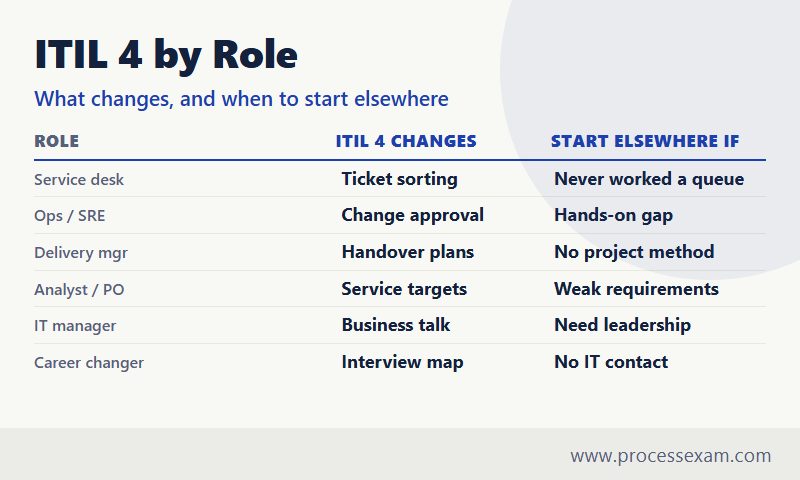
If you want a rough sort before reading the role sections, use this one:
- Mostly yes now: service desk analysts, change and release coordinators, service delivery and vendor managers, and anyone whose job title already contains the word service.
- Yes, with a technical certificate first or beside it: operations, SRE and DevOps engineers.
- Yes, after a project method or analysis technique: project managers, business analysts and product owners.
- Yes, but Foundation is only the start: managers on a director or CIO track.
- Yes as a vocabulary, no as a substitute for experience: students and career changers.
What does ITIL 4 change for a service desk analyst?
The day job. ITIL 4 separates three things that a busy desk blurs together: an incident is an interruption to a service, a service request is a routine, pre-agreed ask, and a problem is the underlying cause behind repeated incidents. An analyst who sorts tickets by those definitions stops fixing the same password-policy complaint forty times and starts passing the pattern to someone who can remove it. The other change is the notes. Under the guiding principle of focusing on value, a good ticket update says what the user can and cannot do now, not just which log was checked.
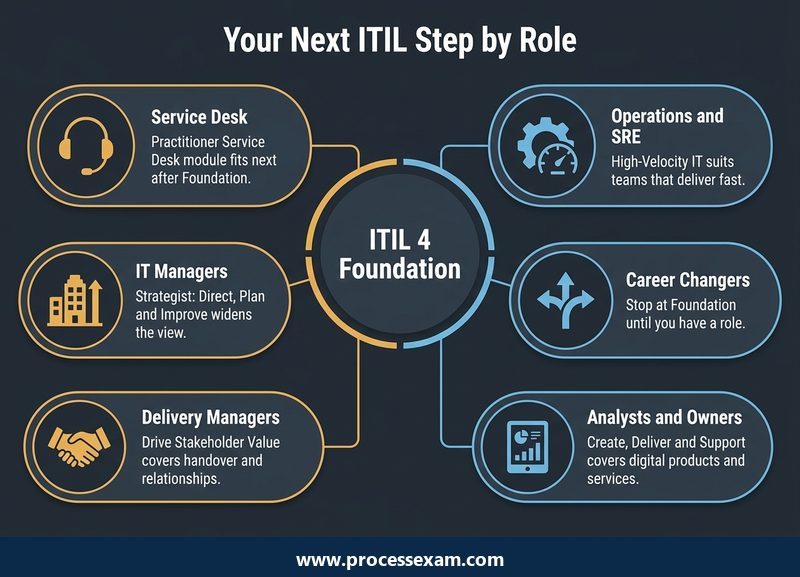
Which module fits next. PeopleCert lists a Practitioner: Service Desk module, a Practitioner: Incident Management module and a Practitioner: Service Request Management module, each at the lower price tier. For a wider view of the whole support area, the Specialist: Monitor, Support and Fulfil module combines five practices: incident management, service desk, service request management, monitoring and event management, and problem management. Take a Practitioner module first if your desk's weak spot is one practice; the Specialist module suits an analyst already thinking of team lead.
When ITIL is not the first certification. If your employer or its customers name a Service Desk Institute qualification, that comes first; PeopleCert's own page carries SDI certifications as a separate family about service desk standards. And if you have not yet worked a live ticket queue, a few months of real tickets will make the Foundation vocabulary stick far better than studying it cold.
How to show it. Keep a short log of three recurring tickets you traced to one cause and what changed afterwards. In an interview or a review, that log proves the incident-versus-problem idea better than the certificate does, and the certificate then explains that you know the names for what you did.
Does an operations or SRE and DevOps engineer need ITIL?
The day job. Engineers meet ITIL as the process wrapped around their work: a change request form, a release calendar, a major-incident bridge. ITIL 4 reframes those as practices to be fitted to the team rather than gates to be defended. The Change Enablement module's own description is about maximising the number of successful changes by assessing risk, authorising changes and managing the schedule. For a team that deploys many times a day, that is an argument for lightweight, risk-based approval instead of a weekly committee. Engineers who already write blameless post-incident reviews will find problem management familiar, with a different name and a longer memory.
Which module fits next. The closest match on PeopleCert's list is Specialist: High-Velocity IT, described as adapting service management practices to a dynamic environment, with resilient systems and faster delivery. Below it sit Practitioner modules named Monitoring and Event Management, Deployment Management, Release Management and Problem Management. Pick the one that matches the process you are actually asked to follow at work, not the most senior-sounding title.
When ITIL is not the first certification. If the gap on your profile is hands-on capability, such as cloud platforms, containers or automation, ITIL will not prove it. PeopleCert's page lists a DevOps Institute family for people bridging development and operations, and a vendor or cloud certification may speak louder to a manager hiring an engineer. Treat ITIL as the layer that lets you speak with the service desk and the change board, taken after technical proof rather than instead of it.
How to show it. Point to one change you tied to a measured result, such as fewer failed releases after you added a risk check to the schedule. Operations teams trust engineers who bring that evidence, and the certificate tells a recruiter who has not worked with you that the vocabulary is shared.
Is ITIL worth it for a project or delivery manager?
The day job. Projects end at go-live; services do not. ITIL 4 gives a delivery manager the vocabulary for the other side of that handover. Picture a portal project that closes on schedule and then opens 200 tickets in week one because nobody wrote the support model, the knowledge articles or the service level. A manager who has studied ITIL asks in the first month who the service owner will be, what the agreed response targets are, and which team takes the calls on day two. Those are ordinary requirements, but they are rarely written down without that vocabulary.
Which module fits next. Specialist: Drive Stakeholder Value covers relationships and the user experience through value co-creation, which is the closest to a delivery manager's daily conversations. The Practitioner modules for Change Enablement, Release Management and Service Level Management cover the three places where project plans meet operational reality.
When ITIL is not the first certification. If you run projects but have no recognised project method yet, start there. PeopleCert's own page describes its PRINCE2 family as the skills for project, programme and portfolio management, and that is where a project manager's first proof belongs. ITIL then widens a project profile; it does not replace the method that tells you how to plan, control and close the work.
How to show it. Add a handover section to your next project plan: service owner, support hours, response targets and the knowledge articles needed on day one. A single page like that is visible proof to operations colleagues that you think beyond go-live, and it gives your Foundation study a live example to attach to.
What does ITIL add for a business analyst or product owner?
The day job. Business analysts and product owners already think in outcomes, and ITIL 4 gives that thinking an operations-side partner. A service level agreement is a requirement written as a measurable promise; a service request catalogue is a list of what users may ask for without a project; and the idea of co-creating value with the consumer is the service version of stakeholder engagement. A product owner who has met these ideas can write acceptance criteria that include response times and support hours, instead of leaving them to be discovered after launch.
Which module fits next. Specialist: Create, Deliver and Support covers designing, delivering and managing digital products and services, including strategy, issue management and continual improvement. Specialist: Drive Stakeholder Value and Practitioner: Service Level Management suit the analyst side. PeopleCert's newer Version 5 line adds modules called ITIL Product and ITIL Experience, described as managing digital products as integrated value streams and building human-centred design into services. Read each module's page for its entry requirement before you buy.
When ITIL is not the first certification. If you cannot yet elicit, document and prioritise requirements to a recognised standard, a business-analysis qualification is the stronger first signal. ITIL will not teach you interviewing, modelling or prioritisation techniques. It teaches you what happens to the requirement once it is live, which is valuable only after you have written a good one.
How to show it. Rewrite one vague acceptance criterion in your backlog as a measurable service target, with who is affected, how fast support responds and how availability is reported. Stakeholders from operations will read that as respect for their side of the product, and it is the kind of detail that a Foundation syllabus asks you to recognise.
Does the IT manager or CIO track need more than Foundation?
The day job. A manager rarely uses a practice step by step. What ITIL 4 changes is the conversation with the business and with suppliers: what a service costs to run, what a service level really commits the team to, which improvements are worth the effort, and how risks are reported upward. The Foundation gives you the common language; it does not make you a strategist.
Which module fits next. PeopleCert's listing has two rungs written for this audience: Strategist: Direct, Plan and Improve, covering workflows, organisational change and the alignment of business and IT strategies, and Leader: Digital and IT Strategy, covering digital leadership and responding to disruption. Its filters also name a Strategic Leader path, and in the Version 5 line there are modules called ITIL Strategy and ITIL Transformation. Practitioner: Continual Improvement and Practitioner: Information Security Management are cheaper ways to cover a single concern you own.
When ITIL is not the first certification. Foundation alone is rarely what marks out a leadership profile, so do not stop there if your target is a director or CIO role. And if your next promotion depends on a different skill, such as budgeting, people management or security governance, put that qualification ahead of ITIL and treat ITIL as the layer that explains how the service organisation hangs together.
How to show it. Bring a one-page service report to a leadership meeting: what the services cost to run, which service levels were missed and which improvement you propose first. Managers who study only the exam stop at definitions; those who bring a page like this are the ones the strategy modules are written for.
Should a student or career changer start with ITIL?
The day job. You do not have one yet, which is exactly the point. ITIL 4 Foundation gives you a map of how IT work is organised before you are inside it: what a service desk does, why a change is reviewed, what a service level is and how improvement is supposed to happen. That map helps in an interview, where a candidate who can explain the difference between an incident and a problem sounds like someone who has already worked in the area. PeopleCert's own listing of roles for its learners includes the IT Service Desk Technician, described as providing first-line support for IT issues, which is the usual entry point.
Which step comes next. Stop at Foundation until you have a role. Practitioner and Specialist modules are priced and written for people who already run the practices, and a module bought without a live queue to apply it to is mostly an expense.
When ITIL is not the first certification. If you have no contact with IT work at all, a hands-on route, a help-desk placement or a basic technical certification gives a recruiter evidence that a Foundation certificate cannot. Do ITIL alongside, as the vocabulary that makes the rest of your story easier to tell.
How to show it. Write a short home-lab or volunteer example: set up a mock ticket queue for a club or a family business, define which requests are standard, and record what you would do about a repeating fault. A page like that gives an interviewer something concrete to ask about, and it costs nothing.
Which ITIL version would you study, and when does ITIL 4 end?
PeopleCert's own pages, checked in October 2026, show this. ITIL (Version 5) now sits beside ITIL 4 on its listing, with a Version 5 Foundation and a short Foundation Bridge for ITIL 4 holders. PeopleCert's ITIL FAQ says PeopleCert currently plans to withdraw every ITIL 4 module on 31 December 2027, and that voucher validity dates for ITIL 4 will be announced in due course. Until that date ITIL 4 Foundation stays on sale, and a candidate who passes in the coming months holds a certificate that the same FAQ calls a valid prerequisite for the Version 5 higher levels; plan any later module purchase with the date in mind. In the meantime the knowledge carries over, because Version 5 is described as an evolution rather than a reset. Whether Version 5 changes your choice depends on your timetable, which another article on this site works through. For this decision, the practical rule is the one the role sections already suggest: take the Foundation that the adverts for your target job name.
The exam itself, in one place, with the vendor's own page at PeopleCert's ITIL 4 Foundation listing:
| Exam detail | ITIL 4 Foundation |
|---|---|
| Exam name | PeopleCert ITIL 4 Foundation |
| Exam code | ITIL 4 Foundation |
| Vendor | PeopleCert |
| Number of questions | 40 |
| Duration | 60 minutes |
| Passing score | 65% |
| Exam price (US dollars) | 463 |
Before paying PeopleCert's fee, the ITIL 4 Foundation practice exam lets you test whether the vocabulary from your role's section has actually stuck, which is cheaper than finding out on the day.
Frequently Asked Questions
Why is ITIL important for IT professionals?
ITIL gives teams a shared way to describe incidents, requests, problems, changes and service levels, so work moves between people without argument over terms. Its value is greatest for roles that hand work to other teams. Hands-on technical skills still need separate proof.
What is ITIL certification for?
It shows that you understand how IT services are managed, from the value chain and guiding principles to practices such as incident and change management. It suits service desk, operations, delivery and management roles, and it is the entry point to PeopleCert's higher ITIL modules.
Is ITIL useful for DevOps and SRE engineers?
It helps when you work alongside service desks, change boards and major-incident processes, and High-Velocity IT is a PeopleCert module written for fast delivery. It does not prove cloud or automation skills, so most engineers take a technical certification first and ITIL second.
How hard is the ITIL 4 Foundation exam?
The paper has 40 questions in 60 minutes and needs 65% to pass. The syllabus is broad rather than deep, so candidates with no service management background usually need a structured course or study guide, then practice questions to learn how the wording behaves.
Is ITIL 4 still worth studying with Version 5 available?
PeopleCert's FAQ says the current plan is to sunset ITIL 4 modules on 31 December 2027, and it describes Version 5 as an evolution. ITIL 4 Foundation is still sold, so it remains sensible if your employer or target adverts name it.
- ITIL 4 Foundation Question Bank |
- ITIL 4 Foundation Test Questions |
- ITIL 4 Foundation Body of Knowledge (BOK) |
- ITIL 4 Foundation Certification Cost |
- ITIL 4 Foundation Certification Requirements |
- ITIL 4 Foundation PDF |
- PeopleCert ITIL 4 Foundation Test Questions |
- ITIL 4 Foundation Simulator |
- ITIL 4 Foundation Mock Exam |
- PeopleCert ITIL 4 Foundation Book |
- PeopleCert ITIL 4 Foundation BOK PDF |
- PeopleCert ITIL 4 Foundation Sample Questions |
- ITIL 4 Foundation Exam Questions Download


