
PSPO I Certification: How to Pass the Product Owner Assessment
A popular belief says the PSPO I is a test of writing good user stories. It is not. Scrum.org's Professional Scrum Product Owner I assessment checks whether you understand how a Product Owner maximizes value inside Scrum. You get 80 questions, 60 minutes and a pass mark of 85%, the fee is $200 USD per attempt, no course is required, and the certification never needs renewing.

That belief matters because it shapes how people study. Candidates who prepare by polishing backlog-writing technique often walk into questions about empiricism, Sprint cancellation, stakeholder influence and forecasting, and discover that the assessment is really about accountability and judgement. This page was first written several years ago and has been rebuilt around the assessment Scrum.org runs today, with every detail checked on Scrum.org's own pages in September 2026. It covers what the certification proves, how the test is set up, the focus areas and topics behind the questions, the Product Owner rules that trip people up, a four-week preparation route and a plan for the sixty minutes themselves.
What does the PSPO I certification actually prove?
Scrum.org presents PSPO I as evidence of a fundamental understanding of the Scrum framework and of how to apply it to maximize the value delivered with a product, including at least the minimum knowledge of the Product Owner accountabilities. In plainer words: you know what Scrum asks of the person who owns a product, and you can reason about value rather than about tasks. Scrum.org also frames it as proof that you can bridge the gap between strategy and agile product management.
It is a knowledge credential, not an experience credential. Nobody checks whether you have ever held the Product Owner title, and nobody reviews a portfolio. Scrum.org makes a point of this: unlike certifications awarded for sitting through a class, its certifications are earned only by passing the test. That is the main reason hiring managers take it seriously. A certificate you cannot obtain without answering 68 or more questions correctly out of 80 says more than an attendance record.
Who usually takes it
- Product Owners who learned the role on the job and want to check their practice against the definition.
- Product managers moving into organizations that run Scrum and need its vocabulary.
- Business analysts stepping into ownership of a backlog rather than just contributing items to it.
- Scrum Masters who coach Product Owners and want to understand the product side in depth.
- Managers and sponsors who fund Scrum Teams and want to know what they should, and should not, ask of the Product Owner.
What the certification does not prove is equally useful to know. It does not show that you can run discovery, negotiate a roadmap with executives or read a market. Those abilities sit in the advanced Product Owner credentials and, more importantly, in your work history. Treat PSPO I as the foundation stone: it confirms that when you make product decisions, you make them inside the rules Scrum actually sets.
How is the PSPO I assessment set up, and what does it cost?
The assessment is taken online at a time you choose. You buy a password from Scrum.org, and when you are ready you start the test in your browser. The figures below come from our exam records and match what Scrum.org's certification page showed when it was checked in September 2026.
| Item | PSPO I detail |
|---|---|
| Exam name | Scrum.org Professional Scrum Product Owner I |
| Certification awarded | Scrum.org Certified Professional Scrum Product Owner I (PSPO I) |
| Fee per attempt | $200 USD |
| Questions | 80 |
| Time limit | 60 minutes |
| Passing score | 85% |
| Question types | Multiple Choice, Multiple Answer, True/False |
| Validity | Lifetime, with no annual renewal fee |
A few rules around the password are worth understanding before you pay. According to the Scrum.org PSPO I certification page, a password has no expiration date, so you can buy it and sit the test months later, but it is valid for one attempt only. If you do not pass, the next attempt means a new password at the same fee. Scrum.org's instructor-led Professional Scrum Product Owner class, and the self-paced Professional Scrum Product Owner Fundamentals course, are strongly recommended but not a prerequisite. Scrum.org's training classes include a free attempt at the associated certification, which changes the cost comparison if you were planning to take a course anyway.
Language, translation and accommodations
Scrum.org offers the assessment itself in English and Japanese, and a Simplified Chinese edition is available separately through scrum.org.cn. Candidates who prefer another language may use the Google Translate plugin, but Scrum.org asks that you follow its published instructions for doing so and does not guarantee the quality of the translation. If you need accommodations for a physical or intellectual disability, Scrum.org handles each case individually through its support team, so raise it before you start rather than after.
What you receive afterwards
Passing earns a free Credly digital credential that you can add to a professional profile. Whatever the result, Scrum.org does not tell you which individual questions you answered correctly or incorrectly. You receive a breakdown of your performance by Professional Scrum Competency instead. That breakdown is the most useful piece of feedback a failed candidate gets, because it shows which focus area pulled the score down.
Which focus areas does Scrum.org test, and what sits under each?
Scrum.org draws PSPO I questions from three focus areas of its Professional Scrum Competencies and names twelve topics beneath them. It does not publish a percentage for each area, so any weighting you see quoted elsewhere is someone's estimate. What Scrum.org does say is that many questions focus on the Product Owner accountabilities as defined in the Scrum Guide, and on applying Scrum based on your own experience. If you want the topics laid out one by one, our PSPO I syllabus outline gives each one a short description.
Framework knowledge: empiricism, the Scrum Team, events, artifacts and Done
This area checks that your grasp of Scrum itself is exact. Empiricism means decisions are based on what is observed, supported by transparency, inspection and adaptation. The Scrum Team is one Scrum Master, one Product Owner and Developers, with no sub-teams or hierarchies. The events are the Sprint, Sprint Planning, the Daily Scrum, the Sprint Review and the Sprint Retrospective, and each has a purpose and a timebox. The artifacts are the Product Backlog, the Sprint Backlog and the Increment, each paired with a commitment: the Product Goal, the Sprint Goal and the Definition of Done. Expect questions that test the precise wording, such as who owns the Sprint Backlog (the Developers) or when an Increment exists (the moment a backlog item meets the Definition of Done).
People: self-managing teams
Only one topic sits here, but it catches Product Owners who come from command-and-control environments. A self-managing Scrum Team decides internally who does what, when and how. The Product Owner decides what is most valuable and in what order, and the Developers decide how to turn it into a usable Increment. Questions often describe a Product Owner assigning tasks, estimating on the team's behalf or demanding a fixed amount of work per Sprint. In each case the answer that respects self-management is the one Scrum.org expects.
Product management with agility: six product topics
This is where PSPO I differs most from a general Scrum test, and it deserves the largest share of your study time.
- Forecasting and release planning. Forecasts are based on past performance and are revised as new information arrives. Releasing is a business decision, and an Increment may be released before the Sprint ends.
- Product Vision. The vision explains why the product exists and whom it serves. The Product Goal is a concrete, long-term objective that moves the product toward that vision.
- Product Value. Value is judged by outcomes for customers and the organization, not by the volume of features shipped.
- Product Backlog Management. Creating, communicating and ordering items, and keeping the backlog transparent, all stay with the Product Owner even when parts of the work are delegated.
- Business Strategy. Product decisions connect to the organization's goals, markets and constraints, and the Product Owner explains those links to the team.
- Stakeholders and Customers. The Product Owner represents many voices in one backlog and uses the Sprint Review to gather feedback from the people who matter.
What does the Scrum Guide hold a Product Owner accountable for?
The 2020 Scrum Guide, published in November 2020, is still the current version: when we checked in September 2026, Scrum.org's Scrum Guide page hosted the 2020 and 2017 editions, and no newer edition had replaced 2020. Answer every question in the 2020 language. That means "Developers" rather than "Development Team", "accountabilities" rather than "roles", a Product Goal in the Product Backlog, and self-managing rather than self-organizing teams. Old study notes written against the 2017 guide are a common source of wrong answers.
The guide gives the Product Owner one overall accountability, maximizing the value of the product that results from the Scrum Team's work, and then a second one, effective Product Backlog management. That second accountability breaks into four duties: developing and clearly communicating the Product Goal, creating and communicating backlog items, ordering those items, and making sure the backlog is transparent, visible and understood. The Product Owner may hand parts of this work to others, including the Developers, yet the accountability never moves.
Three further lines from the guide account for a surprising number of questions. The Product Owner is one person, not a committee. Anyone who wants to change the Product Backlog does so by persuading the Product Owner, not by editing it around them. And only the Product Owner has the authority to cancel a Sprint, which may happen when the Sprint Goal becomes obsolete.
The Product Owner's part in each event
| Event | What the Product Owner does | The trap in the question |
|---|---|---|
| Sprint Planning | Proposes how the product could gain value in this Sprint; the whole Scrum Team then defines the Sprint Goal | An answer where the Product Owner sets the Sprint Goal alone |
| Daily Scrum | Takes part only if actively working on Sprint Backlog items, and then as a Developer | An answer that makes the Product Owner the meeting's chair or a required attendee |
| Sprint Review | Works with stakeholders on what to do next and adjusts the Product Backlog | Treating the review as a sign-off demonstration or a release gate |
| Sprint Retrospective | Takes part as a member of the Scrum Team | An answer that excludes the Product Owner from improving how the team works |
| Refinement (an ongoing activity, not an event) | Clarifies items and helps Developers understand trade-offs | An answer where the Product Owner sizes items instead of the Developers |
Which Product Owner beliefs cost candidates marks?
Most failed PSPO I attempts do not come from missing knowledge. They come from habits picked up in organizations that use the Scrum words without the Scrum rules. The six beliefs below are the ones that most reliably turn a right instinct into a wrong answer.
1. "The Product Owner is the team's project manager"
Many workplaces describe the job this way, and older articles, including an earlier version of this one, repeated it. Scrum has no project manager. The Product Owner manages value and the backlog; the Developers manage their own work; the Scrum Master is accountable for the team's effectiveness. When an option has the Product Owner tracking individual tasks or chasing people for status, it is wrong.
2. "The Product Owner decides how much fits into a Sprint"
The Developers select the items they can complete, and they are the ones responsible for sizing. The Product Owner can influence the result by explaining value and trade-offs, but a question in which the Product Owner commits the team to a fixed scope is describing an anti-pattern.
3. "Every item must be fully specified before the Sprint starts"
Refinement is continuous. Items that the Scrum Team could finish within one Sprint are considered ready for selection, and detail keeps emerging during the Sprint. The Scrum Guide contains no mandatory "Definition of Ready", so an answer that makes one compulsory should raise your guard.
4. "Each department can own part of the backlog"
Picture two business units that each rank their own features and ask for their own backlog for a single product. Scrum's answer is one product, one Product Backlog and one Product Owner who orders it. The units can argue their case, and a good Product Owner will listen, but the ordering is not split. The same reasoning answers the classic question about several teams working on one product: they share a single backlog and a single Product Owner.
5. "The Sprint Review is where the customer signs off the work"
The review is a working session in which the Scrum Team and stakeholders inspect the outcome and decide what to do next. It is not a presentation, and it is never a gate that value must pass before it can be released.
6. "Delivering more features means delivering more value"
Output is not value. Scrum.org's Evidence-Based Management guide describes value through four key areas: Current Value, Unrealized Value, Ability to Innovate and Time to Market. You do not need to memorize its measures for PSPO I, but reading it once will make questions about product value, and about why velocity is a poor measure of success, much easier to answer.
How can you prepare for PSPO I in four weeks?
Four weeks at roughly an hour a day suits most people who already work around Scrum. Newcomers to Scrum should allow six, and experienced Product Owners who have read the guide recently can compress the plan. What matters is the order: definition first, product thinking second, application third, speed last.
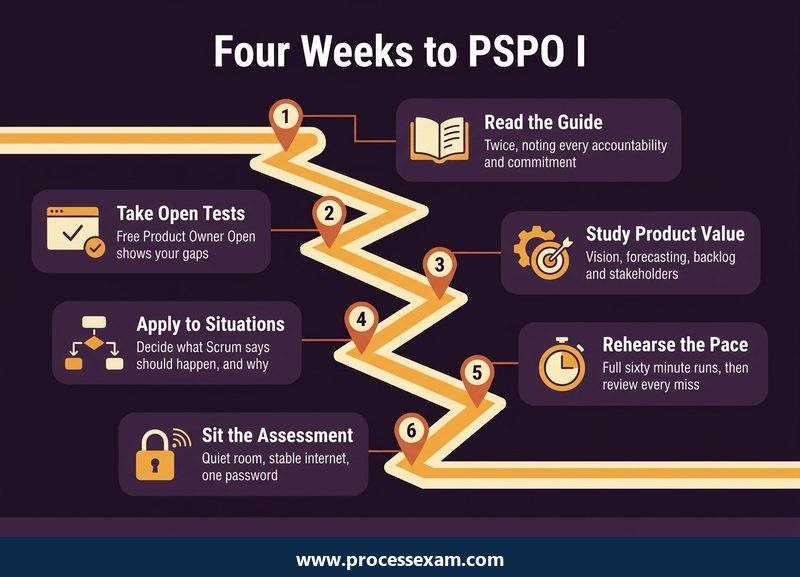
Week 1: read the guide, then measure yourself
Read the Scrum Guide twice. On the first pass, read it straight through. On the second, underline every sentence that uses the words "accountable", "must", "only" or "commitment", and write one line in your own words for each. Then take Scrum.org's free Product Owner Open assessment, which gives you a short set of questions drawn at random from a larger pool, and its Scrum Open assessment. Do not worry about the scores yet; note which questions surprised you.
Week 2: study the product topics
Spend this week on the six product topics listed earlier. Read the Evidence-Based Management guide once. For forecasting, make sure you can explain why forecasts rely on what has already happened and why they are updated every Sprint. For stakeholders, practise explaining how the Sprint Review and a transparent backlog replace status reports. Write a short explanation of each topic as if teaching a new colleague; gaps show up quickly when you have to put them into sentences.
Week 3: apply it to situations
Now test your judgement rather than your recall. Take common workplace situations, such as a sponsor asking for a fixed date and scope, a team asked to work from two backlogs or a Product Owner who is never available, and decide what Scrum says should happen and why. Retake the open assessments, aiming for full marks several times in a row, because the questions change between attempts. This is also the week to move to longer question sets. If you want full-length timed sets written around the same focus areas, our PSPO I practice test gives you 80-question runs with explanations to review afterwards.
Week 4: build pace and confidence
Run at least two complete timed sessions of 80 questions in 60 minutes. Review every question you got wrong and every one you guessed, and trace each back to a sentence in the Scrum Guide. Re-read the guide once more two days before the test. On the last day, rest; cramming new material at this point tends to blur the precise wording you have spent three weeks learning.
How do you handle 80 questions in 60 minutes on the day?
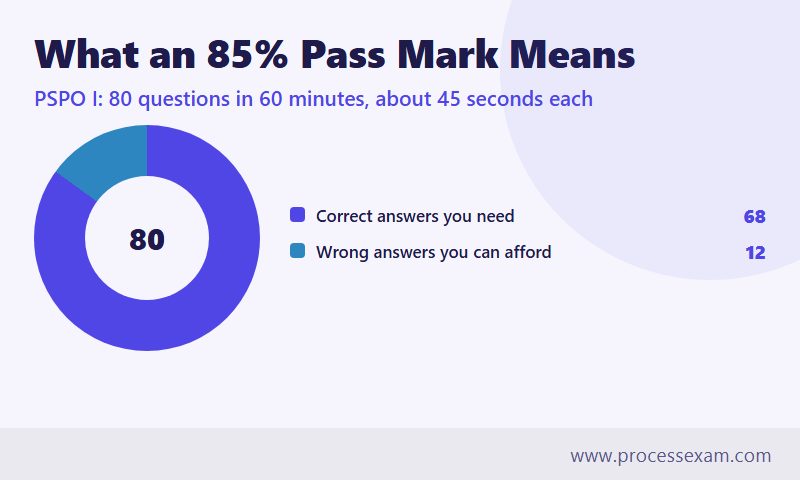
Sixty minutes for 80 questions works out to 45 seconds a question on average. That is enough time for a candidate who knows the guide and not enough for one who is searching it. The pass mark gives you a clear target as well: 85% of 80 means at least 68 correct answers, so you can afford no more than 12 wrong.
Before you start
- Choose a quiet time and a stable internet connection. The password works once, so an interrupted session is costly.
- Close other tabs and silence notifications. Searching during the test mostly burns seconds you do not have.
- If you plan to use the translation plugin, set it up exactly as Scrum.org's instructions describe before you begin.
During the test
- Answer from the guide, not from your office. When your company's practice and the Scrum Guide differ, the guide wins every time.
- Watch absolute words. "Must", "only", "always" and "never" often mark the difference between a correct statement and a near miss.
- Count the answers asked for. On Multiple Answer questions, check how many options the question wants before you choose.
- Do not get stuck. If a question has taken a minute and you are still unsure, choose the answer that best respects value, transparency and self-management, and move on.
- Check the clock at the halfway mark. By 30 minutes you should be past question 40; if you are not, speed up on the straightforward questions.
If the result is not a pass
Read the competency breakdown carefully. A low score in the product area usually means week 2 needs repeating; a low score on the framework means the guide needs another close reading. Buy a new password when your practice scores are consistently above the pass mark, not straight away.
Is PSPO I worth it, and where can it lead?
For most people in or near a product role, yes. The certification is valid for life with no annual renewal fee, so the $200 USD is a single cost rather than a subscription. The Credly credential makes it easy to verify, and because Scrum.org awards it only for passing a demanding test, recruiters and hiring managers read it as proof that you know the framework precisely. It is especially useful when you are moving into a Product Owner position for the first time, or when you work with a team whose Scrum has drifted and you need a firm, shared reference point.
Be realistic about what it will not do. It will not replace experience, and on its own it rarely decides a hiring outcome for senior product roles. Its value is in making you a better Product Owner sooner, and in showing employers that you understand the accountabilities before you are trusted with a product.
Where to go next
- PSPO II for an advanced level of product ownership, covering product vision, backlog management, release and portfolio planning, business strategy and stakeholders in more depth.
- PSPO III, Scrum.org's distinguished level, for people who own a vision and work across a variety of team and organizational situations.
- PSPO-AI Essentials for applying AI tools to product discovery, customer understanding, experimentation and decision-making.
- PSPBM Skills for a focused credential on managing a Product Backlog that is transparent and centred on value.
Whichever route you choose, the habits PSPO I builds, reading the rules precisely and judging every decision by the value it creates, are the ones that carry forward.
Frequently Asked Questions
What is the PSPO certification?
PSPO stands for Professional Scrum Product Owner, a set of Scrum.org certifications for people who own a product in Scrum. PSPO I is the first level. It shows a fundamental understanding of Scrum and of the Product Owner accountabilities, and it is earned by passing an online assessment rather than by attending a class.
How hard is the PSPO I exam?
It is demanding mainly because of the pass mark and the pace. You must score 85%, which means at least 68 correct answers out of 80, within 60 minutes. Candidates who read the Scrum Guide closely and think in terms of product value usually pass; those relying on workplace habits often fall short.
How much does PSPO I cost, and does it expire?
The assessment costs $200 USD per attempt, and each password covers one attempt but has no expiration date. Once you pass, the certification is valid for life and carries no annual renewal fee, so there is no recurring cost to keep it.
Do I need to take a course before the PSPO I assessment?
No. Scrum.org strongly recommends its instructor-led Professional Scrum Product Owner class or the self-paced Fundamentals course, but attendance is not a prerequisite. Many candidates prepare on their own with the Scrum Guide and Scrum.org's free open assessments. Scrum.org training classes include a free attempt at the associated certification.
Is PSPO I the same as the Certified Scrum Product Owner?
No. PSPO I is awarded by Scrum.org after you pass its 80-question assessment. Certified Scrum Product Owner is a separate credential from a different organization, Scrum Alliance, and is tied to attending a course. Both cover the Product Owner in Scrum, but they are earned and maintained differently.
- Scrum |
- Scrum.org Professional Scrum Product Owner Test Questions |
- PSPO I Question Bank |
- Scrum.org Professional Scrum Product Owner Book |
- Professional Scrum Product Owner Certification Cost |
- Professional Scrum Product Owner Certification Requirements |
- Scrum.org Professional Scrum Product Owner Sample Questions |
- PSPO I Exam Questions Download |
- PSPO I Test Questions |
- Professional Scrum Product Owner PDF


