
PSM-AI Essentials Certification: Exam, Training and Study Plan
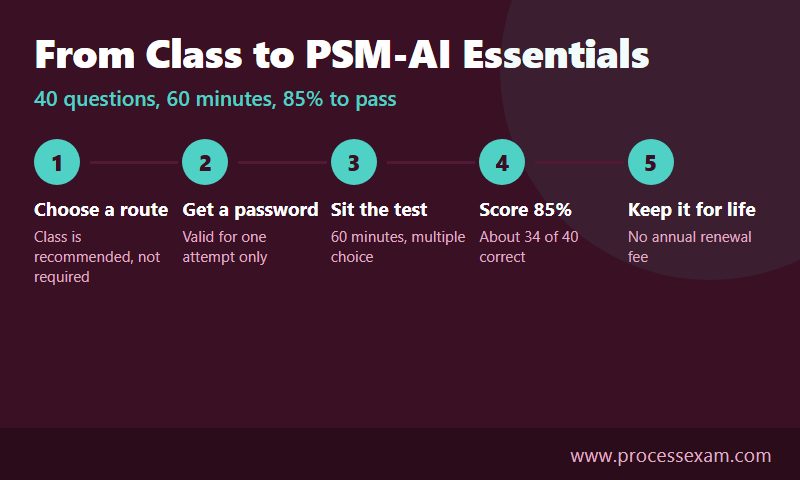
AI will not replace Scrum Masters, because facilitation, coaching and accountability for Scrum stay human work, but the role now includes helping a team use AI well. The Scrum.org PSM-AI Essentials assessment tests exactly that: 40 multiple-choice questions in 60 minutes, an 85% pass mark and a fee of $200 per attempt. This guide covers what is tested, whether to take the course, and a two-week plan.
Will AI replace Scrum Masters, and what does PSM-AI Essentials prove?
The fear behind the question is understandable. Generative AI can draft a retrospective agenda, summarise a long thread of comments, cluster feedback and suggest sprint goals in seconds. If those were the whole job, the job would be at risk. They are not the whole job. The Scrum Guide gives the Scrum Master accountability for the Scrum Team's effectiveness and for Scrum being understood and enacted, and neither of those can be handed to a tool. A tool cannot notice that two developers have stopped talking to each other, cannot earn a Product Owner's trust and cannot decide that a team needs a hard conversation rather than a better template.
What changes is the surrounding context. Teams already use AI to write code, tests, stories and documentation, and someone has to help them do it without lowering transparency or quality. That is a Scrum Master concern. Scrum.org describes the PSM-AI Essentials certification as evidence that you understand how to apply AI tools and practices to improve Scrum Team effectiveness, including generative AI for collaboration and transparency and a commitment to responsible, ethical use and its impact on the Definition of Done.
Read that description carefully, because it tells you what the credential is and is not. It is a knowledge check on applying AI in the Scrum Master role. It is not a machine learning qualification, it does not test how to build models, and it does not ask you to write code. The training page says the same thing in plain terms: the course is for people who want to work with AI tools in practice, not those seeking advanced data science content.
So the useful way to frame the credential is this. Passing shows that you can tell where AI helps a Scrum Team, where it creates risk, and how to ask a language model for something usable. Employers and teams still judge the rest by what you do in the room.
What are the PSM-AI Essentials exam facts?
The figures below come from Master data and match the certification details Scrum.org lists on its assessment page, which I checked in September 2026.
| Exam detail | PSM-AI Essentials |
|---|---|
| Full name | Scrum.org Professional Scrum Master - AI Essentials |
| Exam code | PSM-AI Essentials |
| Vendor | Scrum.org |
| Number of questions | 40 |
| Duration | 60 minutes |
| Passing score | 85% |
| Exam fee | USD $200 per attempt |
| Format and language | Multiple choice, English |
| Validity | Lifetime, no annual renewal fee |
Three details from Scrum.org's page are easy to miss. Each password is valid for one attempt only, though it has no expiry date. A free Credly digital credential comes with a pass. And the four question categories are named on the page: AI Theory and Primer, AI Security and Ethics, AI for Scrum Masters, and Effective AI Prompting. Scrum.org also notes that many candidates take the test in their own language with the Google Translate plugin, and asks you to follow its instructions for doing so; it does not guarantee translation quality.
Because the vendor changes its assessments from time to time, treat the assessment page as the final word on the day you book. If you want to see how the question style feels first, the free PSM-AI Essentials sample questions on ProcessExam are a quick way to check your starting point.
What do the four topic areas actually test?
Scrum.org lists four categories and does not publish a percentage weighting for them, so do not budget study time by an imagined split. Treat all four as examinable and give the most time to the one where your current answers are weakest.
AI Theory and Primer
This area checks that you can speak accurately about what AI is. The course outcomes name machine learning, deep learning, generative AI and agentic AI, so expect to distinguish them. A useful test is whether you can explain each in two sentences to a Product Owner who has never studied the subject: what it does, what it needs to work, and what it cannot be trusted to do.
The limits matter as much as the capabilities. A language model produces plausible text, not verified facts, so it can state something false with complete confidence. It has no knowledge of your team's context unless you supply it. Its answers can differ from one request to the next. Questions in this area tend to reward candidates who hold both sides: AI is useful, and AI output must be checked.
AI Security and Ethics
This is where the credential connects to a Scrum Master's responsibility for how a team works. Think about what happens to information when you paste it into an AI tool. A sprint backlog may contain customer names, unreleased plans or contract details. A retrospective transcript may contain frank comments about named colleagues. Before any of it goes into a tool, someone should know where it goes, who can see it and whether the organisation permits it.
Ethics questions cover bias, fairness, transparency and accountability. If an AI tool ranks backlog items, summarises team sentiment or drafts an assessment of someone's work, the people affected deserve to know, and a person remains accountable for the result. The certification page ties this to the Definition of Done: if AI produced part of an Increment, the team's quality standard still applies to it, and the team owns the outcome.
AI for Scrum Masters
This area is the practical heart of the assessment. It asks how AI can strengthen your accountabilities: helping the team with effectiveness, supporting Scrum events, coaching, removing impediments and helping the organisation. The next section works through the events one by one. The point to hold onto is that AI supports the Scrum Master and the team; it does not stand in for a Scrum event, a Scrum role or an accountability.
Effective AI Prompting
Prompting is the most hands-on topic, and the one where practice beats reading. A weak prompt is short and vague: "Give me retrospective ideas." A strong one states who the audience is, the purpose, the context, the format wanted and any constraints. For example: "Our team of six has finished a sprint where two stories were not completed. Suggest three retrospective activities of about 20 minutes each that look at how work was pulled in, avoid blaming individuals, and can run remotely. Give each a goal and a first question."
You can expect questions about giving context, asking for a specific format, iterating when the first answer is weak, and checking the result before using it. Practise by using a real assistant on real Scrum Master tasks and writing down what changed when you added context. The habit you are building is treating the first response as a draft.
Where does AI genuinely help in Scrum events, and where should it stay out?
A good way to prepare for the applied questions is to walk through the events and ask two things each time: what could AI take off the team's plate, and what must stay a human conversation. The table gives one way to think about it. It is a study aid based on the Scrum Guide's purpose for each event, not a list taken from the exam.
| Event | Where AI can help | What should stay human |
|---|---|---|
| Sprint Planning | Drafting a first-cut Sprint Goal wording, spotting unclear Product Backlog items, listing questions to clarify | Choosing the goal, forecasting what fits, the team's commitment to it |
| Daily Scrum | Summarising progress for a team that is spread across time zones | The Developers' own conversation about progress toward the Sprint Goal |
| Sprint Review | Tidying notes, drafting a stakeholder summary of the Increment | Collaboration with stakeholders and the adaptation of the Product Backlog |
| Sprint Retrospective | Suggesting activities, grouping themes from anonymous input | Honest discussion, trust and the team's decisions on improvement |
Preparing events without taking them over
Scrum Masters often spend evenings preparing. AI can shorten that: draft an agenda, propose a format for a workshop, or turn a wall of sticky-note text into themes. The risk is over-reliance. If the team starts to expect an AI-generated retrospective every time, the format goes stale and the facilitator stops listening. A sound approach is to use AI for preparation and for options, then choose deliberately.
Helping with transparency
Another legitimate use is making information easier to see. AI can help summarise a long Product Backlog, spot near-duplicate items or draft plain-language explanations of technical terms for stakeholders. Transparency is one of the three pillars of empiricism in the Scrum Guide, so anything that makes the work easier to inspect fits the role. But the summary is only as good as the source data and your review of it; a confident summary that misses a key dependency makes things less transparent, not more.
Coaching the team's own use of AI
The exam looks beyond your personal use. The training page lists how AI can be applied by the members of a Scrum Team, and how it influences the organisation. Developers may use AI for code and tests, Product Owners for research and story drafts. A Scrum Master helps the team agree working rules: what may be shared with tools, how AI-assisted work is reviewed, and how the Definition of Done reflects it. A team that agrees these rules in a Retrospective is better placed than one that discovers the gaps after an incident.
What AI should not do for you
Some tasks look tempting but conflict with the role. Deciding who is underperforming from message data, scoring individuals on sentiment, or replacing the team's discussion of impediments with a generated list all undermine trust and self-management. If an exam scenario describes a Scrum Master who hands the human parts of the role to a tool, the answer that protects people, transparency and accountability is usually the right one.
Should you take the course or just sit the exam?
Scrum.org states that attending a training class is not a prerequisite, so you can buy a password and sit the assessment directly. It also says a class is highly recommended, and the two routes are worth weighing honestly.
| Question | Exam only | Course, then exam |
|---|---|---|
| Cost | USD $200 per attempt | Set by the class provider; includes a free attempt |
| Time | Your own study plan | Generally one day in person, or shorter days spread out when delivered as a Live Virtual Class |
| Second chance | Buy another password | Official class participants who sit the exam within 14 days of receiving the password and score under 85% get a second attempt at no extra cost |
| Best for | Scrum Masters who already use AI tools daily | Those who want guided practice and discussion with a trainer |
Details about the class come from Scrum.org's PSM-AI Essentials training page. Read the course price from the provider you book with, because classes are run by different trainers and the fee is not a single figure. The page also says the class suits Scrum Masters, Agile Coaches, Agile leaders and team facilitators who already understand Scrum and have worked on a Scrum Team, and it recommends Scrum Master training and certification beforehand.
That last point deserves attention. The assessment assumes you know Scrum. Its questions ask how AI applies to Scrum, and a candidate who is unsure about the Scrum Master accountabilities or the purpose of each event will struggle to answer them however good their prompting is. If your Scrum knowledge is rusty, spend a few evenings with the Scrum Guide before you start on AI topics.
A simple way to choose
If your employer pays for training, the class is a sensible route because the free attempt and the second-chance offer lower the pressure. If you are paying yourself and already use AI assistants in your work, going directly to the exam at $200 with a focused study plan is realistic. If you have no experience with AI tools at all, budget extra time for hands-on practice whichever route you take, because the prompting questions are hard to answer from reading alone.
How hard is an 85% pass mark on 40 questions?
Candidates who describe the exam as moderate usually say the same thing: the content is not deep, but the pass mark leaves little room. If every question carries the same weight, 85% of 40 is 34 correct answers, which allows six misses. Scrum.org does not say how questions are weighted, so use that as a working target rather than a promise, and aim to score higher than 85% in practice.
The pace is friendly. Sixty minutes for 40 questions is a shade under a minute and a half each, and most people finish a first pass with time to review. The demanding part is accuracy. Many wrong answers on a test like this are not absurd; they are plausible statements that fail on one word, such as an option that says AI will "decide" something a person remains accountable for, or one that treats a generated summary as verified fact.
Where well-read candidates lose points
- Trusting the output. Any option that treats AI output as correct without review is a red flag. The safe answer includes checking, especially for facts, figures and anything customer-facing.
- Handing over the human part. Options that let AI run a Scrum event, choose the Sprint Goal or judge individuals conflict with the role and with self-management.
- Ignoring data protection. If a scenario involves confidential or personal information, the answer that considers where the data goes before using the tool is the likely one.
- Vague prompting. When asked how to improve a poor result, the strong choice adds context, a role, a format and constraints rather than simply repeating the request.
- Weak Scrum basics. Confusing accountabilities, mixing up who owns the Definition of Done, or misplacing an event will cost marks on questions that only look like AI questions.
- Answering for a tool you know. The exam tests principles, not one vendor's product. An answer that only makes sense for a particular assistant is usually wrong.
Reading a scenario the way the exam frames it
Take a short example. A Scrum Master pastes a full retrospective transcript, with names, into a public AI chatbot and asks for a summary of who caused problems. Two things are wrong: the data has gone somewhere the team did not approve, and the purpose turns a learning conversation into blame. The better response is to stop, tell the team what happened, agree what may be shared with tools, and use anonymised themes next time. Notice how the sensible answer combines security, ethics and Scrum values. Many questions work that way, so practise reading each scenario for all three.
How do you prepare in two weeks?
This plan assumes you already know Scrum and can study for about an hour a day. If your Scrum knowledge or your experience of AI tools is thin, stretch each block and take three or four weeks.
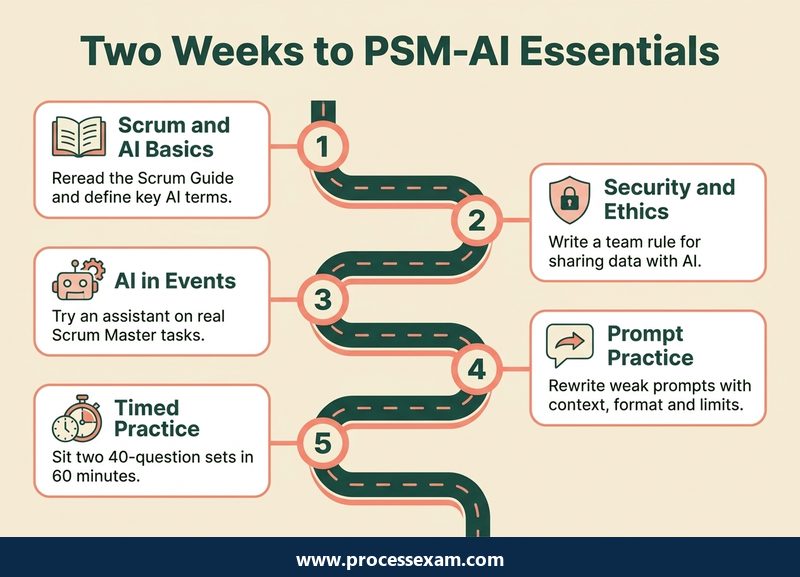
| Days | Focus | What to finish |
|---|---|---|
| 1-2 | Scrum baseline and AI vocabulary | Reread the Scrum Guide; explain machine learning, deep learning, generative AI and agentic AI in your own words |
| 3-4 | Security and ethics | Write a one-page team agreement on what may be shared with AI tools and how output is reviewed |
| 5-8 | AI for Scrum Masters | Use an assistant on real tasks for each Scrum event and note what you would keep, change or reject |
| 9-11 | Prompting practice | Rewrite five weak prompts using audience, context, format and constraints; compare outputs |
| 12-14 | Timed practice and review | Two 40-question sets in 60 minutes; write down why every missed answer was wrong |
Turn the study time into evidence
The plan works because each block ends with something you wrote or did, not something you read. The team agreement from days 3 and 4 doubles as a useful document at work, and a set of prompts you refined is a small library you can reuse. When a candidate can explain why a rewritten prompt worked, the exam's prompting questions become straightforward.
Use practice questions to find gaps, not to memorise
Timed sets show whether you can hold your pace and which topics are weak. The PSM-AI Essentials practice exam on ProcessExam is set up in the same 40-question, 60-minute format, so you can rehearse the timing. After each set, sort your misses by category. If most fall in one area, return to the source material for that area instead of doing more questions on it, because repeating questions mostly repeats the same misunderstanding.
The day before and the day itself
Skip new material the evening before. Reread your notes, your team agreement and your list of missed questions. Check that you have your password, a stable connection and a quiet space. During the assessment, read the last sentence of each scenario first so you know what is being asked, remove options that trust AI output blindly or give away human accountability, and flag anything taking more than two minutes. Leave the last few minutes to revisit those flags.
What will your team notice once you hold the credential?
The plain answer is that the credential gives you a shared vocabulary and evidence of a baseline, and the rest depends on how you use it. Scrum.org states that the certification is lifetime with no annual renewal fee, and that a Credly digital credential is included, so you can show it on a profile without extra cost.
Conversations you are better placed to lead
After preparing, you can start conversations that many teams avoid. What are we allowed to paste into AI tools? Who reviews AI-assisted work, and how does that show in our Definition of Done? Which repetitive tasks in our events are worth automating, and which are worth keeping human because they build trust? Leading those talks is a natural Scrum Master contribution and needs no special authority, only a clear framing.
Small experiments, honestly measured
Scrum is empirical, and AI adoption should be too. Choose one modest change, for example using an assistant to prepare Sprint Review summaries, run it for a couple of Sprints, and inspect the result with the team. Did it save time? Did stakeholders find it clearer? Did anyone feel unheard? Treat those answers as data. That approach reflects how the certification describes the role: applying AI to improve effectiveness while staying responsible.
Where it sits among Scrum.org's other credentials
PSM-AI Essentials is a specialised assessment rather than a replacement for the core Scrum Master certifications. Scrum.org itself lists PSM I, PSM II and PSM III alongside it on the assessment page, and its training page recommends Scrum Master training and certification first. If you have not yet proved your Scrum foundations, PSM I is the logical first credential, and PSM-AI Essentials then shows you can apply AI on top of it. No salary claim is made here because Scrum.org does not publish one for this credential, and any figure would be a guess.
When you are ready to test yourself, start with the free sample questions, take one timed set, and read the assessment page again before you buy a password. That order tells you how much preparation you still need and avoids paying for an attempt before you are ready.
Frequently Asked Questions
What is the PSM-AI Essentials exam?
It is the Scrum.org Professional Scrum Master - AI Essentials assessment: 40 multiple-choice questions in 60 minutes, in English, with an 85% passing score and a fee of USD $200 per attempt. Questions cover AI Theory and Primer, AI Security and Ethics, AI for Scrum Masters and Effective AI Prompting.
Do you need the training course before taking PSM-AI Essentials?
No. Scrum.org says attendance is not a prerequisite, but it highly recommends the class. Anyone can buy a password and sit the assessment. Official class participants also receive a free attempt, plus a second one if they score under 85% within 14 days of getting the password.
What is the passing score for PSM-AI Essentials?
The passing score is 85%. On a 40-question test that works out to 34 correct answers if every question counts equally, though Scrum.org does not publish the weighting. You have 60 minutes, which is roughly ninety seconds per question, so accuracy matters more than speed.
How much does the PSM-AI Essentials certification cost?
The assessment costs USD $200 per attempt, and taxes may apply at checkout. Each password covers one attempt only. Taking an official Scrum.org class instead includes one free attempt in the class fee, which is set by the trainer, not by a single published price.
Does the PSM-AI Essentials certification expire?
No. Scrum.org describes it as a lifetime certification with no annual renewal fee, and a free Credly digital credential is included. Passwords have no expiry date but are valid for one attempt only. Because assessments can change, check the Scrum.org page before you book.
- Scrum |
- PSM-AI Essentials Question Bank |
- PSM-AI Essentials Body of Knowledge (BOK) |
- PSM-AIE Simulator |
- PSM-AIE Mock Exam |
- Scrum.org PSM-AI Essentials BOK PDF |
- Scrum.org PSM-AIE Question Bank |
- Scrum.org PSM-AIE Book |
- Scrum.org PSM-AIE Study Guide |
- PSM-AIE Certification |
- PSM-AIE Certification Cost |
- PSM-AIE Certification Requirements |
- PSM-AI Essentials Exam Questions Download |
- PSM-AI Essentials Test Questions |
- Scrum.org PSM-AIE Exam Questions |
- Scrum.org PSM-AIE Sample Questions |
- PSM-AIE |
- PSM-AIE PDF |
- Scrum.org Professional Scrum Master - AI Essentials Test Questions |
- Professional Scrum Master - AI Essentials Certification Cost |
- Professional Scrum Master - AI Essentials Certification Requirements |
- Scrum.org Professional Scrum Master - AI Essentials Book |
- Professional Scrum Master - AI Essentials PDF |
- Scrum.org Professional Scrum Master - AI Essentials Sample Questions


