
PRMIA APRM Certification: Risk Career Guide and Study Plan
Risk teams hire people who can already speak the language of the desk: exposure, capital, governance, model limits. The PRMIA Associate PRM certificate is how many analysts, auditors, accountants and systems staff prove they can, long before they have years of front-line risk work behind them. It is one exam, 90 multiple-choice questions in 180 minutes with 60% to pass, and this guide covers how to earn it.
APRM is the short name for the Associate Professional Risk Manager certificate, awarded by the Professional Risk Managers' International Association (PRMIA). PRMIA positions it for staff entering the risk profession and for the people who meet risk work from the side: auditing, accounting, legal, research and systems roles that still need to understand how risk is measured, reported and controlled.
What follows answers the questions candidates in that position actually ask. Which roles the certificate supports. Whether you are eligible to enrol. What the nine exam domains ask and how many questions each one carries. When you can sit the exam and how it is delivered. How the certificate differs from PRMIA's PRM designation. What it costs. And how to turn eight weeks of evenings into a pass.
Which risk roles does the APRM certificate open up?
The Associate PRM is a breadth credential. It does not make you a quantitative modeller, and PRMIA does not present it as a substitute for experience. What it does is prove that you understand the whole risk landscape well enough to be trusted with work inside it, which is exactly the gap that stops many capable finance, audit and operations people from moving into a risk team.
Roles the certificate supports
Employers most often see the Associate PRM on the profiles of people moving in one of two directions. The first is into risk from an adjacent function: an internal auditor who wants to join the operational risk team, a management accountant moving to treasury, a business analyst joining a risk technology project. The second is upwards within an existing junior risk seat: a risk analyst who wants to be given the credit portfolio rather than the data extract.
- Risk analyst in market, credit or operational risk, where the day job mixes measurement with reporting.
- Credit risk associate, working with scoring models, ratings, delinquency and loss rates.
- Treasury or ALM analyst, where interest rate gap, funding liquidity and funds transfer pricing are routine vocabulary.
- Operational risk and resilience roles, including loss data, key risk indicators and scenario work.
- Compliance, audit and regulatory reporting, where Basel pillars and capital definitions come up constantly.
- Risk technology and change roles, where the person who understands both the system and the risk framework is rare and valuable.
Where Associate PRM holders actually work
PRMIA states that holders of the certificate include staff from large banks and corporations, advisory services groups, universities, government agencies and other non-financial organisations, naming employers such as EY, Standard Bank, Postal Savings Bank of China and Absa among the organisations represented. That mix matters. Risk management has spread well beyond bank trading floors into insurers, asset managers, fintech lenders, corporate treasuries, regulators and consultancies, and the certificate reads the same way in all of them.
One caution worth stating plainly, because it saves disappointment. The Associate PRM is a certificate that validates knowledge; it is not a professional designation, and it will not by itself move an experienced risk manager into a head-of-risk role. Its value is concentrated at the point of entry and at the first promotion, where a hiring manager needs evidence that you already know the framework the team works inside.
Who can enrol for the APRM exam, and what do you need first?
This is the question that stops most people from starting, and the answer is simpler than they expect. There is no degree requirement, no supervised-experience log and no sponsor to find. PRMIA describes the certificate as designed for individuals with at least two years of experience in the financial or risk management profession, but that is guidance on who will get value from it rather than a barrier at the enrolment screen.
PRMIA sets out three requirements for the certificate on its official Associate PRM page and in the candidate guidebook:
- A PRMIA network account. You must have an account at prmia.org to enrol. Paid membership is not required to enrol or to achieve the certificate, although Sustaining members pay the member price.
- A commitment to the PRMIA Standards of Best Practice, Conduct and Ethics. This is not a form you sign and forget; the standards are assessed as part of the examination.
- The examination. You must pass the Associate PRM exam within 12 months of enrolling.
Two timing rules follow from that third requirement and both are easy to miss. The enrolment period runs for 12 months (365 days) from the date you pay the programme fee, and the exam has to be attempted inside that window. On the other side of the exam there is nothing more to do: PRMIA states that its certificate programmes carry no recertification or maintenance requirements, so the credential does not expire and there are no continuing-education points to collect. Holders are expected to keep displaying a commitment to the same ethics standards.
If you are weighing up whether to start now or later, work backwards from those 12 months. Paying the fee starts the clock, so enrol when you can realistically give the syllabus two to three months of evenings, not when you first think about it.
What does the APRM exam actually ask you?
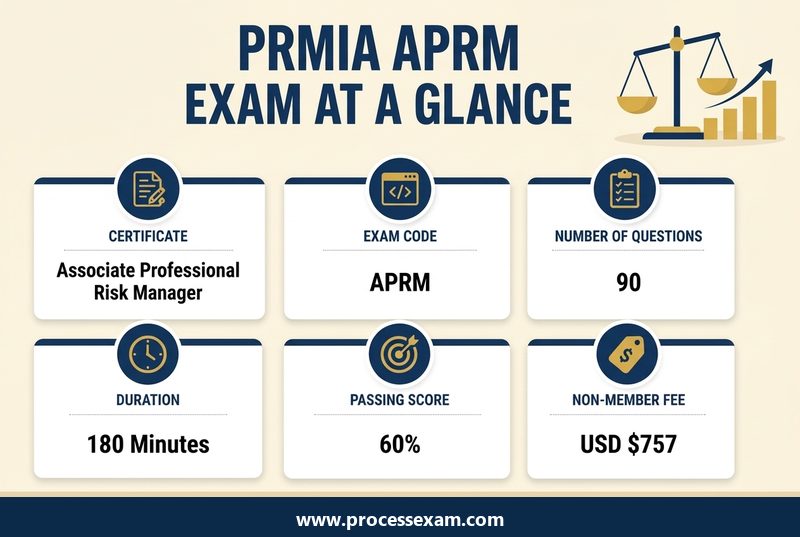
Here are the exam facts in one place before the detail.
| Exam detail | Associate PRM (APRM) |
|---|---|
| Certificate | PRMIA Associate Professional Risk Manager (APRM) |
| Exam code | APRM |
| Awarding body | PRMIA |
| Number of questions | 90 |
| Duration | 180 minutes |
| Passing score | 60% |
| Fee (USD) | Sustaining Member Price - $658 Contributing Member Price - $679 Non-member Price - $757 |
The 90 questions are multiple choice with four options and a single correct answer, and PRMIA publishes exactly how they are distributed across nine domains. That distribution is the most useful planning document you will find, because it tells you where marks live. The counts below come from the Associate PRM candidate guidebook, which also lists the reading and the learning objectives behind each domain.
| Domain | Questions |
|---|---|
| A. Risk Management, Corporate Risk Management, and Risk & Return Theory | 12 |
| B. Risk Governance and Financial Regulation | 12 |
| C. Fintech and Its Impact on Financial Intermediation and Risk Management | 6 |
| D. Introduction to Financial Markets | 12 |
| E. Market Risk, Asset-Liability Management, Stress Testing, and Scenario Analysis | 12 |
| F. Credit Scoring, Retail Credit Risk Management, Commercial Credit Risk Management, Risk Management Practices | 12 |
| G. Operational Risk | 6 |
| H. Risk Capital Attribution and Risk-Adjusted Performance Measurement | 6 |
| I. Case Studies and PRMIA Standards | 12 |
The five heavyweight domains
Six domains carry 12 questions each and three carry six, so two thirds of the paper sits in the heavy group. Domain A asks you to define risk types and the risk management process, describe the role of the risk manager, and handle risk and reward, hedging, diversification and risk-adjusted returns at a conceptual level. Domain B is regulation and governance: the Basel Accords, economic versus regulatory capital, Tier 1 against Tier 2, the three pillars, the roles of the board and the chief risk officer, and climate risk disclosure mandates.
Domain D covers the structure of global markets and the instruments in them, from money, bond, stock and foreign exchange markets to futures, over-the-counter, commodities, energy and crypto assets. Domain E is the measurement core: interest rate risk and what drives it, yield and forward curves, DV01, duration and convexity, value at risk and expected shortfall with their known weaknesses, asset and liability management, funding liquidity measures, funds transfer pricing, and stress testing and scenario analysis. Domain F runs the credit chain end to end, from credit scores and retail delinquency through rating agencies and internal ratings to counterparty exposure, netting, securitisation, risk-based pricing and credit derivatives.
Domain I is the one candidates consistently underestimate. Twelve questions, the same weight as market risk, come from the PRMIA Standards of Best Practice, Conduct and Ethics, the governance principles and bylaws, and a fixed set of case studies: Barings, Long-Term Capital Management, Metallgesellschaft, National Australia Bank FX options, Orange County, Riggs Bank, and the more recent additions of SVB and FTX. Each case has specific lessons, and the questions test those lessons rather than the story.
The three six-question domains
Domain C is fintech: what it is, the services it provides, the Merton approach to the core functions of a financial system, the risks and opportunities for consumers and banks, and the regulatory risks that follow. Domain G is operational risk, covering operational losses, how operational events link to other risk types, key risk indicators against key risk drivers, basic frameworks, scenario-based processes, model risk and the role of insurance. Domain H is risk capital attribution and RAROC, including how risk capital differs from regulatory capital and how it is used in business decisions.
Six questions each still means 18 marks between them, which is more than the gap between passing and failing for most candidates. Treat them as short topics to finish rather than topics to skip. A domain-by-domain breakdown of the same syllabus areas, written out as study topics, sits on the ProcessExam APRM certification exam syllabus page if you want it in checklist form.
What the questions feel like
The exam is not a calculation paper. PRMIA states that calculators are neither needed nor provided, which tells you what the questions are doing: they test whether you can interpret a measure and choose the right response, not whether you can grind through arithmetic. Expect to be asked what a value-at-risk figure fails to capture, why a particular capital charge applies, which committee owns an escalation, or which lesson a named case study illustrates. The exam is offered in English only.
When can you sit the APRM exam, and how is it delivered?
There are no fixed sitting windows to wait for. PRMIA has contracted with Pearson VUE to deliver the Associate PRM examination, and exams are offered throughout the year, either at a Pearson VUE test centre or online through the remote proctored service. You choose the date, not a calendar published months in advance.
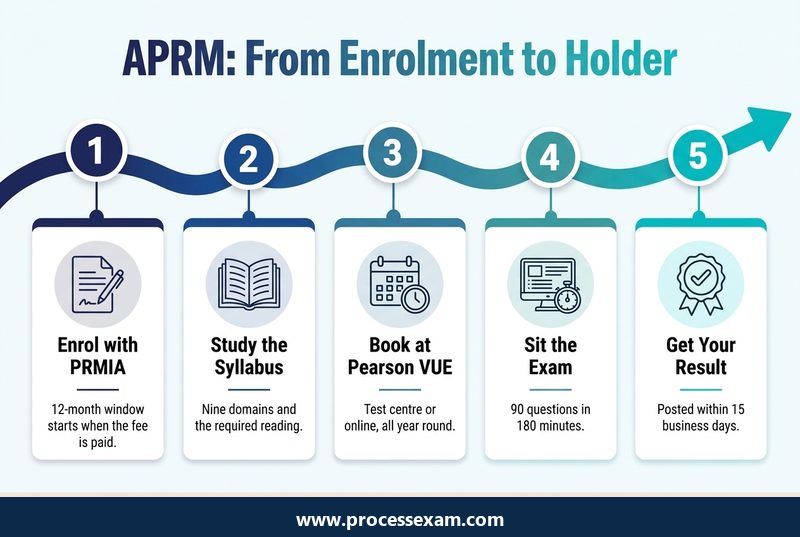
The sequence from payment to result is short and worth knowing before you start, because two steps have deadlines attached.
- Enrol and pay. Instant access to the digital textbook follows, and within two to three business days you receive an email explaining how to schedule the exam.
- Create your Pearson VUE account. Enter your profile details exactly as they appear in your PRMIA profile, because those details are what link the two records. You can then see your pre-approved exam and available dates at Pearson VUE's PRMIA page.
- Book, and reschedule free if you need to. Changes are free through Pearson VUE, but must be made at least one business day before the testing date; later than that and the whole exam fee is forfeited. Authorised exams also carry an expiry date visible in the Pearson VUE account.
- Check in. Arrive at the test centre at least 15 minutes early, or log in 30 minutes early for the remote proctored exam. Two forms of identification are required, the first being a current government-issued ID with a photograph and signature. Candidates who arrive late may not be admitted, and the full fee is still charged.
- Sit the exam. After a tutorial and a short message from PRMIA, you get your 180 minutes. No paper may be taken into the test centre, but an erasable board is provided on request, and the system lets you mark questions and return to them while time remains.
Results are posted to your PRMIA profile no later than 15 business days after the test date, with an email telling you how to view them. If the result is not the one you wanted, the retake rule is specific: candidates may sit the Associate PRM exam only once every 90 days, and those who do not pass are eligible to retake 90 days from the date of the last exam. PRMIA notifies you at the start of the month you become eligible and sends instructions for purchasing the retake.
One practical consequence of the 90-day rule deserves a sentence of its own. A failed attempt does not just cost a fee, it costs a quarter of your 12-month enrolment window. That is the strongest argument for not booking the exam until your practice scores are consistently above the pass mark.
How does the Associate PRM compare with the PRM designation?
Candidates searching for PRM certification often land on the Associate PRM by accident, so it is worth being precise about the difference. PRMIA offers certificate programmes and it offers the Professional Risk Manager (PRM) designation. The Associate PRM is a certificate: it validates knowledge of risk management concepts and practices, it is achieved through a single exam, and it carries no recertification requirement. The PRM designation is the senior credential, aimed at people who want to be recognised as risk leaders rather than to evidence a body of knowledge.
The two are related by design. PRMIA states that the subject matter in all of its certificate programmes is drawn from elements of the PRM designation, which is why the Associate PRM works as a first step: the vocabulary, the frameworks and the ethics standards carry over. The guidebook suggests the test to apply, and it is a good one. Ask whether you need validation of your knowledge or a professional designation, whether you already know the topics in the syllabus, and whether the programme is recognised in the region where you work.
Where the other PRMIA certificates fit
The Associate PRM is the broad one. PRMIA's certificate family also includes focused programmes in operational risk management, credit and counterparty risk management, and market, liquidity and asset liability risk management, alongside newer certificates in cyber risk management and AI risk management. Those go deep into one discipline and assume you already have the general picture.
For most people the sensible order is breadth first. Take the Associate PRM to get the whole map, then add the specialist certificate that matches the desk you actually sit on, and consider the PRM designation once you have enough experience for it to mean something. Going the other way round, specialising before you can place your specialism inside the wider framework, is how candidates end up with a credential that impresses nobody in an interview.
What does the APRM certificate cost, and what does the fee include?
The programme fee depends on your membership status with PRMIA:
- Sustaining Member Price - $658
- Contributing Member Price - $679
- Non-member Price - $757
Unlike many certifications, that single fee is not just an exam entry. PRMIA states that the programme fee includes authorisation for the required examination and access to the digital textbook The Essentials of Risk Management, Third Edition, edited by Michel Crouhy, Dan Galai and Robert Mark, plus the web-based resources candidates need: the PRMIA Standards, governance principles and bylaws, the case studies, and the Group of Thirty best practices. Access to the textbook is instant once the fee is paid.
Three cost rules are worth reading before you pay. Programme and exam fees are final, non-refundable and non-transferable. A retake is purchased separately, so the real cost of an underprepared first attempt is the retake fee plus three lost months. And membership is optional: you can enrol and achieve the certificate without paying for membership, though Sustaining members receive the member price on the programme and related fees, which narrows the gap between the two costs.
Is the spend worth it?
Judge it against what the fee replaces rather than against cheaper exams. You are buying a current textbook, a structured reading list built from it, a fixed syllabus with published question weights, a globally recognised certificate with no renewal costs, and a directory listing that employers can check. For someone trying to move into risk from an adjacent function, that package is usually cheaper than a single university module covering the same ground.
How should you plan eight weeks of APRM study?
The plan below assumes eight to ten hours a week and a working knowledge of finance. If markets and credit are new to you, stretch the middle weeks rather than compressing the practice at the end. Its logic is simple: give the most time to the domains that carry 12 questions, and finish every domain once before you start revising any of them twice.
| Week | Focus | What to finish |
|---|---|---|
| 1 | Domain A and the risk vocabulary | Risk types, the risk management process, the risk manager's role, risk and reward, hedging and diversification |
| 2 | Domain B governance and regulation | Basel Accords, economic versus regulatory capital, Tier 1 and Tier 2, the three pillars, board and CRO roles, climate risk disclosure |
| 3 | Domain D financial markets | Market structures and instruments across money, bond, stock, FX, futures, OTC, commodities, energy and crypto assets |
| 4-5 | Domain E market risk and ALM | Interest rate risk, yield and forward curves, DV01, duration and convexity, VaR and expected shortfall, ALM, liquidity, FTP, stress testing |
| 6 | Domain F credit risk | Credit scoring, retail delinquency and loss rates, ratings and transitions, counterparty exposure and netting, securitisation, credit derivatives |
| 7 | Domains C, G and H | Fintech and its regulatory risks, operational loss and KRIs, model risk, risk capital attribution and RAROC |
| 8 | Domain I and full revision | PRMIA Standards and governance, all eight case studies, timed practice and an error log |
How to use the last two weeks
Week seven is where most of the marks are won back, because it combines three small domains that are quick to finish with the first serious block of timed questions. Do the reading in the first half of the week and spend the second half answering questions under the clock. A timed set of APRM practice questions at that point tells you, domain by domain, where the remaining 20 marks of doubt are sitting, which is far more useful than another pass through the textbook.
Week eight belongs to Domain I and to revision. Read each case study once, then write three lines for each: what went wrong, which control failed, and which PRMIA standard it illustrates. Those three lines are usually enough to answer any question the exam asks about that case. Keep an error log through the week and sort it by domain, not by the order you made the mistakes; a domain with six entries is telling you something a chronological list hides.
How to know you are ready
The pass mark is 60%, so scoring 62% on a practice set is not a signal to book. Use three tests instead. Are your scores consistently above the pass mark on questions you have not seen before? Can you finish 90 questions inside 180 minutes with time left to revisit the ones you flagged? And can you explain why the three wrong options are wrong, not only why the right one is right? When all three are true, book the date.
Which mistakes cost candidates the APRM exam?
The failure patterns on a broad, conceptual exam like this one are predictable, and every one of them is avoidable.
- Treating Domain I as background reading. The standards and case studies carry 12 questions, exactly as many as market risk. Candidates who skim them give away marks they could have banked with two evenings of work.
- Studying by topic interest instead of by weight. Fintech is more enjoyable than funds transfer pricing, and it carries half as many questions. Let the published counts, not your preferences, set your hours.
- Expecting a calculation paper. PRMIA provides no calculator because the exam asks you to interpret measures. Learning to compute a VaR number without understanding what it misses is preparation aimed at the wrong target.
- Memorising definitions. Questions are framed around what you would do or conclude, so a definition learned without its context rarely survives contact with the four options.
- Booking the exam too early. The 90-day gap between attempts means an optimistic booking can cost a quarter of your enrolment window.
- Leaving the enrolment clock running. Twelve months feels generous until work gets busy. Set your own target date inside it, and book early enough that a reschedule is still possible.
In the last 48 hours
Stop adding material. Re-read your error log and your one-page summary: the nine domains with their question counts, the Basel pillars and capital tiers, the market risk measures with their weaknesses, the credit chain from scoring to transfer, and the eight case studies in three lines each. Confirm the appointment details, and if you are testing remotely, check the room, the connection and both pieces of identification the day before rather than on the morning.
During the 180 minutes
Two minutes per question is a comfortable pace, so the usual failure is over-thinking rather than running out of time. Read the last line of the question first, eliminate the options that contradict the framework before weighing the two that remain, and mark anything that takes more than three minutes so you can return to it. Finishing the first pass with 20 minutes in hand gives you a calm review of the marked questions, which is where a borderline score most often turns into a pass.
After the exam
Results reach your PRMIA profile within 15 business days. If you pass, you become a holder, you can display the digital certificate, and you are listed in the Associate PRM directory with no renewal to schedule. If you do not, write down the domains that felt weakest while the exam is still fresh, use the 90-day wait to work through them properly, and treat the second attempt as the one you were always preparing for.
Frequently Asked Questions
How many questions are on the APRM exam, and how long does it take?
The Associate PRM examination has 90 multiple-choice questions and a time limit of 180 minutes, which is three hours. Each question offers four options with one correct answer. That works out at roughly two minutes per question, so pace is rarely the problem for well-prepared candidates.
What is the passing score for the APRM exam?
The passing score is 60%. Because the exam is scored across nine domains of differing size, a safe target on practice tests is comfortably above that mark on questions you have not seen before, rather than a single result that just scrapes past 60%.
Do I need experience or a degree to enrol in the Associate PRM?
No formal degree or experience is required to enrol. PRMIA designs the certificate for individuals with at least two years of experience in the financial or risk management profession, but enrolment needs only a PRMIA account, a commitment to its ethics standards and the programme fee.
How soon can I retake the APRM exam if I fail?
Candidates may sit the Associate PRM exam only once every 90 days, and those who do not pass become eligible to retake it 90 days after the date of the last attempt. PRMIA sends instructions for purchasing the retake at the start of the eligible month.
How much does the APRM certificate cost?
The programme fee is listed as Sustaining Member Price - $658, Contributing Member Price - $679 and Non-member Price - $757. The fee covers exam authorisation and the digital textbook with the required web resources. Fees are non-refundable, and a retake is purchased separately.
Is the Associate PRM the same as the PRM designation?
No. The Associate PRM is a certificate that validates knowledge through one exam and carries no recertification requirement. The PRM is PRMIA's senior professional designation. The certificate programmes draw their subject matter from elements of the PRM designation, so the Associate PRM works as a first step.
Where is the APRM exam delivered, and when can I sit it?
PRMIA delivers the exam through Pearson VUE, either at a test centre or online with remote proctoring, and exams are offered throughout the year rather than in fixed windows. The exam must be attempted within the 12-month enrolment period that starts when the fee is paid.
- Risk Management |
- PRMIA Associate Professional Risk Manager Test Questions |
- APRM Question Bank |
- APRM Body of Knowledge (BOK) |
- Associate PRM Simulator |
- Associate PRM Mock Exam |
- PRMIA Associate Professional Risk Manager Book |
- PRMIA APRM BOK PDF |
- Associate Professional Risk Manager Certification Cost |
- Associate Professional Risk Manager Certification Requirements |
- PRMIA Associate PRM Question Bank |
- PRMIA Associate PRM Book |
- PRMIA Associate PRM Study Guide |
- Associate PRM Certification |
- Associate PRM Certification Cost |
- Associate PRM Certification Requirements |
- PRMIA Associate Professional Risk Manager Sample Questions |
- APRM Exam Questions Download |
- APRM Test Questions |
- Associate Professional Risk Manager PDF |
- PRMIA Associate PRM Exam Questions |
- PRMIA Associate PRM Sample Questions |
- Associate PRM |
- Associate PRM PDF


