
PRINCE2 Practitioner Jobs: Roles, Sectors and Career Path
A PRINCE2 Practitioner certificate will not get you a project manager's job on its own, but it does get your CV past the first filter on many adverts and gives you the shared vocabulary that project boards expect. This guide covers the jobs that ask for it, the sectors that value it, the ladder from project support to programme level, and what to pair it with.

Most people who search for PRINCE2 jobs want one thing: to know whether the credential changes their chances. The honest answer depends on where you start. A coordinator with two years of experience gains more than a manager who has run projects for fifteen years under another method.
What do PRINCE2 Practitioner job adverts actually ask for?
Open a UK job board and search for PRINCE2 Practitioner and you will see what the adverts put in their headlines. On the results page of one large UK board that we opened in October 2026, the titles ran from "IT Project Manager" and "Project Manager" through "Transformation Programme Manager", "Project Support Manager/PMO" and "NEC Project Manager" to graduate and trainee coordinator posts and a project-management trainer role. The employers were a mix of a housing association, a surveying firm, a technology partner, and recruitment or training companies.
That results page showed titles, employers, locations and pay, but not whether PRINCE2 was essential or merely welcome, and we did not open each advert in full. So treat the list as a sample of role types, not a count, and read the "essential" and "desirable" lines of any advert you apply to. Two patterns are worth knowing when you do:
- "PRINCE2 Practitioner" as a requirement tends to appear on public-sector, housing, health and large-programme posts, where the organisation runs its projects on the method.
- "PRINCE2 or equivalent" or "PRINCE2 desirable" is common on private-sector posts, where it signals that the hiring manager will accept a recognised method of any brand.
PeopleCert, which now runs the PRINCE2 certifications, gives its own list of who the Practitioner course suits. On its PRINCE2 7 Practitioner page it names project managers, programme managers, project coordinators, business analysts, PMO managers, risk managers, change managers and product managers, along with executives and senior leaders. That list is the best guide to the roles where the vocabulary helps, and it is wider than the single title "project manager".
Which job titles does the Practitioner certificate open up?
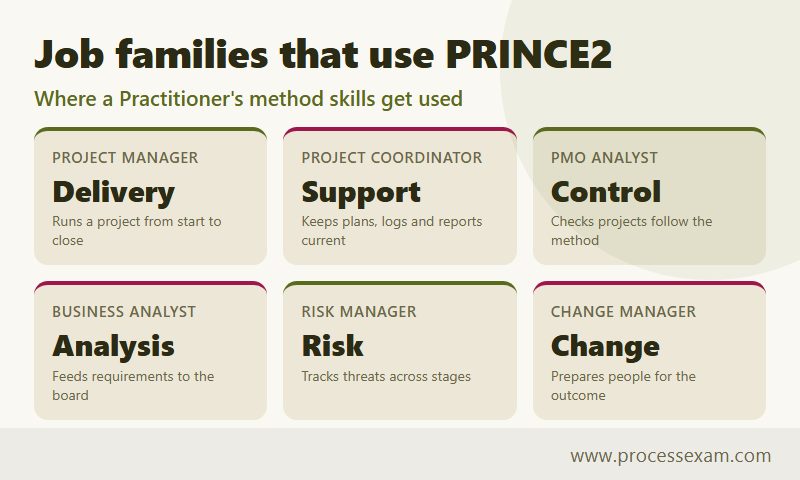
Think in families of work, not one title. The same method turns up wherever someone must plan, control and report on a piece of change with a start and an end.
Project delivery roles
Project manager, senior project manager and IT project manager are the obvious ones. Here the Practitioner shows that you can apply the method to a described situation: set up a business case, split work into stages, handle tolerances and escalate when a stage will overrun. Some adverts name the project type instead of the method, such as an NEC project manager in construction, where PRINCE2 sits beside contract-management knowledge.
Support and control roles
Project coordinator, project support officer, PMO analyst and PMO manager all work with the products the method produces: plans, registers, highlight reports and lessons logs. A Practitioner who can explain why a risk register is reviewed at each stage, and who owns it, is quickly useful to a PMO.
Roles around the project
Business analyst, risk manager, change manager and product manager appear on PeopleCert's own list because they feed the project board with requirements, risk views and benefits. For them, Practitioner is less a gate than a way to speak the same language as the project manager they work with.
Interim and contract work
Contract and interim postings often list the method as a checkbox, because the client wants someone who can pick up a running project without a long induction. If you plan to contract, hold a current certificate and be ready to show how you tailored the method on a past job.
How does the career ladder run from project support to programme level?
A project career climbs in rungs, and the certificate matters differently at each one. The table below describes the rungs in general terms; titles vary between employers, so read the duties in an advert before trusting the label.
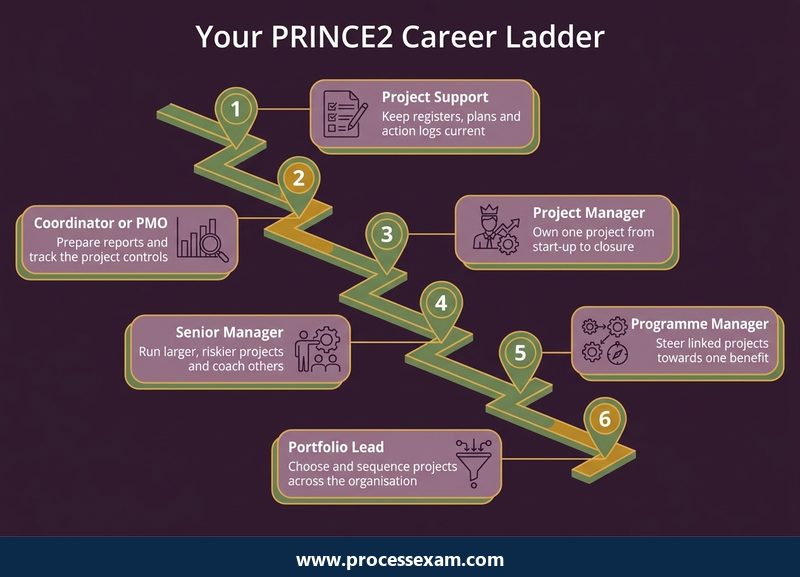
| Rung | Typical titles | What the work looks like | What employers want beyond PRINCE2 |
|---|---|---|---|
| Entry | Project administrator, trainee coordinator, graduate project role | Keep registers, book meetings, chase actions, draft reports | Reliable organisation, spreadsheet skill, clear writing |
| Support | Project coordinator, PMO analyst, project support officer | Maintain plans and logs, prepare highlight reports for a manager | Planning tools, a sense of risk and dependencies |
| Delivery | Project manager, IT project manager | Own a project from start-up to closure, report to a project board | Track record of delivered work, stakeholder skill, domain knowledge |
| Senior delivery | Senior project manager, lead project manager | Run larger or riskier projects, coach other managers | Budget ownership, supplier management, a reputation for calm escalation |
| Programme | Programme manager, transformation programme manager | Coordinate several linked projects towards a benefit | A programme method such as MSP, plus years of senior delivery |
| Portfolio | Portfolio manager, head of PMO | Choose, fund and sequence projects across an organisation | A portfolio-level qualification such as P3O, plus financial and analytical depth |
Two points follow from the table. First, Practitioner is most useful at the support and delivery rungs, where the day-to-day work is the method itself. Second, programme and portfolio posts usually ask for a different qualification family: programme managers often meet MSP in adverts, and portfolio roles meet P3O. PRINCE2 remains the project-level foundation underneath them, so a candidate who has both is easier to place than one who has only the higher qualification.
Titles are the least reliable part of a job advert. A "project manager" in a small firm may do the work of a coordinator, a PMO analyst and a manager in one post, while the same title in a large programme may be a narrow role under a senior manager. When you compare advert titles, compare the duties: who you report to, what budget you control and how many stakeholders you deal with. Those three facts place a role on the ladder far better than its name does.
Moving up takes time and evidence, not a certificate. A manager who has delivered several projects, and can describe what went wrong on one and what they changed, will usually beat a candidate with more credentials and no stories.
Which sectors and regions value PRINCE2 most?
PRINCE2 began as a UK government method, and the PRINCE2 article on Wikipedia traces its origin to UK public-sector IT projects. That history still shows in where it is requested. From the adverts we looked at, the strongest pull comes from three areas.
- Public sector and agencies: central and local government, health bodies, education and housing providers often run projects on the method and list it as essential.
- Technology and transformation: IT departments, consultancies and integrators use it for systems projects, often alongside agile delivery, and sometimes ask for Practitioner on the lead role only.
- Large and regulated organisations: utilities, finance, telecoms and manufacturing programmes use it to keep governance consistent across many projects. PeopleCert's page shows IBM, HP, Vodafone and Philips among the companies it says trust its certifications.
Where is it requested?
The method is strongest in the UK and in other parts of Europe, and it is used in a number of other countries. PeopleCert offers the Practitioner exam in 14 languages, which suggests an international audience, but a language list is not a hiring map. Before you invest, search the job boards of your own country for "PRINCE2" and see how many adverts name it. If few do, a locally dominant credential may serve you better, and PRINCE2 can still be a useful second string.
Agile is worth a word here, because many technology adverts ask for both. PRINCE2 supplies the governance layer, such as who approves a stage and who may change scope, while agile supplies the way the team builds. A candidate who can say how the two fit together, and give an example of each applied on a single project, answers the question hiring managers in digital teams ask most.
Remote work has widened the pool: a UK-based programme office may hire a coordinator elsewhere, and a certificate that both sides recognise removes one question from the interview.
What does the certificate prove to a recruiter, and what does it leave unproven?
A recruiter reading a CV has a few seconds. The Practitioner line tells them three things and leaves four open.
What it proves
- You passed a proctored exam that asks you to apply the method to a described project, not just recall definitions.
- You already held a prerequisite: PeopleCert lists PRINCE2 Foundation Version 7, earlier PRINCE2 editions, PMP, CAPM, IPMA levels and some other qualifications as ways to qualify for the Practitioner exam.
- You can talk about business case, stages, tolerances, risk and quality in the terms a project board uses.
What it leaves unproven
- That you have delivered anything. The exam describes a project; it does not test whether you can get a stakeholder to sign off a late change.
- That you can tailor the method. A good manager scales it down for a small project. Interviewers will ask for an example.
- Your domain knowledge. A construction project and a software release need different expertise.
- Your people skills. No exam measures how you handle a sponsor who changes their mind.
The practical fix is to make the line on the CV carry a story. "PRINCE2 7 Practitioner" is one fact; "applied stage boundaries to a six-month office move and brought it in within tolerance" is evidence. Write one such sentence under each project on your CV and prepare to expand it aloud. The areas the paper tests are laid out in our PRINCE2 Practitioner syllabus overview, which helps you match your examples to them.
What should you pair with Practitioner to get hired faster?
Employers read credentials in combinations. The table sets out what each common companion adds and when it is worth the effort.
| Pair it with | What it adds to your profile | Worth it when |
|---|---|---|
| Agile or Scrum training | Shows you can run iterative work as well as stage-gated work | Your target employer delivers software or digital change |
| A programme qualification such as MSP | Signals readiness to coordinate several projects | You already manage senior projects and aim at programme roles |
| A portfolio or PMO qualification such as P3O | Signals control of many projects at once | You work in or want to lead a PMO |
| PMP or another global project credential | Broadens recognition outside PRINCE2 strongholds | You apply to multinationals or work across countries |
| Domain or sector skills | Shows you understand the work being managed | The role is in construction, health, finance or IT |
| Planning and reporting tools | Shows hands-on productivity from the first week | You apply for coordinator or support roles |
Do not collect every row. One companion that fits the job you want beats five that do not. If you are early in your career, tools and a domain skill usually come first; if you are mid-career, a programme qualification or a global credential has more pull.
Soft skills belong on the list too. Adverts for delivery roles repeatedly stress stakeholder management, clear reporting and calm under pressure. Pick two examples from your own work that show each, and keep them ready for interview.
Can you start without project experience, and how should the search run?
Yes, but not by certificate alone. A Practitioner credential with no project history is weaker than the same credential on someone who has coordinated even a small piece of work. Three routes build the missing evidence.
- Move sideways inside your employer. Ask to join a project team as an analyst, tester or coordinator. Employers fill project-support posts from inside more easily than they hire strangers.
- Apply for entry and trainee roles. Graduate, trainee and coordinator posts appear regularly on the boards, and they are designed for people with the method but little experience.
- Document experience from outside work. Organising an event, running a fundraiser, leading a volunteer project or managing a house move involves scope, time, cost, risk and stakeholders. Describe each in project terms: what the goal was, who was involved, what went wrong and what you changed.
Write such examples with outcomes you can defend, and keep them to one line each on a CV that also shows paid work.
If you are already a project manager under another method, the picture is different. Your task is to translate: show how your current practice maps to business case, stages, controls and exception handling, and pass the exam to confirm the mapping. The Practitioner is then a bridge into employers that insist on the name.
What does it cost in time and money, and how long does it last?
The facts below come from the exam data we hold, and from PeopleCert's own page where noted.
| Detail | PRINCE2 7 Practitioner |
|---|---|
| Exam | PeopleCert PRINCE2 Project Management Practitioner (Version 7) |
| Duration | 150 minutes |
| Marks available | 70 |
| Pass mark | 60% |
| Fee | USD $500 |
One clarification that matters when you read around: the figure of 70 is marks, not questions. PeopleCert's page describes the paper as 56 questions and sub-questions worth 70 marks, taken open book, so a "70-question" description is not accurate. Fees vary by country and bundle; PeopleCert listed an exam bundle at 424 pounds including VAT when we checked, with eLearning packages priced higher, so confirm the price for your own package before you book.
Does the certificate expire?
PeopleCert states that the Practitioner certification is subject to renewal. It asks for 60 CPD points, which you can earn through PeopleCert Plus membership, or you can pass an exam in another course from the same suite before the renewal date. For a job-seeker this means a lapsed certificate should be renewed before you apply for roles that name it as essential, since recruiters may check the status. The wider range of PRINCE2 qualifications sits on PeopleCert's PRINCE2 page.
Before paying the fee, try one open-book sitting of a PRINCE2 Practitioner practice exam with the manual beside you; how often you have to hunt for a page tells you whether the method has sunk in.
Turning it into a job search
A short plan beats a long wish list. Start with the adverts: collect ten for the role you want and mark where PRINCE2 is essential, desirable or absent. Then compare what else they ask for and fill the largest gap first. Put the certificate in the headline of your CV only if most adverts you want name it; otherwise lead with delivered work and list it under qualifications. Prepare three project stories, one about a plan that held, one about a risk you caught early and one about something that went wrong, and tell each in terms of the method's controls. Finally, say which version you hold: employers still see 6th Edition and Version 7 on CVs, and naming yours avoids confusion.
Questions to expect at interview
Interviewers who see Practitioner on a CV tend to probe the gap between the paper and the job. Expect prompts such as: how did you decide when a problem was big enough to escalate; what did you do when a stage was going to overrun its tolerance; who signed off the business case and what happened when it changed; and how did you adapt the method for a small project. Answer each with a real project, the decision you made and what the board or sponsor did next. If your experience is thin, use a smaller piece of work and be clear about its size; panels respect an honest small example more than an inflated large one.
The certificate is a door-opener and a common language, not a guarantee. Used with evidence, a clear story and one or two companions that fit the job, it moves a candidate from the maybe pile to the interview list.
Frequently Asked Questions
What jobs can you get with PRINCE2 Practitioner?
The certificate is asked for on project manager, senior project manager, programme manager, project coordinator and PMO roles. PeopleCert also lists business analysts, risk managers, change managers and product managers as suited to it. It helps most where the organisation runs projects on the method.
Is PRINCE2 Practitioner worth it for a career?
It is worth it when your target employers name PRINCE2 in adverts, which is common in UK public sector and large programmes. It proves you can apply the method but not that you have delivered projects, so pair it with experience and examples before expecting a promotion.
What are the PRINCE2 Practitioner exam details?
PeopleCert describes the Practitioner exam as 56 questions and sub-questions worth 70 marks, open book, with 150 minutes allowed and a 60% pass mark. The 70 is marks, not questions. Fees depend on country and bundle, so check PeopleCert before booking.
Can you get a PRINCE2 job without experience?
Entry-level and trainee coordinator roles exist, and the certificate helps you qualify for them. Employers still weigh evidence, so describe small projects from work, study or volunteering in project terms: the goal, your role, the risks and what you changed.
Does PRINCE2 Practitioner expire?
PeopleCert says the Practitioner certification is subject to renewal. It asks for 60 CPD points, which can come through PeopleCert Plus membership, or you can pass an exam from another course in the same suite before the renewal date. Check the status before applying for roles that require it.
- Project Management |
- PRINCE2 Practitioner Question Bank |
- PRINCE2 Practitioner Test Questions |
- PRINCE2 Practitioner Exam Questions Download |
- PRINCE2 7 Practitioner Simulator |
- PRINCE2 7 Practitioner Mock Exam |
- PRINCE2 7 Practitioner Certification |
- PRINCE2 7 Practitioner Certification Cost |
- PRINCE2 7 Practitioner Certification Requirements |
- PRINCE2 7 Practitioner |
- PRINCE2 7 Practitioner PDF |
- PeopleCert PRINCE2 Project Management Test Questions |
- PeopleCert PRINCE2 Project Management Book |
- PeopleCert PRINCE2 Practitioner BOK PDF |
- PRINCE2 Project Management Certification Cost |
- PRINCE2 Project Management Certification Requirements |
- PeopleCert PRINCE2 7 Practitioner Question Bank |
- PeopleCert PRINCE2 7 Practitioner Book |
- PeopleCert PRINCE2 7 Practitioner Study Guide |
- PeopleCert PRINCE2 Project Management Sample Questions |
- PRINCE2 Project Management PDF |
- PeopleCert PRINCE2 7 Practitioner Exam Questions |
- PeopleCert PRINCE2 7 Practitioner Sample Questions


