
PRINCE2 Practitioner Exam: Format, Open-Book Rules and Prep Plan
The PRINCE2 7 Practitioner exam is open book, but that does not make it easy. You get 150 minutes and 70 marks, and you need 60% to pass, so the manual only helps if you already know where things are and can apply them to a described project. This guide covers the format, who may sit it and how to prepare.

Search for this exam and you will find two kinds of advice. One says the open-book rule means you can turn up with no revision and look everything up. The other says it is a memory test in disguise. Both are wrong. The paper rewards candidates who have used the method on real or imagined projects, so the pages they open are the right ones and the answers reflect a decision, not a definition.
Everything below about the exam itself comes from the exam figures we hold for this credential and from PeopleCert's own PRINCE2 7 Practitioner page, checked in September 2026. Where the two differ, the text says so.
Is the PRINCE2 7 Practitioner exam really open book, and what does that change?
Yes. PeopleCert lists the Practitioner exam as open book and as "objective testing", which means the answers are chosen or scored against a fixed key rather than written as essays. The exam is web-based and proctored, so you sit it at a computer under supervision instead of in a classroom.
What "open book" changes is the type of effort, not the amount. There is no reward for memorising the wording of a definition you can look up in half a minute. There is a heavy penalty for not knowing which part of the manual applies, because the clock keeps running while you search. That is why the strongest preparation is built around navigation and judgement.
What the manual cannot do for you
A reference book cannot tell you which of four plausible actions a project manager should take in the situation in front of you. It can only confirm the rule once you know which rule you need. Candidates who fail an open-book paper usually describe the same experience: they found a lot of accurate text and still picked an answer that did not fit the project as described.
Two small habits help. First, decide what the question is really asking before you touch the manual: a role, a responsibility, a management product, a point in the project or a tailoring decision. Second, treat the manual as a way to confirm an answer you have already narrowed to two options, not as a search engine you type the whole question into.
Check which materials your session allows
PeopleCert's page confirms the open-book format, but the details of what you may bring, and in what form, are set out in the instructions you receive when you book. Read those rules before you plan your revision around a printed or an electronic copy, and practise with the same kind of copy you will be allowed to use.
Booking an online proctored slot also means checking your room, computer, camera and connection well before the day, following the technical instructions PeopleCert sends. Do a full mock sitting on the same machine and desk, so that the first time you use that setup is not the day your marks are at stake.
What does the Practitioner paper look like: marks, time and pass line?
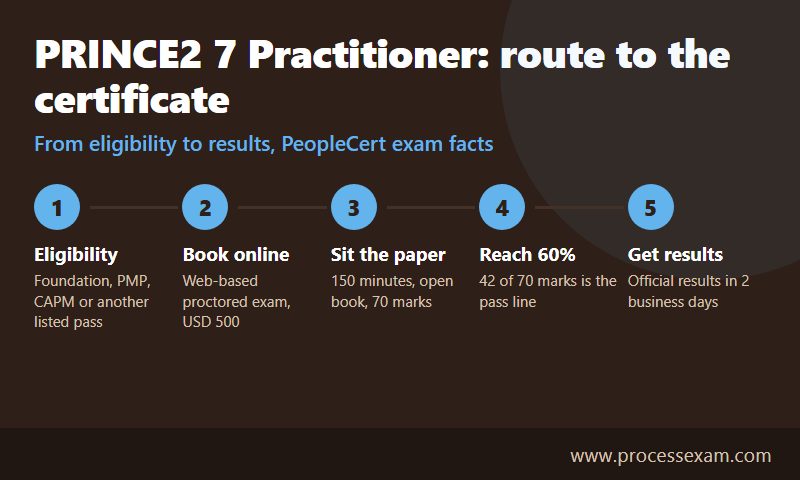
This is the part most candidates get slightly wrong, because the paper is often described as "70 questions". PeopleCert's official PRINCE2 7 Practitioner page gives the real shape: 56 questions and sub-questions, worth 70 marks. The 70 is the figure that decides your result, and it counts marks, so treat 70 as the marks available and 56 as the number of items you will actually work through.
| Exam detail | What is listed |
|---|---|
| Exam | PeopleCert Certified PRINCE2 Project Management Practitioner (Version 7) |
| Exam code | PRINCE2 Practitioner |
| Fee | USD $500 |
| Duration | 150 minutes |
| Questions | 56 questions and sub-questions, worth 70 marks |
| Passing score | 60% |
| Format | Open book, objective testing, web-based and proctored |
| Results | Official results in 2 business days |
Sixty per cent of 70 marks is 42 marks. That is the number to hold in your head: you can lose 28 marks and still pass. It also removes a common source of panic. A candidate who cannot answer six or seven difficult items has not failed; the margin exists so that a few hard scenarios do not sink the paper.
How much time does each mark get?
Divide 150 minutes by 70 marks and you get a little over two minutes per mark. Divide it by 56 items and you get roughly two and a half minutes per item, though sub-questions inside one item mean the real figure varies. Use the marks figure for pacing: if a question is worth one mark and you have spent four minutes in the manual, you have overspent, whatever the item looks like.
A workable rhythm is to answer what you know from memory in a first pass, mark anything that needs the manual, and use the second pass for lookups. Keep the last fifteen minutes free to re-read the items you flagged, because a fresh look catches misread scenarios more often than a longer search does.
Who can sit the Practitioner exam without taking Foundation first?
PeopleCert requires evidence of one qualification before you can book the Practitioner paper. According to its page, that can be any one of these:
- PRINCE2 Project Management Foundation (Version 7).
- PRINCE2 6th or 5th Edition, Foundation or Practitioner.
- Project Management Professional (PMP) or Certified Associate in Project Management (CAPM).
- Other recognised qualifications, including PPQ, PMQ, IPMA levels A to D, CSPM-2 and CSPM-3.
So the answer is yes: a current PMP or CAPM holder, or someone with an older PRINCE2 edition, can go straight to the Practitioner paper for Version 7. Whether you should is a different question. If your PRINCE2 knowledge comes from an older edition, the vocabulary has moved on and you will need to relearn it before the exam, not just before the qualification check.
The wording that trips people up
The seven themes of older editions are now called practices, and the Version 7 material adds weight on people, sustainability and digital and data management. If you learned PRINCE2 in the 6th Edition era, expect to find your old notes half right. We cover that renaming on its own page, so this guide does not repeat it; what matters here is that old notes need a full pass against the current manual.
If you are weighing the route rather than the exam, PeopleCert's list of PRINCE2 mock exams shows the vendor's own practice options, and the Foundation certification remains the simplest entry for someone new to the method.
What does the Practitioner exam ask you to do that Foundation does not?
Foundation asks whether you know the method. Practitioner asks whether you can use it. PeopleCert's page lists the content areas as principles, practices and processes; key roles and responsibilities; people management and collaboration; sustainability and ESG; digital and data management; and effective communication methods. Those are the areas to organise your study around, and the topic list on our Practitioner syllabus page lines up with them.
| Area on the PeopleCert page | What to be able to do with it |
|---|---|
| Principles, practices and processes | Choose which element answers a stated project problem, and say why the alternatives do not |
| Key roles and responsibilities | Say who decides, who advises and who is only informed in a given situation |
| People management and collaboration | Recognise when a project problem is about engagement or ownership rather than a missing document |
| Sustainability and ESG | Fit sustainability into business case, quality and risk thinking instead of treating it as a separate topic |
| Digital and data management | Connect information, tools and records to control and reporting |
| Communication methods | Match the way you communicate to the audience and to the decision needed |
Application questions in practice
Expect items that describe a project in a few sentences and then ask what should happen next, who should be told, or which document should change. The correct option is normally the one that respects the roles and the level of authority in the story. A distractor often describes something sensible that the wrong person would do, or something right done at the wrong moment.
A useful practice is to rewrite each wrong answer you meet as a true statement about a different situation. "The project manager approves this tolerance change" is wrong in one story and right in another, and knowing the boundary is the skill the exam is measuring.
The newer topics deserve real time
Sustainability, people and digital topics are the ones older study guides skip or cover thinly. Candidates with years of PRINCE2 experience are often surprised by how much of the paper these can influence. Give each of them a dedicated study session rather than hoping they will come up inside the processes.
How do you work through the manual without losing your minutes?
The candidates who finish comfortably treat the manual as a set of known locations. They do not read it during the paper. Build that map in the weeks before, and rehearse it under the clock.
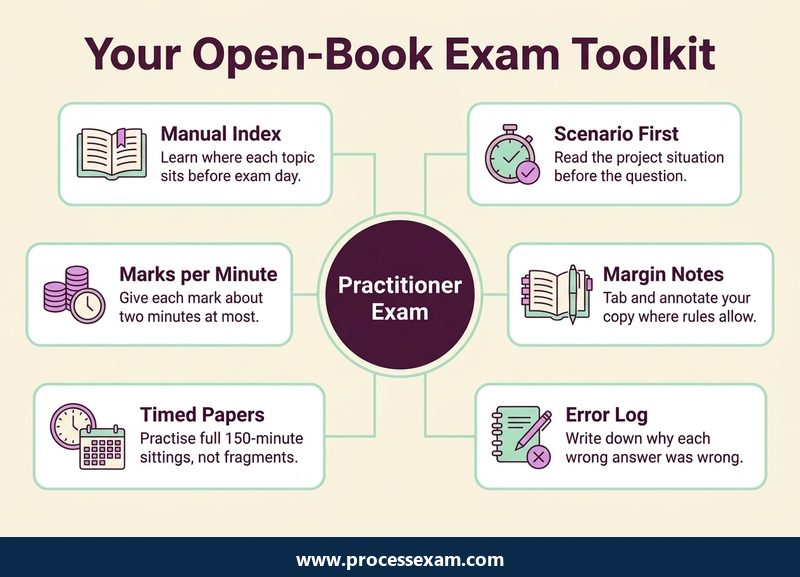
- Build an index of your own. On one page, list the ten or fifteen lookups you expect to repeat: the roles and their responsibilities, the contents of each management product, the activities inside each process and the tailoring guidance. Note the section for each.
- Mark your copy where the rules allow it. Tabs, highlighting and short notes cut lookup time, but only if the session rules permit them, so confirm that first.
- Practise the two-step lookup. Decide the category of the question, then go straight to that section and read only the relevant lines, rather than scanning a whole chapter.
- Time your lookups. During practice papers, note every lookup that took over a minute and add the topic to a weak-area list.
- Stop looking things up that you know. If you have checked the same fact three times in practice, learn it. Lookups should be for detail, not for the basics.
Reading the scenario before the question
Read the project situation first and underline the facts that matter: who is involved, what stage the project is in, what has changed, and what authority is mentioned. Then read the question. Candidates who read the question first tend to skim the scenario for a keyword and miss the detail that decides the answer.
Removing the options that break a rule
With four options, eliminate the ones that break a rule or belong to another role. Two options will usually remain. The manual then confirms which of the two fits the stage and the level of authority in the story. This approach uses the open-book advantage while keeping the search short.
How long should preparation take, and what goes into each week?
There is no official study duration for this exam, so the honest answer depends on what you already know. Use the starting point that matches you, and be realistic about it.
| Where you start | Time to plan | What to focus on |
|---|---|---|
| Passed Version 7 Foundation recently and remember it well | About two weeks | Roles, management products and application practice |
| Work with PRINCE2 on live projects but studied an older edition | About four weeks | Relearn Version 7 terms, then practise scenarios |
| Hold PMP or CAPM and have not used PRINCE2 before | About six weeks | Learn the method from the manual, then practise |
These are planning estimates from how the material builds, not vendor figures. Adjust them after your first timed paper; a score well under 60% means add time, and a score well over means shorten it.
If you have two weeks
Spend the first half on gaps. Take a timed paper straight away, list every topic that cost you marks, and study those in short sessions. Use the second half for two or three more timed papers and a final read of the roles and management products.
If you have four weeks
Use the first fortnight to refresh the method against the Version 7 manual, one area per session, writing your own summary of each. Move to scenario practice in the third week and full timed papers in the fourth. Leave the last two days for your error log and your index rather than new material.
If you have six weeks
Give the first three weeks to learning the method properly, alternating reading with short question sets. Bring in the newer topics early so they are not left until the end. Spend weeks four to six as the four-week plan does, with timed papers from the fifth week.
Which practice habits raise a Practitioner score fastest?
Practice papers help only if you treat the wrong answers as the point. A full PRINCE2 Practitioner practice exam taken under exam conditions shows your pace and your weak areas at once, and reviewing it properly takes as long as sitting it did.
Habits that pay off
- Keep an error log. For each wrong answer, write the rule you missed, the option you chose and why it looked right. Patterns show up within three or four papers.
- Sit full 150-minute papers. Short quizzes will not show whether you can hold concentration and pace for the whole session.
- Practise with the same kind of manual you will use. Switching between a printed copy and a screen copy costs time you will not have on the day.
- Review the questions you got right by guessing. A lucky mark hides a gap that a different question will expose.
Mistakes that cost marks
- Using the manual to search for keywords from the question instead of deciding what is being asked first.
- Choosing an option that is correct in general but wrong for the role or stage in the story.
- Spending five minutes on a one-mark item while easier marks wait later in the paper.
- Studying from a source written for an older edition without checking it against Version 7.
- Leaving no time to re-read flagged items.
The old advice to "join a study group" is fine, but a group is most useful when it sets scenarios for one another and argues over the answers. Passive discussion is less valuable than a shared error log.
Does the Practitioner certificate expire, and how do you renew it?
PeopleCert states that official results arrive within two business days. The certification is subject to renewal, and PeopleCert's page says 60 CPD points are needed to renew, so it is worth keeping a record of your professional development activity from the day you pass. Check the same page for the current renewal terms, as those rules are set by PeopleCert and can change.
Retakes and rescheduling are covered by PeopleCert's booking terms, which also set out any fees for late changes. Read them before you choose a date, and leave enough margin that a bad day does not force a rushed rebook.
Once you have passed, use the following few weeks to apply the method: tailor a live or past project against the Version 7 practices, and write down where you would have decided differently. That habit turns a passed exam into working skill, and it makes the renewal record easier to build.
What the credential does and does not prove
The Practitioner qualification shows you can apply the method to a described project. It does not replace experience, and the more projects you have tailored the method to, the more natural the exam feels. If you want to see how the role market treats the credential, we cover that separately in our piece on PRINCE2 Practitioner job opportunities; this guide stays with the exam.
Finally, keep the language of the current version in your notes. The exam is for Version 7, and using it consistently in your revision means the wording on the paper will feel familiar rather than new.
Frequently Asked Questions
What is the format of the PRINCE2 Practitioner exam?
The PRINCE2 7 Practitioner exam is open book and lasts 150 minutes. PeopleCert describes it as 56 questions and sub-questions worth 70 marks, taken as a web-based proctored paper, with 60% needed to pass. That pass line works out at 42 of the 70 marks.
Is the PRINCE2 Practitioner exam open book?
Yes, PeopleCert lists the Practitioner exam as open book. That helps with lookups, not with judgement: the paper asks you to apply the method to a described project, and the clock keeps running while you search. Check your booking instructions for what materials your session allows.
What are the requirements to take the PRINCE2 Practitioner exam?
PeopleCert requires one prior qualification: PRINCE2 Foundation Version 7, PRINCE2 6th or 5th Edition Foundation or Practitioner, PMP, CAPM, or another recognised qualification it lists, such as IPMA levels A to D. You must show one of these before you can sit the Practitioner paper.
How much does the PRINCE2 Practitioner exam cost?
The PRINCE2 7 Practitioner exam is listed at USD 500. Fees and bundles change, and eLearning packages may include a retake, so check the current price on the PeopleCert page for your country and package before you book a date for the exam.
How long does it take to prepare for the PRINCE2 Practitioner exam?
There is no official study time. As a planning guide, allow about two weeks if you passed Version 7 Foundation recently, four if you know an older edition, and six if you come from PMP or CAPM. Take a timed paper early and adjust the plan to your score.
- Project Management |
- PRINCE2 Practitioner Question Bank |
- PRINCE2 Practitioner Test Questions |
- PRINCE2 Practitioner Exam Questions Download |
- PRINCE2 7 Practitioner Simulator |
- PRINCE2 7 Practitioner Mock Exam |
- PRINCE2 7 Practitioner Certification |
- PRINCE2 7 Practitioner Certification Cost |
- PRINCE2 7 Practitioner Certification Requirements |
- PRINCE2 7 Practitioner |
- PRINCE2 7 Practitioner PDF |
- PeopleCert PRINCE2 Project Management Test Questions |
- PeopleCert PRINCE2 Project Management Book |
- PeopleCert PRINCE2 Practitioner BOK PDF |
- PRINCE2 Project Management Certification Cost |
- PRINCE2 Project Management Certification Requirements |
- PeopleCert PRINCE2 7 Practitioner Question Bank |
- PeopleCert PRINCE2 7 Practitioner Book |
- PeopleCert PRINCE2 7 Practitioner Study Guide |
- PeopleCert PRINCE2 Project Management Sample Questions |
- PRINCE2 Project Management PDF |
- PeopleCert PRINCE2 7 Practitioner Exam Questions |
- PeopleCert PRINCE2 7 Practitioner Sample Questions


