
Key Features of PRINCE2: The Seven Principles at Work
Updated on 15 October 2026. What’s new: rewritten for PRINCE2 7, where themes are now practices and people are built into the method alongside the seven principles.
The defining feature of PRINCE2 is that every project, whatever its size, is run against seven principles: keep the business case justified, learn from experience, define roles and relationships, manage by stages, manage by exception, focus on products, and tailor the method to the project. Around them sit seven practices, seven processes and, since version 7, an explicit people element. Together they make a project controlled, accountable and easy to stop if it stops making sense.
This article takes the features one at a time and ties each to something you would actually see on a project: a decision at a board meeting, a line in a plan, a report that did or did not get written. It also corrects a few things that older descriptions of the method still get wrong, such as the idea that PRINCE2 has four core components or that its guidance is a list of themes. Everything below was checked against PeopleCert's PRINCE2 7 pages and the other sources linked in the text in October 2026.
What sets PRINCE2 apart from other ways of running a project?
Most project guidance tells you what to do. PRINCE2 mainly tells you how decisions are made and who makes them. It is a management method, not a technical one: it says nothing about how to design software, lay a foundation or run a clinical trial, and it is designed to sit on top of whatever technical work the project involves. What it controls is the management layer, meaning the reasons for the work, the authority to carry on, the shape of the plan and the way trouble is escalated.
Five features carry most of that weight.
- A reason to exist that is tested repeatedly. A project needs a business case, and the case is checked again at each stage rather than filed once.
- Defined accountability. The project board holds authority for the project and the project manager works day to day within limits the board sets.
- Control in stages. The project is planned and released one manageable stage at a time, so that the board can stop, change or continue it at known points.
- Management by exception. The board is not drowned in updates; it hears when something is forecast to move outside an agreed tolerance.
- A product focus. The plan starts from what must be delivered and to what quality, and the activities are worked out from that.
Each of these comes straight from the principles covered below, and a sixth idea, tailoring, ties them together. The method's history explains why they look the way they do. According to Wikipedia's history of PRINCE2, PRINCE came out of the UK government's computer agency in 1989 and PRINCE2 followed in 1996 as a generic method; ownership later passed to AXELOS and, in 2021, to PeopleCert, which published PRINCE2 7 in 2023. A method written for public-sector programmes, where money is spent on behalf of others, naturally puts justification, accountability and escalation at the centre.
What does each of the seven PRINCE2 principles require of the team?
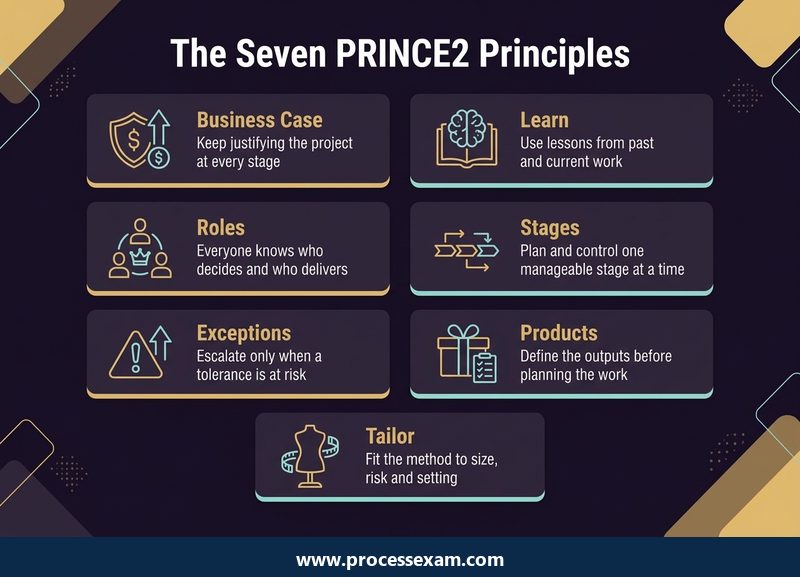
PeopleCert describes the principles on its PRINCE2 7 Foundation page as universally applicable and as the guide to project management decisions and actions. That wording matters. A principle is not an optional technique. A project that drops one is no longer really running PRINCE2, however many of the templates it still uses. Here is what each one asks for, in the order the method usually lists them.
Continued business justification
There must be a documented reason for the project, and it must stay valid. The reason is the business case, which weighs what the project costs and risks against what it should deliver. The word "continued" is the point: the case is reviewed whenever something significant changes and at the end of every stage. If the costs grow and the benefits shrink until the project no longer makes sense, the right response is to stop it. A project closed early on this principle has done its job; it has stopped money being spent on something that no longer pays back.
Learn from experience
Teams are expected to look for lessons from earlier projects when they start, to record lessons as they go, and to pass them on when they finish. In practice this means a lessons log that is opened in the first week and read before each stage is planned, not a report written at closure that nobody reads. The principle is easy to agree with and easy to neglect, because lessons rarely feel urgent while a deadline is close.
Define roles, responsibilities and relationships
PeopleCert-aligned training material words this principle as defining roles, responsibilities and relationships. It asks that everyone involved, inside and outside the organisation, knows who is accountable for what and who they report to. The standard structure has the project board on top, with an Executive who is ultimately accountable, a Senior User who speaks for those who will use the result, and a Senior Supplier who speaks for those building it. A project manager runs the project within the authority the board delegates, and team managers deliver the work packages. The addition of "relationships" matters in version 7, because the method now treats the links between people, including customers, suppliers and other organisations, as something to plan for.
Manage by stages
A PRINCE2 project is planned and controlled in stages. There is a high-level plan for the whole project and a detailed plan for the current stage only, which is more realistic than detailing months of work that will change. At each stage boundary the board decides whether to release the next stage. Stages therefore give the board scheduled moments to ask whether the project is still worth doing and still on course, which is how the first principle gets enforced.
Manage by exception
Each level of management is given tolerances: agreed margins around time, cost, quality, scope, risk and benefits within which it can act without asking permission. Version 7 adds sustainability as a further performance target, according to PeopleCert. When a forecast says a tolerance will be breached, the issue goes up to the next level together with options and a recommendation. The board is not asked to approve routine progress; it is asked to decide the things only it can decide. For a busy executive sponsor this is a large part of why the method is liveable.
Focus on products
The project exists to produce outputs that users can use, so PRINCE2 plans around products rather than activities. For each important product there is a product description that states its purpose, composition, quality criteria and how it will be checked. Teams that skip this often find at the end that "done" means different things to the supplier and the user. Defining the product first, with its acceptance criteria, is what makes the later quality checks possible.
Tailor to suit the project
PRINCE2 is meant to be adapted to the size, complexity, risk and setting of each project. The Foundation page describes the skill as applying and tailoring the method to a project's specific needs, size, complexity and context. Tailoring is allowed to change how the principles are applied, for instance by keeping the project board to two people on a small job or writing a one-page product description, but not whether they are applied. A later section looks at what that means in practice.
How do these principles show up on a real project, week by week?
Take an example that has nothing to do with software: a regional retailer replacing the stock-control system in twelve shops. The project looks routine until you watch the principles at work.
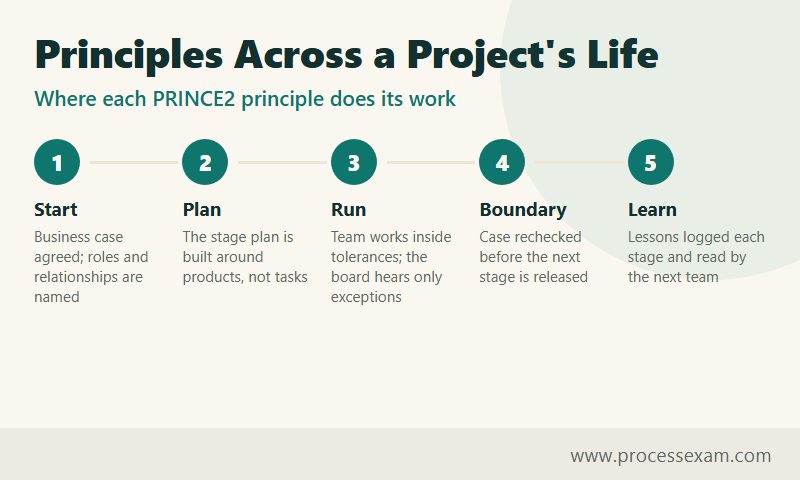
At the start, the Executive, a finance director, signs off a business case promising lower write-offs and fewer empty shelves. The Senior User is the operations head who will live with the system, and the Senior Supplier is the vendor's delivery lead. Naming the three is the "define roles" principle at work, and nobody argues later about who could approve a change of scope.
In planning, the project manager does not begin with a task list. She lists the products: configured system, migrated stock data, trained store staff, tested till interface, support guide. Each gets a description and a quality criterion, such as "stock counts match a physical count within a stated margin in a pilot shop". The detailed plan covers only the first stage, which is the pilot in two shops.
During the stage, a data migration problem threatens a two-week delay. The stage tolerance on time is one week. The project manager does not wait for the monthly meeting; she raises an exception report with three options, a recommendation and the effect on the business case. The board picks an option the same week. Before that, it had heard nothing but a short highlight report, which is management by exception.
At the stage boundary, the board is shown an updated business case. The vendor's price has moved and the benefit estimate has dropped because two shops have closed. The case still holds, narrowly, and the board releases the rollout stage with a tighter budget tolerance. If the case had failed, this is the moment the project would have been stopped.
Throughout, the lessons log grows: "pilot data was loaded from the wrong extract", "store managers needed training before cutover, not after". The next stage's plan starts from those lines. None of these steps required a heavy template, and several would be absent from a project that treated PRINCE2 as a document set.
Where do people fit in PRINCE2 7, and why was that added?
The principles and the board structure describe a method that could sound mechanical. Version 7 answers that by adding people as an integrated element. PeopleCert's Foundation page lists "people management" among the topics the exam covers and says the method now includes a people element, emphasising the importance of people in effective project outcomes. A PeopleCert article by Jo Lucas, a co-author of PRINCE2 7, calls the new people chapter the largest single addition to the method (PeopleCert: people at the core of PRINCE2 7).
What does it ask for in practice? Three habits stand out in that guidance.
- Build relationships on purpose. Identify the key relationships early and invest in them before you need them, rather than discovering at a crisis that you have no standing with the people who must agree.
- Lead by influence. The guidance moves away from command and control. A project manager usually has little formal authority over the people the project depends on, so persuasion and clear communication carry the load.
- Adapt to the team you have. Tailor the way processes run to the people, the culture and the stage of the project instead of expecting the team to adapt to the method.
Communication belongs to the same thought. The Foundation page lists it as a topic in its own right: sharing project information with stakeholders so that progress and issues are visible. In the retail example above, the store managers who needed training before cutover were the people element. A plan that counts only software tasks has no line for them.
How much of PRINCE2 can you adapt before it stops being PRINCE2?
A common complaint is that PRINCE2 is too heavy for small projects. The method's own answer is tailoring, and version 7 gives it more weight than before: guidance published alongside the release makes flexibility and tailoring more explicit. The useful distinction is between what you may scale and what you may not remove.
What tailoring can change
- The number of stages: a short project may have just two, a start-up stage and one delivery stage, while a large programme-style project may have many.
- The size and format of management products: a business case can be a page, a risk register a shared sheet, a product description a few bullets.
- The governance weight: the same person can fill more than one board role on a small project, provided the accountability is still clear.
- The terminology and tools, so that the method fits the way an organisation already talks and works, including agile or digital delivery within a stage.
What tailoring cannot remove
- A business case that is reviewed and can lead to a stop decision.
- Someone accountable for the project and a route to decisions above the project manager.
- Points at which authority to continue is given again, however informal.
- Tolerances and a way to raise exceptions.
- A statement of what is being produced and to what standard.
- A way of capturing and using lessons.
Look at the two lists together and the pattern is clear: tailoring touches the form, the principles hold the substance. A one-person team can satisfy "manage by stages" with a checkpoint on a calendar and a short note to the sponsor. A multi-supplier programme needs formal stage-end reports. Both are applying the same principle, and the difference is proportion. This is also the usual cure for the "PRINCE2 is bureaucratic" complaint: bureaucracy is what happens when form is kept and the reason for it forgotten.
Why do older descriptions of PRINCE2 list four elements and themes?
If you read older posts, you may be told that PRINCE2 has four core components: principles, project environment, processes and themes. That is a description of an earlier edition's structure and it no longer matches PRINCE2 7. Three changes matter.
- Themes became practices. The aspects of project management that run through the whole project are now called practices, which PeopleCert describes as recurring aspects of project management addressed continuously to support project success. They are the subject of their own article on this site, so they are not repeated here.
- People became part of the method. Neither "people" nor "project environment" is a separate ingredient in the way the old list suggests; people are integrated, and the setting in which the project runs is handled through tailoring.
- Digital, data and sustainability moved to the foreground. PeopleCert's Foundation page lists digital and data management as a topic and says sustainability is integrated into project performance.
The principles are the stable part. The sources that describe version 7, including PeopleCert's, still present seven principles. If you are working from material that talks about themes, a manual older than 2023 or a Foundation course that predates version 7, treat the principle descriptions as reliable and the practice and people material as dated.
Another old claim is that PRINCE2 "isolates the management aspect" of a project and therefore says nothing about the technical work. That is accurate and is still the case, though it is more a strength than a gap: the same management layer can sit above software, construction or change projects, and teams with specialist methods such as agile frameworks combine them with it.
Where does PRINCE2 help most, and where does it fit badly?
A fair description of a method's features includes the places it is awkward. PRINCE2 earns its keep where there is a customer and a supplier, public or shared money, regulated governance, or an executive who needs to be able to stop work. Typical examples are a government system replacement, a facilities relocation, a merger integration and any project where more than one organisation is paid to deliver.
It fits less well when the work is a continuous stream of small changes by a stable team, where there is no meaningful end, no distinct stages and no reason to ask a board for permission each month. Product teams working from a backlog may borrow its business-case discipline and its lessons habit without adopting stages or a formal board. Tailoring allows that sort of partial use, but it is worth being honest that the full machinery is built for projects with a start, an end and a sponsor.
Two claims that circulate in older write-ups deserve correcting as well. One treats PRINCE2 as software that helps an organisation understand its past project errors. PRINCE2 is not software. It is a method, and the learning comes from the lessons habit and the stage reviews described above, not from a tool. The other implies that certification alone delivers benefits. Certification gives a person the vocabulary; the benefits arrive when the project actually runs by the principles.
What does the PRINCE2 Foundation exam ask about these features?
PRINCE2 Foundation is the entry exam from PeopleCert, and the principles are tested in it directly next to the practices and processes, and the syllabus goes on to roles, people, performance targets, digital work, communication and tailoring. Questions on principles usually give you a short situation and ask which principle is being applied or which one has been ignored. Because the principles are named differently in different training materials ("define roles and responsibilities" and "define roles, responsibilities and relationships", for example), learn them from the PRINCE2 7 manual and PeopleCert's syllabus rather than from a blog, including this one.
| Item | PRINCE2 Foundation (Version 7) |
|---|---|
| Vendor | PeopleCert |
| Certification | PeopleCert PRINCE2 Foundation Certified - Project Management |
| Questions | 60 |
| Duration | 60 minutes |
| Passing score | 60% |
| Price | USD 338 |
PeopleCert's page for the exam gives the format as multiple choice and closed book, and lists it in 14 languages. The PeopleCert PRINCE2 7 Foundation page holds the current fees in each currency and any updates, so check it before you book. The topics above map to the PRINCE2 Foundation syllabus, which is the best checklist for what to revise.
A practical way to revise the principles is to take each of the seven and write one sentence for each of three things: what it means, what a project looks like when it is followed, and what a project looks like when it is ignored. If you can do that without looking, scenario questions become much easier. Once the principles feel familiar, a PRINCE2 Foundation practice exam is a quick way to find out whether you can spot them inside a two-sentence scenario.
Foundation is also the usual first step to Practitioner, which tests how you apply the method to a case study rather than whether you can name its parts. The principles carry over, so the effort you put in here is not wasted if you go on.
Frequently Asked Questions
What are the salient features of PRINCE2?
PRINCE2 runs every project on seven principles: continued business justification, learning from experience, defined roles and relationships, management by stages, management by exception, a focus on products and tailoring. Version 7 adds an explicit people element, and the method is applied through seven practices and seven processes.
What are the seven principles of PRINCE2?
They are continued business justification, learn from experience, define roles, responsibilities and relationships, manage by stages, manage by exception, focus on products and tailor to suit the project. PeopleCert describes them as universally applicable, meaning every PRINCE2 project follows them whatever its size or sector.
Did PRINCE2 7 change the principles?
PeopleCert's PRINCE2 7 Foundation page still presents seven principles, and sources describing the new edition say they remain central. What changed was around them: themes became practices, people management was added, and digital and data management and sustainability gained more weight. Wording of individual principles can vary between training providers.
Can you tailor PRINCE2 and still be using PRINCE2?
Yes, tailoring is itself a principle. You can scale the number of stages, the format of documents and the weight of governance to the project. What you cannot remove is the substance: a reviewed business case, clear accountability, stage-based authority, tolerances and exceptions, a product focus, and lessons.
How many questions are in the PRINCE2 Foundation exam?
The PRINCE2 Foundation (Version 7) exam from PeopleCert has 60 multiple-choice questions in 60 minutes, closed book, with a pass mark of 60%. The exam fee is USD 338, and PeopleCert's own page shows current prices by currency.
- Project Management |
- PRINCE2 Foundation Question Bank |
- PRINCE2 Foundation Exam Questions Download |
- PRINCE2 Foundation Test Questions |
- PRINCE2 7 Foundation Simulator |
- PRINCE2 7 Foundation Mock Exam |
- PRINCE2 7 Foundation Certification Cost |
- PRINCE2 7 Foundation Certification Requirements |
- PRINCE2 7 Foundation PDF |
- PeopleCert PRINCE2 7 Foundation Test Questions |
- PeopleCert PRINCE2 7 Foundation Book |
- PeopleCert PRINCE2 7 Foundation Sample Questions


