
PRINCE2 7 Practices: The Seven Themes Renamed and Explained
Updated on 22 September 2026. What’s new: rewritten for PRINCE2 7, where the seven themes are now the seven practices and organizing and issues replace organization and change.
If you searched for the PRINCE2 themes, here is the short answer: in PRINCE2 7 they are called the seven practices. They are business case, organizing, plans, quality, risk, issues and progress. Five names survived the rename unchanged; organization became organizing and change became issues. Each practice is a part of project management that has to be looked after from the first day of the project to the last, not in one phase only.

The word "theme" belongs to the sixth edition, published in 2017, and to the earlier versions before it. PRINCE2 7 arrived in 2023, and PeopleCert, which owns PRINCE2 and runs its exams, now describes the Foundation syllabus as seven principles, seven practices and seven processes, plus roles, people management, project performance, digital and data management, communication and tailoring. This article goes through the practices one at a time: what each one controls, which management products carry it, who makes the decisions inside it, how the seven lean on each other when a real project goes off course, and how the Foundation and Practitioner exams turn all of this into questions. Everything here was checked against PeopleCert's pages in September 2026.
Why did PRINCE2 7 rename the seven themes as practices?
The change is more than a new label. In the older editions a theme was presented as a body of guidance attached to the method. In PRINCE2 7 a practice is something the project team does, continuously, and adapts to the project in front of it. PeopleCert's Foundation page describes the practices as seven recurring aspects of project management, which is the clearest one-line definition you will find: they recur because none of them can be finished and put away.
Two names changed, and each rename says something about how the authors want the practice read.
Organization became organizing
A noun became a verb. The old theme was easy to read as an organization chart: draw the boxes, name the people, move on. Organizing is an activity that carries on through the project. People leave, suppliers change, a stage needs a different mix of skills, and the structure of accountability has to be reviewed at every stage boundary. The rename sits comfortably beside the new people element of PRINCE2 7, which asks the project manager to pay attention to relationships, culture and leadership as well as to roles on paper.
Change became issues
This rename matters most for exam candidates. Brad Bigelow, a co-author of PRINCE2 7, explains in a PeopleCert article on the issues practice that the practice is now called issues because issue management is as much about communication as it is about control. An issue can be a problem, a concern, a business opportunity, a request for change or something off-specification. His summary is worth remembering word for word: not all issues result in changes, but all changes start as issues. Calling the practice "change" suggested that every item raised was a change request waiting for approval, and that was never the intention.
What stayed the same
Business case, plans, quality, risk and progress kept their names, and their core purpose is recognisable to anyone who studied the 2017 edition. What changed inside them is the detail: sustainability now appears as a performance target alongside time, cost, scope, quality, benefits and risk; a product register joins the quality guidance; and new management approaches cover areas such as digital and data management and sustainability. If a study source still says "themes", it can help with background, but every name and definition you learn for the exam should come from PRINCE2 7.
What does each of the seven PRINCE2 practices control?
A useful way to learn the practices is to ask of each one: what question does it keep answering, what documents carry it, and who has the authority to decide? The descriptions below follow that pattern.
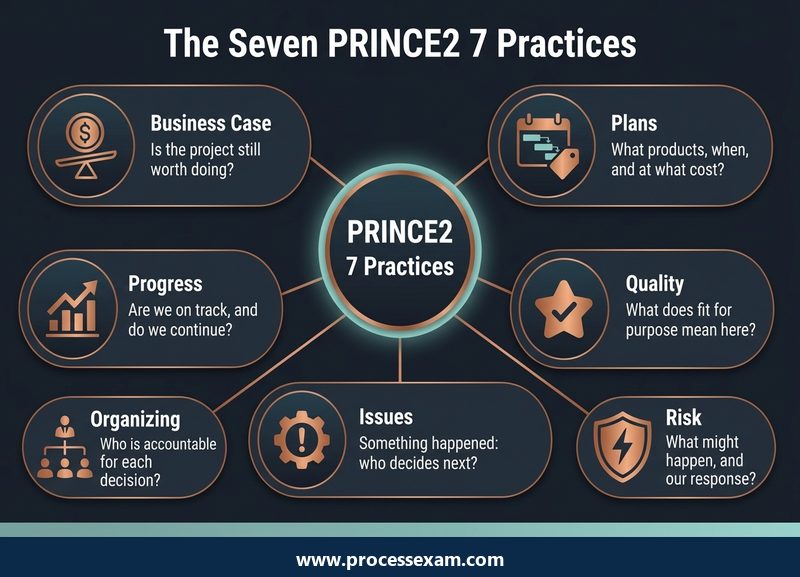
1. Business case: is the project still worth doing?
The business case practice sets up the way the project's justification is created, checked and kept alive. Its main management product is the business case itself, which sets the expected benefits against the costs, timescales and major risks. Alongside it sits the benefits management approach, which describes how and when each benefit will be measured, including the benefits that can only be measured after the project has closed.
The Executive owns the business case, and the Senior User is responsible for specifying the benefits and, later, for showing that they have been realised. The case is first sketched in the project brief during starting up, developed in full during initiation, and then reviewed at every stage boundary. PRINCE2 draws a careful line between outputs, outcomes and benefits, and it also asks for dis-benefits to be recorded: a consequence that someone will see as negative, such as a temporary loss of productivity while staff learn a new system. A project whose business case no longer holds should be stopped or redirected, and the method treats an early, controlled closure as a sound decision rather than a failure.
2. Organizing: who is accountable for what?
Organizing establishes the project's structure of accountability and responsibility. At the top is the business that commissions the project and sets its constraints. Below it, the project board directs, the project manager manages day to day, and team managers lead the people who build the products. The board has three roles that represent three interests: the Executive speaks for the business interest, the Senior User for everyone whose work will depend on the outputs, and the Senior Supplier for the designers, builders and vendors who produce them.
Around that core sit project assurance, which checks the project on the board's behalf; the change authority, a person or group to whom the board can delegate decisions on requests for change; and project support, which handles administration and the project's records. Organizing also covers how the project talks to its stakeholders, set out in the communication management approach, and how it works with suppliers under contract, which PRINCE2 7 addresses through a commercial management approach. Roles can be combined on small projects, with one limit you should know for the exam: the Executive's role cannot be shared, because accountability has to rest with one person.
3. Plans: how, when and at what cost?
The plans practice decides how the project's work is planned and at what level of detail. PRINCE2 recognises a project plan for the whole project, a stage plan for each management stage, optional team plans for the work inside a work package, and an exception plan that replaces a stage or project plan when a forecast breach of tolerance has been accepted by the board.
The distinctive feature is that planning starts with products rather than tasks. The project product description sets out what the project must deliver as a whole; it is broken down into the products needed to get there, each with its own product description; and only then are the activities, dependencies, estimates and schedule worked out. Planning this way makes scope visible and checkable, and it ties the plan straight to the quality practice, because every product description carries the quality criteria that product must meet. Plans are also where management stages are chosen. Their length reflects risk and the board's appetite for control rather than a fixed calendar.
4. Quality: what does fit for purpose mean here?
The quality practice splits into two parts: quality planning, which agrees what "good enough" means before work starts, and quality control, which checks each product against that agreement. Planning captures the customer's quality expectations and acceptance criteria in the project product description, then writes quality criteria into each product description. The quality management approach explains how the project will apply its quality standards and who will review what. During delivery, the quality register records each planned quality activity and its outcome.
PRINCE2 7 adds a product register. In PeopleCert's article on the quality practice, the register is described as a checklist of what the project will deliver and when those products will be inspected and accepted. The same article sums up the edition's attitude to requirements as "ready, aim, fire": understand firmly what the customer needs, act, and then let requirements evolve under change control rather than freezing every detail on day one. For the exam, keep quality assurance apart from project assurance: the first is run by the wider organisation, outside the project's own management team, while the second reports to the project board.
5. Risk: what might happen, and what are we doing about it?
The risk practice identifies, assesses and controls uncertainty. A risk is an uncertain event that would affect the project's objectives if it happened; it may be a threat or an opportunity. The risk management approach records how the project will handle risk, including the scales it uses for probability and impact, the risk appetite of the organisation and the roles involved. The risk register records every identified risk with its cause, event and effect, its owner and the chosen response.
Two roles are easy to confuse. The risk owner is responsible for managing a particular risk and watching it; a risk actionee carries out a specific response on the owner's behalf. Risk and issues are closely linked: when a risk materialises it becomes an issue, and when an issue is analysed it often reveals new risks. Budgets set aside for dealing with risks sit apart from the stage's normal costs, so the board can see how much of the project's money is buying protection against uncertainty.
6. Issues: something has happened, now who decides?
The issues practice gives the project a controlled way to capture, assess and decide on anything that has happened, or has been requested, and that could affect the project. The change control approach sets out how issues are handled, who can decide what, and how the project's baselines are protected. Issues that need formal handling are recorded in the issue register, and an issue report holds the analysis and the decision for each one.
The general route is capture, assess, recommend, decide and implement. Small matters that the project manager can deal with informally can be noted without formal treatment. Everything else is analysed for its effect on the business case, the plans and the risks, and then decided at the right level: a request for change within the change authority's delegated limits is decided by the change authority; one beyond them goes to the project board. An off-specification may be accepted as a concession, which means the product is taken as it is without a fix.
7. Progress: are we on track, and should we carry on?
The progress practice gives the controls that compare what has happened with what was planned, forecast where the project is heading and escalate at the right time. Its engine is management by exception. The board sets tolerances for the project, the project manager holds tolerances for a stage, and team managers hold tolerances for a work package. As long as forecasts stay inside tolerance, each level gets on with its work; a forecast breach is escalated one level up.
The tolerance areas are time, cost, scope, quality, benefits, risk and, since PRINCE2 7, sustainability. Controls are either event-driven, such as an end stage report at a stage boundary or an exception report when tolerance is threatened, or time-driven, such as the checkpoint reports teams send to the project manager and the highlight reports the project manager sends to the board. Lessons are part of progress too: they are logged throughout and reported at stage ends and at closure, so the organisation learns from the project rather than just the team.
Which management products belong to which practice?
Many Foundation questions describe a situation and ask which document records it, or ask what a named document contains. The table maps the main management products to the practice that relies on them most. Several products serve more than one practice; the project initiation documentation, for example, gathers the business case, the project plan and the management approaches into one baseline that the board approves before delivery begins.
| Practice | Management products it leans on | Where the decisions sit |
|---|---|---|
| Business case | Business case, benefits management approach | Executive owns the case; Senior User answers for benefits |
| Organizing | Project brief and PID role descriptions, communication management approach, commercial management approach | Business appoints the Executive; Executive and project manager design the team |
| Plans | Project plan, stage plans, team plans, exception plans, product descriptions | Board approves project and stage plans; team managers own team plans |
| Quality | Project product description, quality management approach, quality register, product register | Senior User states acceptance criteria; reviewers approve products |
| Risk | Risk management approach, risk register | Each risk has a named owner; board sets risk tolerance |
| Issues | Change control approach, issue register, issue reports | Change authority within delegated limits; board beyond them |
| Progress | Work packages, checkpoint, highlight, end stage, exception and end project reports, lessons log and report | Tolerances flow down; forecast breaches go one level up |
PRINCE2 7 also brings in approaches for digital and data management and for sustainability management. They join the initiation documentation like the other approaches and are tailored to the project, so a small internal project may cover them in a paragraph while a large programme-linked project writes them in full.
How do the practices work together when a project hits trouble?
The practices are taught one by one, but on a project they fire together. Follow a single event through a realistic case and the links become obvious.
A regional hospital trust is replacing its outpatient appointment system. The project is in its third management stage, building the booking module and training staff. The stage has a tolerance of two weeks on time and ten percent on cost. Then the supplier writes to say that the interface with the patient records system will be five weeks late because the records vendor has changed its data format.
Issues catches it first
The supplier's letter is an issue: something has happened that affects the project. The project manager records it in the issue register, opens an issue report and starts an impact analysis, asking the Senior Supplier for the technical picture and the Senior User for what a delay means for clinics.
Progress sees the breach coming
The impact analysis shows the stage will finish four weeks late, which is beyond its two-week time tolerance. The project manager cannot absorb that, so the progress practice requires an exception report to the project board setting out the options: wait for the interface, launch the booking module with a manual workaround, or change the scope of the stage.
Risk and business case are re-checked
Each option changes the risk picture. The manual workaround adds a risk of booking errors, which goes in the risk register with an owner in the clinics. The Executive then asks the question the business case practice exists to ask: if the planned savings start two months later, is the project still justified? The updated business case shows the savings are delayed but not lost, so the answer is yes.
Plans, quality and organizing close the loop
The board chooses the workaround and asks for an exception plan to replace the current stage plan. The quality criteria for the booking module are changed to accept a manual step for four weeks, which is an off-specification accepted as a concession, and the product register is updated with the new acceptance date. Finally, organizing comes in: clinic managers take on a temporary checking role, so their responsibilities are written down and the communication management approach gains a weekly message to clinic staff.
One supplier letter touched all seven practices, and each did a different job. That is the point the exam makes in many forms: the practices are not seven separate procedures but seven lenses on the same project.
How are the practices tailored to small, agile or large projects?
Tailoring is one of the seven principles, and the practices are where most tailoring happens. The rule to hold on to is that the principles are always applied, while the practices are adapted in formality, detail and tooling. PeopleCert's Foundation syllabus lists tailoring as its own learning area, and questions on it are common.
- A small internal project might combine the Senior User and Executive roles in one person, keep a single register for risks, issues and lessons in a spreadsheet, and hold its business case to one page. It still justifies itself at each stage boundary and still sets tolerances.
- A project delivered in sprints maps sprints to the delivery work inside management stages. Plans can be set at the level of features and releases, quality criteria can be held in a definition of done, and progress can be tracked through burn charts, provided the board still receives what it needs to decide.
- A large multi-supplier project writes each management approach in full, leans heavily on the commercial side of organizing and uses a formal change authority with clear delegated limits.
- A project inside a programme may inherit its benefits management approach, its risk scales or its issue procedures from the programme, and the practices refer to those rather than rewriting them.
In each case the practice keeps its purpose. What changes is how much documentation and ceremony it takes to achieve that purpose, and the tailoring decisions themselves are recorded in the project initiation documentation.
How does the PRINCE2 Foundation exam test the practices?
The Foundation exam checks that you know what PRINCE2 says and can recognise it in a short situation. It does not ask you to run a project. PeopleCert's PRINCE2 Foundation (Version 7) page lists the practices as one of nine learning areas alongside the principles, processes, roles, people management, project performance, digital and data management, communication and tailoring.
| Exam detail | PRINCE2 Foundation | PRINCE2 Practitioner |
|---|---|---|
| Full exam name | PRINCE2 Project Management Foundation (Version 7) | PeopleCert PRINCE2 Project Management Practitioner (Version 7) |
| Vendor | PeopleCert | PeopleCert |
| Duration | 60 minutes | 150 minutes |
| Passing score | 60% | 60% |
| Exam fee | USD 338 | USD 500 |
| Questions | 60 multiple choice, closed book | Scenario-based, open book |
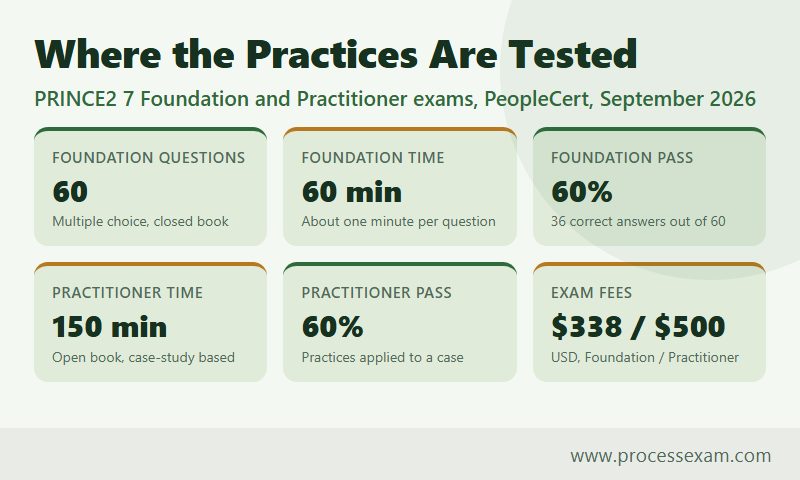
At 60% of 60 questions, you need 36 correct answers to pass Foundation, and there is no penalty for a wrong one. Questions on the practices tend to fall into a handful of patterns:
- Purpose questions. Which practice establishes mechanisms to judge whether the project is desirable, viable and achievable? Learn one crisp purpose sentence for each practice.
- Product questions. Which management product records the agreed quality criteria for a product, or who a project uses to decide on requests for change? The table above is the map.
- Role questions. Who is responsible for specifying benefits? Who can accept an off-specification? These usually point to the board roles rather than the project manager.
- Relationship questions. A risk has occurred: what does it become? A forecast breach of stage tolerance: what report follows? These test the links traced in the hospital case above.
- Edition traps. Options that use sixth-edition words, such as "the change theme", are there to catch candidates who studied old material.
A good test of readiness is whether you can answer questions from all seven practices at a steady minute each. Once you know the practices well, a timed PRINCE2 Foundation practice test will show which ones still slow you down, so your last week of study goes to the right chapters.
What changes when the Practitioner exam tests the practices?
At Practitioner level the question is no longer what a practice is but how you would apply it to a given project. PeopleCert's PRINCE2 Practitioner (Version 7) page describes an open-book exam of 150 minutes with a 60% pass mark, and Foundation (Version 7) is one of the accepted routes in. You work from a case study, and questions ask you to judge whether an entry in a register is appropriate, what should go into a product description for this project, or how a practice should be tailored for the situation described.
Three habits help. First, read every question against the case study, not against your own workplace. Second, use the manual to confirm a detail, not to learn it; with 150 minutes there is time to check, but not to study. Third, treat the practices as connected: a question about an issue often has a correct answer that also protects the business case or the tolerances. If you are planning the step up, a scenario-based PRINCE2 Practitioner practice exam is a realistic rehearsal of reading a case study against the clock.
Which misreadings of the practices cost candidates marks?
These are the misunderstandings that most often turn a known topic into a wrong answer. None of them is about memory; all of them are about reading the practice the way PRINCE2 7 intends.
- Treating a practice as a phase. Risk is not something done during initiation and then left. Every practice runs from start to finish, which is what separates the practices from the processes.
- Assuming every issue is a change. A concern, a problem or an opportunity can be an issue without touching a baseline. Only some issues lead to change.
- Thinking quality means testing at the end. Quality starts with the customer's quality expectations and acceptance criteria, long before anything is built.
- Reading plans as schedules. A PRINCE2 plan starts with products and their descriptions; the timeline comes after.
- Believing progress is just reporting. Progress is about control: tolerances, forecasts and the decision to escalate. Reports are its tools, not its purpose.
- Treating the business case as an approval form. It is reviewed at every stage boundary, and after closure through benefits reviews, not signed once and filed.
- Mixing up practice names across editions. In the exam there is no organization theme and no change theme; there are organizing and issues practices.
For background on how PRINCE2 has evolved through its editions, including the move from themes to practices, the Wikipedia article on PRINCE2 gives a neutral history. For the exam itself, rely on the PRINCE2 7 manual and PeopleCert's syllabus. If you can explain each practice in a sentence, name the products behind it and trace how one event moves through all seven, you are ready for the questions Foundation asks and well placed for the ones Practitioner asks next.
Frequently Asked Questions
What are the 7 themes of PRINCE2?
In PRINCE2 7 the seven themes are called practices: business case, organizing, plans, quality, risk, issues and progress. The sixth edition called them themes and used the names organization and change for two of them. The exam now uses the PRINCE2 7 names, so learn those when you study.
Why were the PRINCE2 themes renamed practices?
PRINCE2 7, published in 2023, presents them as recurring aspects of project management that the team carries out continuously and tailors to each project. Change became issues because not every issue leads to a change, and organization became organizing to show that team structure is an ongoing activity.
What is the difference between PRINCE2 principles, practices and processes?
Principles are the seven rules every PRINCE2 project must follow. Practices are the seven aspects of management, such as risk and quality, handled throughout the project. Processes are the seven sets of activities that describe who does what, and when, from starting up to closing a project.
How many questions are in the PRINCE2 Foundation exam?
The PRINCE2 Foundation (Version 7) exam has 60 multiple-choice questions in 60 minutes. It is closed book, the pass mark is 60%, so you need 36 correct answers, and the fee is USD 338. Questions on the practices sit alongside principles, processes, roles and tailoring.
Is the PRINCE2 quality theme still part of PRINCE2 7?
Yes. Quality is one of the seven PRINCE2 7 practices. It covers quality planning, which agrees acceptance criteria and product quality criteria, and quality control, which checks products against them. PRINCE2 7 adds a product register listing what the project will deliver and when each product is accepted.
- Project Management |
- PRINCE2 Foundation Question Bank |
- PRINCE2 Foundation Exam Questions Download |
- PRINCE2 Foundation Test Questions |
- PRINCE2 7 Foundation Simulator |
- PRINCE2 7 Foundation Mock Exam |
- PRINCE2 7 Foundation Certification Cost |
- PRINCE2 7 Foundation Certification Requirements |
- PRINCE2 7 Foundation PDF |
- PeopleCert PRINCE2 7 Foundation Test Questions |
- PeopleCert PRINCE2 7 Foundation Book |
- PeopleCert PRINCE2 7 Foundation Sample Questions


