
PMP or PRINCE2? Which Certification Fits Your Region and Career
Updated on 12 October 2026. What’s new: pmp is now 180 questions in 240 minutes, and prince2 7 foundation is 60 questions in 60 minutes
It depends on where and for whom you work. Job adverts in the UK, much of Western Europe and Australia, and in public bodies that follow UK practice, tend to name PRINCE2; in North America they more often name PMP. The PMP exam has 180 questions in 240 minutes and costs USD $425 for PMI members or USD $675 for others, while PRINCE2 7 Foundation has 60 questions in 60 minutes and costs USD 338.
That split is a tendency, not a rule, which is why a general ranking of the two credentials is not much use. A project manager in a London council and a project manager in a Texas software firm can both be excellent and both be right to pick different exams. This guide sets out what each credential is, how the two compare on eligibility, format and cost, how your experience changes the order, and whether holding both is sensible. It was checked against PMI’s July 2026 exam content outline and PeopleCert’s PRINCE2 7 pages in October 2026.
Which one do employers in your region and sector actually ask for?
Start with the place the credential will be read, because that is where the two differ most. PRINCE2 began as a UK government standard for information systems projects, and the Wikipedia entry on PRINCE2 describes it as adopted in the UK, Western European countries and Australia, and as a de facto standard in many UK government departments and across the United Nations system. PMP comes from the Project Management Institute in the United States and is delivered through testing centres worldwide; the same entry summarises the pattern as the US and the Americas preferring PMP, and the UK, Australia and Europe preferring PRINCE2.
| Where you work | What tends to be named | What to do before you pay |
|---|---|---|
| UK central or local government, or firms that deliver for them | PRINCE2 is widely used in government departments | Open three current adverts and tender documents and look for “PRINCE2” by name |
| Western Europe, Australia and organisations with UK parents | PRINCE2 is widely recognised; PMP appears alongside it | Ask your own PMO which one its project governance is written around |
| United States, Canada and other North American employers | PMP is the more common ask | Search adverts for your job title and count how many say PMP and how many say PRINCE2 |
| Consulting firms, multinationals and contractors who change clients often | Either; the client decides | Take the one your largest current or target client uses, then consider the other |
| Software, product and start-up teams | Often neither is a stated requirement | Check whether a PMP or PRINCE2 line appears at all in the adverts you want |
Treat the table as a hypothesis to test. Adverts change faster than any article, and some employers write “PMP or PRINCE2” because their recruiters accept either. A ten-minute search of real adverts for your job title in your country is worth more than any general claim about which is more respected. When most listings name one credential, that answers the question for the next two or three years. When they name both or neither, the sections below decide it.
What does each certification set out to prove?
PMP: judgement about people, process and the business
The Project Management Professional is a PMI credential for people who lead projects. Its July 2026 content outline splits the exam into three domains: People 33%, Process 41% and Business Environment 26%. The exam uses case and scenario questions, so it asks what a project leader should do in a situation, whether the project is run predictively, with agile methods or with a mix. PMP is not tied to one method; it is built around judgement, ethics and communication, and the outline’s introduction says PMI tested the exam against trends such as artificial intelligence and sustainability.
PRINCE2: a defined method you are expected to apply
PRINCE2 stands for PRojects IN Controlled Environments and is a method rather than a standard. Version 7 is based on seven principles that cannot be tailored, and its content is organised around practices, management products, roles and a process model that runs from starting up a project to closing it. PeopleCert has published it since it acquired AXELOS in 2021. Where PMP asks you to choose a sensible approach, PRINCE2 gives you one and asks you to tailor it, so its exams reward people who can name roles, products and responsibilities precisely.
A small example of the difference
Picture a hospital replacing its patient-booking system. The supplier tells you on Monday that delivery will slip by three weeks. A PMP-style answer starts with the people and the context: who is affected, what the sponsor has been told, which options exist and what a project leader should do first. A PRINCE2-style answer starts with the structure: the slip is probably beyond the stage tolerance, so the project manager raises an exception to the project board, which then decides whether to continue, and the business case is reviewed. Neither answer is wrong. They reflect two ways of thinking, and the exam you pick trains one of them harder.
How do eligibility, format and cost compare side by side?
This is the table most readers come for. The PMP column follows PMI’s exam content outline and published fees; the PRINCE2 columns follow PeopleCert’s PRINCE2 7 Foundation and Practitioner pages.
| Detail | PMP | PRINCE2 7 Foundation | PRINCE2 7 Practitioner |
|---|---|---|---|
| Vendor | PMI | PeopleCert | PeopleCert |
| Entry requirement | Application showing 24 to 60 months leading projects and 35 hours of project management training | None listed | Foundation, or an accepted alternative such as PMP or CAPM |
| Exam fee | Member Price: USD $425; Full Price: USD $675 | USD 338 | USD 500 |
| Questions | 180 (170 scored, 10 unscored) | 60 multiple choice | 70 marks (PeopleCert lists 56 questions and sub-questions) |
| Duration | 240 minutes | 60 minutes | 150 minutes |
| Passing score | Above Target / Target / Below Target / Needs Improvement | 60% | 60% |
| Books in the exam | Closed book | Closed book | Open book |
| Renewal | 60 PDUs every 3 years, plus a renewal fee | Every 3 years with 60 CPD points | Subject to renewal; 60 CPD points |
Two things stand out. The first is the entry gate: PMP is an application-based credential that PMI can audit, while PRINCE2 Foundation lets anyone book. The second is the shape of the exams. PMP is one long paper that tests judgement across four hours; PRINCE2 splits the learning into a short closed-book Foundation and a longer open-book Practitioner that tests whether you can apply the method to a scenario. The PMP result is reported as a performance band rather than a number you can aim at, while each PRINCE2 paper states a 60% threshold.
Who can sit PMP, and who can sit PRINCE2, at your stage of experience?
PMI’s July 2026 outline sets four routes, each counted in non-overlapping months of experience leading projects within the last ten years, and each needing 35 hours of project management training. A secondary-school route needs 60 months; an associate-level or equivalent route needs 48; a bachelor’s degree or an equivalent qualification mapped to EQF Level 6 needs 36; and a degree, bachelor’s or postgraduate, awarded by a programme that PMI’s Global Accreditation Center has accredited needs 24. An active CAPM holder does not have to document the 35 hours. The PMI exam content outline lists these routes and states that the experience must be in leading and directing projects, so coordinator work counts only where you can show you led it.
PRINCE2 Foundation lists no entry rule on PeopleCert’s page, so the decision at that level is about usefulness, not permission. The Practitioner page lists Foundation first among its accepted prior credentials, and the same list includes PMP and CAPM, along with earlier PRINCE2 editions and some IPMA levels.
| Where you are now | What the entry rules mean for you | A reasonable first step |
|---|---|---|
| Little or no project experience | PMP is not yet available; PRINCE2 Foundation is | PRINCE2 Foundation if your region uses it; otherwise gain experience and consider CAPM |
| Supporting projects, not leading them | Support work may not meet PMI’s leading-and-directing test | PRINCE2 Foundation now; reword your experience before applying for PMP |
| Three or more years leading projects, with a degree | You may meet the 36-month route if you can document it | PMP if adverts name it; otherwise Foundation, then Practitioner |
| Five or more years leading projects, no degree | The 60-month route may apply | PMP is realistic; add PRINCE2 only if your clients ask |
| Already hold PMP | You can go to PRINCE2 Practitioner without Foundation | Practitioner if your clients or employer use PRINCE2 |
| Already hold PRINCE2 Foundation or Practitioner | PMP still depends on the months you have led projects | Count the months on your own record before you apply |
Read the PMI route as a documentation exercise as much as an experience one. PMI can audit an application, so each project entry should show dates, your role and what you led. The PMP exam syllabus page sets out the domains and tasks that your training hours should map to.
What will each route cost in fees, training and renewals?
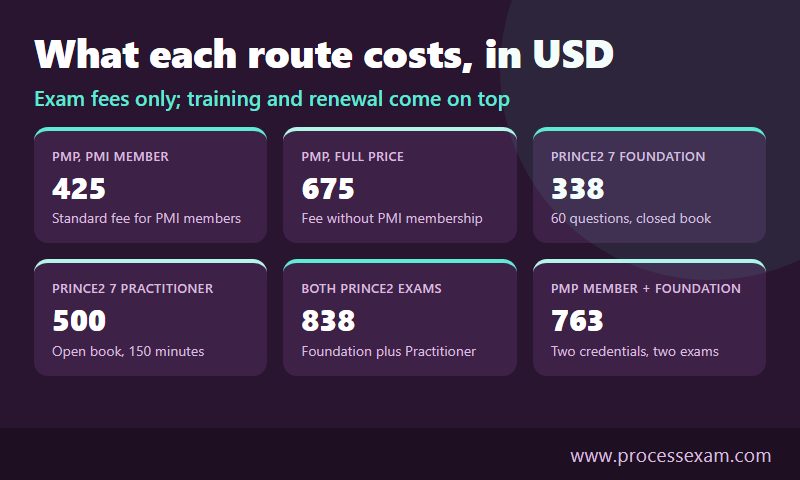
Exam fees are only part of the bill, but they are the part you can compare cleanly. PMP costs USD 425 for PMI members and USD 675 for everyone else, a USD 250 difference, so the member price only wins if the annual dues in your country, which PMI publishes on its site, are lower than that gap. PRINCE2 Foundation is USD 338 and Practitioner USD 500. Taking both PRINCE2 exams therefore costs USD 838, which is more than the PMP at either price, and a PMP at the member rate plus PRINCE2 Foundation comes to USD 763.
Several costs sit outside those numbers. PMP candidates need 35 hours of project management training, which PMI accepts from authorised training partners, universities, employer programmes, training companies and self-paced courses with an end-of-course assessment, but not from books or practice exams alone. PeopleCert sells PRINCE2 as bundles: on its Foundation page the exam bundle is listed in pounds including VAT, next to eLearning bundles at higher prices, so what you pay in your own currency can differ from the USD fee above. Rescheduling is free up to 48 hours before the exam and carries a fee after that.
Renewal is the quieter difference. PMP asks for 60 professional development units every three years and a renewal fee. PRINCE2 Foundation also renews every three years with 60 CPD points, which PeopleCert says can come through a PeopleCert Plus membership or by passing another exam in the same product suite. Keeping either credential alive is a recurring commitment of hours, so ask your employer whether it will fund renewal as well as the exam.
Salary is the cost question people most want answered here, and this guide gives no figures for it. Salary surveys differ by country, sector and years of experience, and a single average hides more than it shows. If pay is the deciding factor, look up a current survey for your own country and job title and compare certified and non-certified respondents there.
Which exam is harder to sit, and in what way?
They are hard differently. PMP is long and varied: 180 questions in 240 minutes, with two ten-minute breaks, and once you start a break you cannot return to the section you finished. PMI’s outline lists case or scenario questions, graphic-based questions, enhanced matching, drag-and-drop and hotspot items, and lets you sit up to three times inside the one-year eligibility window. Stamina matters: 240 minutes over 180 questions is under a minute and a half per item, but case sections reward careful reading.
PRINCE2 Foundation is shorter and more factual. With 60 questions in 60 minutes and a 60% pass mark you need 36 correct answers, and the paper tests whether you know the principles, practices, roles and processes without a book in front of you. Practitioner reverses the problem: the manual is allowed and 150 minutes is generous, but the 70 marks come from scenarios, and a candidate who has not learned the method can spend the whole paper hunting for answers they should already know.
If you are not sure which style suits you, try a timed set of scenario questions before booking. A timed PMP practice exam tells you within an hour whether long scenario papers feel natural, and the same test applies to a PRINCE2 Foundation sample paper if you are leaning that way.
Does holding both PMP and PRINCE2 make sense?
For some careers it does, and the two fit together better than their rivalry suggests. The Wikipedia entry on PRINCE2 notes that PMP, built around the PMBOK Guide, can be used with PRINCE2, and the two are often presented as complementary: PRINCE2 as a method, PMP as a standard. In practice, a consultant who serves a UK public client and a North American commercial one in the same year may be asked for both.
The cases where it pays are specific:
- You move between regions or clients where each credential is the default, such as a contractor serving both UK public bodies and US corporations.
- You work in a PMO that writes governance in PRINCE2 terms while its staff are recruited from PMP-led markets.
- You are aiming at senior or consulting roles where speaking both vocabularies reduces friction in a bid.
The cases where it does not pay are just as clear. If every advert you want names one credential, the second adds cost and renewal hours without opening doors. The order usually follows the setting: take the credential your employer or target market asks for first, then add the other when a real client or role requires it. A PMP holder gains a shortcut, because PeopleCert lists PMP among the accepted prior credentials for the Practitioner exam, so no Foundation exam is needed first. Going the other way, a PRINCE2 holder still has to satisfy the experience route that PMI sets.
Keep vocabulary in mind if you study both close together. PRINCE2 uses words such as tolerance, exception and product in defined ways, while PMP scenario questions use more general language about stakeholders, risk and value. Leaving a gap of a few months between the two exams helps you keep the two sets of meanings apart.
Which five questions settle the choice between the two?
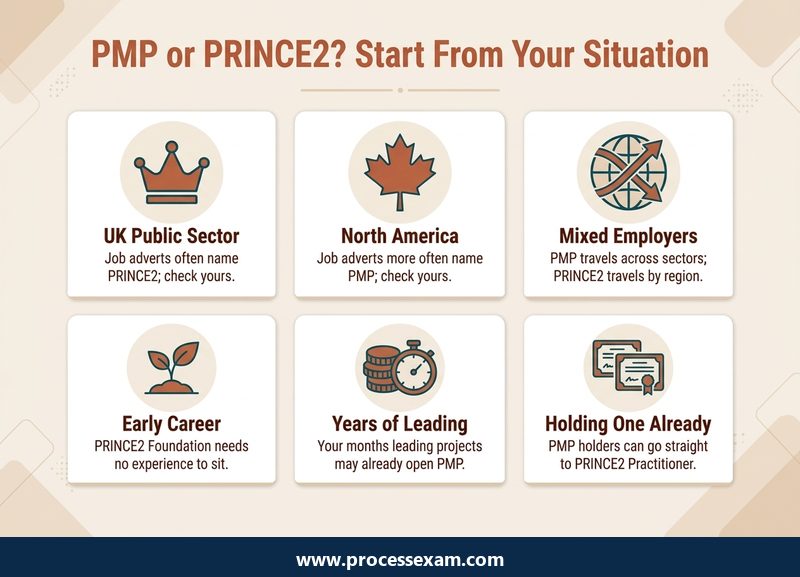
Work through these in order and stop at the first clear answer.
- What do the next ten adverts for your job title name? If most say PRINCE2 or most say PMP, choose that one.
- Do you meet a PMP route today? Count the months you have led projects, not supported them, against the 24, 36, 48 or 60 months PMI asks for at your education level. If you fall short, PRINCE2 Foundation is the credential open to you.
- Who is paying? An employer that funds one exam usually has a preference, and following it costs you nothing. If you are paying yourself, weigh USD 425 or 675 for PMP against USD 338 for PRINCE2 Foundation and USD 838 for both PRINCE2 levels.
- Will your clients or board expect a named method? PRINCE2 gives you a shared vocabulary for roles and reports; PMP gives you a broader credential for judgement across approaches.
- Could you study for four hours of scenario questions, or would a one-hour closed-book paper be a better first step? Be honest about your timetable. A Foundation exam in a few weeks may build momentum for the longer route.
Whichever answer comes out, treat the decision as reversible. Many project managers begin with the credential their market recognises and add the second later, when a client asks. The costly move is not choosing one over the other; it is paying for an exam before checking that anyone you want to work for will read it.
Frequently Asked Questions
PMP or PRINCE2: which is better?
Neither is better in general; the better one is the one your region and employers recognise. PRINCE2 is common in the UK, Western Europe, Australia and UK-linked public bodies, while PMP is more commonly named in North America. Check the adverts for your job title and take the credential most of them name.
Is PRINCE2 or PMP easier to pass?
They test differently. PRINCE2 7 Foundation has 60 closed-book questions in 60 minutes with a 60% pass mark, so it is shorter and more factual. PMP has 180 scenario-led questions in 240 minutes and needs an approved application first. Most candidates find the PMP the larger commitment.
Do I need experience for PRINCE2 as I do for PMP?
No experience is listed for PRINCE2 7 Foundation. PMP needs between 24 and 60 months of experience leading projects, depending on your education, plus 35 hours of project management training. PRINCE2 Practitioner needs Foundation or an accepted alternative such as PMP or CAPM.
Can I hold both PMP and PRINCE2?
Yes. Many project managers hold both, particularly contractors and consultants who serve UK and North American clients. PeopleCert accepts PMP as a prior credential for PRINCE2 Practitioner, so a PMP holder can skip Foundation. Both renew every three years with 60 points, so plan the extra renewal hours.
How much do PMP and PRINCE2 cost together?
The exam fees are USD 425 for PMP at the PMI member price, USD 338 for PRINCE2 7 Foundation and USD 500 for Practitioner. PMP plus Foundation therefore totals USD 763 before training, books and renewals. PMP at the full price of USD 675 raises that total to USD 1,013.
- PMP Certification |
- PMI Project Management Exam Questions |
- PMI Project Management Question Bank |
- PMI Project Management Questions |
- PMI Project Management Study Guide |
- PMI PMP Quiz |
- PMP Questions |
- PMP Practice Test |
- PMP Study Guide Material |
- PMP Sample Exam |
- Project Management Certification |
- PMI Project Management Book |
- Project Management Certification Cost |
- Project Management Certification Requirements |
- PMI Project Management Sample Questions |
- PMP Exam Questions Download |
- PMP Test Questions |
- Project Management PDF |
- PMI Project Management Professional


